1 free read left. Create a free account for unlimited reading + AI research.
Create free account
Affordances - How Design Teaches Us Without Words - Extra Credits
Key insights
7 takeaways- 01Affordance is the design principle of using an object's physical or visual properties to intuitively communicate its function to the user without explicit instruction.
- 02Designers bridge the gap between virtual and real-world experiences by leveraging existing physiological and cultural associations to make complex game systems feel natural.
- 03Hardware ergonomics, such as the specific placement of thumbsticks and triggers on controllers, guide players toward natural hand positioning and input methods.
- 04Effective use of affordance reduces player cognitive load, allowing for seamless interaction with game mechanics rather than requiring the memorization of abstract rules or mathematical formulas.
- 05Environmental and object design uses form to imply function, such as modeling sci-fi weapons after familiar firearms or using context to define abstract items like currency.
- 06Navigational and systemic affordances direct player movement through visual cues and clarify complex interactions, such as rock-paper-scissors balancing, through logical, intuitive labeling.
- 07Maintaining player immersion relies on grounding virtual interactions in recognizable logic, which prevents the player from being pulled out of the experience by confusing or unintuitive design.
Ask AI about this video
Transcript
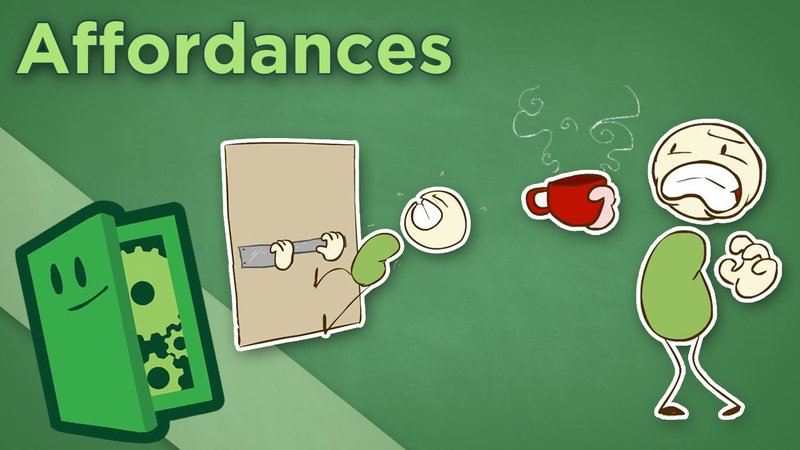
Do you ever wonder why when you walk up to some doors, you don't know whether to push or to pull to open them? Whereas with other doors, it just seems natural how they're supposed to open. That's often because of how they're designed. Next time you're at a public building, look at the doors. If both sides of the door are the same, it's confusing. But if one side of the door has a bar that goes horizontally and the other side has a bar that goes vertically, you intuitively know what to do. This your body knows how to interact with these two objects. The vertical bar is just natural to grip and it's much more ingrained to pull something we've grasped with one hand than it is to push it. Especially if it's the size of a door. Conversely, the horizontal bar matches the breadth of your body and practically asks you to put both hands on it. And once you've done that, the only intuitive thing to do next is to put the weight of your body into it and push rather than try to back up and pull with both of your hands fixed on the door. So, why do we care? Because that's what we call an affordance and they're an important part of game design. You see, affordances in traditional design
are things built to be naturally, almost physiologically intuited. The most common example is the handle of a teacup or a teapot. Without being taught it's the part of the object you're supposed to grasp, it's the first place a person's hand goes because, well, in the simplest terms, it's a hand-shaped hole. And clearly, for something meant to contain hot liquid, that's an important feature. That's something you just need people to get. Well, this is a concept we've taken in game design and run with, extending far beyond our physiological understanding. We've had to work hard to get players to intuit things in a virtual world by trying to link them to their understanding of the real one. This pervades every part of game design, from controls to mechanics to narrative. The first and the most obvious example is simply modern controllers. We've tried to do everything we can to get players to naturally put their hands in the right place on a controller in order to play games based around moving, looking and shooting simultaneously in a 3D environment. Because while this may be second nature to most of us at this point, getting 3D shooters to feel even remotely right on a console was a huge challenge at one point. In fact, I would argue that most of modern controller design is based around that problem.
Look at how the shoulder buttons have evolved to make it more intuitive to rest your fingers there instead of gripping the side of the controller. Look at how the thumb sticks went from being bowed out to being curved in so they naturally seem like the place to rest your thumbs. But the concept of affordance in games goes well beyond this. We use it anywhere where form implies function. How do you know that those crazy sci-fi guns in your game set in the distant future even are guns? Well, they share a shape we already have associations for. How do you know to drop that boulder in that hole? Because the hole's boulder shaped. And heck, getting back to controls, how do you know that the right trigger is used to accelerate and the left trigger is used to brake in pretty much every game with vehicles there is? Because they're mapped to the pedals in your car. But this is just the most basic level of affordance. It's important and if you don't think about it as a designer, you'll fail to produce intuitive games. It's completely essential for puzzle design and the lack of it was one of the biggest stumbling points for old school adventure games back in the day. But that's just the beginning. Let's blaze through some of the more interesting uses. First, navigational affordance. We've talked about this a little in a previous episode so I'll keep it short.
But how do you get your player to go where they need to? By making it the natural place to go. By implying where to go with a path or a doorway or a break in the barbed wire or a brightly colored carpet or whatever. Directing the player down a specific path. Then there's environmental affordance. This is one of the most fascinating ones and I can't take any credit for it. Harvey Smith turned us onto it a few years ago at a South by Southwest. Before the generation of super high-res video gaming, designers often had to get you to understand what blurry textures or awkward graphics were supposed to be. In fact, the player has to intuit those things to stay immersed in the world. Even today with third-person games, we'll often have objects that are simply too small for the player to see clearly and yet they're the little details that make the world feel whole. So how do you get someone to understand what these things are? Affordance. Green rectangles and silver circles mean nothing to a player on their own, but if you put them next to an an cash register, voila, suddenly they become dollars and coins in the mind of the player. Understanding how to use the object in your environment to give definition and to make distinct the pieces of the environment that might not otherwise
make sense is a huge boon as an artist or a designer. Lastly, let's talk about systemic affordance. Spearman beat horseman, horseman beat footman, footman beat Spearman. How do you know? Because it just makes sense. Of course, you could use a system like this without calling the units Spearman, horseman, and footman. Technically, the system is would be the same no matter what you call them. They could be broccoli, bean sprouts on a beluga whale, but no, you call them horseman, Spearman, and footman because simply by labeling them in this manner, we offer the player an affordance. Instead of having to understand all the math underlying your game up front, the player can instead intuit how they should play. There are hundreds of other examples of affordance in games. I'm sure you'll easily pick out as you play. Because as designers, we've got to do everything we can to make this inherently strange and remote task of playing a character on a screen feel intuitive and even natural. And it's becoming even more important as we explore the uncanny world of touch screens and motion games. We can't do the concept justice here, but I hope it gets you thinking on how to use it and how it's been used on you in games. If you want to dive a lot deeper, I recommend reading the design of everyday
things. It's about physical design, but I think it'll get you thinking about game creation in whole new ways. See you next week.
Summary
Affordance serves as a fundamental principle in design, describing how the physical or visual properties of an object intuitively communicate its function to a user without the need for explicit instruction. In the context of game development, this concept is essential for bridging the gap between the virtual world and the player’s real-world experiences. By leveraging existing physiological and cultural associations, designers can create intuitive interfaces, mechanics, and environments that allow players to interact with complex systems naturally.
The application of affordance in gaming spans multiple dimensions. At the hardware level, modern controller design utilizes ergonomic shapes and button placement—such as curved thumbsticks and shoulder triggers—to guide players toward natural hand positioning. Within the game world, designers use form to imply function, such as shaping sci-fi weaponry to resemble familiar firearms or using environmental context to define abstract objects, like placing geometric shapes near a cash register to signify currency.
Furthermore, affordance is critical for guiding player behavior through navigational and systemic cues. Navigational affordance directs movement by highlighting paths or doorways, while systemic affordance uses logical labeling—such as the rock-paper-scissors relationship between infantry and cavalry—to help players intuit complex game mechanics without needing to memorize underlying mathematical formulas. Ultimately, the effective use of affordance is a vital tool for maintaining player immersion. By grounding virtual interactions in recognizable logic, designers can reduce the cognitive load on the player, transforming the inherently abstract act of playing a digital character into a seamless and intuitive experience.





















Comments