1 free read left. Create a free account for unlimited reading + AI research.
Create free account
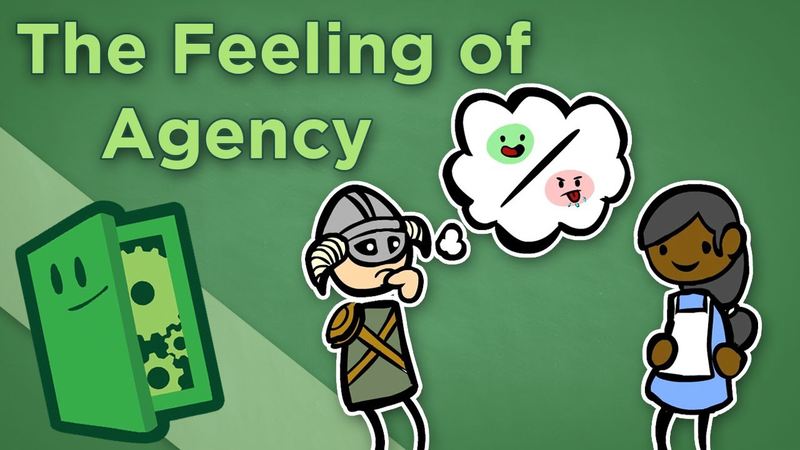
The Feeling of Agency - What Makes Choice Meaningful? - Extra Credits
Key insights
6 takeaways- 01Meaningful choice is the defining element of video games, as it transforms the audience from passive observers into active participants through agency.
- 02A choice is only meaningful if the player has sufficient context to weigh options against their goals or character traits, rather than making an arbitrary selection.
- 03Agency evaporates when players perceive that their decisions are inconsequential or when they are indifferent to the potential outcomes.
- 04Mathematical optimization, such as choosing an objectively superior character build, removes agency by turning a decision into a rote execution of logic rather than an act of volition.
- 05The perception of meaningful choice is subjective and scales with player expertise, as experienced players can navigate systems with more informed intent than novices.
- 06To maintain agency, game design must ensure that multiple distinct, mutually exclusive actions lead to outcomes that the player believes are unique and impactful.
Ask AI about this video
Transcript
[Music] hey did any of you guys watch strip search you should have it was great anyway I ask because today we've got a special guest artist and he just so happened to be a contestant on strip search so say hi to Nick tro he's the cartoonist behind Mint Condition comics and an all-around great guy so go read his comic and see him on strip search anyway moving on over the next few weeks we'll be talking a lot about choice and video games we'll be talking about what a meaningful choice is why the illusion of choice is often as powerful as real choice just how much choice you need to feel like you have agency in a game and why choice is so powerful why we care about the feeling of choice in a video game where we don't in any other medium but first today we have to Define Choice there are a thousand different ways to Define that word but in the context of games for our purposes we're going to try to lay out one concrete definition that we'll be using throughout a choice is any moment during play that the player could perform two or more
distinct actions but has to pick some number of actions less than the total number available to execute this can happen in the context of mechanics at this moment I can either Dodge right Dodge left or shoot but I can only do one in this Frame or in the context of narrative like in this dialogue tree I can either be nice to this person or a jerk to this person but picking one precludes picking the other and both are equally valid and essential to our understanding of game design any definition of choice and meaningful choice we use should be able to cover both which leads us to the question what does meaningful choice mean and why do we care about it well a choice is Meaningful when the decision-making process isn't arbitrary when the player understands the choice they're making and has some system to weigh their options this doesn't by any means mean that they have to fully understand what the consequences of each option will be only that they believe they have what they need to weigh the choice is presented to them for example when choosing from various dialogue options you don't often know the exact outcome of your choice but if the dialogue options are well written and you know enough about the character you're talking to you can make some informed meaningful assumptions about what to say based on your goals your character's person personality and traits and the
personality of the character you're talking to and so on and so forth additionally for it to be a meaningful Choice the player has to believe that what they choose will lead to different results if you know a choice in a game isn't going to do anything or if you're completely indifferent about the thing it does it ceases to be a meaningful Choice next a choice is not a calculation this may be the most controversial of these definitions but if there's a definitive right answer that can be ascertained wholly through mathematics or strict logical reasoning that's performable by the player and the time allotted to make the choice the choice is no longer meaningful for example there was a period in World of Warcraft history where talent and Equipment choices were rendered essentially meaningless by there being a definitive right answer there were demonstrably Superior character builds and since these right answers were circulated throughout the community and posted online players no longer had to make a choice but instead follow the steps given to them to get the best result lastly it's important to note that the same Choice can be meaningful or not meaningful for different players we the people in front of the screen Are Not absent from this equation for example a player who picks up the controller in a fighting game for the
first time may not have meaningful choices their choices are essentially arbitrary they Mash buttons because they don't understand what their choices are whereas for someone who's played fighting games for years their choices are not arbitrary they know what their options are and they can use some internal understanding to weigh which possibility will be best for them to execute this doesn't mean that they know what the end result will be as that's also dependent on the other player but they are indubitably presented a deep and meaningful set of choices so why does this all matter why does Choice come up so often in discussions about games why is it so prevalent in conversations on game design when it's never seem to bother us that it's absent from any other mass media well namely because of the fact that it's absent from all other mass media games are the only form of mass media where the audience gets to interact games are the only place where we can explore parts of the human condition even when it's just the Primal part that wants to run and Gun through our own choices rather than by interpreting the choices of others this is an incredibly powerful and empowering thing it lets us pose questions in ways we've never been able to before it allows us to better understand ourselves and shows us just how amazing our ability to act through volition to have choice and agency in
our lives is fundamentally games are about choice choice is at the heart of the medium and what makes it so engaging to us the ability to do rather than to be told or shown is the whole reason why we love games and it's the reason we'll be spending the next few weeks talking a lot more about choice I know that a lot of this episode was sort of a recap of information scattered across various other episodes we've done before but we wanted to make sure that everybody was on the same page before launching into a big multi-week series on a major topic we may do this again whenever we need to set up an extended series now that we're six seasons in thanks for sticking with us and we'll catch you all later as we start discussing some of the finer points about Choice thank you for the help Nick we'll see you guys next [Music] week
[Music]
Summary
Meaningful choice serves as the foundational element of video game design, distinguishing the medium from all other forms of entertainment by granting the audience agency. A choice is defined as any moment during gameplay where a player must select from two or more distinct, mutually exclusive actions. This framework applies equally to mechanical decisions, such as combat maneuvers, and narrative decisions, such as dialogue branches.
For a choice to be considered meaningful, it must avoid arbitrary decision-making. Players must possess enough context to weigh their options based on their goals, character traits, or environmental information, even if the specific outcomes remain uncertain. Furthermore, the player must believe that their selection will lead to distinct results; if a choice is perceived as inconsequential or if the player is indifferent to the outcome, the sense of agency evaporates.
A critical distinction is drawn between meaningful choice and mathematical calculation. When a game offers a definitive, objectively superior path—such as an optimal character build in a role-playing game—the decision-making process shifts from an act of agency to a rote execution of logic. In such cases, the choice ceases to be meaningful because the player is merely following a prescribed path rather than exercising volition.
The perception of choice is also inherently subjective and dependent on the player’s expertise. A novice player may find a set of options arbitrary due to a lack of understanding, while an experienced player can navigate the same system with deep, informed intent. Ultimately, the power of video games lies in this capacity for interaction, allowing players to explore the human condition through active participation rather than passive observation.






















Comments