Monetization reports and market data
Documents
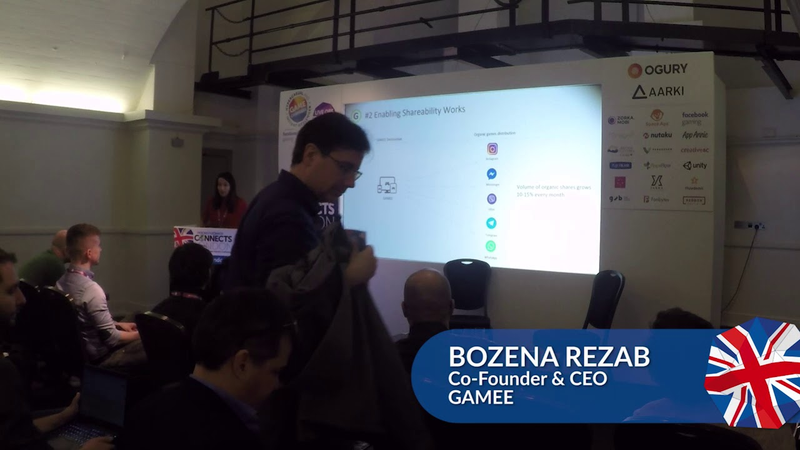
What Gamee learned about hyper-casual games from 3 billion gameplays across 70 games
The analysis of over three billion gameplays across 70 hyper-casual titles reveals that social integration and platform context are primary drivers of engagement and retention.
- Implementing a unified meta-layer for progress, points, and tournaments across a portfolio of games can double engagement metrics compared to standalone titles.
- Increasing social density by facilitating direct connections between friends significantly improves both day-one and day-seven retention rates.
- Optimizing the timing of share prompts and providing meaningful incentives like high-score comparisons can increase organic sharing by 10% to 15%.
Hutch on monetising for live ops
The presentation outlines a strategic framework for monetizing live operations in mobile free-to-play games, specifically drawing from the experience of the London-based studio Hutch.
- Hutch increased average revenue per user (ARPU) by over 25% in Top Drives by implementing a system that triggers targeted starter pack offers every five player levels.
- Live Ops allows for continuous revenue growth beyond the launch month by building a base of hyper-engaged, long-term players who remain invested for years.
- Effective monetization in Live Ops relies on an expansive meta-game built on granular, extensible content that feeds directly into the core gameplay loop.
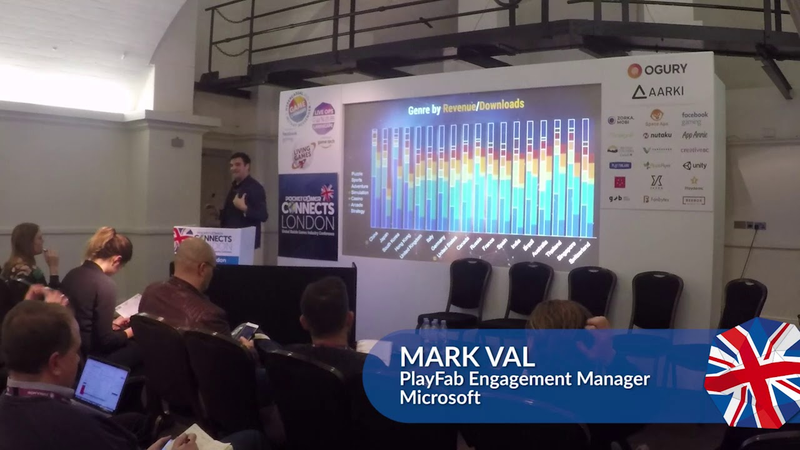
PlayFab on game monetisation with live game operations
Live game operations serve as a critical framework for modern, always-online titles, shifting the focus from initial launch to long-term player engagement and sustainable monetization.
- Retention is the primary driver of revenue, as a significant portion of the player base does not begin monetizing until after the first 28 days.
- Localization is a critical growth lever, with 50% of global users preferring to interact with game content in their native language.
- Successful live operations rely on treating game development as a service, utilizing A/B testing and rapid iteration to align content updates with player behavior.
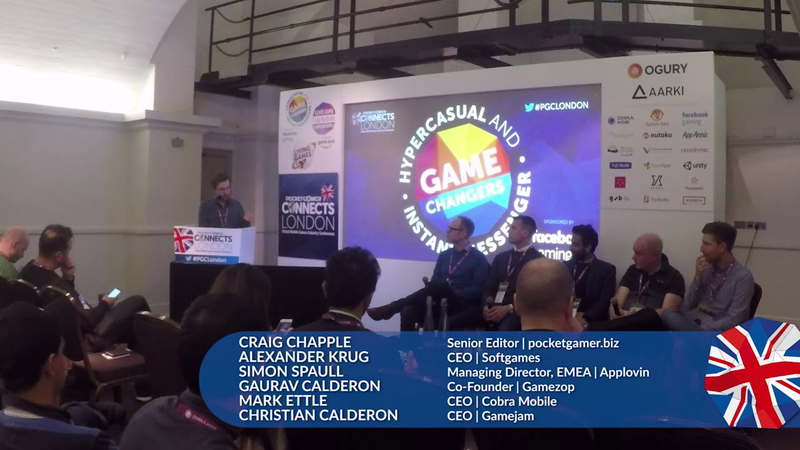
Keys for success in hypercasual and Messenger games
Hyper-casual and messenger games represent a distinct segment of the mobile industry defined by accessible, snackable mechanics and rapid development cycles.
- Hyper-casual games are defined by core gameplay loops that engage users every 1–3 seconds, with success often driven by iterative design rather than complex metagame features.
- User acquisition has become the primary driver of success in the hyper-casual market, shifting the focus from pure game design to the ability to measure and scale paid marketing profitably.
- Messenger-based games rely heavily on viral sharing and social moments to drive organic growth, which can potentially bypass the need for traditional paid user acquisition.

How Facebook works with games publishers to support sustainable businesses
Facebook supports game publishers by providing a comprehensive ecosystem that facilitates the entire commercial lifecycle, from initial user acquisition to long-term monetization.
- Facebook distributed $3.2 billion to game publishers through its monetization networks in 2017, highlighting its role as a major revenue driver for the mobile gaming economy.
- 73% of gamers accept advertising as a standard component of free-to-play titles, viewing it as a fair trade for content access.
- Successful publishers are shifting from retrofitting ads to designing games with monetization strategies integrated into the core experience from the outset.

App Annie on demystifying an ever-changing games market
Market intelligence platforms play a critical role in the mobile gaming industry by providing developers and publishers with the data necessary to navigate shifting global trends.
- Developers must integrate monetization strategies into core product design from the outset by utilizing market intelligence platforms to analyze downloads, revenue, and active user metrics.
- Regional genre preferences are diverging significantly, with battle royale titles dominating the Asia-Pacific market while hyper-casual games see the most traction across Europe, the Middle East, and Africa.
- Emerging markets like India and Brazil show high monthly active user counts for hardcore games, indicating that mobile devices are the primary platform for high-end gaming in these regions.


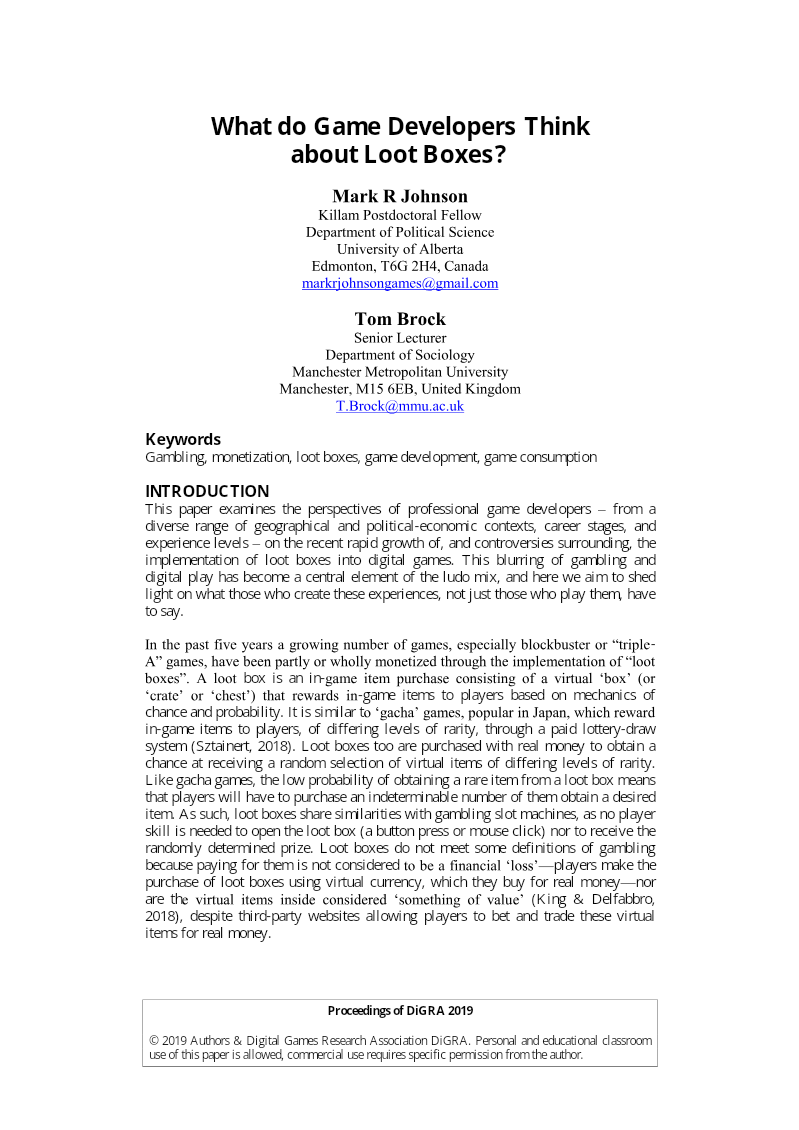
What Do Game Developers Think About Loot Boxes?
This paper investigates how professional game developers view loot boxes, the paid chance-based virtual items that have spread through major games and drawn regulatory and player criticism.
- The study fills a gap by centring game developers' own views on loot boxes, a debate previously shaped mainly by players and regulators, and argues developers have been neglected despite directly building these systems.
- Based on in-depth interviews with almost thirty professional developers from triple-A studios and independent single- or small-group teams across seven countries (UK, US, Canada, Germany, Poland, Singapore, Taiwan), the sample is geographically and career-diverse.
- The authors frame loot boxes as a hybrid of gambling and play, likening them to gacha games and slot machines because they require no player skill and deliver randomized rewards for real money.

At Your Service: Event-Based Design in Japanese Mobile Games
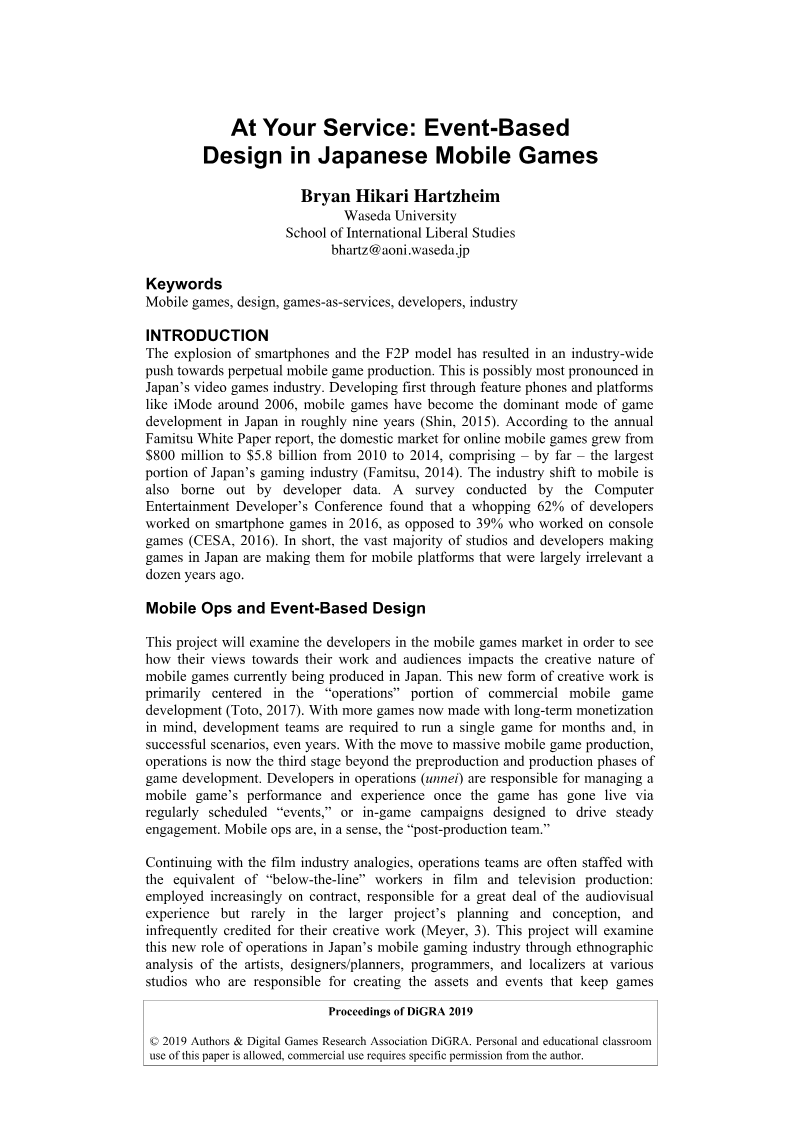
This paper examines how developers working on mobile games in Japan conceptualize their work, their products, and their audiences, with particular attention to the emerging operations ("unnei") function that manages live games through regularly scheduled in-game events.
- Many Japanese mobile game developers treat their products as ongoing services rather than finished games, designing for immediate, frequent pleasure and treating the most engaged, highest-spending players as the primary reference point for changes to rules, art, and design.
- The domestic online mobile game market in Japan grew from roughly 800 million yen to 5.8 billion yen between 2010 and 2014, according to Famitsu figures cited in the paper.
- A CESA survey found that 62 percent of Japanese developers worked on smartphone games in 2016, compared with 39 percent who worked on console titles, showing mobile has become the dominant platform for studios.
Gaming DOTA Players: Iterative Platform Design and Capture
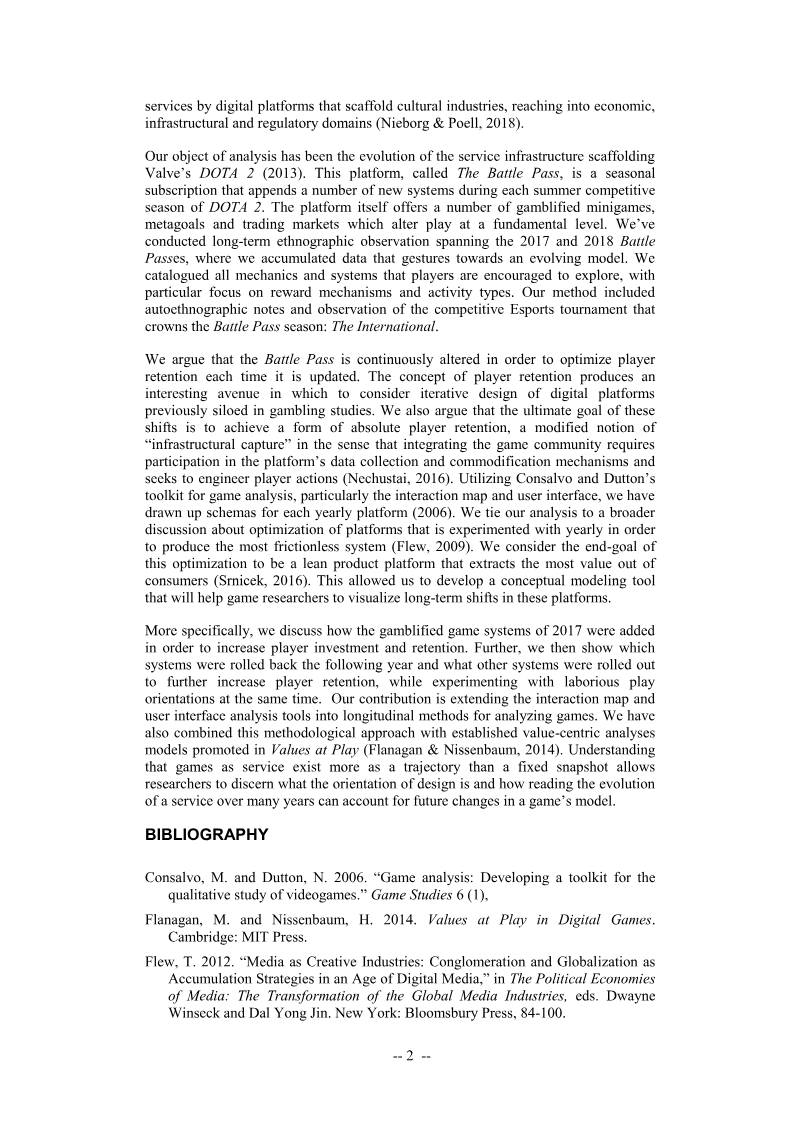
This paper examines how the service infrastructure of Valve's DOTA 2 has been iteratively redesigned, with a focus on the seasonal Battle Pass subscription, as a case study in gamblification and platformization within digital games.
- The paper argues that DOTA 2's seasonal Battle Pass is continuously redesigned to optimize player retention, aiming at what the authors call absolute retention and infrastructural capture, where community participation feeds the platform's data collection and commodification.
- Based on long-term ethnographic observation of the 2017 and 2018 Battle Pass seasons, the authors combined autoethnographic notes with observation of The International, the Esports tournament that concludes each season.
- Gamblified systems introduced in 2017 to raise player investment were partly removed the following year, while new systems were added to boost retention and encourage more laborious forms of play, showing a pattern of additions and rollbacks between years.

Analyzing Random Reward System Mechanics and Social Perception
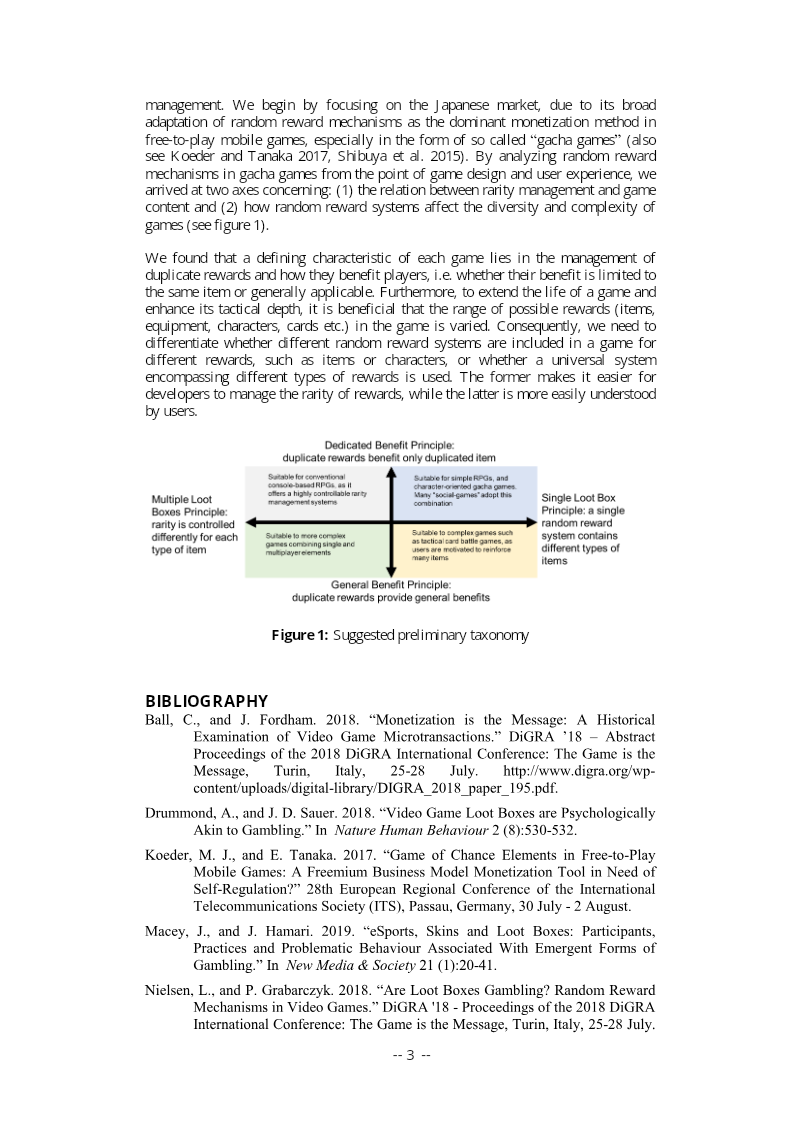
This paper examines random reward mechanisms in video games, commonly known as loot boxes, with the aim of building an empirically grounded taxonomy that can support clearer debate about their controversial role in monetization and player reception.
- The paper argues the most fundamental distinction among random reward mechanisms (loot boxes) is whether they are embedded in a monetization model, meaning they can be triggered with real money, or isolated from it.
- Rather than focusing on the link to gambling as prior typologies such as Nielsen and Grabarczyk's four-part classification did, the authors aim to identify the conditions under which players reject these systems.
- The proposed framework compares variables including implementation context (genre, platform, business model, franchise, publisher), eligibility to trigger rewards (real-currency purchase vs. in-game earning or free attempts), reward content (cosmetic vs. pay-to-win), and whether the mechanism is integral to play or optional.
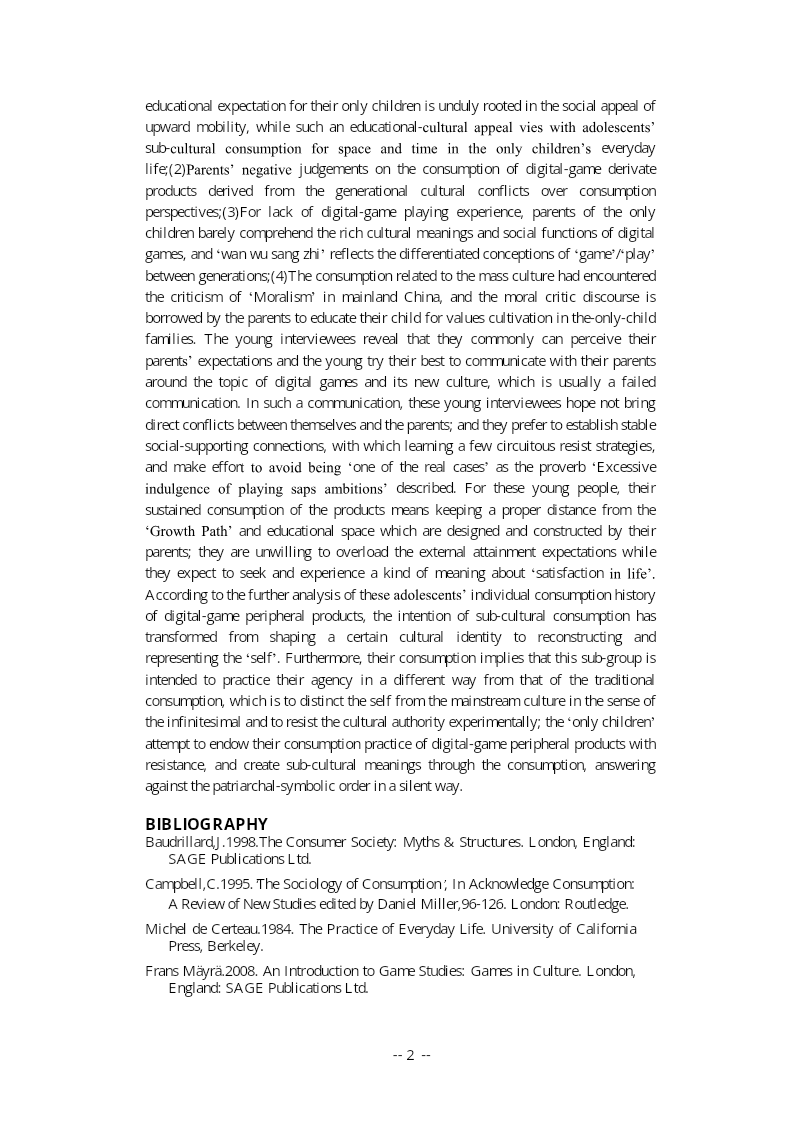


Critical Thinking of 'Excessive Indulgence of Playing Saps Ambitions (Wan Wu Sang Zhi)': A Research on Urban Adolescents' Consumption of Peripheral Products of Digital Games in Mainland China
This study, presented at DiGRA 2019 and conducted by researchers at Sun Yat-sen University, examines how urban adolescents in mainland China consume peripheral products of digital games, and how their parents interpret that consumption through the traditional proverb "excessive indulgence of playing saps ambitions" (wan wu sang…
- The study, presented at DiGRA 2019 by Sun Yat-sen University researchers, argues that parents' use of the proverb "excessive indulgence of playing saps ambitions" to criticize adolescents' game peripheral consumption masks deeper generational conflicts over consumption, education, the meaning of play, and morality.
- The research is qualitative, drawing on 13 intensity-sampled narrative cases of only children in Guangzhou, a first-tier city, so its findings describe patterns in a small urban sample rather than national figures.
- Parents' criticism is linked to upward social mobility expectations that compete with sub-cultural consumption for adolescents' time, and to limited parental gaming experience that prevents recognition of digital games' cultural and social significance.
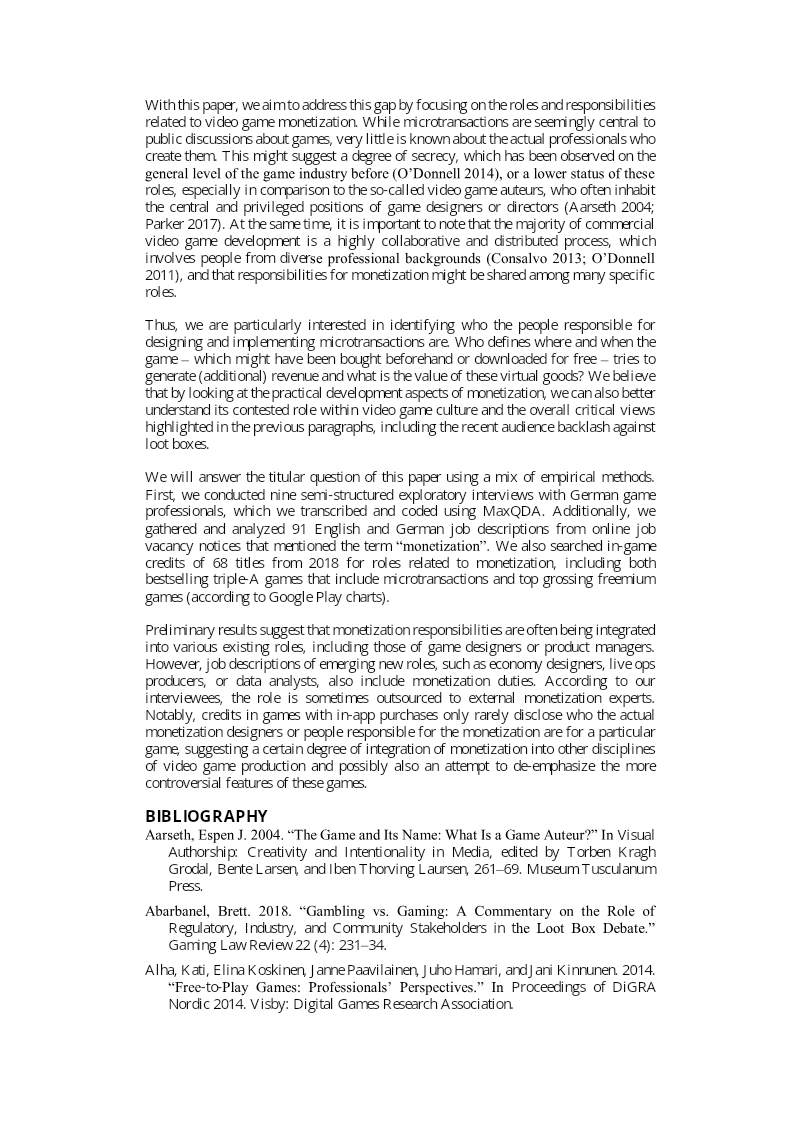
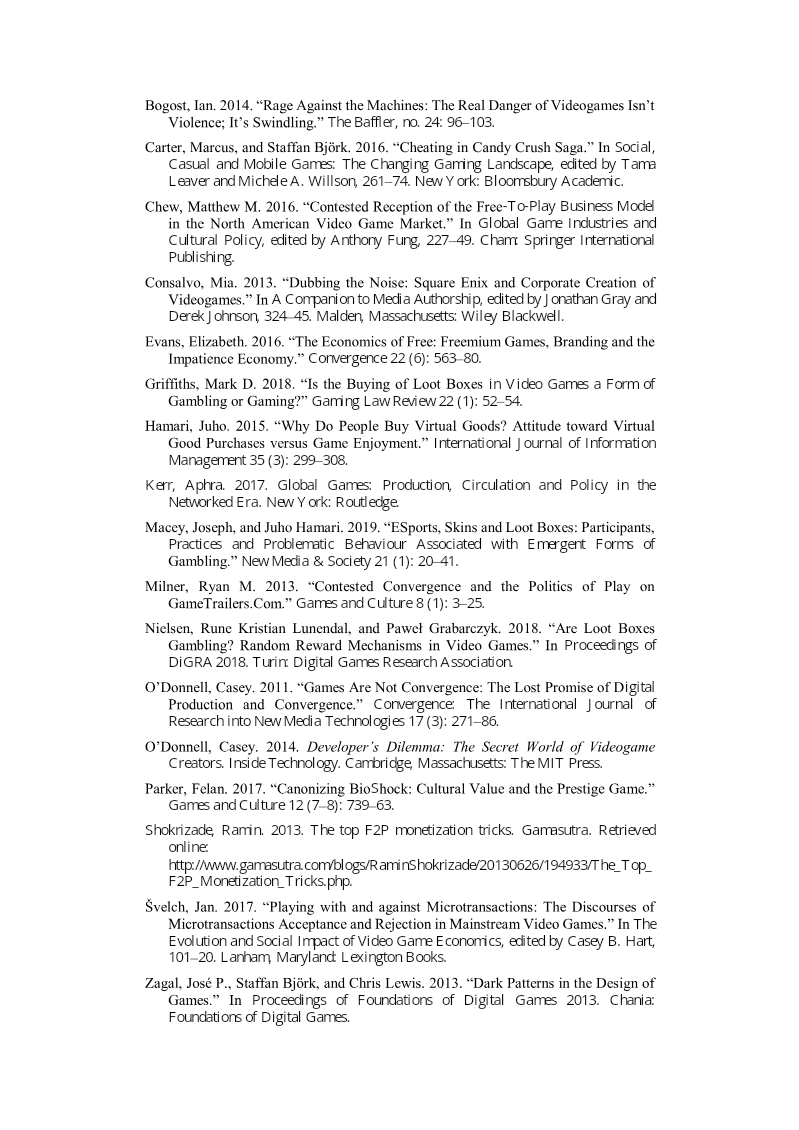
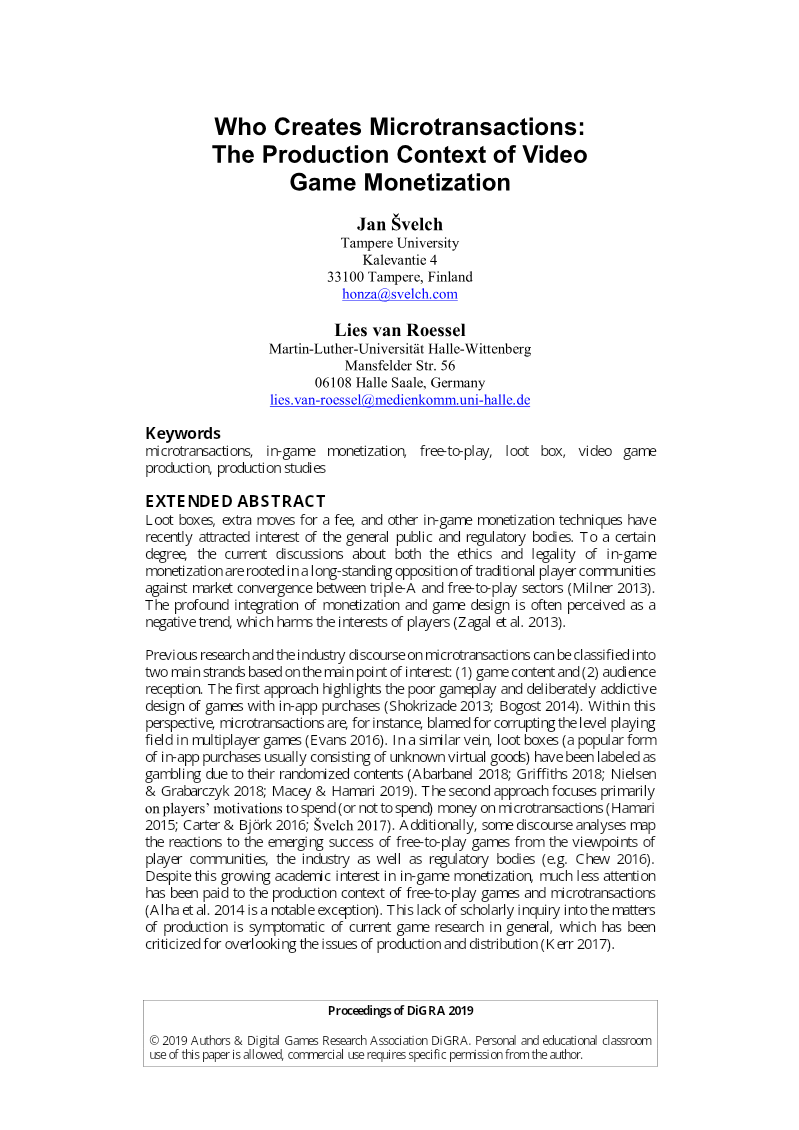
Who Creates Microtransactions: The Production Context of Video Game Monetization
This paper examines the production context of video game monetization, asking who actually designs and implements microtransactions, loot boxes, and other in-game purchase systems.
- Monetization responsibilities are usually absorbed into existing roles such as game designers and product managers rather than handled by a dedicated function, though emerging positions like economy designers, live operations producers, and data analysts increasingly carry these duties.
- Interviewees reported that monetization design is sometimes outsourced to external monetization specialists.
- The study uses a mixed-methods design combining nine exploratory interviews with German game professionals, analysis of 91 English and German job vacancy notices mentioning "monetization," and a review of credits from 68 titles released in 2018.