1 free read left. Create a free account for unlimited reading + AI research.
Create free accountWhitepaper DiGRA
1 free read left. Create a free account for unlimited reading + AI research.
Create free accountWhitepaperDiGRA
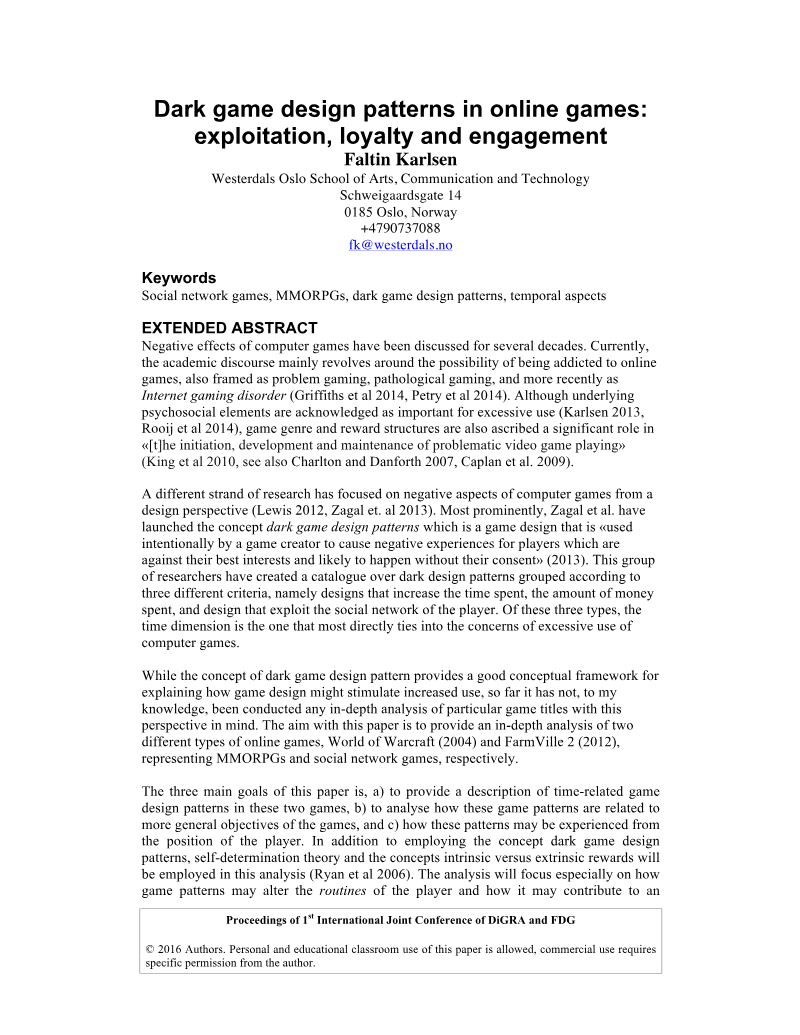
The Battle Pass is a seasonal subscription within Valve's DOTA 2 service infrastructure. The paper treats it as a case study of gamblification and platformization in digital games.
This paper examines how the service infrastructure of Valve's DOTA 2 has been iteratively redesigned, with a focus on the seasonal Battle Pass subscription, as a case study in gamblification and platformization within digital games. Its central argument is that the Battle Pass is continuously altered to optimize player retention, with the ultimate aim of achieving a form of absolute retention that extends what the authors describe as infrastructural capture, in which community participation feeds the platform's data collection and commodification and shapes player behavior.
The analysis rests on long-term ethnographic observation spanning the 2017 and 2018 Battle Pass seasons, combining autoethnographic notes with observation of The International, the competitive Esports tournament that concludes each season. The authors catalogued the mechanics and systems players are encouraged to explore, with particular attention to reward structures and activity types, including gamblified minigames, metagoals, and trading markets. They applied Consalvo and Dutton's game analysis toolkit, especially interaction maps and user interface schemas, to produce a schema for each yearly iteration of the platform.
The findings describe a pattern of additions and rollbacks between years. Gamblified systems introduced in 2017 were intended to increase player investment and retention, some were removed the following year, and new systems were introduced to further raise retention while encouraging more laborious forms of play. The authors interpret this trajectory as an optimization process aimed at producing a lean platform that extracts maximal value from consumers, drawing on critical political economy frameworks of platform capitalism.
The study's methodological contribution lies in extending interaction map and interface analysis into longitudinal methods for studying games as service, which the authors argue exist as evolving trajectories rather than fixed snapshots. By integrating these tools with value-centric analysis from Values at Play, the paper offers a conceptual modeling approach for tracking long-term design shifts and anticipating future changes in a game's business model. The scope is limited to a single title over two seasons, a constraint that bounds the generalizability of its conclusions.
Each row is a game or company this document names, each column a document, oldest first. A mark means that document names it. Select a row to see those documents.

DiGRA · 2026

DiGRA · 2026



DiGRA · 2026



DiGRA · 2026



DiGRA · 2026



DiGRA · 2026



DiGRA · 2026



DiGRA · 2026

DiGRA · 2026



DiGRA · 2026



DiGRA · 2026

DiGRA · 2026
Extra Credits · 2022