Monetization reports and market data
Documents
LiveOps - F2P Sales Best Practices 2020
Maximizing player lifetime value in free-to-play gaming requires a transition from static, calendar-based promotional strategies to a dynamic, behavioral-driven framework known as Targeting, Timing, and Offers.
- Transitioning from static, calendar-based promotions to behavioral-driven targeting can increase player lifetime value by 40% to over 100%.
- Utilize RFM segmentation (Recency, Frequency, and Monetary value) combined with machine learning to identify optimal engagement moments, such as progression difficulty or churn risk.
- Avoid generic, deep currency discounts that train players to wait for sales, as these erode long-term revenue and devalue the game economy.

Should Game Devs Focus on Making Money?
The central debate within the indie game development community concerns the tension between maintaining artistic integrity and pursuing commercial viability.
- The perceived conflict between artistic integrity and commercial viability is a false dichotomy; balancing creative passion with entrepreneurial ambition is essential for long-term sustainability.
- Industry benchmarks for Steam wishlist conversion are often overestimated, as real-world data indicates total conversion rates typically fall between 10 and 15 percent rather than the commonly cited 50 percent.
- Treating game development as an entrepreneurial endeavor helps creators maintain objectivity, which can prevent burnout and provide the motivation necessary to finish projects.
Epic VS Apple | Roundtables News Episode 232
The legal conflict between Epic Games and Apple centers on the contention that Apple’s mandatory 30 percent commission fee for in-app purchases constitutes monopolistic behavior.
- The core of the Epic Games versus Apple legal dispute is Epic's challenge to Apple's mandatory 30 percent commission fee on in-app purchases, which Epic characterizes as monopolistic.
- Apple's App Store generates approximately $15 billion in annual revenue, making it a critical financial pillar that the company is unlikely to dismantle due to external pressure.
- Epic’s strategy of intentionally violating platform terms resulted in the loss of roughly $100 million in monthly revenue previously generated by Fortnite on iOS.
GDC Summer Live Podcast - Day 2
Predictable success in the independent game industry relies on a rigorous, data-driven approach to publishing and community management.
- Launch performance is best forecasted by prioritizing data-driven metrics, specifically Steam wishlists and platform-specific algorithm behavior.
- The Nintendo eShop ranking system favors unit volume over revenue, incentivizing developers to use aggressive discounting to achieve top-seller visibility.
- Discord communities are more effective than traditional mailing lists for driving the early reviews and wishlist counts required for successful game launches.
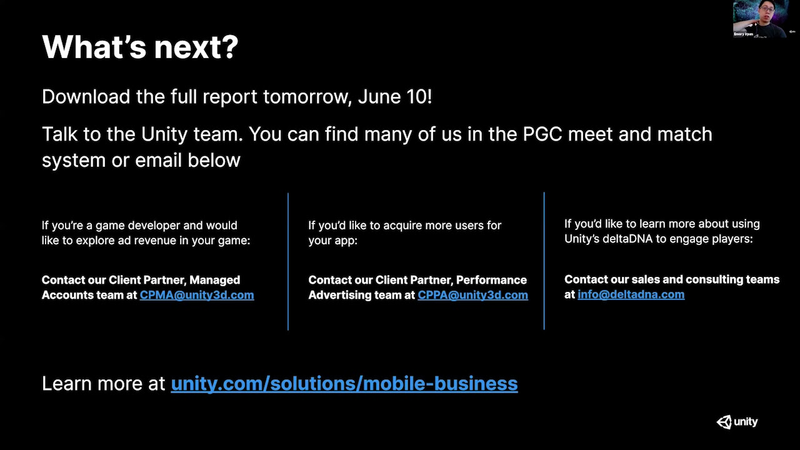
Superstar Session: A Look into the Impact of COVID-19 PG Connects Digital #2
This analysis examines the impact of the COVID-19 pandemic on the global mobile gaming industry, utilizing data from Unity Technologies’ monetization platform.
- Mobile ad revenue and ad impressions surged by 60% and 56% respectively in 2020, driven by a massive increase in global user traffic during the pandemic.
- Daily active users for mid-core and hardcore games rose by 35% compared to the 2019 baseline, as remote work and lockdowns shifted player behavior toward longer, more immersive sessions.
- While total in-app purchasing volume increased, the average revenue per player decreased, indicating that a broader base of users began spending smaller individual amounts.
Embracer Group Acquires DECA Games
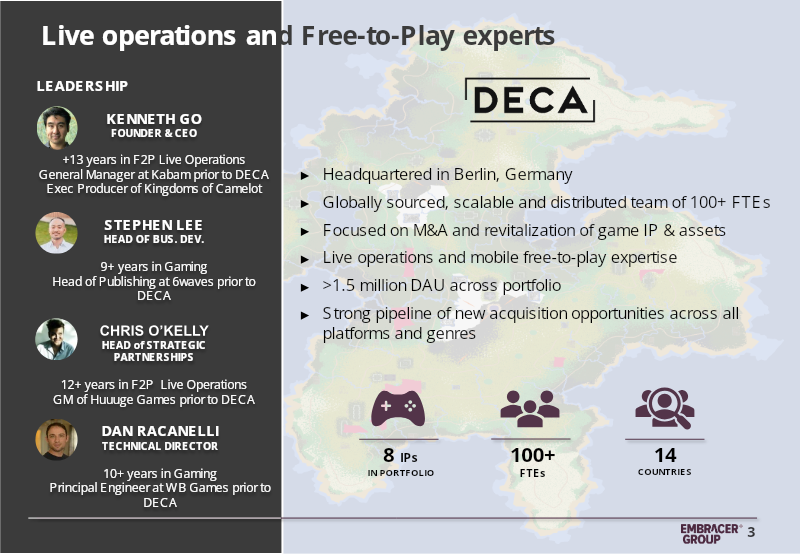
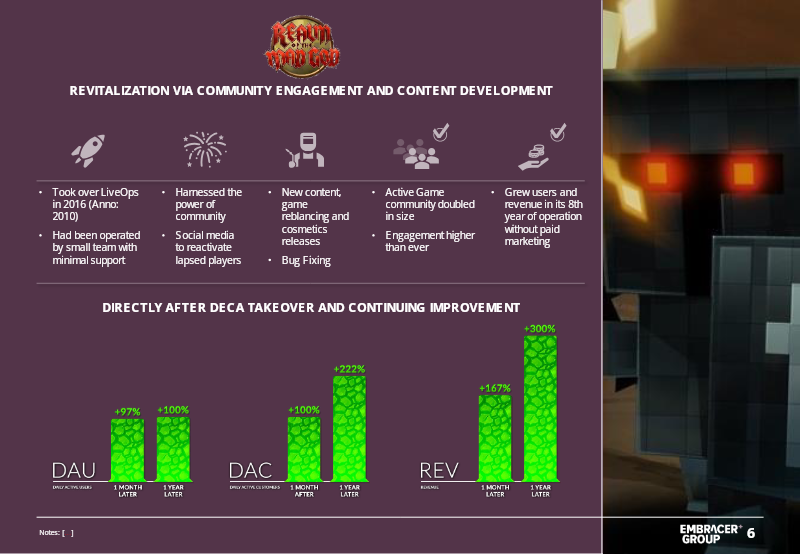
Embracer Group has acquired DECA Games, a specialist in mobile and free-to-play (FTP) asset management and live operations, to serve as its sixth operative group.
- Embracer Group acquired DECA Games for an initial €25 million in equity, with potential earnout payments of up to €60 million over seven years tied to financial growth targets.
- DECA Games will function as Embracer’s sixth operative group, providing a scalable platform to expand the parent company's presence in the mobile and free-to-play (FTP) sectors.
- DECA Games reported over €20 million in revenue and an operating EBIT margin exceeding 35% for the 2020/2021 fiscal year.

Monetise not Bastardise | PocketGamer.biz RoundTable
The mobile gaming industry is currently undergoing a critical transition in its approach to monetization, moving away from disruptive, full-screen video ads that often degrade user experience and retention.
- Mobile gaming has evolved into the largest digital medium, shifting from a niche market in 2014-2015 to a global audience that requires more sophisticated, non-intrusive monetization strategies.
- Programmatic audio advertising has expanded from a U.S.-centric model to over 50 countries, driven by the massive growth in music and podcast consumption on platforms like Spotify, SoundCloud, and YouTube.
- Player retention is heavily impacted by ad frequency and placement; developers must align ad triggers with natural game flow transitions—specifically the shift from frustration to relief—to maintain immersion.

Exploring the Mobile Industry with Nadav Ashkenazy | Game Dev Unchained Episode 230
The mobile gaming industry has undergone a fundamental transformation, shifting from speculative development cycles toward a rigorous, data-centric model that prioritizes marketability and financial sustainability.
- Mobile game development has shifted to a data-centric model that uses minimum viable products (MVPs) to test marketability, cost per install, and lifetime value before committing full production resources.
- The integration of creative design with rigorous business metrics is now the primary strategy for mitigating high development risks and reducing the frequency of studio closures.
- Studios must prioritize mobile-specific user experience design rather than simple platform porting to remain competitive in an increasingly complex digital landscape.

Data Driven Decision Making | Murka's Growth Through Data at the Organization and Product Level
Murka achieves sustained revenue growth and market outperformance by embedding a comprehensive, data-driven framework across its organizational, product, and portfolio operations.
- Murka utilizes a three-tiered player segmentation model—categorizing by demographics, activity patterns, and a 360-degree holistic view—to dynamically adjust live-ops, rewards, and challenges.
- The organization maintains a structural separation between business intelligence infrastructure and business-focused analysis to ensure teams can adapt to player behavior without being overwhelmed by data.
- Data analysts are embedded directly into product and monetization teams to facilitate the use of machine learning for predictive modeling, including churn forecasting and conversion optimization.
What does Live Ops mean Anyway? PG Connects Digital #2
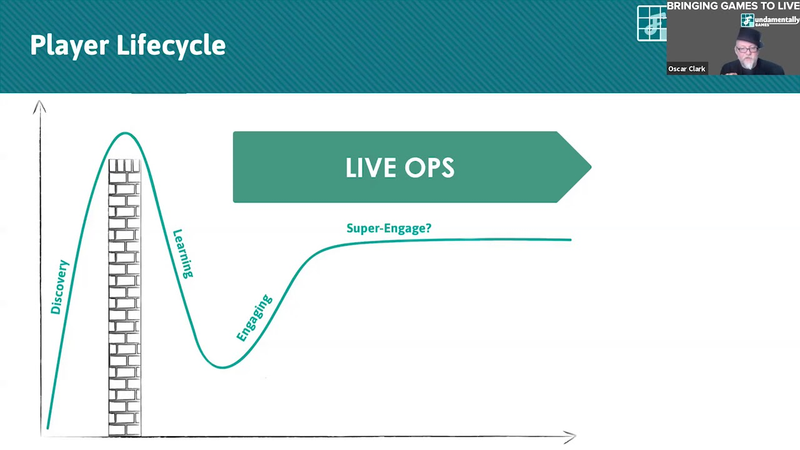
Live operations, or Live Ops, is defined as the strategic process of maximizing player engagement and retention by continuously delivering value, content, and community-driven experiences.
- Live Ops is the strategic process of prioritizing player retention over user acquisition to ensure long-term game viability and revenue growth.
- Effective Live Ops requires a shift to a service-oriented model, necessitating robust backend infrastructure built during the initial concept phase to support agile updates and bug fixes.
- Developers should implement a predictable pipeline of content, including daily challenges and seasonal events, to build player trust and manage expectations.
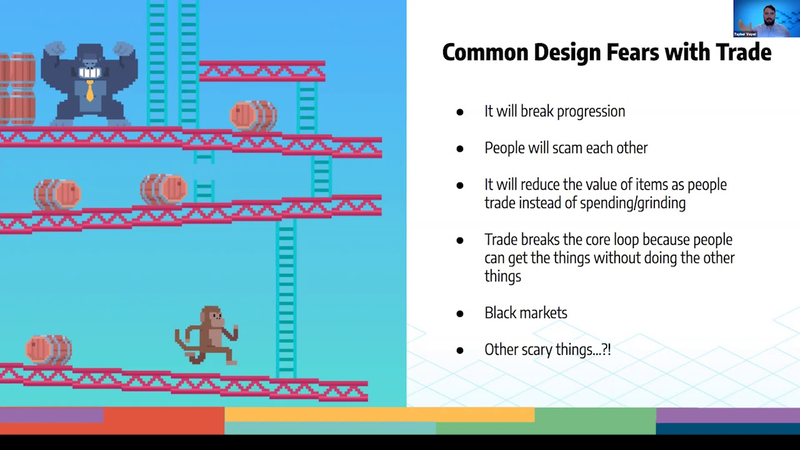
Emergent Behaviour, Informal Currencies & Black Markets-How Trade Adds Value to Your Virtual Economy
The integration of trade systems into virtual economies serves as a powerful tool for enhancing player monetization, retention, and social engagement.
- Implementing trade mechanics in 'Party in My Dorm' resulted in a sustained 35% increase in average revenue per daily active user (ARPDAU).
- Integrating trade systems shifts player psychology from consumption to asset management, reducing purchase friction by framing virtual goods as long-term investments rather than sunk costs.
- Prioritizing social-first trade interfaces, such as embedding exchange directly into chat, fosters community trust and acts as a natural deterrent to fraud compared to automated auction houses.
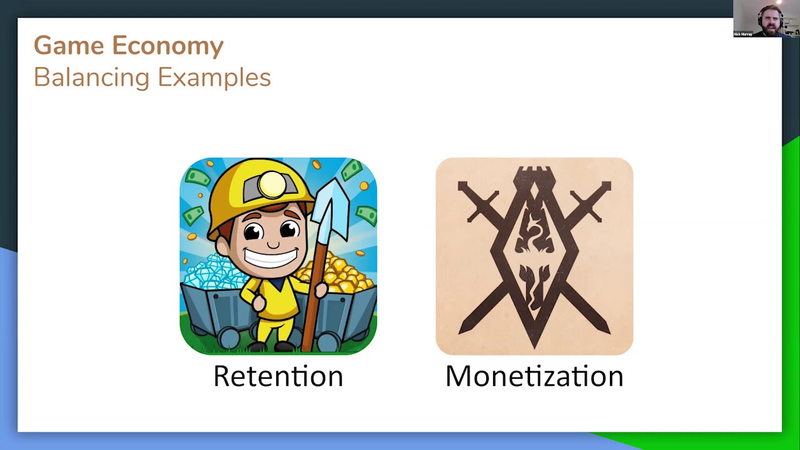
Building & Running Game Economies PG Connects Digital #2
Sustainable game economy design hinges on the strategic balance between player retention and monetization, with long-term engagement serving as the primary foundation for financial success.
- Sustainable game economies rely on a dual-currency framework where soft currency drives gameplay progression and hard currency is reserved for time-saving mechanics or exclusive cosmetics.
- Developers should anchor hard currency value in real-money equivalents to manage inflation and ensure that in-app purchases remain the primary acquisition method over free rewards.
- Resource management requires balancing sources and sinks by monitoring cumulative currency gains against spending objectives to identify and resolve progression bottlenecks.