1 free read left. Create a free account for unlimited reading + AI research.
Create free account
Emergent Behaviour, Informal Currencies & Black Markets-How Trade Adds Value to Your Virtual Economy
Key insights
6 takeaways- 01Integrating trade systems shifts player psychology from consumption to asset management, reducing purchase friction by framing virtual goods as long-term investments rather than sunk costs.
- 02Careful design is required to ensure trade systems do not disrupt core game progression loops or diminish the value of social interaction.
- 03Allowing players to upgrade common items to match the stats of rare ones preserves the long-term value of all assets while simultaneously driving social prestige and self-expression.
- 04Implementing trade mechanics in 'Party in My Dorm' resulted in a sustained 35% increase in average revenue per daily active user (ARPDAU).
- 05Prioritizing social-first trade interfaces, such as embedding exchange directly into chat, fosters community trust and acts as a natural deterrent to fraud compared to automated auction houses.
- 06Developers can utilize informal, player-driven currencies—like the 'bento box' system—to create stable, divisible mediums of exchange that are easier to influence than formal, hard-pegged currencies.
Ask AI about this video
Transcript
I would love to take some time to enter this table for who is actually a thinking it from a thinking egg and he's going to talk to us about emergent behavior in formal currencies and black markets and how traders can add value to a virtual economy taker do we have you online can you hear me there we go hello Hebert go ahead and take up I'm actually kind of curious about a thinking meat and I'm curious about black markets tell us about that all right so I guess I'll start by sharing my screen and we'll get some Lisa little technical things going here all right okay I think I'm set up
here all right so I'm here to talk to you guys about emergent behavior in formal currencies an in-game traded a little bit about black ops a black market story as well and so before I get started I just want to highlight that I've never done a presentation like this on zoom' and I'm really used to seeing an audience's face so apologies in advance if I go a little bit faster I don't react the way I normally would also I tried to condense this presentation down to 20 minutes which was also a challenge because there's a lot to talk about in here so and also my toddler might run it without further ado though here is my presentation on emergent behavior in formal currencies and in game trade so a little bit I'm just the kind of what I'm going to go through I'll talk a little bit about myself and I think a p-- so you have some context about the game in particular which is party in my dorm where we have trade why you should consider trade to boost monetization in
your game the design problems with trade and then I'm talk a little bit about what the diablo got wrong with the auction house because i think it's a really interesting use case and then go over our implementation and just go over some of the really interesting things that have happened with merchants behavior some of the informal currencies that have come up in our game and then just revisit why i think you should consider trade in your game so I am cable lawyer and I'm head of product and thinking eight I'm making games for years in the free2play space and I started on Facebook games I've worked on Facebook games and then moved over to mobile and I've been at thinking eight making mobile games for seven years and I have a BA in political economy and that's only relevant because I studied currencies in school and I had been planning to do a master's in social currencies and so it kind of is part of the passionate reason why I wanted to try to create interesting trading economies in games that I make just a quick overview of a TAS
timeline just to give some context so our first game was kingdoms at war it was launched in 2009 when the AppStore I was just sort of starting and there was actually no free to play mechanics in the App Store so the game actually had a thing where you would buy a premium version of the game which is unlocked currency in in the game and so now we've been around for a long time making games on in the space for it for a very long time and then party my dorm actually launched originally in 2010 I joined the company in 2013 we made a bunch of games since then most recent games kingdoms of heckfire so we have four products that are still in the market today that's Kingdom heckfire party my dorm kingdoms at war it's still around actually it does still quite well it has a really vibrant community we still are working on it in launching content every week and then we also have a small casino game and now we have a new game and development called project dolphin which is a game that Trice actually I
shouldn't say too much about it because it's still in development so about party in my dorm so as I said the game watched in 2010 inside over 12 million downloads in its lifetime it continues to have grossed in revenue year over year the core loop is basically PvE raids that draw item progression currency and event progress stats come from items gifts and permanent upgrades and various percentage bonuses it's a highly social game and it's got hardcore risky PvP meaning that anyone can hit anyone and some of the PvP is actually zero somewhere you can actually you know do real damage to a player's account which is pretty unique for a game that has a target age of 18 to 34 and skews more towards a female audience and so I think that's a really unique thing in mobile is that I think a lot of times people think that in order to build a game for for mobile you have to build something for yourself and that they're you know only certain audiences want to
play these hardcore strategy games what we found is actually there's a whole underserved market of people that want deep rich strategy games and actual social mechanics and part of my party my dorms evidence of this I first want to have a little disclaimer that whatever solution you do come up with for monetization trading or game make sure you check with the App Store guidelines in terms of use because over time the guidelines get changed quite a bit and so you have to be cognizant that whatever you're doing isn't violating their the terms of use for the App Store so right now there are restrictions for example on how players can use gifts yeah on Apple platform and could you just check that up before you start designing so I think is really poor to kind of step back and talk about monetization before we get too deep into this because I think often times when we see monetization panels at conferences
there's sort of this like idea that you're gonna go on and there talk about like battle pass how to make a good battle pass or how to make a good subscription and it's it's often about actually merchandising and not about monetization and I think partly it's because when you only have 20 minutes to present you kind of want to look at implementation it's often the thing that people focus on but really monetization is about when it's about an exchange of value so monetization is when a player agrees to give a developer money in exchange for something of value and I think that's the piece that often gets missed in mobile games is that you still need to be giving something about it there's a lot of like ways to speed a progression and people think about timers as being you know really propelling their loot boxes being really compelling but at the end of the day players have to find value and trade can actually strengthen the value proposition for players and extend the lifetime value of your virtual goods so when a game has a trade economy what happens is players know that the item can be valuable for in-game mechanics
but also it can be an important story value and so trade shifts the psychology of buying for a player as they consider the store value the store value and an example would be they know that if they buy something or they don't want it anymore you don't like it they can actually sell it later and you know there are games that have you know auctions or exchange markets with real money and that is actually not allowed in the App Store so you know this is reduced slightly and that people have to find either a black market to sell their items or it's any game value regardless what we found is that it's a it's a big shift in psychology for the players where they feel a little bit better about spending it reduces some of the friction because they know that later on they can trade whatever item they've so what are some common design fears with trade so this is a pretty design Center talk to because you know I'm
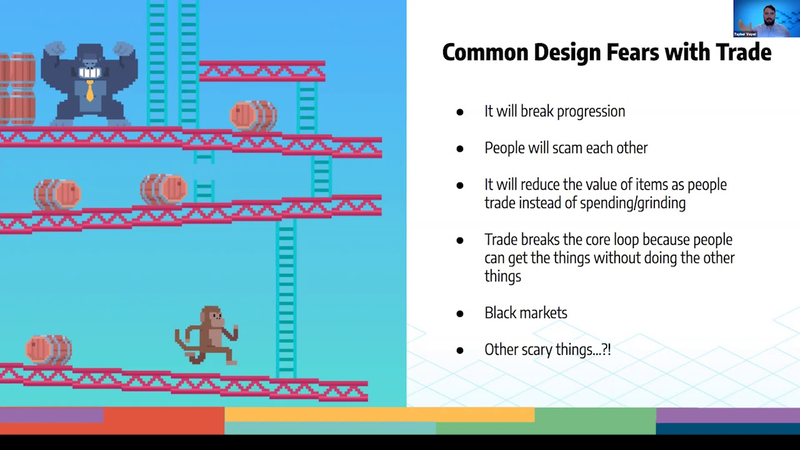
designer at heart and I think some common fears are that trade will break your progression people will scam each other right it will reduce the value of items as people can trade for them instead of spending or grinding and that it breaks the core loop because people can get things without doing other things like you know playing the game and you might have your might be afraid of black markets and other scary things right so there's always like a lot of problems with trade and it is a big hairy problem but when if you can solve some of these things you actually will unlock a lot of potential so I'll talk a little bit about the Diablo auction house now you know I respect Blizzard a lot and it's a great company this was a great game there's a good talk though about some of the expansion pack and the lessons learned from that in the GDC vault where they talk a little bit about the auction house and the design director it talks about the intention of the auction house which was actually provide players with a safe environment
where they could trade because Diablo 2 was plagued with fraud and credit-card account theft which is a really good thing to want us all if you do want to stop people from getting scammed but what they actually did was they broke their cord loop and so you know later on in the presentation he says any type of trade will fundamentally ruin the core reward loop even if your friend gives you an awesome item and you love him for it he's robbed you on X number of hours of upgrades and that's a big problem so think about that for a second on one hand they want to solve the scamming problem so they put in an auction house and then they misunderstand fundamentally what trade is what was interesting about trading D - right when you were playing Diablo 2 you might find a really high level player and they would give you something in a location and so you had to be in the same spot as them you had to socially interact and they would drop something for you and that was a really exciting thing in fact he even uses the word love you might love him for it and so he's missing out on this idea that that social
interaction is actually a high highly powerful thing for you to harness it designer and instead they ripped out the auction house completely in this upgrade and auction house in itself was actually you know it's only metagame which I found quite fun one at lunch but I could see how it broke the game but assuming that any trade is going to break your core loop I think is really naive and a bit sort of like designing for yourself and the solution that they came up with the auction house I also think it was sort of like hey well we don't really understand trade it's not what we want people to do so let's just make it super easy efficient so they made two efficient people could easily bypass the game they just discounted the value of social trade and underestimated how much players will min/max on the system and they misunderstood the fun of trade and the reason I bring up this example is because it really informed my design thinking when I started to look at trades for our games because one of the things that we started with is we wanted to reduce the amount of scamming that was happening with our gifting system
and that's where trade was born it's also sort of held up as this example of you know of like how trade you'd always go wrong you just can't do it if Diablo can't do it nobody could do it which I think it's kind of silly so how we solve some of these problems first we decided that we would create a new content system that would allow players to have a deep well of content to trade right one of the things that you need is you actually need things for people to exchange in order for trade to work really effectively and so our content system is a furniture based system and what you can do is decorate your dorm room however you like so all of the items in this image here can be changed and I give an example of the bed here all the different beds that you can buy and each one of these beds is $20 and players are able to change any piece of furniture and in this room and there's three parts to the room so there's multiple vectors of value in the system players can change the way that the
furniture looks but they can also upgrade the stats for each piece of furniture so each piece of furniture can be upgraded and they also can break each piece of furniture down to get the upgrade materials for their other furniture and what we tried to do with this is to remove the burden of optimum play meaning we try to make so that when a player gets one piece of furniture and they can upgrade that to its maxed at level no matter what its rarity so you might find a really common piece of furniture maybe it's like you know that your first dorm room bed it's really ugliest got a stain on it well you can actually upgrade that piece of furniture to the same level as the most rare item in the game now what that does is it stops players from having to use the best or most rare or most recent item that drops for them and it means that they can actually have self-expression because they can choose how to decorate their dorm room however they like and this also creates some social prestige where people know that if you have something really rare and they see it in your room that you achieved either you know a really
compelling core loop achievement by unlocking this item or you might be a really good trader and that's supported by also a really really deep economy in that these items require a huge amount of of pieces of upgrade materials to actually operate to the macro level and so that and that system can actually be extended but whatever we feel whenever we feel like it we can just add levels to all of the furniture items and because they're all the same progression vector it's really simple for us to do that we don't have to like change every item we actually just changed the upgrade map for the item slot and for us when we have thousands and thousands and thousands of items that's a really practical and important piece of our tech so here are some examples of people decorating that same slot with a bunch of different furniture and you can even see that two of these images use the same roof or ceiling in the same wallpaper but the room ends of having
quite a different feel so there are thousands and thousands and thousands of these different items and thousands of different combinations and these are just a few of the the top players rooms so how does trade actually work in the game we also decided early on that we wanted trade to remain a social experience we wanted it to be fundamentally something about relationships this is a social strategy game and social interactions and relationships are fundamentally important to how the players play the game and how they interact so we made it so that you actually have to trade within the chat system so this took a little bit longer than it would have if we had just made like an auction house and or just like a really simple you know trade system back and forth but because it's social you have to be friends with the player we have a friending mechanic so you first have to make friends with them open a chat dialog and convince them to chat with you and as a result we reduce a lot of the scamming because we have a highly
contextual record of what happened so if there's a scam report our Sam team can go and look at the chat history and they can actually see everything that was said before and everything I've said after so you can see here somebody says hey I've got some cool items you want trade with me yes no you say yes you can add your own items once both people have opened the chat dialog and see both set of items both people have to agree if anybody changes any of the items in the tray then it resets and both people have to agree again so we have consent for the trade on both ends and we have a highly contextual chat log of everything that happened during the trade so it helps us to figure out you know who if anybody scammed what happened and it also forces players to go and find each other and forces the experience to be quite social no this might seem a little bit inefficient in fact it's so inefficient that people started flooding all of our campus chat with you know ads for trade and so that is kind of interesting
because it actually makes the app look really really a lot if people are constantly posting and not just about this but even you know social interactions are really important in the game so we're looking for relationships like oh I'm looking for new clubs we actually have this sort of this campus chat it just ends up being a constant stream of activity of people selling things you can see here you know people are selling bento boxes or they're selling any starred items on their wall people could start and that they want for sale and we ended up splitting out our world chat into a campus chat it has all these kinds of things and then another chat which is more social called the pub but that's a whole nother talk the game is 18 plus and some interesting things happens go Balter go let's talk for another days it is inefficient because it forces people to find these avenues to broadcast their trade and we didn't have to blow the channels and it can be kind of confusing to new players but it does create its own set of activities within the game that are sort of a meta game on itself that we found players find highly rewarding and also really really improve retention and
monetization some more interesting emergent behavior and you know if you ever read about EVE Online there's really great stories about this in that game as well and this I was really happy to see emerging within our game is that we have the idea of trusted trader so both players sort of agreed to a trade then they will post back and forth on each other's walls that this is a trusted trader and you can trade with them it's obviously capable but that's social currency within the game is really important people get to know who is valuable and who's not who's a good trader and who's not so this is just an example of one player that I found as a trusted trader and it's a really good and interesting way to see how these kinds of emergent behaviors create you know rules within the game that you maybe didn't plan but are highly useful for players and you know makes people feel really good this person is medics you know a ton a ton of time and kind of money becoming this trusted person within the community and that's a role that they get to play that we you know
have served for an underserved market even our price guides our social players will go to our forums and like websites and they post what the prices of different items are and this is something that's really interesting because we didn't build a currency for trade so all trades have to happen with goods virtual goods within the game so you can see here they're talking they're asking for a price check on different items and I think it's really cool because they have your poster you can see these little bento boxes right so what is that what are those well this is the next really cool piece of emergent behavior is that an informal currency happened so in our game we have these things called chibi avatars and they automatically combined into a bento box set and it's a way for people to trade around a divisible good essentially so players can watch video ads in our game and they get these spinner tokens and they spin the spinner and they get
chance to give some chibis or bad totes it was completely accidental on our part we actually wanted to sort of make a gotcha mechanic for our prize wheel and we accidentally created an informal currency so it meets all the properties of a currency because it's scarce alright people are constrained by the number of videos that ads that are available in the economy so the you know value of that currency isn't gonna stop and it isn't gonna skyrocket although I you know we sometimes thinking about experimenting with you know flooding the market or doing some interesting things but also that's a talk for another time but they are indivisible as well so you know they can be broken back down and they're transferable so you can trade to any pentose TVs and then they're fungible one is the same as another so is a really cool thing where you know you can see people have created their own currency and this just happened sort of organically we've been sort of like planning to launch the feature and see what happened and think about how you would adopt a trade currency but they sort of just came up with one on their own so this is a really accidental but
super interesting um so why should you try it this is a graph that shows when we've launched trade our average revenue per daily active user and the scale here is that it boosted that ARP down by about 35% and then it actually sustained it as well so the combination of this content system with trade has created a sustained arced out increase that it was you know represents you know a global Maxima shift in our game and has actually allowed us to scale we came up and so we've actually actively been growing you way for the game since 2017 which is pretty remarkable freaking that's how interesting 2010 I'm so I know that was a lot of content and I ripped through it pretty quick but I'm at the end of the twenty minutes and I think now it's time for questions well - okay thank you very much I really appreciate that that's fascinating stuff couple questions I'd like to ask first of all when you're designing your
trading system I like it one it's clever how you did that via chat but quick question um why did you only choose a barter trade why didn't you instantiate a soft currency I mean we all I hear about is soft and hard currencies these days was that whiskey was unintentional it was intentional at the time and part of the reason was people had already sort of developed an informal way of trading gifts back and forth and we wanted to the way we typically do things is we like to launch a small MVP in the feature and then see how it does and this feature had ballooned it was supposed to take you know a month or two but the implementation of chat trade was a lot more complex than we thought some of the UI and UX around it took a lot longer than we thought so we're already at a point where we really were invested in it and wanted to see how it would do and then also I knew you know from my academic studies I knew that people would find their own means of exchange and I was a little bit hesitant to
preemptively launch a currency for it without having a good handle and how much volume there would be in the trade market and we were just lucky enough to have like a quite developed game where we were really confident people would use it regardless I toyed with the idea of launching a trade currency since then but it is one of those things where you know if you have to be really really careful about how you value your trade currency because that ends up being sort of something that players have to trust you a lot right now they they know what the value of a good is in bento boxes and they know humbie bento boxes are roughly in the economy but if you start launching your own currency all of a sudden you're a little bit more like you know the Federal Reserve and then I'm putting on my Janet Yellen hat trying to manage you know in the supply of a currency in a market which for me who sounds like the great job that's kind of like all I want in life but no I have other other duties as well and it's something that we weren't we couldn't really figure out whether there would be any increased value in it so that's a
long sort of winded answer but generally it was something that we've always thought about doing and we didn't end up needing to do it so we did so I mean the bone you could simply introduce more bento boxes to have an inflationary effect on the currency if you wanted to yeah exactly we do control the supply of bento boxes so it's just sort of you know this emergent behavior that we decided not to formalize into its own currency and just keep it the way it is but you know we also are seeing that you know video ad inventory for this group of people is sometimes now when you have like a like an older game with a smaller audience it's not super wide you sometimes don't earn as high of a revenue with video ads so it's sort of a challenge for us to make sure that we have a good supply and also there's a you know a significant portion of our game is from two or three countries and even I have as much a video supply so there is some friction there but it just was like the natural way for us to keep the value pretty consistent but you do
you do use the tokens that you get from the video ads and the results of the spinner to generate additional bento boxes so you actually have a some small inflationary pressure built into the game now is that intentional yes the value of everybody's goods is always well you know today is worth lesson then tomorrow yeah that's actually a really important distinction that I didn't make is that we were really careful to peg the value of goods the more tradable goods really really high so furniture items have like a very very high virtual currency cost that relates to like a high IEP cost even though players can know that they can trade it and that the price is a little bit lower when they get that drop or they make that trade they still feel like they got $20 or $30 or $40 $50 item and so for them they
just see you know bentos is a way for them to like slowly earn currency to get an item that they might be saving up for and so they don't necessarily see it as something that we have control over do they feel like it's all controlled by the video ends but we in fact can tweak that up and down yeah okay so you cannot buy bento boxes through an in-app purchase no we've tried it before and it wasn't very successful and so you can't find them through any that person's you can go about good to my trade prevent toes and limits a member a bento is in circulation yes yeah yeah I've tried to convince the designers to like do big shifts in the bento market and they do like you know make some inflation in just like experiment with it but they're the the content designers are very very hesitant to do that because they see it as like this nice closed system that is raw well balanced and does well for us but I'm always trying to tweak it have you seen this replicated in other platforms or other genres I mean like how would you do this in the first-person shooter yeah I mean one of the influences that I
have is the counter-strike game actually has an auction house where you can trade items back and forth and you can customize your own items and so they have a video I could I could share it in chat afterwards but it's a really really interesting video from 2016 where they were talking about their system and they do it through more of an exchange platform like the steam trading economy but is there really really they still have a lot of the same content ideas that we have so I have that's one of the influences that I had and another big image was just mmo's when I was younger we I would play them and oftentimes we need to counter a really high level player and they might drop something for you and then you've the gate items weren't so restricted that you could use it and that to me was one of the most interesting parts of the game is that you have this person super powerful they drop something in the game and you feel amazing because you have this item that now you can use that's too powerful and helps you through the game a little bit maybe breaks the core loop a little bit but that player also feels amazing
because now they get to show off how cool they are right now when you go play them em oh it's really rare that that player can actually influence the world and that sort of runs the whole point of an MMO it's not just about rhyming it's about that social prestige so we wanted to bring that back a little bit and give these good players away they look you know boost each other interact with each other it's a mobile game with 10 years we have so much content and they and the game is so deep that it doesn't really matter if people accelerate you know through the game a little bit faster in fact that's probably a good thing have you ever considered trading cross game for example using a bento box currency and maybe purchasing assets and one of the other properties we don't do it across game but we did after the success of this system we did poured it into kingdoms at war so we do have some cross-pollination between the games of systems and players but I've never thought about that that's actually really interesting I'm going to do that I'm going to try that that's a good question
- game to the shame same genre to encourage some to get some sort of trade going between them I'd that would just be a lot of fun and talk about thinking of getting users engaged in both games that might be a fun way to do it yeah and you know that's something you have to make sure that the currency is fungible across games if that's the case there's some you know challenges there and I think that's one reason why it's really difficult I've had people approach me where maybe they have a product that allows you to trade between games or EMA currency but it's really hard to create a sense of value between both currencies across bulbs like make sure that's equal that kind of that can be really challenging unless of course you come up with a saw a common soft currency but then you have to manage inflation and both games are gonna get hard but Wragge between the games a political science major who has an emphasis on see you will love that I'm sure yeah and I don't think that would
be the the part would be hard to trust another studio like another developer to like make sure that it's the same I mean early on in my career I did have to do a thing where I would balance all of our virtual currency as a real world dollar because we were paying so I'm a vendor out based on how much currency they some kind of the game so that was a really fun challenge to come up with like what does the formula for our value of our currency that was you know transparent enough that the vendor feels confident in our exchange rate we feel confident that was a fun project well hey thank you very much paper I really appreciate it's been super having you on hopefully people will connect with you on discord and I hope you enjoy the rest of your conference
Summary
The integration of trade systems into virtual economies serves as a powerful tool for enhancing player monetization, retention, and social engagement. By shifting the player’s psychological perspective from simple consumption to asset management, developers can increase the perceived value of virtual goods. When players understand that items hold potential resale or trade value, the friction associated with in-app purchases is often reduced, as the acquisition is viewed as a long-term investment rather than a sunk cost.
Successful implementation requires careful design to avoid common pitfalls, such as the disruption of core reward loops or the proliferation of scams. Rather than relying on automated, highly efficient auction houses—which can inadvertently bypass game progression and diminish the value of social interaction—developers should prioritize systems that foster community. In the case of Party in My Dorm, a social strategy game, trade was implemented directly within the chat interface. This design choice forces players to interact, build relationships, and establish social trust, which acts as a natural deterrent to fraud. Furthermore, the use of a player-driven, informal currency—such as the "bento box" system—can emerge organically, providing a stable, divisible medium of exchange that the developer can monitor and influence without the complexities of managing a formal, hard-pegged currency.
Data from Party in My Dorm indicates that implementing these trade mechanics resulted in a sustained 35% increase in average revenue per daily active user (ARPDAU). By allowing players to upgrade common items to match the stats of rare ones, the game preserves the value of all assets while encouraging self-expression and social prestige. Ultimately, trade systems transform a game from a solitary progression experience into a vibrant, player-driven economy, provided the developer remains cognizant of platform guidelines and maintains a balanced, social-first approach to exchange.

















Comments