1 free read left. Create a free account for unlimited reading + AI research.
Create free account
What does Live Ops mean Anyway? PG Connects Digital #2
Key insights
6 takeaways- 01Live Ops is the strategic process of prioritizing player retention over user acquisition to ensure long-term game viability and revenue growth.
- 02Strategic promotions must provide genuine value to the player to successfully combat churn and deepen community engagement.
- 03Developers should implement a predictable pipeline of content, including daily challenges and seasonal events, to build player trust and manage expectations.
- 04Studios must account for regional cultural nuances, as spending habits and social engagement preferences differ significantly between Western and Asian gaming markets.
- 05Effective Live Ops requires a shift to a service-oriented model, necessitating robust backend infrastructure built during the initial concept phase to support agile updates and bug fixes.
- 06While not every title requires massive live service infrastructure, all developers must integrate marketing, community feedback, and in-game activities to create a self-sustaining cycle of growth.
Ask AI about this video
Transcript
I will I will rapidly change my background so you can think of me as a speaker rather than a host for a few moments so I and I'll share my screen so turn here we go right so yep hopefully that's shared and displayed let me just change cool okay so yeah so I'm as you can tell Oscar from fundamentally games we are a group of people who've been around the industry for a long time myself have been around for 22 years I've been running live up spaced games for about most that time got my my career started
in games when I worked with British Telecom on an online gaming platform called why play with dial-up modems yes dial-up modems I'm that old so we had games like quake Unreal Tournament counter-strike we I get to claim my safe counter-strike it's a bit of a lie but we did actually buy them some new computers and the fifth I think was the fifth beta for counter-strike was had our logo everywhere but enough of that and I've worked in our mobile with running his operator platform and I've also worked as home architect on PlayStation Home so virtual virtual world which I so wish still exists in this era but sadly was long to party and and I've been a consultant for a long time so earlier this year in end of March early April we closed a seed round for a new company which is fundamentally a games and we focus on live operations so what I want to try and talk about basically is what on earth is live ops and to me live ops
is actually pretty straightforward it's about getting more people doing more things more often for longer that's very simple mentality but if you think about it you know the idea of acquiring and understanding users and understand what they do and how to get them through that more often and more regularly and to keep doing it to me that's the magic of scale yeah we can just buy users we can we can go and do the mark we can do the the implements generation if we don't focus on the players and the value they get we are wasting our time doesn't matter how much audience we get coming in if we don't look after them now I think we wrong I think there are amazing people out there who do amazing things with user acquisition we're publishing even self-publishing but what we want to focus on is how do you get more players doing more things more often for longer so why do I think this well obviously I've been around a long time I've looked at a lot of data and I
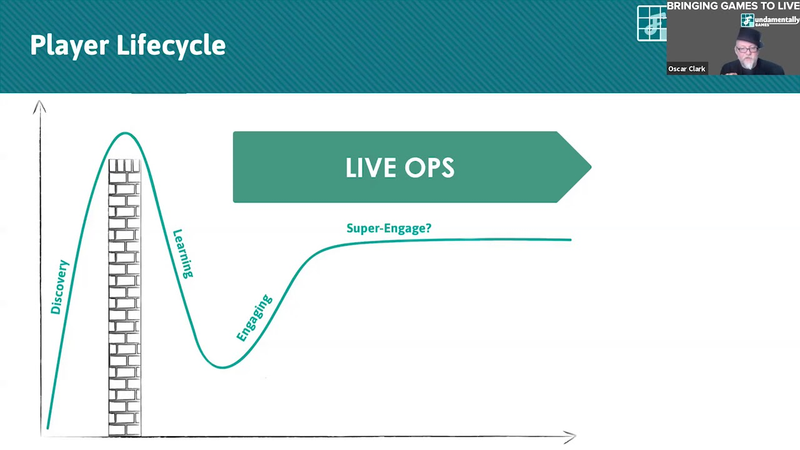
try to do is to think about the user experience and I use a model based on a book called Jeffrey book called crossing the chasm by a guy called Jeffrey Moore Jeffrey Moore it's an old book I'm a trained marketing guy most of you will never read this book but it was quite influential to me and it looks at the adoption of goods particularly technology goods and used a thing called their Gartner hype curve if you've heard of the term crossing the chasm or bridging the gap this these terms come from that book to put it into game terms essentially I saw this pattern emerging when I looked at the data for players in different platforms and it was almost always the same data so you look at the frequency of engagement over time and you start with is the discovery get cleared find the game and you've got to get them excited enough to get them over whatever the barrier is for them to acquire it so this is the job that publishers and self-publishing and all
the marketing side is about which is getting people excited anticipating your game sufficiently to get over the paywall if there's a pay upfront or the frustration wall if there is a you know you can always have some level of frustration even if it's just have I got space on my phone right now so it's always going to be a level of frustration so we're going to get enough anticipation those people can be bothered to click on the link and install that game whatever platform it is but it doesn't end there and we actually also need to think about the learning stage so what is learning me well it's not just learning the controls but if you think about it the experience of a player the first time they play we'll be their worst because they don't know the controls they don't have any real emotional engagement with the game yet and they don't know yet where where the game fits into their daily routine so if we don't look after that if we don't have a great first-time user
experience we don't manage that expectation of future delight we will find that they churn you know people leave that's gonna be life and but what we want to do is avoid that this stage in the gun ID curve if you ever want to look at that it's often called the pit of disillusionment yes that's how we feel something happens to us is that buyer's remorse when we buy the wrong pair of jeans and it's like or we we order something and it turns up damaged there's this buyer must why did I do that and that's what's happening in this stage we have it in every every walk of life now if you've got a product what happens then is that you try to manage that product and you try to manage effectively the long tail you may have heard that phrase now so basically to my mind what you're doing is you're just trying to manage to make sure you get new users but that's it you're just
trying to manage getting users yes will do things like sales promotions yes will do you know you know Steam sale or whatever but it's not really managing the experience in life of the current players and to me that's what live ops is live ops is about getting the current players you've already acquired and building up their engagement its sustaining their interest helping them find the patterns of play which delight them that fit to their daily routine so they find the go to experience that they choose is your game whether that's on the loo whether that's when they come home after a long day at work all or monke nowadays small when they get off their screen from doing video calls and now want to play something on a screen maybe I know that's kind of idea so we want to engage people but it's not leaving it there we also want to see if those people want to super engage the
super engage is kind of what some people used to call a less I don't like that term anymore I've gone off it completely because I think it's the wrong psychology it's a great word for gamblers there is a definitive that group of people who have a behavior in gambling that is called whales by the gambling industry that isn't the same mindset in games in my opinion instead people look at games as part of their hobby and some people will super engage but to them super engages are spend five Panem a week that's great if somebody is going to spend five pound a week in my game I'm very happy and but other people have a larger disposable income and they want to find ways that they can invest in the game if you've got a hobby like sailing or golf even football and there it's amazing how much you will spend there's something you're truly passionate about and I don't mean
tricking people into spending here you know if you're an Arsenal fan and heaven forbid if you are but anyway I don't speak sports oh I don't know I'm talking about but if you are a fan of a particular team don't you want that t-shirt don't you want that yeah but we'll talk you know don't you want those items and actually that's the point is understanding that though people want certain things as an expression of their social identity as somebody who belongs to people who like doing these things as much as it is about the genuine passion for playing the game but whatever we do in super engaging we can't make that something which makes people feel excluded it makes the people feel like the game is biased because if we create pay2win what we do is we break the game but we get very sense about what pay2win means and actually different cultures have different views on what's acceptable or not if you're in the Asian market spending a lot of money upfront
is actually quite a normal thing to do because you want to get ahead you want to get involved you want to see how the game plays and and that's a valuable thing for some players in the way doesn't tend to be the case in the West wheat more likely to be waiting for you know a few days maybe a week maybe eight day 812 days seems to be a common range for a lot of games because if you haven't started spending within two weeks you're probably not going to be a spender but if you have started spending of earlier you will often be a one-time spender our interest is finding people who love the game and find value in ongoing engagement with the game and we want to provide things that they love well what better way to find things they love than to provide an ongoing series of activities with new and exciting and valuable content that's focused and reached into why we love the game and again the realization that keeping people playing matters retention is
disproportionately valuable to with a revenue of your game and so if people love the game give them a reason to keep playing if you abandon them if you don't give them the support guess what they stop playing so really engaging people again is a massively important thing your game will not last forever unless you're very very very lucky it's not every game is chess but there are some amazing games in the top ten who've been in the top ten for years with good reason you know why does League of Legends last forever because it's got an amazing community that's managed them them right do an amazing job why does candy crush or something like clash of clans still survive because it has an amazing experience that's continuously evolving and if you want your game what you find the right scale of activity which means that you satisfy your audience's needs when I try and think of it like a funnel sometimes if you have lots of inputs coming in you're gonna
see that funnel decline but you don't want to just people have people drop out and discovery you want to keep activating them so they become engaged and if they are engaged we want to convert them so they can spend some money in the game and feel good about it and at the end of the day we need to understand that those people who do super engage at whatever level they become aspirational figures for people engaging with a game look what they've done look what they've got and that could feed into the community and the values of the game and also if the engaged audiences are telling their friends they can feed into virality word-of-mouth still is a massively important factor in terms of engagement so it's a funnel thinking about the lifecycle of the game is a funnel but have I really answered what why hopes is what is live ops really well for me live ops is about focusing on what happens for the point of view of the player and I use events as a starting point for
that and events can be any number of sizes it can be a daily challenge it could be a theme that you have for a month it might be a target for the whole community to achieve a value by a certain point in a week it's a series of modifications to the game it's a series of activities all focused on retention and moving on from there we've got promotions well what promotions well we're going to talk a bit more about that but it's essentially activity that's focusing on the revenue for the game because we are a business as much as we are focused on first and foremost the player experience and absolutely that's first and foremost we also opening a lot of effort and we are building a business and we need to focus on how do we encourage people to want to spend money to want to watch ads to want to engage in the game in a commercial way and doing that in a sensitive way to that audience we also
have to think about content I new contnue new elements new items we've got to think about features how do we keep a momentum of that and we'll talk a bit more about that in a second and it all comes down to how do we maximize our engagement with our community giving them something to look forward to for shadowing what's coming giving us sense of expectation and also Center on the finished business if we get that right we drive growth if we drive growth we drive revenue and growth doesn't have to be just in terms of numbers of new players it's the amount of engagement the longevity of that engagement the momentum of retention that drives for revenue and then we can drive that on to events as an ongoing positive continuous cycle so with that in mind what are events well we kind of know what they are they're normally spectacular but it'd have to be there are just a range of items here you know a daily challenge even up to the marshmallow I forget the name of the
last artis we've fought like the smashed record a non gaming thing happening in a game bringing huge communities together is amazing and every game can do something maybe not attract the biggest stars in the world but thinking about your game as a social experience it can be a really powerful thing and it doesn't have to be directly visible I remember a game called tribal wars which is a web-based game and the amount of community activity that went on offline we ended up having to use line as a chat mechanism because people were spying seriously the way the game worked you were inevitably doomed but you used to get together and you could be attacked at any time in the morning any time in the day and so you had to make sure you had team members who were awake at all hours just to sustain your group and be able to react appropriately anyway the point being is that what is sociable for a game is a massive driver and whether
it's just shared values shared experience even if it's just a space to communicate on discord I'm saying how you build activity that stimulates that that's seasonal that's actually something we can look forward to and it doesn't have to be new content although often it is it doesn't have to be new features although often it is it can simply be configurations and I think that's really the power if you design your game well you empower your community team to be able to add little twists each day that give people compelling reason to come back what are promotions well they're anything that can be drawn about driving retail about reviving value and if you do that hand in hand with the events if you know what's coming you can be smart about it you can create reasons discounts value propositions that people care about and they get excited about you know people get excited about waiting for the steam cell and I don't actually argue the steam cells not necessarily a good model but if I had a an event that's
going to use lots of health potions and I happen to also do a a discount for but bundles of health potions then I can give more value to players at a point where they care about it so thinking about what it as a retailer what is going to be valuable to your customers who are your players again though always think about what the value is to the player this has got to be about a love affair between you and the player and giving them value so that they're supporting you and building your business as a game so moving on from that what's content well concerts a bit different content is not necessarily what you think it is it can be this sort of outfits the collections it can be getting all the weapons and using all the weapons it can also be progression it could be here's something which allows me to see that I've got a goal and I've gone and achieved it and I've had a satisfying
journey through that piece so creating events which are round progression a sense of movement that maybe is separate from the general core loop or the core context of the game again can be super powerful it can be about optimization I love the hot dog principle in terms of creating texture to the economy of the game for example if you have a hot dog you normally come in packs of eight but the actual hub of buns typically come in packs of six so you're always having to get the right balance to optimize things I'm a big believer in scissor paper stone models anything which means that it's not a linear thing don't have a plus one hand a plus ten hat have a hat of wonder and a hat of insight make them do different things so that when you buy things you're making a strategic choice you're not just hopping linearly in a boring way you're actually encouraging people to make the game more interesting
I go up against somebody who's got the flames my behavior in the game should be different I want the water shield Oh Braden is afraid I want that kind of decision-making process so that my purchases actually make everybody's game more interesting it can also be narrative can be about the journey the personal journey I go on even tetris arguably had a kind of narrative a literal one if you remember eventually opened up the King there's a Kremlin and fired lasers aliens seriously look it up and then actually the biggest thing the biggest thing about what content is is other players one of the most important things is how do you encourage people to see other players as as part of the experience features I think are massively important but features do not have to be big features can be modes they can be updates they can be you know new things that you can offer like mounts we had pets in PlayStation a long time ago
there are massive but actually don't have to be big one of the things I always advise people to do is think about your releases in a long-term basis so let's say every three months you do a feature release within that a third that should be improvements to the user user experience a third of that should be bug fixes and the rest of the last third should be three small feature updates but they need to be things that people look forward to and I won't release them on day one I release one in the first month I release the second in the second month and I reached a third at the end of that three-month period after it's released because that means I have a pipeline and what's more important is predictability if I can show you regular predictable updates weekly on the dot content races monthly on the dot feature races that build trust and Trust builds community so thinking in pipelines
matters thinking in the experience matters and at the end of the day to sum it up it's about having a love for life and that's what we try to do if you're trying to work out what on earth we are about we're basically a very it's similar to the way people work as publishers we sit in between a developer focused on how we deliver revenue and retention so we work as a live ops of the service we let developers keep their content in keep their thing we don't want to take it away we're partner and essentially what we do is we provide community scheduling and bums on seats to help you deliver your game and then you're free to work with either self-publishing or working with external publishers to work on the user acquisition the marketing the things that those guys are excellent at so that's basically us in case you're interested we're also currently doing a free review so if you've got a game and
a pitch deck and you want to share it with us go to our website fundamentally games sign up the newsletter and ping me an email with the pitch deck and video the gameplay and I'll get our game design amis to give you a view of your game and your pitch you're completely free and that's us so that's me talking about me and now I'm opening up to sort of whatever questions people have so does anyone have any questions or do I have to ask myself questions so not really sure so oh hey go this seems to be a question in oh it's a statement Marcus and trainee Scott she doesn't care about competition fairness they just want to win competition by any means I'm not sure that's quite fair I think that there's just different cultural perspectives and so what is competition the competition based on I have money isn't as socially awkward in Asian cultures and not just in China but in
general I think there is an aspect of just different values in terms of socialization as well so what is kind of considered a positive social experience in an Asian game is not necessarily the depth that we would expect for a social experience in say a Western game if you think about the kind of trash-talk quakenet culture we've built up in a lot of first-person shooters that would be complete a lien in a an Asian game experience and it can be toxic absolutely but it can also be quite valuable for certain segments of a western audience and the biggest challenge in running a live ops for a game like that is finding the balance where you can remove the toxicity and you can make sure you you don't commit bullying and you don't permit you know are the general abuse and but at the
same time allow people to enjoy that Canabalt bantering process and that's a really tricky balance but yeah and I think that's really really tricky to get and as Mark said just for clarity for those who aren't seeing the show he didn't mean that in a negative light his point I think is as mine is it's really understanding the cultural differences and I can also apply to the user acquisition and the marketing of the game but I think it doubly affects the engagement with the game one thing I noticed was doing a review for Pocket Gamer Jordan last year where I looked at pop G mobile and I discovered that Saudi Arabia is the largest second largest revenue source the pocket for pub G MOBA in the world the only larger one was the US but what I also noticed when he did a bit of analysis is that the average player in Saudi Arabia was spending about four to five times per population
than US users so there is a culture you may not have understood as being such a hardcore gaming environment that mobile play worked really well for that a lot of game studios haven't been targeting and yet you look at $0.10 and $0.10 worked it out and I've been really doubling down and that's in that area so really I think understanding your audience and whatever they are authenticity around the community or building and actually joining the dots something I didn't really go into in this talk is how important it is to join the dots between what you do as a living game and how you acquire users so for us it's really important that when we build a schedule we're looking what you're doing in the daily your weekly a monthly activity we're creating assets to help foreshadow that we're using social media we're using all of the channels we're using engagement with influencers or whatever as appropriate
so if you're working with a publisher if you're working with an external party for your Marty or even if you're doing that yourself tying together the dots between what you know is coming and the way you promote your game can be hugely effective you know it's about creating a set of anticipation and a fear of missing out if you can show people you've got a living breathing exciting delighted community who themselves are reinforcing what you're saying because you're listening to them you're using data you're understanding their sentiment as well as what they actually do and you're using that to inform your event scheduling your promotion changing your content chilling and your feature scheduling that way you're actually living up to the promise and trying to deliver an experience that players truly care about and to my mind that's what it's all about so basically that's me done and like I say if anyone is
interested in a free report then just feel free to go and sign up to our newsletter and ping us an email and we'll be happy to to help out also we have a lot of free material for anyone if you want to see the events calendar there's we're now maintaining an immense calendar for games we also have finance a list so if you're interested in finding out who is being invested particularly in UK games the financier list is maintained on a regular basis also if you are an investor and you're not on that list please let us know because again we're trying to make sure we keep that up to date and there's a whole bunch of articles and webinars and various other activities we do regular series about events and articles and updates as well so for our mind being part of the game development community is critical we make games you know we we sit with teams making games and bringing games to life so that's really what we're all about enough about me though I think unless anyone's got any last questions for me
so hard asking yourself questions I will at that point say thank you to me oh there are questions here I missed it okay so what saves the product lifecycle should people start realistically enabling LiveOps hey Joanne hi no basically as I was saying it in the previous talk start at your concept understand what it is you're going to do you don't need a team you need to think about how your back-end how your DevOps is going to work and how you're going to enable your live team to run those activities what data needs to be local so people can play offline because I think offline plays important but what tools do you need your all your live ops team to be able to have to hand so you can deal with problems they can deal with creating events and activities and they can actually delight players and also how they roll back things make sure you can deal with it if something goes wrong problem management kills games if you don't have the resources the ability
to triage in place and thinking about that is really pond it's very rare that the same people that you can make the game are good at delivering a game in life very rarely that they have that retail that live community experience that is so essential to running a live game Dan's got a question here where you brought handy gate it's live ops of the career well we're currently looking for a live ops producer but you have never games production experience for that and I think eventually is basically working with teams and thinking about the game and really just paying attention to what data and what sentiment you can get from how people run activities like any game developer it's really difficult there's the QA path but I think increasingly working community management can be a really powerful thing to do and it's a little bit easier in some studios to get in as a community manager but volunteer engage you know really try and embrace doing more than just you know the social
media messaging actually try and see how you can help them understand what value players have for their game on an ongoing basis dan I hope that answered that and all the games that don't suit LiveOps Andy of course there are you know this and I probably have this conversation with you before and there are lots of games which are a nugget of delight however even if your game doesn't require LiveOps if you're not thinking about how you as a developer retaining your players how you sustain the audience for that game that is essentially a problem and I think bringing that together bring that whole experience together whether it's you as a developer or the specific game is the same fundamental skill set it's understanding your audience it's using data it's communicating to people and delivering authenticity at the end of the day that phrase I used before it's all about basically having a love for life and on that note I am going to say
thank you very much to the guys who asked me the questions I you guys know who you are
Summary
Live operations, or Live Ops, is defined as the strategic process of maximizing player engagement and retention by continuously delivering value, content, and community-driven experiences. The primary thesis posits that the long-term success of a game depends on shifting focus from mere user acquisition to sustaining the interest of existing players. By fostering a "love for life" through consistent, predictable updates and events, developers can transform casual players into deeply engaged community members, which in turn drives revenue and long-term game viability.
The methodology for effective Live Ops involves a structured approach to the game lifecycle, utilizing data-driven insights to manage player expectations and combat churn. Key components include the implementation of regular, predictable event schedules—ranging from daily challenges to seasonal content—and the use of strategic promotions that provide genuine value to the player. The approach emphasizes that features and content should be released in a pipeline to build trust and anticipation. Furthermore, the analysis highlights the importance of understanding cultural nuances in player behavior, noting that spending habits and social engagement preferences vary significantly across global markets, such as the distinct differences between Western and Asian gaming cultures.
Successful Live Ops requires a shift in mindset from traditional development to a service-oriented model. This includes building robust backend infrastructure early in the concept phase to allow for agile adjustments, bug fixes, and event management. The analysis concludes that while not every game requires a massive live service infrastructure, every developer must prioritize retention and community management. By aligning marketing, community feedback, and in-game activities, studios can create a self-sustaining cycle of growth, ensuring that the game remains a relevant and evolving experience for its audience.













Comments