1 free read left. Create a free account for unlimited reading + AI research.
Create free account
Building & Running Game Economies PG Connects Digital #2
Key insights
6 takeaways- 01Economic complexity must be proportional to the game's content volume, with casual titles requiring simplified models and complex games necessitating multi-layered systems.
- 02Sustainable game economies rely on a dual-currency framework where soft currency drives gameplay progression and hard currency is reserved for time-saving mechanics or exclusive cosmetics.
- 03Developers should anchor hard currency value in real-money equivalents to manage inflation and ensure that in-app purchases remain the primary acquisition method over free rewards.
- 04Time-to-level curves should be designed to ramp up during the mid-game before stabilizing to prevent long-term players from feeling penalized by the economy.
- 05Resource management requires balancing sources and sinks by monitoring cumulative currency gains against spending objectives to identify and resolve progression bottlenecks.
- 06Live operations, such as targeted sales and competitive tournaments, serve as essential tools to normalize economic imbalances identified through quantitative tracking and A/B testing.
Ask AI about this video
Transcript
and our next speaker will be nick murray he's from gameconsulting.net and what nick is going to talk to us about a little bit is building and running game economies um given what we just heard from emory i think uh game economies are going to be super important uh to get out there and get more users even if they're not spending as much but just getting more money more money flowing through a paid game economy for uh hard currency and um i'm betting nick is also going to talk a lot about how soft currency game economies work as well um nick uh how are you doing this morning hey i'm doing well thanks and yeah i will try and cover everything i can in the 20-minute slot um not much but hey congratulations just
get going with nick thank you all right i'm hoping everyone can see the screen if not someone jump onto audio and tell me cool so today we're just going to talk about some practical advice for game economy design and balancing as a brief introduction i'm nick i've been working in consulting for the last couple of years been working in the games industry for about 11 years i think total um as a consultant i've worked with companies like rovio spiel games crazylabs nitro etc there's a few examples of the ones there um and i do kind of workshops deconstructions hands-on design balancing um a bunch of different things really um and as a quick highlight of my previous career my first job in games um actually led me to doing online virtual weddings in a korean mmorpg and there is a couple of screenshots for
you so typing out a wedding service in a korean mmorpg feels like a distant memory but fun times and probably a good time to be had during corona actually in that mmo um all right so some initial thoughts on economy design just get us warmed up um so credit to the constructor fund for for breaking this down so eloquently basically um if we think about the traditional model of games uh like the boxed game that you would buy on a shelf 10 years ago that basically means you are going to spend 60 dollars you're you're paying out of pocket you know you're at a loss and then at some point depending on how how long the game lasts for you you get a sense of value so if the game is three hours long for sixty dollars you probably feel like you've made a loss if the game is a few hundred hours like a grand theft auto 5 or red dead or an mmo of some kind then
you get a large amount of value out of it with the freemium free to play model it's a little bit different because obviously the the player pays nothing up front um and the creators have to kind of take that hit now the importance of designing a good economy basically is this point kind of where it slightly goes red and then green again that's that's the kind of pinch point where you would hope that a game economy is actually forcing someone or pushing someone a little to spend and the economy design helps convince the player to spend in the first place but it also helps convince the player the value that they're receiving from that point and then obviously it continues on in this chain in an ideal scenario if you have a spender who repeatedly comes back repeatedly receives value etc so how do we start about creating a strong economy um first thing on that is that there's
no such thing as a perfect economy um basically real world economies as a point of comparison are constantly shifting particularly now during pandemic obviously like there are a lot of economies that are suffering the games industry is doing quite well but for individual game economies you don't really have to worry about political situations as much there are other factors that you have to be more concerned with though and those are primarily your kind of player focused factors things like uh different types of players like some players will grind like crazy in order to boost all their soft currency some players will simply uh like spend their way to the top um some players have 10 minutes to play a day other players have 10 hours there's a lot of differences in the way that you can think about your different types of players and subsequently designing a perfect economy that suits everybody's needs
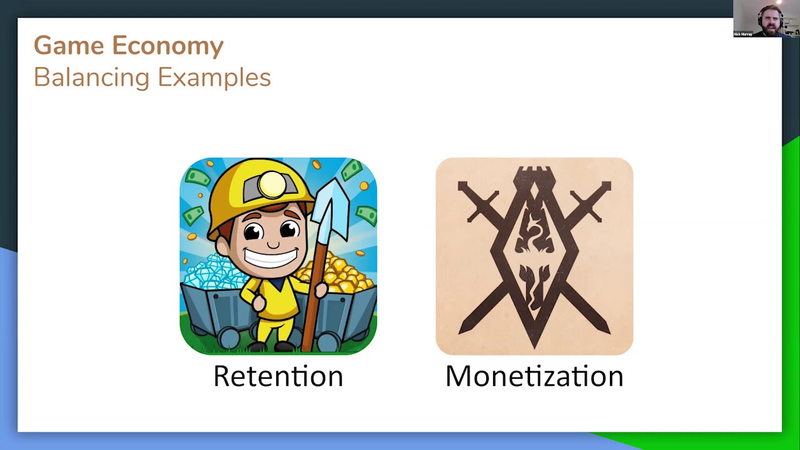
is just not going to be possible um so worth acknowledging now that's good i have a google error give me one second i have to reload what do i alright all good let's try again i'm going to reload this it's not the level of technical problem that i expected to have but we shall see if we can continue [Music] apologies for this um basically even without the help of slides um [Music] the quality of an economy is basically defined by its purpose um and the purpose is up to you to decide so that can be um like that can be based on either retention or monetization these are the two kind of primary vectors that people would look at
so you can have an economy which is focused more on just making sure that all your players are going to be happy and you know they stay in the game there's a bit of challenge but they never feel the need to spend or you can find a way to just try and get as much money out of your place as you can as quickly as possible like both options are viable um i wouldn't necessarily recommend kind of either extreme um to give you a couple of examples um idle minor tycoon is a game that is very much focused on retention they're extremely generous in terms of the starting currency in terms of um like ads to boost your currencies lots of giveaways prizes and very occasional difficulty spikes um elder scrolls blades uh and a caveat here this was the early access version i played um was very very grindy and monetization focused it really tried to push players to
convert because the economy was so punishing because you received so few resources at different points and in order to really progress you'd have to grind through tens of dungeons or you'd have to spend so once you've defined the purpose that you want and again ideally on this point i would go for somewhere in between the two probably more in favor of retention because at least a retained player has a chance of monetizing later that doesn't help if you're or if your players already all left so with that in mind i want to talk about currencies um and basically there's a there's a very clear reason for having two currencies at minimum um one is that where you have a soft currency and a hard currency primarily so that your soft currency if it has a problem with inflation which it probably will at some point in the game lifetime particularly if it's a
long-running game particularly if there's lots of live operations then your gem currency is going to be less affected um so basically you try and keep your hard currency as a rarer resource so that it maintains its value often you would also hope that the currencies fulfill slightly different purposes so your soft currency used for everyday basics like the structures of play and then the hard currency gives you like a bypass of grind and time exclusive items some gacha if you want um yeah basically i think it's just it's important to have at least two because games that have one currency tend to find themselves uh very very inflated very quickly often there are certain game systems that will be planned in and have the best intention but that might end up being exploited for ridiculous gain so i talked through for a while recently to a studio
working on a kind of classic board game um and they had a single currency and their most committed players had like millions of this currency um and it was it was far too unbalanced for anyone new because they couldn't compete against these older players so they just churned out um so currencies are a really big deal here um an additional point on currencies if you have unique system currencies they're much easier to understand so if you have a sword coin for buying a sword or a shield coin for buying a shield then the player can't really go wrong if you're a new player to to a game particularly a new type of game uh or a new genre that you maybe haven't tried before you can quickly lose your way if you don't know what to spend a single currency on so if you have a single currency that can buy a sword or that can buy a shield the game might have an expectation that
you're actually going to buy the sword because that will help you get further in this quest but in reality new players can often find themselves at a disadvantage because they didn't know what to spend on and they spent on the wrong thing so in the in some ways it's actually just much easier if you can have unique currencies for different things so that players have a clear understanding of where they should be spending their money um an important thing to know when you are dealing with your currencies is like convert them all into real money like it's a really really simple step um but it's one that a surprising amount of people don't bother doing but at least if you do this your live ops can be far more efficient you can be far more structured in terms of uh like how you define value of the different currencies your value should be based on a bunch of different things it should be based on the game impact the frequency and game the time invested as well as like the intuition of value
sometimes so for example you have a set of armor that doesn't necessarily function better but it looks amazing compared to the other sets so that would have a higher intuitive value than the rest um yeah so the last thing i want to mention on this section is about hard currency gain hierarchy which is a bit of a mouthful but basically all i'm saying here is um in a lot of games it can be unclear as to where the best place to to get your currency is so hard currency should always be something that is desired it's coveted people want to get their hands on as much as they can um to buy a new item or to skip a bunch of timers whatever it happens to be um but sometimes there are games that don't make it clear so if we think about some games that maybe allow you to skip
timers with ads that's fine but then if i can skip all my timers with ads then why would i ever bother spending on gems to do the same function um so i think it's very clear in what should be very clear to your players like what is the hierarchy of obtaining hard currency where can i get the most favorable deals where can i where can i get the like the most hard currency as much as i will ever want and i think the focus obviously on number one would be spending so spending on in-app purchases number two should be achievements because that's something that drives long-term retention number three should be login rewards which is short and midterm retention focused and lastly i would do rewarded video because that just focuses on short term retention it's easy for players to churn out after using rewarded video it's a lot harder if they've already spent money and feel far more invested in the game all right so let's move on to talking
briefly about balancing a live economy and to start off i would ask you to think about the currencies and the resources that players use in your game so typically those would be things like soft currency hard currency maybe you've got some other crafting materials in there like those old counters currencies as well uh if you have wood and stone etc they're currencies i think the main currency that i would like to start off by talking about though is time and you get a virtual high five if that was the one you went for time is a really important factor for your players it's extremely valuable and it's not something that they can buy so how do you balance by time in practical terms this is an example that i would like to share so basically this comes from a game i worked on um last year and it was i guess similar
to heyday in some ways um but with a different theme and we looked at i was trying to diagnose what what might be the trouble uh particularly in later levels with regards to the game and i looked at the let's say non-cumulative time per level so that's just the the individual amount of time spent on any one level um so for example here at level 28 you can see was like 500 minutes um and yes it's broken down into minutes but very quickly you can see that there are issues in this graph in the in the latter part so around level 26 20 uh and then uh kind of going up to level 31 33 etc there are these huge peaks and drops um basically what this shows to me is that players are struggling for resources generally at this point like you usually have two options either comes down to resources or difficulty but given that this is a farming game
there is no real difficulty to speak of so it's a resource shortage problem um where it drops players clearly have more resources uh because it shows that they're getting through that level quicker than the previous one when it peaks it's a sign that actually okay the players really took a long time on this level and it was a real struggle so if we look particularly around level 35-ish that's crazy that the players have to spend such a huge amount of time uh in order to actually get past that level um so what did we do i mean basically the idea was we redesigned the time curve we looked at the resources that players had on hand uh in order to get past it so what you would look at is a bit more about like the soft currency balance of players at that point in game i'll move on to more of that in a moment um so the next part i'd like to look at
is how you would design an ideal time curve um credit here is a guy called tiago tex pine who does a very very good breakdown of this um and basically if we think about um the game time per player level this is actually the graph of approximately how it should look so this is how the previous graph should have looked um basically what it means is you have high speed fulfillment in the beginning the tutorial learning phase goes very quickly you reward players as they level up and then there's a ramp up in time during the mid game so you know more regularly you're having to spend a little bit longer to reach that next level and then at the end the time should become constant the idea here is that if you have players who are sitting around or who are sticking around in your game for a long enough time you don't want to keep moving the goal post you don't want to keep punishing them for staying longer by saying oh well that last level only took you one hour to do this next level is going to take you
three it feels unfair so at some point your time curve should become consistent and this is how it looks um as like as a total game time uh graph and again like time in the late game should become constant not exponential all right so briefly on to balancing sinks and sources um so this was an example for a team i worked with in india who are working on a cooking management game and all i wanted to do with this was illustrate okay what are your sources of gold what are your sources of gems xp and boosters and what are your sinks for all these things just to try and make sure that we did actually have enough sources and sinks in place for each currency this is a very good way of just getting a kind of brief overview but realistically you need to go deeper this is good for indication but it doesn't actually tell you the scale of the problem it doesn't tell you if someone's getting a million gold when they should be
getting 10. um so in order to do that you look at this i wonder if i can get rid of that um you look at this which is the modal cumulative soft currency gain and cumulative soft currency syncs so firstly i use modal because i like to look at where most of the player base are you can use medians as well averages are less accurate in this situation but basically all you're doing is comparing here on a graph like soft currency gain and soft currency syncs by level um so at the beginning here you can see like the blue line represents soft currency gain so actually i have more soft currency than i need to sync that's great and then at some point these lines cross over and soft currency syncs stay above the blue line meaning that actually i need a bit more soft currency than i have on hand which again is perfectly viable strategy because you want players to struggle a bit and to have objectives to aim for
um where you have issues is maybe here around level eight where actually the distance just becomes too big there is a clear feeling that okay maybe if i'm at this level my next soft currency sync objective let's say that's i don't know in this case a cooking game uh building a new type of uh restaurant somewhere or something like that um maybe that feels too far away from me as a player and that can mean that i would churn um so then balancing with goals focus is another way of doing this which is really effective so you look at again modal balances on level up and you basically place objectives in front of them so if i have 250 coins um then actually give me an objective for 300 coins it gives me something that i'm almost there and you can also balance with live operations as well so if you give away too much currency use a leaderboard tournament to sync a lot of
it if you don't give away enough currency then make sure that everybody gets some in some kind of uh milestone based tournament there are lots of different ways through live operations that you can rebalance this um when you're rebalancing with live ops sorry i'm speeding up a little bit because i'm conscious of time when you're rebalancing with live ops then keep an eye on your estimated value it's a very basic formula but basically the idea is that you should understand the real value of a chest or an item so for example in this case this chest has 750 normal value 350 promotional it's a 214 ev then you would put this on a graph where you see your revenue and correlate that to your effective value to make sure that all your promotions are actually working as they should be so final steps tracking and data so play test as much as you can of this stuff because if you play test your
economy you'll often get a very quick feeling of if it feels good if it feels broken or not um there's really no substitute for it and playing the game from the beginning is important a b testing uh is another great way of doing this particularly soft launch phase preferably not post launch so as a brief summary game economy should fulfill the purpose you define more current scenes mean more to keep track of but it simplifies player choice align all currencies to real money and help your players understand the hierarchy of currency attention and then balancing by time is a good first step then compare sinks and sources based on cumulative soft currency think about how you can work goals into the mix and boost retention and then correct balances with live operations with a consistent estimated value and then if you make changes measure the implications quantitatively qualitatively through tracking play testing and a b testing and last point uh i will be doing a much longer
you can tell i had to rush a lot at the end a much longer master class actually hosted by pocketgamer the provisional date right now is 24 20 to 21st of july so keep an eye out for that on the gamer website thank you very much hey that is fantastic nick i really appreciate you doing that for us um i'm sure there's a huge virtual round of applause happening right now so just bask in that for a minute um we did get some good questions um for example uh what happens when you've got um ad revenue uh games that games that monetize primarily through ad revenue do any of the ratios or do any of the rules around soft currency and hard currency change and that in that case yeah basically if you are if you're trying to like gauge the value of your soft currency then you need to keep in mind all of the different sources that players can get it and add like actually using ads to double soft currency or triple in some
cases for different things would definitely affect that overall value so you need to take into account precisely how depends on the type of game you're running and if your economy is actually balanced with those ads in mind because if you had the initial intention to always have ads that would increase the the soft currency amount then that's fine like you you should have an economy capable of dealing with it but if you added them at the last minute then you need to double check on actually how much currency your players are getting from those ads and maybe start moving some other parts of the game around so that you're not making it too easy for them so one example i'd like you to consider is where time is is money i mean yes my time is worth something um but how do we peg how much for example if i can get a widget for 99 cents um should i have to watch 30 seconds 45 seconds 60 seconds of rewarded ad videos
before i can get that widget i mean the revenue that i get from the rewarded ad video is probably never going to get to 99 cents but when is it a wash for the customer well yeah you'd have to watch probably a few hundred videos to reach your 99 cents no and unfortunately the value of the video tends to decrease the more you watch them without actually interacting with them um so yeah it takes a very long time to reach that point um i would say when it comes to ad revenue um your best bet is keeping it on like a lower scale and rather than give a widget worth 99 cents then at that point you are actually better giving something that has more flexible value like a soft currency so at least with a soft currency you don't have to give 100 you can give 10 or 50 or some other increment of it but it's best generally not to give a kind of a single item particularly one that has a value uh
with regards to hard currency through ad monetization good call um how do you track the inventory of hard currency and soft currency that customers individually are carrying in your game and then cumulatively is there an off-the-shelf tool that you use for that or did you have to code that up yourself um so i mean personally i tend to work with whatever my clients are working in so quite often they would be using different tools like firebase etc but um by far the best tool for for doing this stuff is unfortunately doing sql on on your own database um just because it gets you like all of the information that you need instead of just some information that people think you might want so you'll write all the visualizations yourself then fair enough yeah so when you notice that you've got some unusually high uh balance and soft currency across your
user group or maybe an unusually low balance do you consider sales as a way to normalize that sorry software currency or sales on hard currency i see um so i mean if you have an unusually high balance then i would say basically i would focus primarily on competitive events that can drive people to spend and then like having prizes tied to a leaderboard so that you know obviously like if you rank first in the leaderboard then you get something worth more than your investment but if you rank in other positions like 120th you'll probably end up having invested more than you would get out of it um you'd still get a prize but just not something as good um with regards to actually increasing the amount of soft currency yeah i would say maybe do some more generous events um around live operations so it's it's difficult to say with a without a kind of clear target in mind but if you were running like a mid-core game
then do some more like guild-focused events where everybody gets like rewarded based on the number of fights they do or um if you're like focused on a more casual game then sure do a currency sale or two the challenge with currency sales is that it can be quite difficult to claw your way back from them you can build a certain player expectation that you're going to do it again yeah that does sound risky um so for the case of an excess inventory of currency giving the opportunity more ways to absorb that currency um perhaps even putting the items that that currency can buy on sale so if you could buy armor for 100 soft currency coins if you had a sale then maybe you could purchase the armor for 80 soft currency coins um might encourage people to use up some of their soft coin inventory also that's absolutely viable um the obviously you need to square that against how you're valuing your other armor sets for example because suddenly
if this armor is so much cheaper how does that reflect on the value of your other armors that you're selling um there are always knock-on effects to consider i will say one way of uh getting rid of um on like hard currency actually um from people's accounts you can you can try out some new things for example um at a company i worked out a while ago we tried uh jackpot chest where we called it actually a lottery chest so it was a gacha which basically would cost you one gem so the lowest amount of hard currency you could spend um and you would either receive i think 10 soft currency or 10 000 hard currency and obviously we you know listed it as a lottery said the odds are extremely low but it was extremely effective as well actually getting players just using up kind of odds and ends of hard currency um which is a really really useful way of doing it how do you end up with odds and ends of hard currency
not enough to spend for something big but you still got some yeah basically a lot of it was based around watching ads in fact so i think you could get maybe five hard currency from watching ads [Music] per day something like that and a lot of players just had a few here and there or they bought an item and then still had a little bit left over but not enough to do anything useful with so it's a way of keeping players engaged in some way are there any good rules of thumb for starting values let's say i'm just launching a game the economy is not going to start itself i'm going to have to see people with soft currency with hard currency with places to spend it are there any good rules of thumb for ratios on on sources versus um you know sinks um not that i've come across to be honest um it's uh you'll make a million in your book sure um it's yeah it's another thing that's just very game dependent so
um it a lot of it will be down to the values that you're ascribing to the different like buyable elements of your game so if you have lots of let's say you're like an mmo and you have hundreds of items to sell that means you can be a bit more generous with your hard currency up front you get players more invested early on um maybe you help them you know with a tutorial to even use that hard currency to buy something cool for themselves but that's fine because you have the later economy depth to support it the biggest challenge is making sure that you don't give away too much which has actually been i think most games that i've seen so far people are really worried about their players leaving so they're actually trying to make sure that players receive a lot of stuff up front and obviously the flip side of that is then players not feeling any need to spend um they need to feel that pinch that there's a you know there could be further value unlocked if i do spend we should want people to get into the habit of spending your soft and hard
currency so that when they do use it up they they they've already become accustomed to it isn't that the strategy for providing so much at the start yeah it definitely is but there is a balance right because again if you give if you make it too easy then actually the game lacks challenge so if you can breeze through everything you buy every item you want along the way then actually it doesn't make a compelling game the most compelling games are the ones where you have to struggle a bit and then you overcome and then you feel powerful and then you struggle a bit again and then you overcome you feel powerful it's actually the puzzle game it's how puzzle games are designed so well actually puzzle games is a really good is a really good segue so let's talk about casual word games do you really need to have two currencies for like a casual word game um depends on your live operations uh like some casual word games would for example potentially inflate currency by running regular tournaments um and paying out a lot of reward money on that basis
but no in general you don't need that many currencies for a casual word game because you're also not really going to have that much to spend on usually it's something like a hint and at that point you don't really need two currencies to buy a hint nick i am really glad you're giving a master class because i have questions i could ask you literally for the rest of the day today um hey i wish i could i mean i might actually try to sneak into that master class virtually leverage my power as a moderator here um thank you so much for your time this afternoon i really do appreciate it uh everyone make sure you check out nick's master class and uh see if you can't get away to get in there and attend that this has been fantastic information thank you very much thank you so much have a good day
Summary
Sustainable game economy design hinges on the strategic balance between player retention and monetization, with long-term engagement serving as the primary foundation for financial success. A dual-currency framework remains the industry standard, utilizing soft currency to facilitate gameplay progression while reserving hard currency for time-saving mechanics or exclusive cosmetic acquisitions. By converting all in-game values into real-money equivalents, developers can effectively manage inflation and ensure that hard currency acquisition remains anchored in in-app purchases rather than excessive free rewards. This approach treats player time as a finite, non-purchasable asset, necessitating a design philosophy that respects user investment while creating clear utility for spending.
Effective management of these systems requires a precise calibration of resource sources and sinks. Analysts must monitor cumulative currency gains against specific spending objectives, utilizing modal data to identify bottlenecks that impede progression. Time-to-level curves should be structured to ramp up during the mid-game before stabilizing, preventing long-term players from feeling penalized. When imbalances occur, live operations such as targeted sales or competitive tournaments serve as essential tools to normalize the economy. These adjustments must be validated through rigorous A/B testing and quantitative tracking to ensure that currency values remain consistent across the entire player lifecycle.
Ultimately, the complexity of an economy should be dictated by the game’s specific content volume and challenge curve. While developers must create a deliberate resource pinch to encourage habit formation and spending, the depth of the system must remain proportional to the game type. Casual titles with limited utility often function best with simplified models, whereas more complex games require sophisticated, multi-layered economies. By tailoring the intensity of the resource cycle to the specific needs of the audience, developers can maintain a healthy, sustainable ecosystem that supports both player satisfaction and long-term revenue growth.



















Comments