Mobile reports and market data
Documents
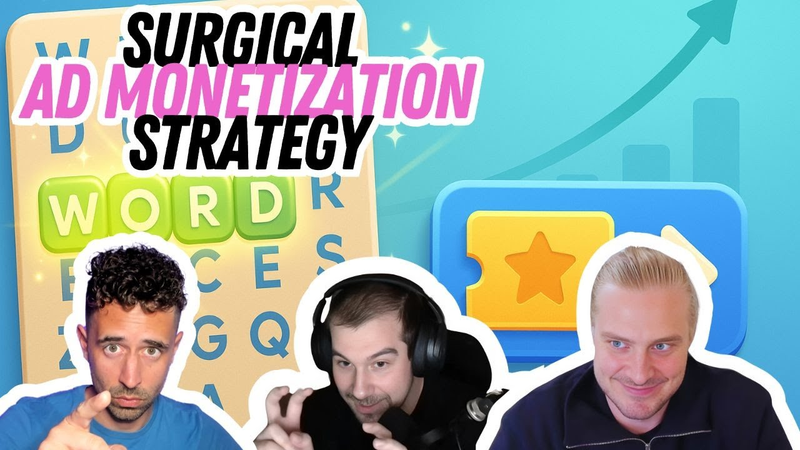
🧩 Word Search Explorer Review: $168K/Day From Ads Alone. No IAPs Needed
Word Search Explorer has established itself as a formidable competitor in the mature casual word game market, currently generating approximately $168,000 in daily ad revenue.
- Word Search Explorer generates approximately $168,000 per day in ad revenue, putting it on track for an annual run rate of roughly $56 million.
- The game maintains a massive user base of 2.9 million daily active users, positioning it as a direct competitor to the long-standing market leader Words of Wonders.
- Monetization is intentionally delayed, with no in-app purchase (IAP) pressure and no significant ad walls until after level 24.

GOAT: Jani Torppa aka Fashion FRIDAY
The mobile gaming industry is currently navigating a critical transition, moving away from a period of stagnation toward a more dynamic and experimental future.
- The mobile gaming industry is shifting toward a decentralized model, with a positive growth outlook projected for 2025 driven by the integration of data-informed creativity.
- The Turkish market is emerging as a high-potential ecosystem for mobile gaming due to favorable government incentives, lower operational costs, and a high volume of agile startups.
- Finland’s gaming sector is currently undergoing a structural renewal, moving away from rigid legacy operational models to regain its competitive edge in innovation.

Squad Busters 2.0 and Supercell's YOLO Game Launch Strategy
Supercell’s Squad Busters 2.0 represents a strategic pivot from a casual, broad-market mobile game to a midcore-focused experience.
- Supercell has abandoned its traditional 18-month iterative testing cycle in favor of an aggressive 'YOLO' launch strategy, prioritizing rapid market entry over the rigorous internal feedback gauntlets that previously defined its success.
- Squad Busters 2.0 is underperforming financially, with monetization metrics currently falling below one dollar per download.
- The game suffers from a lack of cohesive identity, remaining caught between the strategic depth of auto-battlers and the real-time action of brawlers, which contributes to persistent issues with gameplay chaos and limited depth.

TWIG #331 Supercell’s Second Shot, Triple Dot’s Power Move, Microsoft's Strategic Shift
The mobile gaming industry is currently undergoing a significant structural transformation characterized by the concentration of capital and engagement within large-scale franchises.
- Microsoft’s gaming division is potentially deprioritizing hardware and subscription services in favor of AI, with the Activision acquisition increasingly viewed as a short-term financial misstep that may lead to a transition toward third-party publishing or asset divestiture.
- The mobile gaming market is experiencing a 'hollowed-out middle,' where mid-tier players struggle to compete against the concentration of capital and engagement within large-scale franchises.
- Triple Dot acquired AppLovin’s mobile portfolio for $800 million to achieve immediate scale, though the move highlights the operational difficulty of managing diverse, geographically dispersed game assets.
⚠️ The Industry’s Dirty Little Secrets: Confessions from the UA Underground
The mobile gaming industry is currently characterized by a systemic reliance on unsustainable user acquisition strategies that prioritize short-term valuation over long-term profitability.
- Chinese game studios are outperforming Western competitors by utilizing massive creative teams, with some companies employing over 300 people specifically to iterate on ad assets and lower acquisition costs.
- Mobile user acquisition (UA) has become increasingly simplified since 2020, shifting the primary focus for many managers toward creative testing and bidding rather than deep algorithmic understanding.
- Internal UA reporting is frequently subject to 'window dressing,' where managers manipulate data or highlight specific metrics to secure bonuses and satisfy management, often misleading founders who lack a deep understanding of UA mechanics.
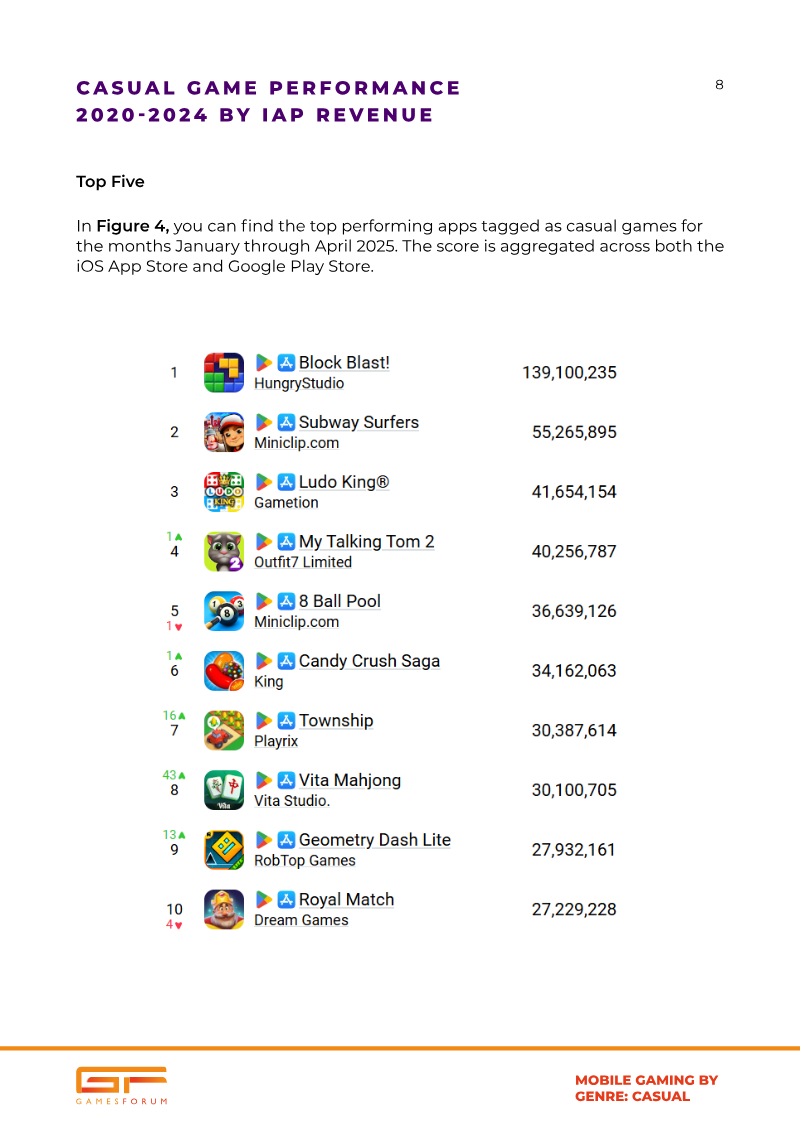

Mobile Gaming: Casual
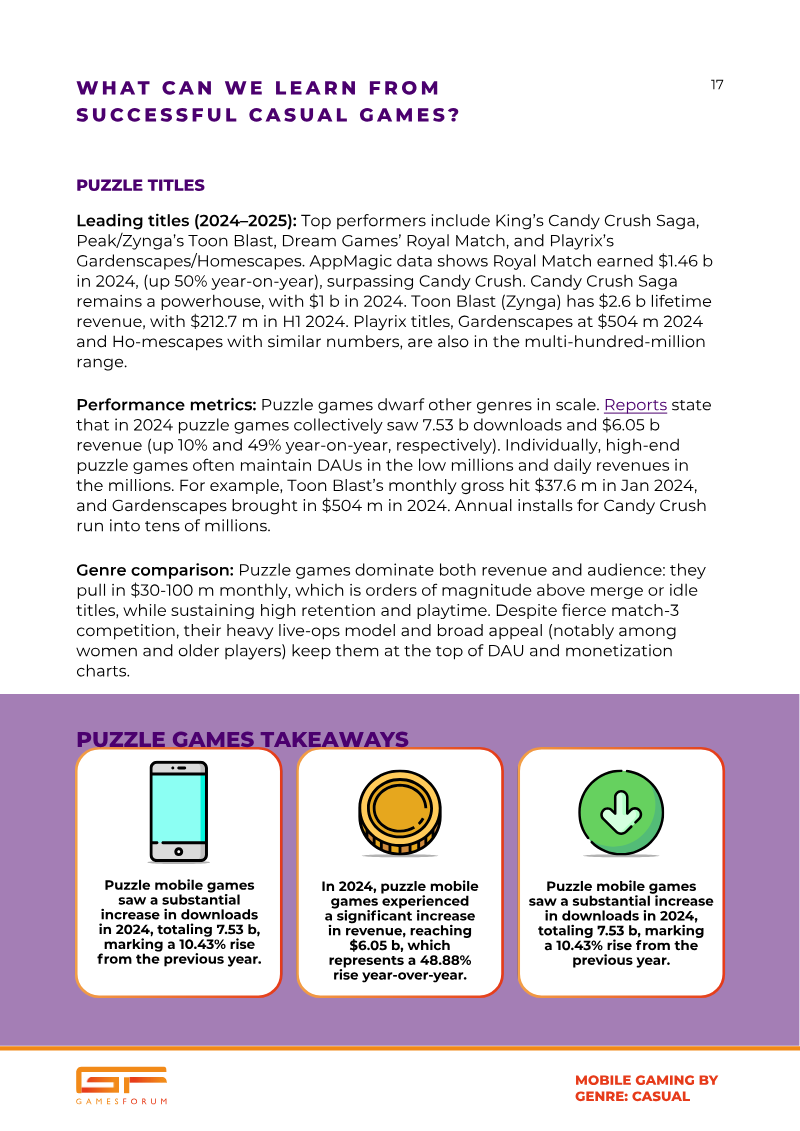
The casual mobile gaming market is undergoing a significant transformation, characterized by a post-pandemic decline in downloads from 2020 to 2023, followed by a projected rebound in 2024 and 2025, expected to exceed 16.4 billion downloads.
- Casual mobile gaming is shifting toward higher revenue per user, with IAP revenue projected to grow from $16.8 billion to $22.9 billion by the end of 2025 despite a fluctuating download volume.
- Market leaders demonstrate divergent monetization strategies: Royal Match ($540M) and Monopoly Go! ($431M) rely exclusively on IAPs, while Candy Crush Saga ($421M) successfully integrates advertising.
- Playrix’s portfolio approach, utilizing a suite of titles like Township and Gardenscapes, generated a combined $554 million, proving the effectiveness of hybrid monetization and established franchise management.

📊 Is 24-Month Payback the New Normal? Real ROAS Benchmarks Revealed!
The mobile gaming industry is currently navigating a period of significant financial strain characterized by a widening gap between user acquisition costs and monetization growth.
- Payback windows for mobile games are extending significantly, with many titles now requiring 12 to 24 months to achieve full return on ad spend (ROAS).
- M1 ROAS serves as the primary predictor for long-term success, where a 40% M1 ROAS typically correlates to a 6-month payback, while under 25% indicates a payback period exceeding 12 months.
- Hybrid monetization is becoming the industry standard, with traditionally IAP-heavy genres like 4X and strategy games increasingly incorporating rewarded ads, and ad-heavy games adopting IAP-focused VIP tiers.

The Evolving Future of User Acquisition with Mistplay's CCO Aaron Thandi
The mobile gaming loyalty sector is undergoing a strategic shift toward long-term engagement, moving away from traditional offer-wall mechanics in favor of AI-driven matchmaking.
- Mobile gaming acquisition is shifting from short-term retention metrics like D1-D7 to long-term lifetime value (LTV) and high-value user cultivation.
- Platforms are replacing traditional offer-wall mechanics with AI-driven matchmaking to provide personalized game recommendations that foster sustainable engagement.
- Strategic success is increasingly measured by time spent in-game rather than session frequency, as the former serves as a more reliable predictor of future player spending.

How Indie Mobile Devs Can Get Noticed: PR Approach That Work
Indie mobile studios can achieve significant market visibility by shifting away from generic marketing tactics toward a strategy rooted in authentic narrative building and consistent brand identity.
- Indie studios should prioritize human-centric communication over AI-generated content to build the trust and credibility necessary to stand out in a saturated market.
- Sharing verifiable revenue figures and user metrics provides the objective data required to attract investment and secure attention from media outlets.
- Studios should diversify media outreach by targeting tech, business, and niche vertical publications rather than relying solely on traditional gaming press.

How I Went From a 3D Artist to GM of a Billion-Dollar Game - Justin MacFarlane
Professional advancement in the gaming industry is best achieved by prioritizing cross-functional mastery and the proactive identification of organizational needs over rigid adherence to specific job titles.
- Operational excellence in live service games requires integrating data-informed decision-making with rapid, iterative development cycles to respond to real-time player engagement metrics.
- Physical proximity of product, analytics, and development teams is a critical strategy for maintaining the high-speed collaboration necessary to manage complex, billion-dollar live service ecosystems.
- Career advancement in the gaming industry is best achieved by prioritizing cross-functional mastery and internal mobility over rigid adherence to specific job titles.

Epic Defeats the Big Bad Apple - Here's What it Means
The recent legal ruling in the Epic Games versus Apple case marks a significant shift in the mobile gaming landscape, as a federal judge determined that Apple violated a 2021 injunction by imposing a 27% commission on external purchases and restricting developers from directing users to alternative payment methods.
- A federal judge ruled that Apple willfully violated a 2021 injunction by imposing a 27% commission on external purchases and restricting developer communication regarding alternative payment methods.
- The court has prohibited Apple from collecting fees on external transactions and from limiting how developers direct users to third-party payment options, despite Apple's ongoing appeal.
- Epic Games is leveraging the ruling to relaunch Fortnite on the US iOS App Store, marking a significant shift in mobile distribution access.

Week in Mobile Games E52: Tim Sweeney's epic App Store win & Tripledot's $800m AppLovin deal
The mobile gaming landscape is undergoing a structural transformation driven by legal challenges to platform monopolies and significant consolidation among major publishers.
- A US court ruling now mandates that Apple must allow developers to link directly to external payment systems on the App Store, a move expected to significantly impact mobile ecosystem revenue tracking and user acquisition strategies.
- Tripledot has acquired AppLovin’s games business, adding 10 studios—including Lion Studios, Machine Zone, and PeopleFun—to its portfolio, creating a combined entity with 2,500 employees and an anticipated $2 billion in annual gross revenue.
- The Tripledot acquisition doubles the company's daily active users to 25 million and expands its footprint to 23 cities, with the firm maintaining a 20% stake in the new venture alongside AppLovin.