Updated Jun 1, 2026 by Gamesforum
Report
Published by Gamesforum
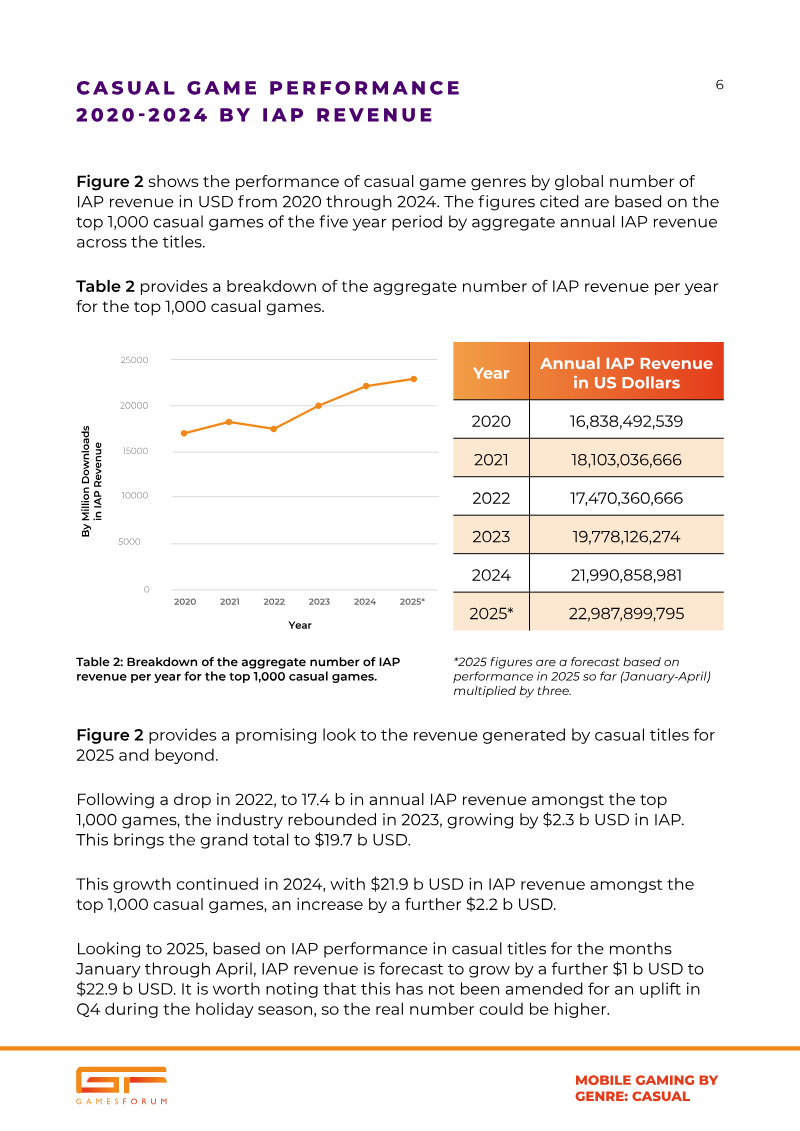
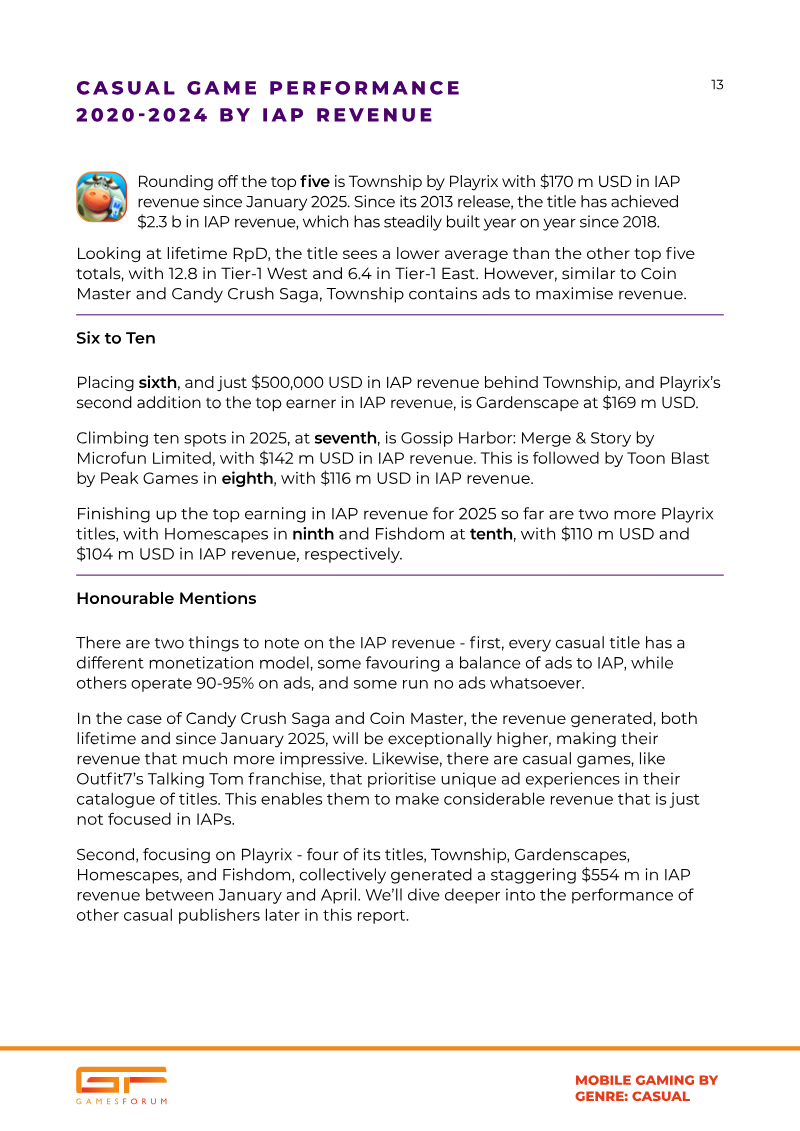
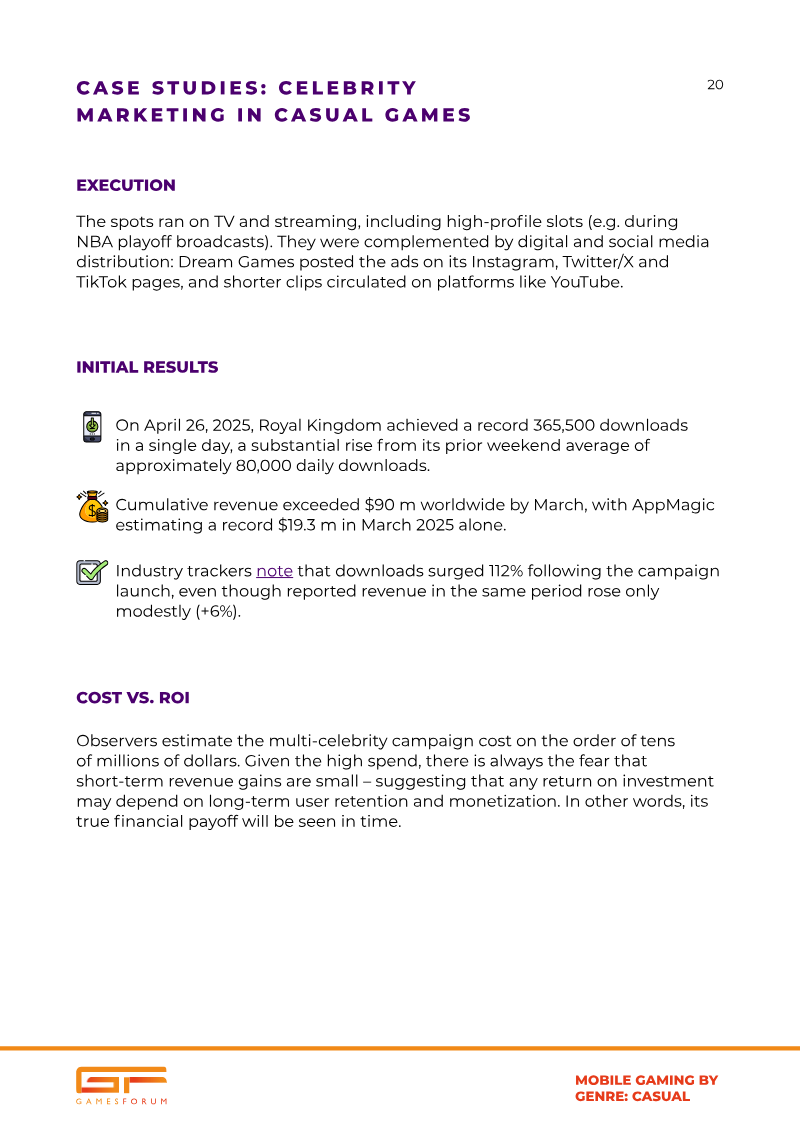
The analysis demonstrates that casual mobile gaming has entered a phase of mature monetization and strategic diversification. Download volumes peaked at 17.3 billion in 2020, dipped to 15.5 billion by 2024, and are projected to rebound to 16.4 billion in 2025, while in‑app purchase (IAP) revenue has risen from $16.8 billion to an expected $22.9 billion by year‑end 2025, indicating a higher revenue per user. Leading titles now blend advertising, IAPs, and brand partnerships to create multiple income streams, with celebrity‑driven campaigns further amplifying user acquisition and lifetime value. In early 2025, *Royal Match* topped the earnings list with $540 million in IAP revenue, followed by *Monopoly Go!* at $431 million and *Candy Crush Saga* at $421 million. These leaders illustrate divergent monetization models: *Royal Match* and *Monopoly Go!* rely exclusively on IAPs, whereas *Candy Crush Saga* incorporates ads. Playrix’s suite of games—*Township*, *Gardenscapes*, *Homescapes*, and *Fishdom*—collectively generated $554 million, underscoring the potency of hybrid strategies and the enduring value of established franchises. Celebrity endorsements have proven effective at generating short‑term spikes. Royal Kingdom’s A‑list television campaign produced a 112 % download surge, while Supercell’s WWE‑inspired “Clashamania” yielded $2.15 million in single‑day IAP revenue for *Clash of Clans*. However, long‑term return on investment hinges on sustained engagement and lifetime value; Scopely’s “Friendship Pays” campaign achieved payback within 120 days, whereas Royal Kingdom’s lift suggests a longer monetization horizon. These findings highlight that high‑profile campaigns must be coupled with robust retention loops and rigorous LTV measurement to justify multi‑million dollar spend. Overall, the casual mobile gaming sector is characterized by a shift toward higher monetization per download, diversified revenue models that combine ads and IAPs, and a strategic use of celebrity partnerships to accelerate growth. Success increasingly depends on balancing short‑term acquisition tactics with long‑term retention and monetization strategies across global markets, primarily in North America, Europe, and Asia-Pacific.
GAME SFO R UM INTELLIGENCE INTELLIGENCE MOBILE GAMING BY GENRE: CASUAL A Marketing and Monetization Report
TABLE OF CONTENTS: Introduction 3 Casual Game Performance 2020-2024 by Downloads 4 Casual Game Performance 2020-2024 by IAP Revenue 6 Top 10 Casual Apps of 2025 by IAP Revenue 11 A Guide to Casual Monetization with Ezgi Dogan 14 What Can We Learn From Successful Casual Games? 15 Case Studies: Celebrity Marketing in Casual Games 19 To Summarise… 25 All data is powered by All data is powered by APPMAGIC
INTRODUCTION INTRODUCTION Casual mobile games are no longer just a gateway into mobile Casual mobile games are no longer just a gateway into mobile gaming - they’re a proving ground for monetization, scale, and cross-media ambition. Once defined by low-friction gameplay and broad appeal, the genre has matured into a high-stakes segment where billion-dollar IPs, celebrity campaigns, and hybrid monetization models are now the norm. Our latest Gamesforum report charts that evolution across five Our latest Gamesforum report charts that evolution across five years of data, from post-pandemic drops to a resurgence in 2024 to 2025. We explore how the best in the business are driving engagement, optimising revenue, and building staying power. What’s Inside Drawing from AppMagic data, subgenre trends, and direct commentary from industry experts, this report provides a grounded look at the state of casual games, and what comes next: • Year-by-year trends in downloads from 2020-2025 • The titles and publishers dominating 2025 so far - and how they’re doing it • Merge, puzzle, and idle genres unpacked: mechanics, revenue, and retention • How to best monetize casual games • Inside the rise of celebrity-led campaigns and what they mean for UA and LTV for UA and LTV
C A SUAL GAME PERFORMANC E 4 2 0 20-2024 BY DOWNLOADS Figure 1 looks at the performance of casual games by global number of downloads per year for 2020 through 2024. The figures are based on the aggregate number of downloads of the top 1,000 casual games of each year. Included is a forecast for 2025 based on the performance in the first four months (January-April) multiplied by three. Table 1 provides a breakdown of the aggregate number of downloads per year for the top 1,000 casual games. 20000 15000 By Million Downloads 10000 5000 2020 2021 2022 2023 2024 2025* Year Table 1: Breakdown of the aggregate number of downloads per year for the top 1,000 casual games. Year Number of Downloads 2020 17,350,344,762 2021 16,669,432,699 2022 15,731,720,266 2023 15,321,425,650 2024 15,573,615,101 2025* 16,426,652,760 *2025 figures are a forecast based on performance in 2025 so far (January-April) multiplied by three.
CASUALGAMEPERFORMANCE 5 2020-2024 BY DOWNLOADS As can be seen in Figure 1, the number of downloads for the casual genre, for the five-year period from 2020-2024, started at a peak of 17.3 b aggregate downloads across the top 1,000 games. This then fell by 680 m in 2021, and a further 930 m in 2022, to 15.7 b. This downward trajectory slowed in 2023, with a total of 15.3 b downloads, before climbing for the first time in five years in 2024 - up 250 m downloads to a total of 15.5 b. If the trend continues, with the improved download numbers in 2025 so far, then the number of casual downloads across the top 1,000 casual games should hit over 16.4 b this year. This would return to a pre-2022 level. The scope of this downward trajectory was also seen in our ~~Midcore Report ~~ released in early April 2025, and speaks to wider accepted trends of global downturn in mobile game downloads in the post-pandemic 2021/22 era, with a knock on effect in 2023. While UA scalability still hinges on the balance between strong marketability and top-tier LTV, casual game marketers should work to strengthen both sides of the equation. On the marketability front, this means going beyond mainstream UA channels, investing in standout creatives, and building long lasting brand equity. On the LTV side, marketing can support product teams by bringing deeper user insights that inspire more engaging, diverse experiences—ultimately driving retention and sustained play. Luis de la Cámara, VP of Marketi
A channels, investing in standout creatives, and building long lasting brand equity. On the LTV side, marketing can support product teams by bringing deeper user insights that inspire more engaging, diverse experiences—ultimately driving retention and sustained play. Luis de la Cámara, VP of Marketing, Rovio Luis de la Cámara, VP of Marketing, Rovio
The mobile gaming industry is entering a period of strategic recalibration, projected to reach $126.1 billion in revenue by 2025. This growth is underpinned by a transition toward hybrid monetization models and the integration of AI-powered personalization to combat persistent retention challenges. While global install volume grew by 4% in 2024, the market exhibits a distinct geographic divide; North American and European markets face stagnation, whereas Latin America and the Middle East and North Africa regions demonstrate robust expansion. Success in this evolving landscape requires developers to move beyond traditional acquisition, favoring diversified channels such as Connected TV and localized, player-centric engagement strategies. Data from early 2025 indicates that user tracking remains a pivotal operational hurdle, with global App Tracking Transparency opt-in rates hovering at 37.9%. Although arcade games have seen notable improvements in opt-in performance, the United States remains relatively static at 32%, underscoring the necessity for refined messaging strategies to maintain visibility. Concurrently, the industry is grappling with a complex financial environment characterized by rising costs per install and declining average revenue metrics. These headwinds are forcing a shift in marketing tactics, as developers increasingly rely on a broader array of acquisition partners and data-informed creative experimentation to sustain growth. Ultimately, the path to profitability in 2025 lies in prioritizing long-term player value over short-term acquisition metrics. By leveraging AI-driven optimization and fostering community-building initiatives, developers can mitigate the impact of declining revenue per user. The industry is clearly moving toward a more sophisticated, data-reliant ecosystem where the ability to measure performance across fragmented channels—including mobile and Connected TV—is essential for maintaining a competitive advantage in a maturing global market.
The analysis highlights a rapid maturation of the hybrid‑casual segment in the mobile gaming market, showing that the top ten titles generated $87 million in net in‑app‑purchase (IAP) revenue in the first quarter of 2025—a 67 percent year‑over‑year increase from the same period in 2024. Puzzle games dominate the revenue mix, contributing 48 percent, while arcade titles account for 45 percent; together they represent more than 90 percent of total earnings. Within puzzles, block‑puzzle titles lead with 71 percent of puzzle revenue, followed by screw‑puzzle (20 percent) and sort‑puzzle (9 percent), the latter posting a 5.6‑times YoY growth. The report covers a global scope of 60 countries, focusing on the period from Q1 2023 through Q1 2025 and concentrating on the hybrid‑casual niche that blends hyper‑casual mechanics with deeper casual‑style monetisation and live‑ops. Methodologically, the study isolates hybrid‑casual games by filtering the hyper‑casual tag for top‑grossing apps, then examines revenue, download, and release data for each title. Key case studies include Color Block Jam, which achieved $25 million in Q1 2025 after a modest Q4 2024 start, All in Hole, whose eat‑and‑grow model drove a nine‑fold YoY revenue surge and now accounts for 84 percent of its sub‑genre’s earnings, Mob Control, which posted 27 percent revenue growth and introduced “skip tickets” to balance ad and IAP streams, and Screwdom, whose shift to 3D puzzle design generated $3.6 million and set a new benchmark for screw‑puzzle games. The findings suggest that successful hybrid‑casual titles combine a highly clickable core loop with layered progression, strategic live‑ops, and nuanced monetisation—often leveraging high‑budget user‑acquisition campaigns and viral social media exposure. This convergence of design and marketing is reshaping sub‑genres, lowering acquisition costs, and establishing hybrid‑casual as a dominant, profit‑rich trend in the mobile gaming ecosystem.
The global casual gaming market entered a period of recovery between April 2023 and April 2024, characterized by rebounding consumer spend despite a slowdown in total downloads. This shift is defined by a strategic migration from hyper-casual titles toward more complex hybrid-casual and 3D match models. User acquisition remains highly bifurcated by platform; iOS costs average $4.83 per install compared to just $0.65 on Android, though iOS continues to deliver a superior Day 7 return on ad spend. North America remains the most expensive and lucrative geographic region, while simulation games have emerged as the most cost-effective genre for acquisition. Casual games function as a critical ecosystem driver, generating 91% of their own installs and significantly influencing mid-core titles. Puzzle subgenres, particularly Match3 and Mahjong Solitaire, now command 37% of casual installs, while the 3D Match category has seen explosive growth, increasing its US iOS market share fivefold in a single year. To sustain this growth, market leaders are increasingly relying on sophisticated LiveOps and social mechanics. Successful strategies include collaborative partner events, social win streaks, and "digging" minigames, all of which leverage group competition to drive engagement and baseline revenue. Monetization strategies have evolved toward player choice and direct-to-consumer models. Progressive offers and "pick-one" bundles are now standard in 70% of top-performing US casual games, providing structured value through tiered rewards. Furthermore, developers are aggressively adopting engagement-linked offers and external web stores. By linking premium rewards to gameplay tasks and moving transactions to proprietary web platforms, developers are successfully bypassing traditional app store fees while fostering long-term player loyalty through exclusive digital storefronts and daily login incentives.
Chinese gaming applications continue to exert a dominant influence on the global stage, particularly within the strategy and role-playing game segments in mature markets such as the United States, Japan, and South Korea. While these regions offer substantial revenue potential, they are characterized by intense competition and elevated costs per install. To navigate these challenges, successful publishers are shifting toward hyper-localized strategies that tailor art styles to regional aesthetic preferences—favoring manga-inspired visuals in Japan and realistic or cartoon aesthetics in Western markets—while utilizing local influencers to establish brand credibility. Technological innovation serves as a primary driver for operational efficiency and user acquisition. The integration of generative AI has become essential for the rapid localization of ad creative, voice-overs, and marketing copy, ensuring both speed and brand compliance. High-performing titles currently leverage high-volume, innovative campaigns that incorporate minigames and AI-enhanced visuals to capture player attention. Beyond acquisition, long-term retention is increasingly supported by the implementation of social hangout spaces, home-building systems, and character trial models that balance accessibility with monetization. Monetization strategies have evolved to prioritize engagement through sophisticated, time-limited mechanics. Publishers are frequently employing box gachas, pull-milestone rewards, and gamified event structures such as diceboards and bingo to incentivize spending. Furthermore, the consistent deployment of diverse live events remains a critical requirement for maintaining player interest and competitive viability. By combining these aggressive monetization tactics with a commitment to continuous content updates, Chinese developers are effectively sustaining growth and deepening their footprint across the global gaming landscape throughout 2024.