Mobile reports and market data
Documents

Session: State Of Gaming - Josh Skinner, Sensor Tower
The mobile gaming industry experienced a notable shift in 2024, characterized by a return to revenue growth despite a contraction in global download volume.
- Mobile gaming revenue grew by 3.8% in 2024 despite a global decline in download volume, driven largely by a 17% drop in casual game installs.
- Live service models are the primary revenue engine for the industry, currently accounting for 84% of all mobile in-app purchase spending.
- Hybrid casual games are a major growth segment, recording a 37% revenue increase as publishers increasingly pivot toward this monetization model.

Take-Two’s Financials Are In — Is the House of Grand Theft Auto Wobbling?
Take-Two Interactive’s recent financial performance reveals a company in transition, balancing a massive legacy console business with a struggling mobile strategy.
- Take-Two Interactive has recorded a cumulative $6.21 billion impairment charge against its Zynga acquisition, consisting of a $3.7 billion write-down this year following a $2.5 billion charge last year.
- While mobile games now account for 52% of Take-Two’s $5.6 billion total net revenue, the company projects flat growth for the mobile segment in the upcoming fiscal year.
- Take-Two’s 33% increase in market capitalization since the Zynga acquisition is driven primarily by investor anticipation for Grand Theft Auto VI rather than operational success from the Zynga integration.

Fat Cats, Steaming Decks, all GaaS and no Subscriptions with Rhys Elliott of Alinea Analytics
The modern gaming industry is undergoing a significant correction as the limitations of massive, high-budget development cycles become increasingly apparent.
- The gaming industry is pivoting away from high-budget, five-year development cycles as the 'fat cat' executive model of securing massive funding based on reputation fails to produce sustainable returns.
- Subscription services like Xbox Game Pass have hit a growth plateau because gaming’s high-engagement, time-intensive nature is incompatible with the passive consumption habits seen in other media sectors.
- Studios are retreating from the 'live service' gold rush, as firms without specialized live-ops expertise cannot compete with established market leaders like Fortnite and Roblox.

2025’s Gaming Landscape: Africa
The African gaming market is currently undergoing a rapid transformation, evolving into a mobile-first ecosystem that serves approximately 350 to 400 million gamers.
- The African gaming market is projected to grow from its current $2 billion valuation to between $7 billion and $10 billion over the next decade, supported by a 12.4% year-over-year growth rate.
- The region currently serves 350 to 400 million gamers, characterized by a mobile-first ecosystem that mirrors the fragmented regulatory and linguistic complexities of Southeast Asia.
- Market entry requires optimizing content for lower-end hardware, as smartphone penetration across the continent remains at approximately 40%.

Scaling 100+ Mobile Games: PSV Game Studio Shows How They Use Tenjin
PSV Game Studio, a Cyprus-based mobile gaming firm established in 2014, manages a portfolio of over 250 titles and provides publishing, marketing, and monetization services for 20 external gaming studios.
- PSV Game Studio manages a portfolio of over 250 titles and provides publishing services for 20 external studios, utilizing Tenjin as its centralized data infrastructure to scale operations.
- The studio tracks day-zero return on ad spend (ROAS) as its primary benchmark to evaluate the success of user acquisition campaigns across more than 100 active applications.
- Analytical strategies include granular performance breakdowns by channel, campaign, and geographic region to identify high-performing segments for scaling and underperforming assets for adjustment.

Apple must allow Fortnite back on iOS — but what does that really mean?
The return of Fortnite to the iOS ecosystem marks a significant, albeit complex, shift in the long-standing legal and commercial conflict between Epic Games and Apple.
- The five-year legal battle between Epic Games and Apple, which cost over $100 million in legal fees, has resulted in a shift toward more open mobile ecosystems, though the immediate impact of Fortnite's return remains largely confined to the United States.
- Regulatory pressure from the European Digital Markets Act, alongside similar initiatives in the UK, Japan, and Korea, is driving a global trend toward decentralizing mobile platform control.
- Analysts project that Apple may eventually lower its mandatory commission fees from 30% to a range of 15% to 20% to mitigate developer attrition and stabilize its platform model.

🚨Lands Of Jail: Prison SIM meets 4X strategy. It's Frozen City + Whiteout + Toy Factory & scaling
Lands of Jail represents a significant evolution in mobile game design, successfully merging idle simulation mechanics with the high-stakes environment of 4X strategy.
- Lands of Jail generates approximately $200,000 in daily revenue by successfully merging idle simulation mechanics with 4X strategy gameplay.
- The game utilizes a hybrid-casual framework, transitioning players from casual resource management—such as operating a prison toy factory—into complex, map-based warfare.
- The development team at EWorld employs a user acquisition strategy that leverages AI-generated content and viral-style tropes to maintain low cost-per-install metrics.

Week in Mobile Games E54 - Fortnite’s Epic return and the challenges of launching a game in 2025
The mobile gaming landscape is currently defined by a volatile intersection of regulatory shifts and extreme market saturation.
- Pokémon Trading Card Game Pocket reached $1 billion in gross player spending in 204 days, outpacing Pokémon Go, which took 282 days to achieve the same milestone.
- Epic Games is currently blocked from releasing Fortnite on the US App Store, as the company refuses to exclude the US market from its update while Apple maintains restrictions on alternative payment links.
- Industry experts agree that launching a mobile game in 2025 is increasingly difficult due to heightened competition and the dominance of established titles that capture the majority of player time.

Full Steam Ahead: How Steam trends influence Mobile games?
The mobile gaming industry is increasingly leveraging Steam as a primary incubator for market validation, utilizing successful PC titles to identify engaging mechanics and creative loops for mobile adaptation.
- Mobile developers are increasingly adapting Steam hits into mobile titles, with some 'copy-paste' clones generating significant short-term revenue, such as one title that earned $1.3 million in ad revenue within 90 days.
- Successful mobile adaptations often involve 'remixing' Steam mechanics into established mobile genres, such as integrating survival or idle mechanics into 4X strategy frameworks, rather than performing direct ports.
- Genre-specific mechanics like digging simulators, Plinko-style roguelites, and idle RPGs show high potential for mobile conversion due to their simple, repeatable loops that align with mobile play patterns.

Sustainability at Embracer Group: FY 2024/25 ESG Fact Sheet
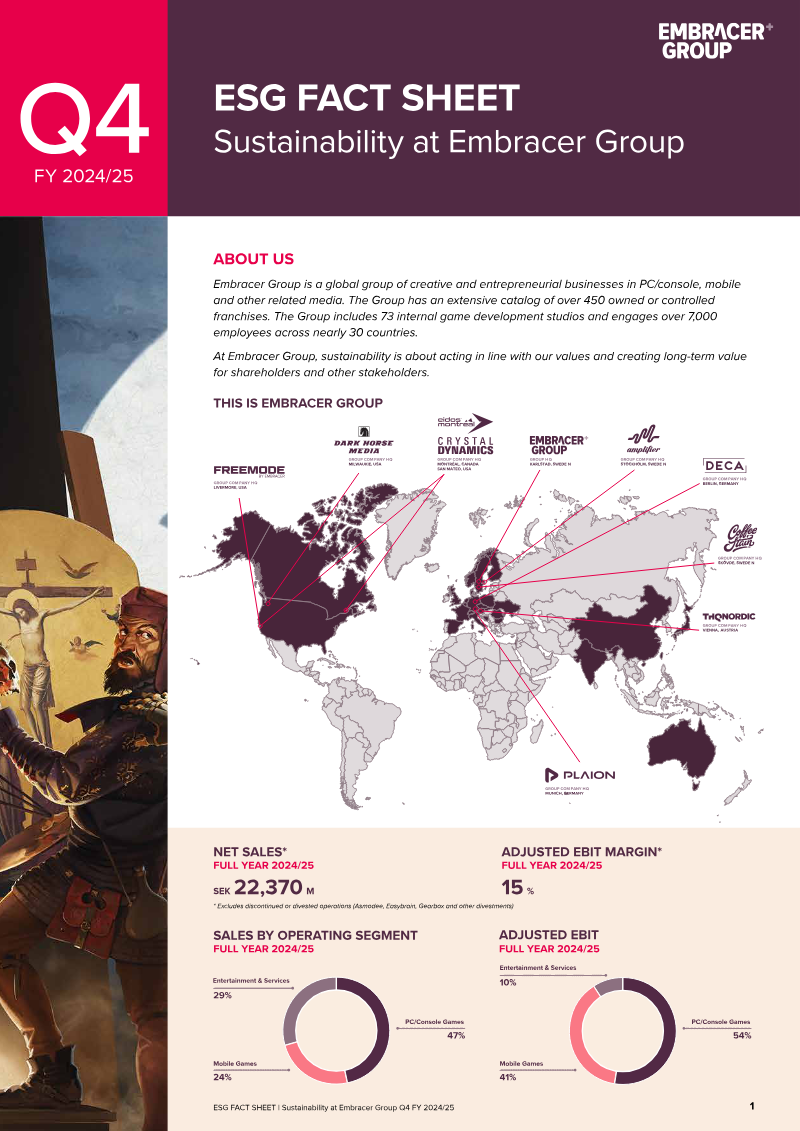
Embracer Group's FY 2024/25 ESG Fact Sheet outlines its commitment to sustainability, integrating environmental, social, and governance principles into its business model.
- Embracer Group reported net sales of SEK 22,370 million and an adjusted EBIT margin of 15% for the FY 2024/25, a period marked by significant structural transformation and divestment.
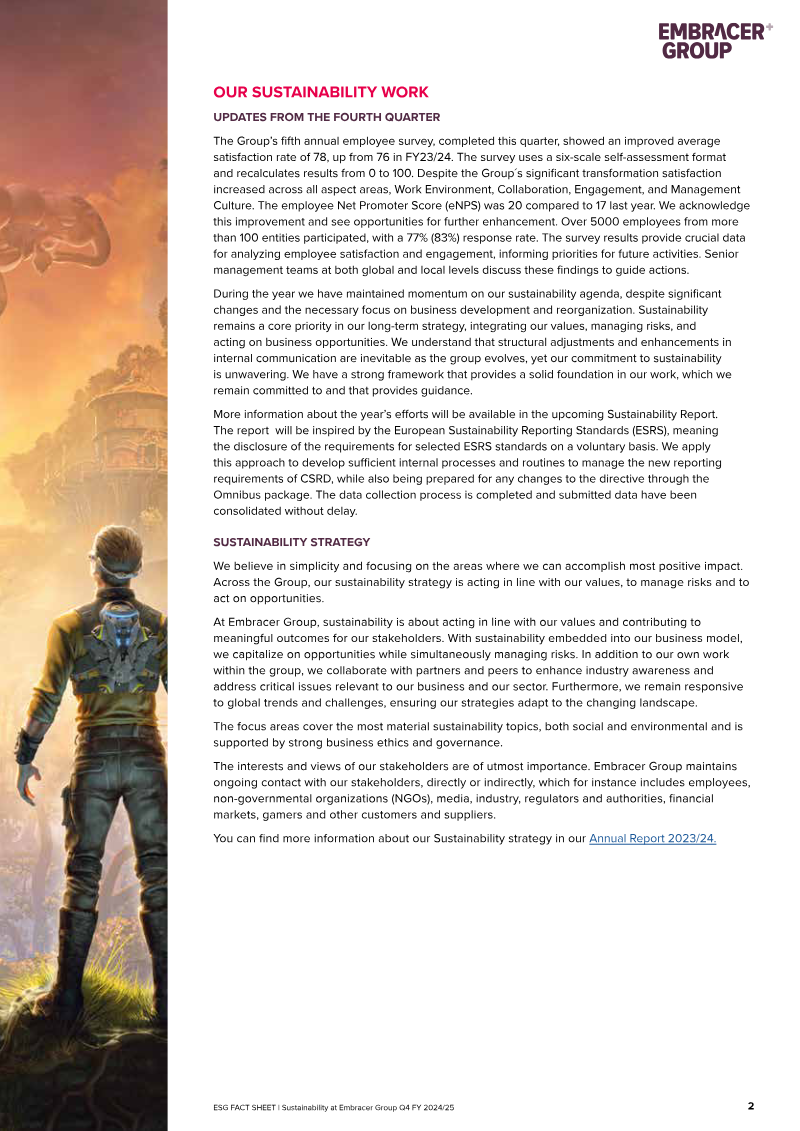
- Employee satisfaction improved to 78 out of 100, up from 76 in the previous year, with a 77% response rate from over 5,000 participants and an employee Net Promoter Score of 20.
- The organization manages its sustainability and governance through a framework of 17 group-wide policies and 17 instructional guidelines covering anti-corruption, privacy, and AI ethics.

How to Avoid App Store Fees with Web Payments
Recent legal developments in the United States and Europe, catalyzed by the Epic versus Apple litigation and the Digital Markets Act, have fundamentally altered the mobile gaming landscape by dismantling anti-steering policies.
- Shifting to web-based payment channels allows developers to bypass standard 30 percent app store commissions, potentially increasing net revenue by 25 percent or more.
- Web payment models typically incur total costs of approximately 8 percent, consisting of a 5 percent provider commission plus additional pass-through processing fees.
- Legal shifts, including the Epic versus Apple litigation and the Digital Markets Act, have dismantled anti-steering policies, legally enabling developers to direct users to external shops.

Week in Mobile Games E53 - Will Squad Busters 2.0 revive its fortunes?
Supercell is currently navigating a critical juncture for its mobile portfolio, specifically regarding the performance of Squad Busters.
- Supercell is attempting to pivot Squad Busters from a squad-based mechanic to a hero-centric model in its 2.0 update to resolve an identity crisis between casual and midcore audiences.
- The 2.0 update for Squad Busters has triggered significant player backlash due to the aggressive removal of established progression systems and features.
- The mobile industry is experiencing increased volatility, highlighted by the recent indefinite delay of a major title just one week before its scheduled launch.