Global reports and market data
Documents


Characters in Computer Games: Toward Understanding Interpretation and Design
The document, "Characters in Computer Games: Toward Understanding Interpretation and Design," posits that character interpretation is fundamental to the player experience, extending even to non-human entities.
- Game characters are often perceived as flat because of weak design rather than any inherent limitation of the medium, and a consistent personality can be built deliberately.
- Personality is conveyed through predefined elements such as cut-scenes, dialogue, and animation, together with the goals assigned to a character and the actions enabled or restricted within the game.
- The authors argue that a protagonist's nature can be encoded into mechanics, meaning which actions are possible or impossible, rather than conveyed only through narrative exposition, and that this generates the conflict and goals that drive player behavior.

Expressive AI: Games and Artificial Intelligence
The document proposes "expressive AI" as a new interdisciplinary agenda that connects game studies, design practice, and technical research, arguing that Artificial Intelligence (AI) in games is not merely a technical detail but a crucial element for creating meaningful player experiences.
- Mateas argues that as graphical gains yield diminishing returns, game development is shifting attention toward artificial intelligence, and proposes "expressive AI" as an interdisciplinary agenda linking games studies, design practice, and technical research.
- Game AI is defined as the production of behavior that players read as intentional, distinguishing it from game physics: Asteroids' asteroids and water simulations generate behavior without inviting psychological interpretation, whereas enemies like Pac-Man's ghosts invite readings of goals, desires, and moods.
- The paper positions game AI as a "white box" vocabulary for analyzing and designing games, complementing the "black box" vocabularies of design patterns and humanistic game studies that deliberately ignore implementation.


Stepping Back: Players as Active Participators
The document, "Stepping Back: Players as Active Participators," posits a novel "active participator" model for game design, challenging the traditional single-character player perspective.
- The paper argues that single-player third-person games can position players flexibly among multiple characters rather than binding them to one fixed role, and that this variable positioning offers dramatic and narrative advantages design has yet to fully explore.
- The central case study is Common Tales, a 1999–2000 prototype by Sony and Cambridge researchers in which players alternate control between two heroes, Thomas and Fiz.
- Common Tales structures the hero relationship through three interaction types (teamwork, anguish, and rescue), along with spatial and cinematic design.


Technology Tells a Tale: Digital Games and Narrative
"Technology Tells a Tale: Digital Games and Narrative" examines how digital games redefine and transform traditional notions of storytelling, rather than simply being narratives themselves.
- Digital games are not narratives in themselves; the digital medium is reshaping how culture understands what a story is.
- The paper frames the long-running debate between narratologists (applying literary and film theory to games) and ludologists such as Aarseth, Frasca, and Eskelinen (prioritizing play and interactivity).
- The author identifies five recurring characteristics of computing as the basis for how games produce meaning: procedurality, participation, quantifiability, modularity, and finiteness.


Problem Solving: The Essence of Player Action in Computer Games
The core thesis of this analysis is that player engagement in computer games fundamentally stems from a problem-solving process, which it terms "computer game agency."
- Player agency in computer games is framed as intentional actions that advance play by solving problems, built on Espen Aarseth's concepts of aporia (an obstacle) and epiphany (its resolution).
- The paper proposes a three-phase model of problem solving: comprehending the aporia, developing a strategy, and executing intentional action, with flawed approaches requiring a return to earlier stages.
- Baldur's Gate II conceals its overarching goal and presents a fixed, staircase-like chain of linked aporia-epiphany pairs with a role-play emphasis.
Space, Agency, Meaning and Drama in Navigable Real-Time Virtual Environments
The document explores the expressive potential of navigable real-time virtual environments, primarily videogames, asserting that interactive space inherently conveys meaning and is fundamental to player experience and mental image formation.
- Navigable real-time virtual environments derive meaning and dramatic force from a hybrid of rule-based systematic organization and situational knowledge drawn from real-world experience.
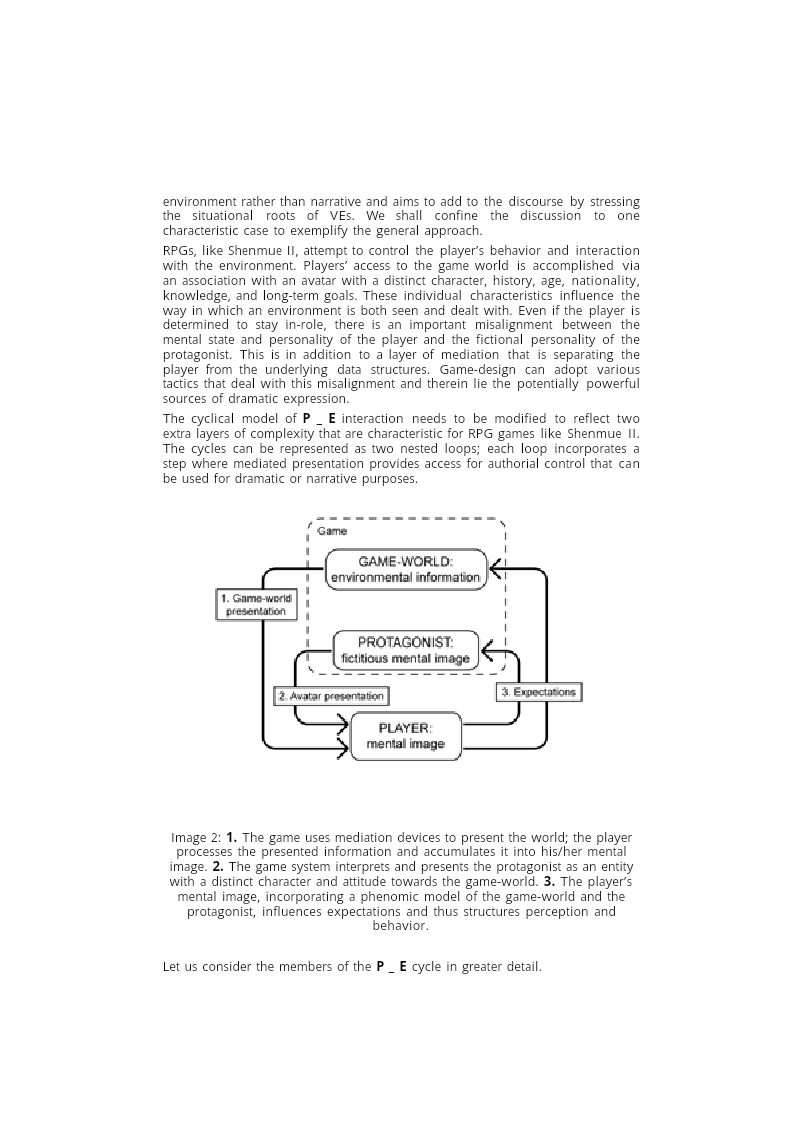
- Grounded in environmental psychology, the authors frame person-environment interaction as a cyclical, bi-directional process in which perception is continually shaped by prior experience, a cycle virtual environments replicate with an added layer of authorial mediation.
- The authors conclude that interactivity and culturally situated associations are the principal sources of engagement, and designers who neglect links to the external world risk producing confusion rather than immersion.


Games as Technological Entry Point: A Case Study of Uzbekistan
This study investigates the role of computer games as a technological entry point for new users, particularly in developing nations, using Uzbekistan as a primary case study and contrasting it with established gaming cultures like South Korea and the United States.
- The study argues that games can work as an entry point to technology for novices, but their effectiveness depends heavily on cultural and infrastructural context, comparing the United States, South Korea, and Uzbekistan.
- South Korea offers the benchmark: over 90 percent of respondents in a 2003 survey had played games, and the shift to online PC gaming driven by broadband expansion generated roughly $2.8 billion in revenue in 2002.
- In Uzbekistan, a March 2003 survey of 317 respondents found only 32.5 percent had used a computer, and about 59 percent of those users had played games, usually simple Windows or web titles.



Apocalypse the Spielberg Way: Representations of Death and Ethics in Saving Private Ryan, Band of Brothers and the Videogame Medal of Honor: Frontline
This analysis examines the distinct representations of death and ethics across Steven Spielberg's World War II productions: the films Saving Private Ryan and Band of Brothers, and the videogame Medal of Honor: Frontline.
- The paper argues that Spielberg's Saving Private Ryan and Band of Brothers depict death in hyperrealistic, emotionally intimate ways that invite viewers to reflect on mortality and moral ambiguity, whereas Medal of Honor: Frontline (2002) adopts a postmodern model in which enemy corpses vanish.
- The game's vanishing corpses are read as a symbolic ritual of conquering death, casting enemies as an abundant, disease-like threat to be continually exterminated in pursuit of heroic reward.
- The author suggests the disappearing corpses may partly stem from technical constraints such as limited memory ('byte economy'), noting that the earlier game Return to Castle Wolfenstein shows corpses can be preserved.


The Diverse Worlds of Computer Games: A Content Analysis of Spaces, Populations, Styles and Narratives
"The Diverse Worlds of Computer Games" presents a comprehensive content analysis of 130 computer and video games released in 2002 across five platforms, employing both quantitative content analysis and formal film analysis techniques.
- The study analysed 130 top-selling computer and video games from 2002 across five platforms, examining the box, manual, opening cinematic, and first ten minutes of gameplay for each title.
- Its central conclusion is that claims that games are uniformly violent and formulaic are not supported by the evidence, given the wide range of settings and character behaviours observed.
- Most games (64%) were set in the present day and only 8% took place in space, while roughly three-quarters featured exterior settings.


Describing Games: An Interaction-Centric Structural Framework
The document proposes an interaction-centric structural framework for describing games, aiming to bridge the gap between game design and analysis.
- The framework's core contribution is a shared terminology for describing game structure and player interaction, rather than empirical findings.
- Björk and Holopainen argue that existing models from game theory and play theory are either too abstract to guide design or too narrow to apply broadly, and position their interaction-centric structure as a complement to game design patterns.
- The framework organizes game components into four categories: holistic, bounding, temporal, and objective, with each core concept situated in one of them.

Participatory Design and Opposing Interests in Development of Educational Computer Games
This study investigates a participatory design process involving 11-12 year old Danish schoolchildren in the development of an educational mathematics computer game.
- The study examined a participatory design process in which 11- and 12-year-old Danish children helped design a math-education computer game meant to be engaging enough that they would voluntarily play it outside school.
- The children's ideas had little practical effect on the final design, mainly because the developers adopted their own time-travel concept early, where it was perceived as strong and hard to modify.
- A key organizational failure was that the developers did not attend the workshops, so insights from the children reached them only secondhand through researchers as general guidelines that were hard to integrate.


Supporting Communities in Massively Multiplayer Online Role-Playing Games by Game Design
The document, "Supporting Communities in Massively Multiplayer Online Role-Playing Games by Game Design," explores the critical role of game design in fostering and sustaining player communities within Massively Multiplayer Online Role-Playing Games (MMORPGs).
- Customizable player housing and guild halls, which let players leave lasting traces in the game world, were found to be particularly effective at building interdependence and community.
- Communities tend to flourish when games offer broad communication options, persistent asynchronous messaging, and room for player expressiveness, while restrictive tools like Toontown's SpeedChat make enduring friendships harder to form.
- Non-zero-sum experience sharing in Anarchy Online strongly encourages group formation, whereas higher-stakes environments in Anarchy Online and Ultima Online lead players to team mostly with friends.