1 free read left. Create a free account for unlimited reading + AI research.
Create free accountWhitepaper DiGRA
1 free read left. Create a free account for unlimited reading + AI research.
Create free accountWhitepaperDiGRA
Navigable real-time virtual environments derive meaning and dramatic force from a hybrid of rule-based organization and situational knowledge from real life.
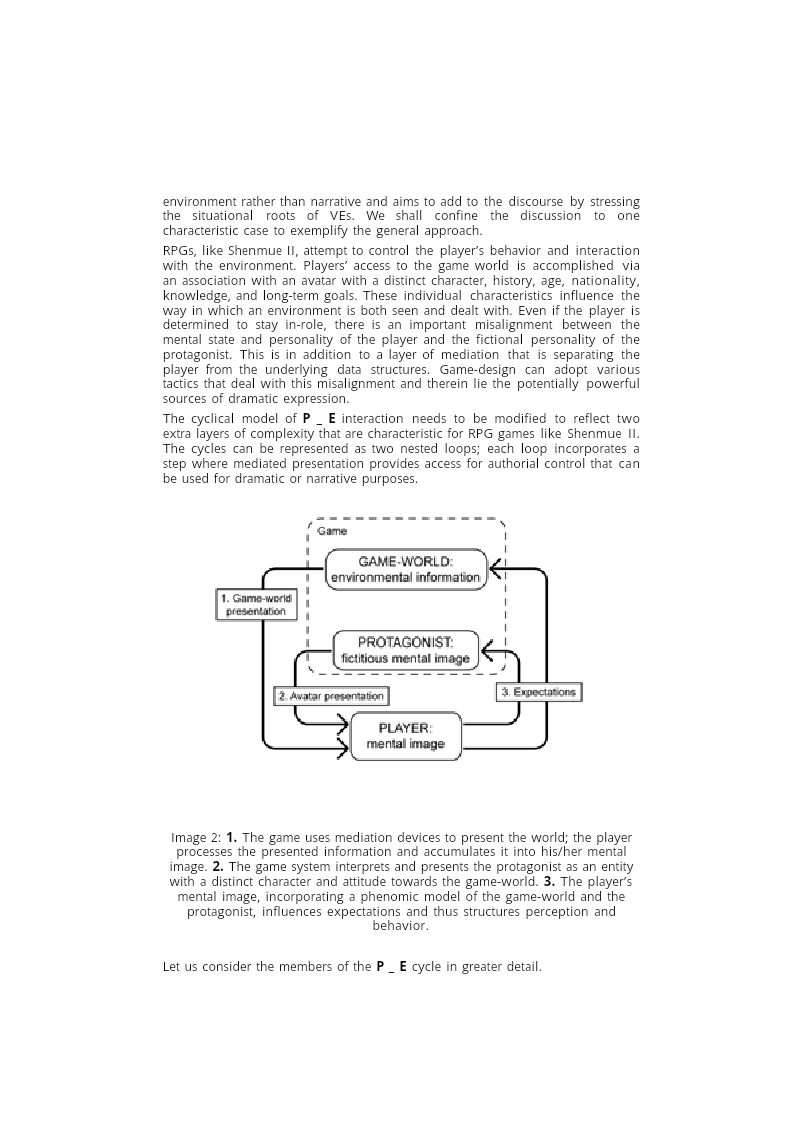
Navigable real-time virtual environments, examined through the action-adventure role-playing game Shenmue II, derive their meaning and dramatic force from a hybrid structure that combines rule-based, systematic organization with situational knowledge drawn from real-world experience. Grounding its analysis in environmental psychology, the work frames person-environment interaction as a cyclical, bi-directional process in which perception is continually shaped by prior experience. The authors argue that virtual environments replicate this cycle while adding a further layer of authorial mediation, since the game's presentation of both world and protagonist filters how the player comes to know the space. Their central conclusion is that interactivity and culturally situated associations are principal sources of engagement, and that designers who neglect these links to the external world risk producing confusion rather than immersion.
The analysis identifies a specific weakness in the game's approach to space. Shenmue II's corridor-like spatial structure and largely static fictional base restrict players' capacity to interpret the game-world through their own cultural knowledge, reducing environmental cues to superficial decoration. The authors contend that designers who disregard how real spaces are socially used and appropriated weaken the meaningful connections between virtual environments and the world beyond them. Attention then turns to the game's presentational devices, including exploration, lexia, cut-scenes, quick time events, free battles, and mini-games, which the authors treat as instruments shaping the player's mental image of the space.
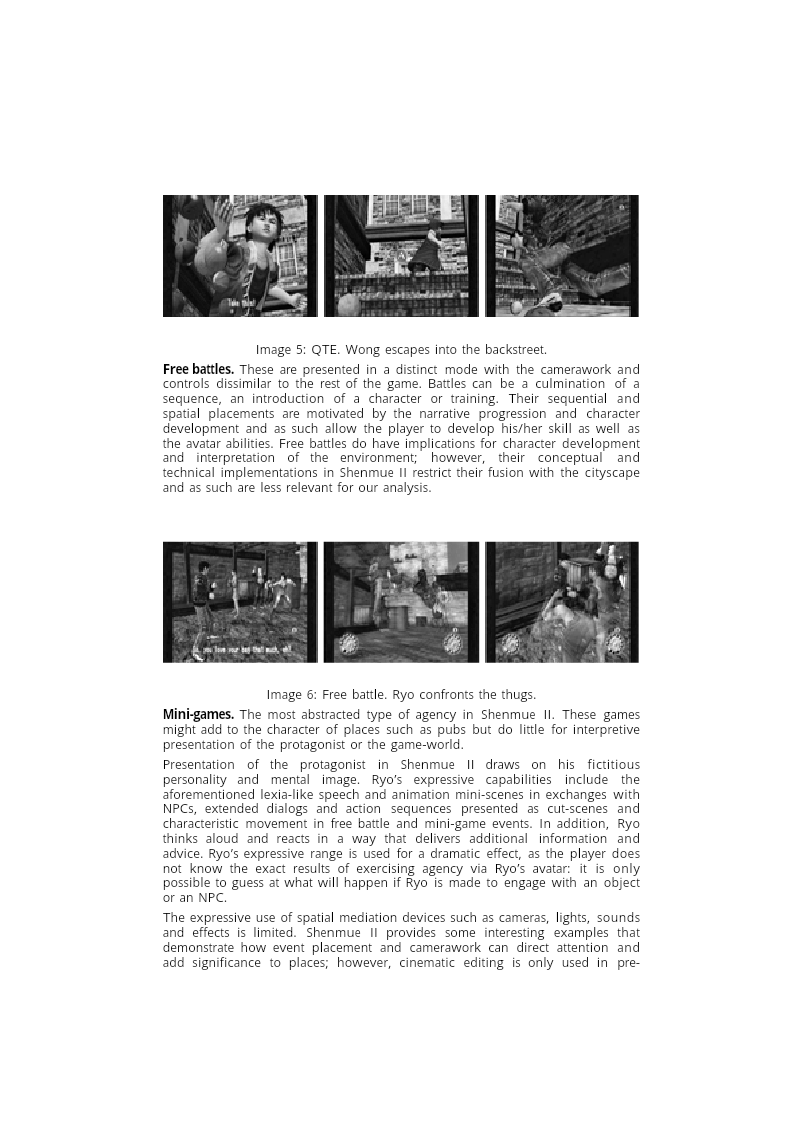
The Wong sequence serves as the principal case study. The authors show how its mix of cut-scenes, quick-time events, and shifts in gameplay control introduces new locations, establishes the protagonist Ryo in contrast to player expectations, and generates suspense and emotional investment unavailable to a passive film viewer. The analysis also records a design flaw: a cut-scene skips a long, looping passage the player has not traversed, leaving them disoriented without a map, and this confusion is never exploited for deliberate narrative effect.












Comments