Global reports and market data
Documents
Baldur's Gate and History: Race and Alignment in Digital Role Playing Games
Christopher Warnes's paper argues that digital role-playing games, using Baldur's Gate I and II as its central case, cannot be fully understood through the formalist approaches that dominate game studies, particularly the ludology/narratology debate.
- Christopher Warnes argues that digital role-playing games such as Baldur's Gate I and II cannot be fully understood through the formalist ludology/narratology approaches that dominate game studies, which he attributes to disciplinary insecurity and anxiety about the games industry's commercial pull.
- Warnes advocates historicised, cultural materialist and postcolonial critique as alternatives, applying them to commercially produced computer games in a sustained way for the first time.
- The paper is a theoretical and interpretive essay, not an empirical study; it draws on literary, historical, and media-studies sources rather than survey data or original player research.
End of Story? Quest, Narrative and Enactment in Computer Games
The document challenges Espen Aarseth's hypothesis that all "narrative games" are better understood as "quest games," proposing Max Payne as a counter-example.
- Løvlie argues against Espen Aarseth's view that 'narrative games' are better understood as 'quest games,' using Remedy Entertainment's 2001 third-person shooter Max Payne as a counter-example whose linear, heavily narrated structure cannot be separated from its gameplay.
- The author proposes 'enactment' as a more fitting concept than acting or authorship, describing the player as reacting to a script of narrative and rules rather than performing a fixed script or freely authoring the experience.
- Max Payne's dream sequences deliberately break genre conventions, and the game's forced repetition of an unavoidable event with identical outcomes is read as an attempt to express metaphysical themes through new media, drawing on Manovich's database-interface model and Jakobson's paradigm-syntagm account of poetry.
Feel It, Don't Think: The Significance of Affect in the Study of Digital Games
The document, "Feel It, Don't Think: The Significance of Affect in the Study of Digital Games," argues that traditional game studies methodologies, which prioritize visual, narrative, and semiotic elements, fail to adequately account for the embodied, multisensory, and physiological dimensions of gameplay.
- Shinkle argues that game studies focused on visual, narrative, and semiotic content overlook the embodied, physiological 'feel' of gameplay, which she calls affect: a multisensory, temporally delocalized experience that operates partly outside linear time and conscious choice.
- The paper distinguishes affect from emotion and presents itself as a preliminary theoretical examination rather than an empirical study, drawing on Massumi, Grodal, Aarseth, and Poole.
- Sega's rave-inspired Rez is cited as an example whose appeal lies in a trance-like synchronicity between player and environment rather than in level completion.
Socio-Ec(h)o: Ambient Intelligence and Gameplay
The research paper "Socio-Ec(h)o: Ambient Intelligence and Gameplay" describes the preliminary work on an ambient intelligent system designed to explore physical group play and learning within a responsive environment.
- The prototype is an early-stage ambient intelligent game for teams of four players progressing through seven levels, and it has not yet undergone formal evaluation, so its claims rest on participatory design workshops and theoretical framing rather than measured outcomes.
- The system uses a twelve-camera motion capture setup, a rule-based reasoning engine that interprets group behavior and manages narrative flow, and audio and lighting display engines communicating over UDP at a 200 ms sampling interval.
- Each level requires a specific combination of body states and an implicit environmental goal, with a generic skill carried forward to later levels, and players are guided by word puzzles and real-time gradient audio and lighting feedback indicating proximity to the goal.
On the Ontology of MMORPG Beings: A Theoretical Model for Research
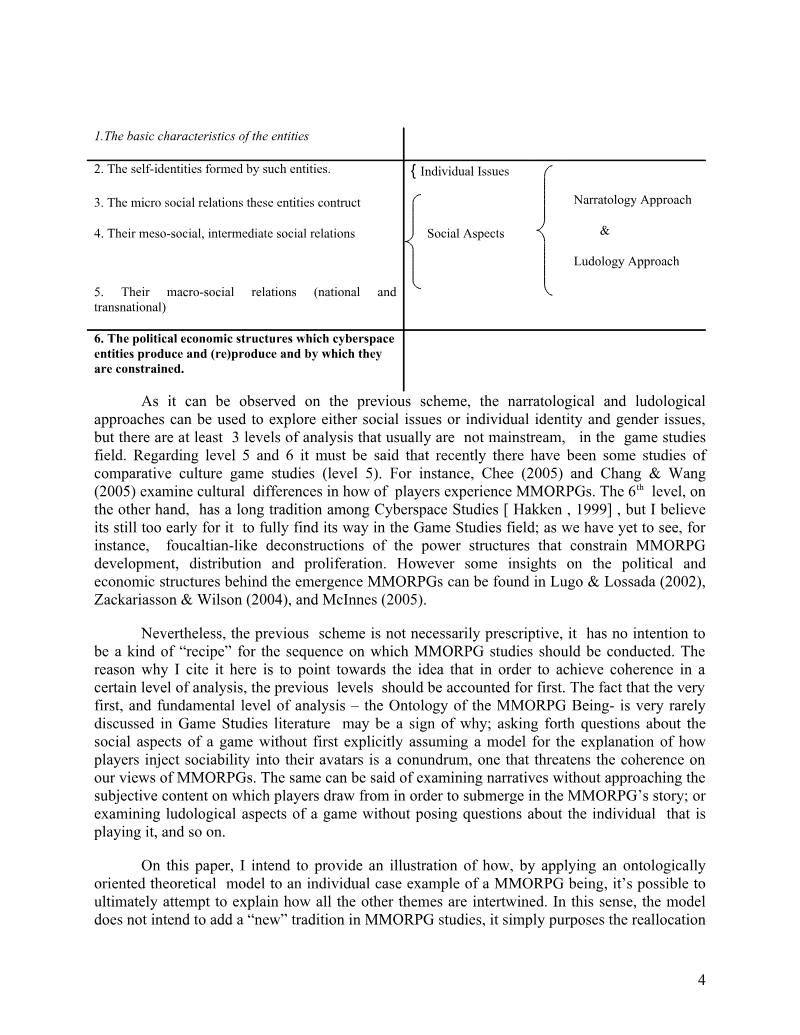
The document proposes a theoretical model for MMORPG research, centered on the "Ontology of MMORPG Beings," to unify the disparate research traditions within Game Studies, specifically social, individual player, narratological, and ludological approaches.
- The paper argues that the ontology of MMORPG beings (the essential characteristics of online avatars) is a neglected fifth research theme in Game Studies, alongside the social, individual, narratological, and ludological traditions.
- Its core claim is that established Game Studies traditions implicitly rely on an ontological foundation that has never been made explicit, so ontological clarification is presented as a prerequisite for coherent MMORPG research.
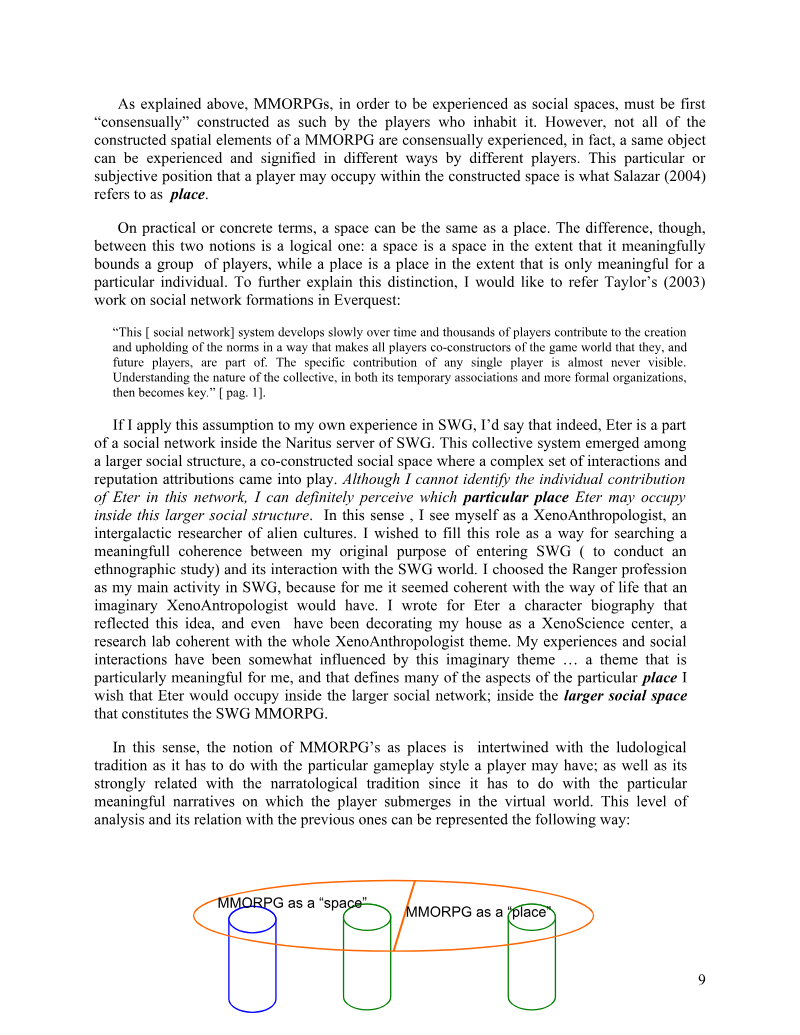
- The proposed model is layered, starting from the player's pre-existing subjective content and developers' software, hardware, and design elements, then analyzing MMORPGs as game spaces, social spaces, and individual places, and culminating in player identity expressed through cyborg-like avatars.
Beyond P-1: Who Plays Online?
This study quantitatively identifies four distinct archetypes of online gamers, moving beyond qualitative typologies to provide empirically sound classifications.
- Exploration and themes/plot (88.5% each), good characters (86.2%), and graphics (79.3%) were the most important game features to surveyed online gamers, while military themes (31.9%) and realism (41.3%) ranked lowest.
- Based on a survey of 1,178 online gamers recruited via websites and bulletin boards, the sample is self-selected, heavily engaged, and skewed toward dedicated and Western players, limiting generalizability.
- Gender preferences diverged: males rated weapons, technology, and competition more highly, while females were more often indifferent to these features.


Canadian Content in Video Games
Leonard J. Paul's paper, "Canadian Content in Video Games," examines whether video games produced in Canada reflect a distinct national culture, despite Canada being one of the world's leading producers and consumers of the medium.
- The paper's central finding is that Canadian-made video games show little distinct cultural identity, with Canadian content surfacing mainly in isolated touches like hockey-themed details or Quebec French-language requirements.
- Studios often replace Canadian place names and spellings with American or generic equivalents to reach the largest market, indicating that publisher market calculations, not national cultural policy, drive how Canadian content appears.
- The author concludes that the sector's economic growth has not yet been matched by culturally distinctive output, though academic game programs and new funding may eventually change this.

Making Right(s) Decision: Artificial Life and Rights Reconsidered
This study explores the ethical implications of artificial life (A-life) and the concept of rights for artificial entities, using the popular video game The Sims as a primary case study.
- The paper argues that as machines become more socially interactive and emotionally expressive, the boundary between human and machine becomes less fixed, calling for a reconsideration of what rights mean for artificial life.
- The author's central evidence is qualitative analysis of public forums about The Sims and the robotic pet AIBO, where players described deliberately cruel treatment of their Sims (such as drowning or confining them) while also expressing guilt and reluctance to harm characters resembling family or friends.
- Research on AIBO users cited in the paper found people were attached to robotic pets yet seldom attributed moral standing to them, showing a gap between emotional attachment and moral consideration.

Mise-en-scène Applied to Level Design: Adapting a Holistic Approach to Level Design
This document proposes that level designers can enhance emotional depth and narrative communication in video games by adopting the filmic concept of mise-en-scène.
- Mise-en-scène, the film concept of deliberately arranging everything visible within a frame to convey meaning, is proposed as a framework for level design to deepen emotional engagement and communicate narrative and psychological subtext.
- The paper maps Robert Kolker's mise-en-scène elements (spatial arrangement, props, camera relationship, color, lighting, and framing) onto level designers' responsibilities such as set dressing, lighting, texturing, and object placement, noting that cinematography and costuming typically fall to other team members.
- Close readings of Kubrick's The Shining show how scale, the Overlook Hotel's labyrinthine architecture, shifting color temperatures from warm amber to cold blue, atmospheric effects like snow and haze, and repurposed props reinforce themes of isolation, decay, and supernatural dominance.
Video Games: A Significant Cognitive Artifact of Contemporary Youth Culture
This qualitative study, "Video Games: A Significant Cognitive Artifact of Contemporary Youth Culture," posits that recreational video games hold substantial informal educative value and should be considered for inclusion in school curricula.
- A study of five 13-year-old players of Final Fantasy IX recorded 600 instances of thinking skills during play, most often predicting, evaluating, and justifying, plus 155 instances of strategy use led by exploration and trial-and-error.
- All five participants engaged in higher-order reasoning while playing, supporting the authors' claim that recreational games can be a legitimate site of cognitive activity.
- Informal cognitive performance during play often diverged from teachers' ability ratings, as one student rated average outperformed a peer rated very high, which the authors use to question conventional academic assessment.
Effects of Violent Video Games on Aggressive Behavior, Helping Behavior, Aggressive Thoughts, Angry Feelings, and Physiological Arousal
Violent video games exert a measurable negative influence on human behavior and psychological states.
- Exposure to violent video games consistently correlates with increased aggressive behavior and a measurable reduction in prosocial, helping behaviors.
- The findings are based on a meta-analysis of 85 distinct studies, confirming that these psychological impacts affect both children and adults across all genders.
- A dose-response relationship exists where the intensity of depicted violence directly correlates with the strength of the observed aggressive thoughts, angry feelings, and physiological arousal.
An Evaluation Function for the Game of Amazons
This analysis details the development and implementation of an evaluation function for the computer program AMAZONG, designed to play the game of Amazons.
- The AMAZONG program achieved a tournament victory at the 2002 Computer Olympiad in Maastricht by utilizing a multi-phase evaluation function that balances territorial control with piece mobility.
- The evaluation function incorporates a mobility correction term that identifies and traps passive or enclosed opponent pieces, a strategy identified as decisive for competitive performance.
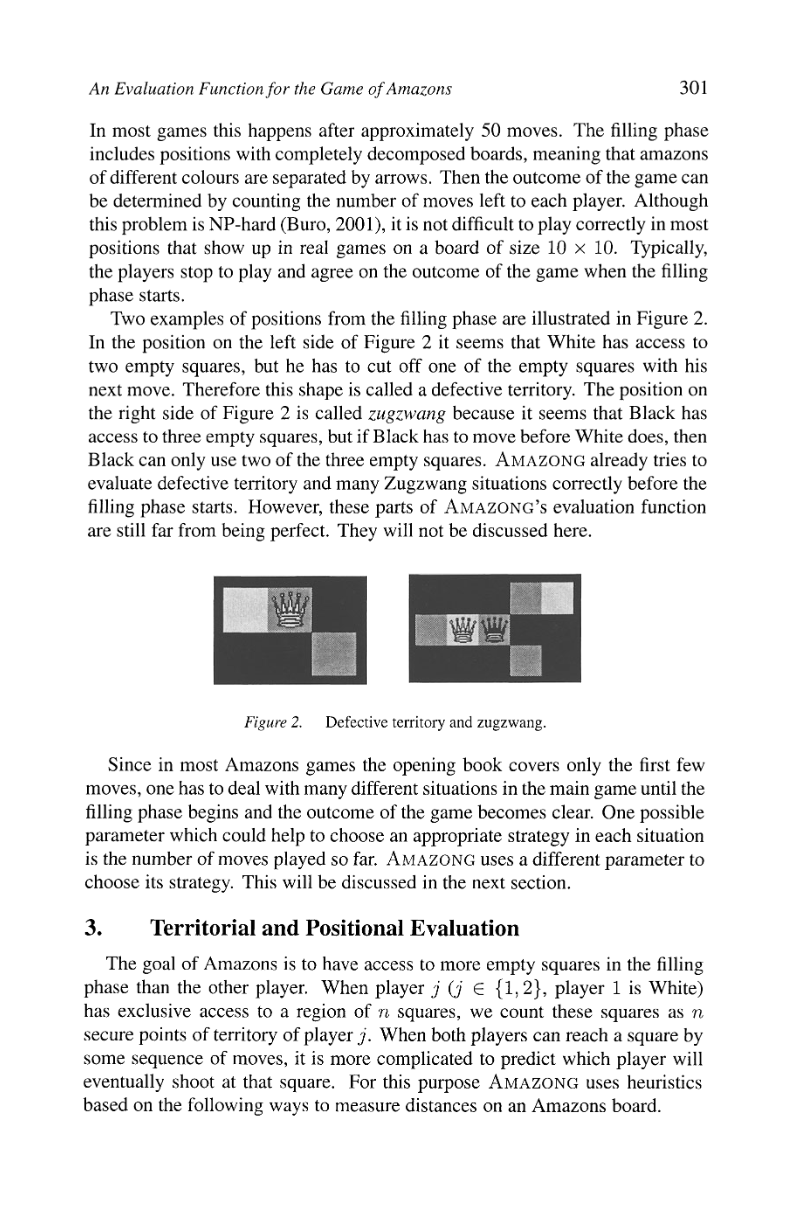
- The system utilizes two specific distance metrics—minimal chess Queen moves and minimal chess King moves—to estimate territorial access and detect potential zugzwang situations.