Global reports and market data
Documents
Videogames as an Inclusive Medium: Handbook for Working with Children with Developmental Disabilities
The "Videogames as an Inclusive Medium: Handbook for Working with Children with Developmental Disabilities," published by the Croatian Audiovisual Centre, serves as a comprehensive guide advocating for the strategic integration of video games into the learning, therapy, and social inclusion of children with developmental…
- Video games are neither inherently beneficial nor harmful; their value for children with developmental disabilities depends on how they are selected, structured, and mediated by adults.
- The handbook frames disability through the WHO's ICF and ICF-CY biopsychosocial model, arguing that disability arises from the interaction between a child's condition and their environment, and that children with developmental disabilities face double marginalization, both physically and digitally.
- Structured, guided play with active adult mediation consistently outperforms purely restrictive approaches, and games are positioned as one tool within broader educational, therapeutic, and family support systems rather than a replacement for them.
Belgian Games Key Facts 2021
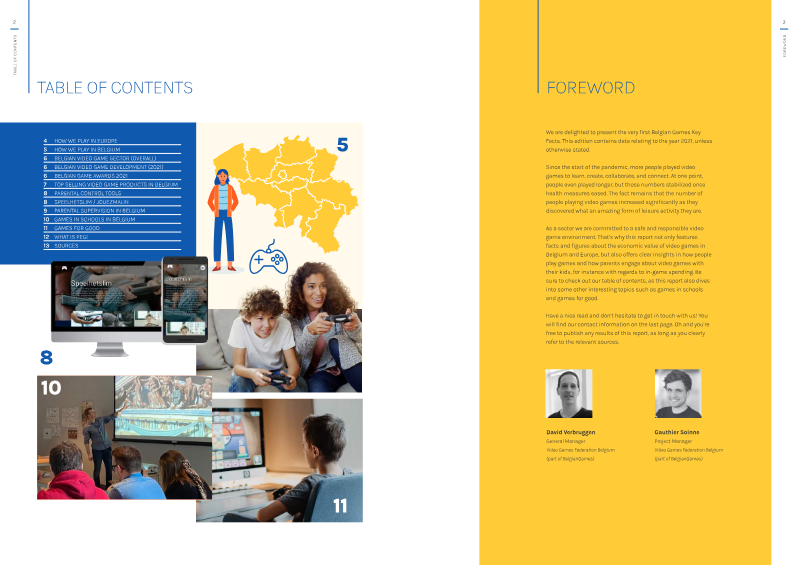
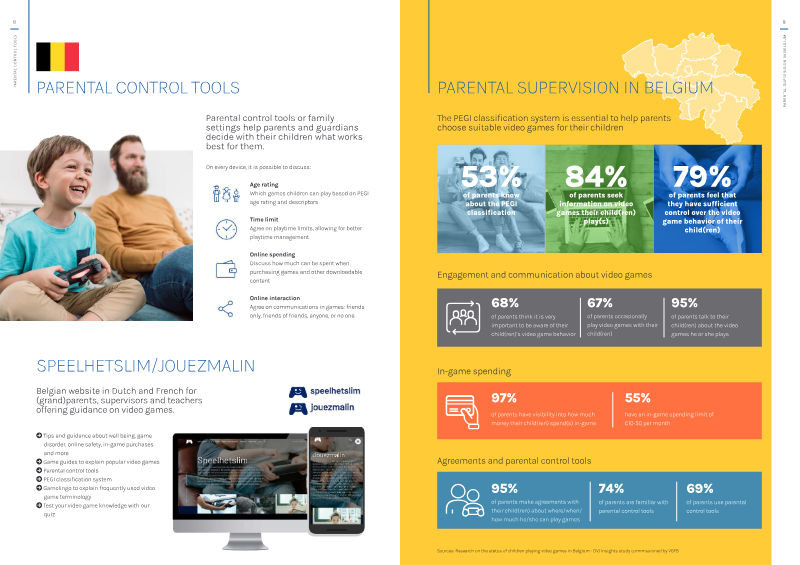
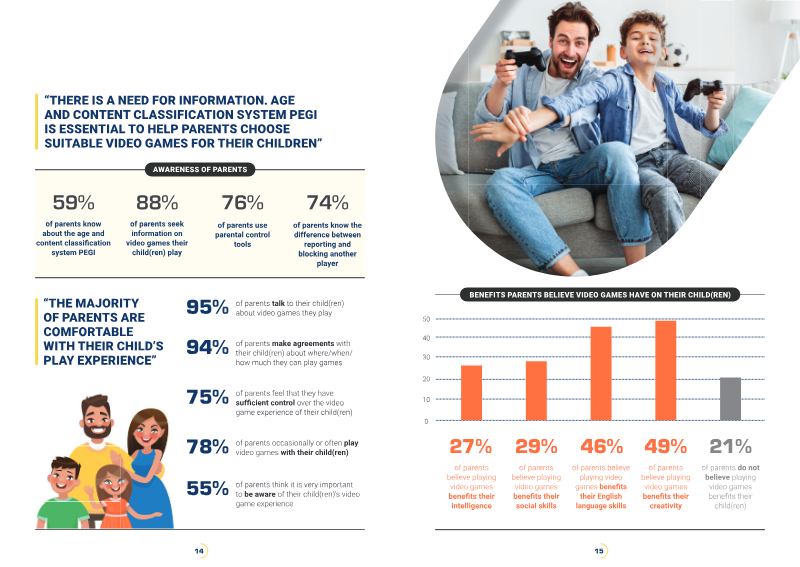
The "Belgian Games Key Facts 2021" report provides an overview of the video game sector in Belgium and Europe for the year 2021, focusing on economic value, player demographics, parental engagement, and the broader societal impact of games.
- Belgium's video game sector was valued at an estimated €600 million in 2021, growing about 4% over 2020.
- Belgian video game development generated €88 million in turnover in 2021 across 110 companies employing 935 full-time equivalents.
- About 52% of Belgians aged 6 to 64 play video games, with an average player age of 31 and women making up 48% of players.
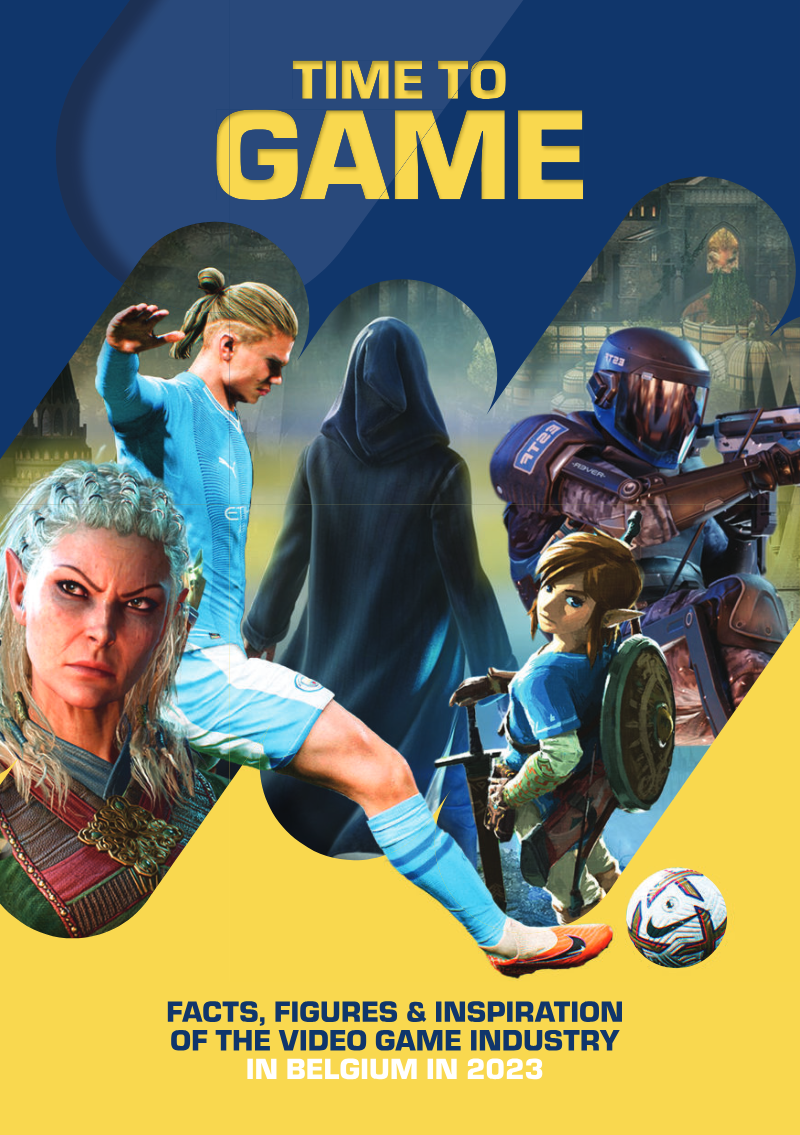
Time to Game at Fever: Facts, Figures & Inspiration of the Video Game Industry in Belgium 2023
This 2023 report from the Video Games Federation Belgium (VGFB) provides an overview of Belgium's video game industry, covering development, sales, player demographics, parental guidance, and educational and inclusion initiatives.
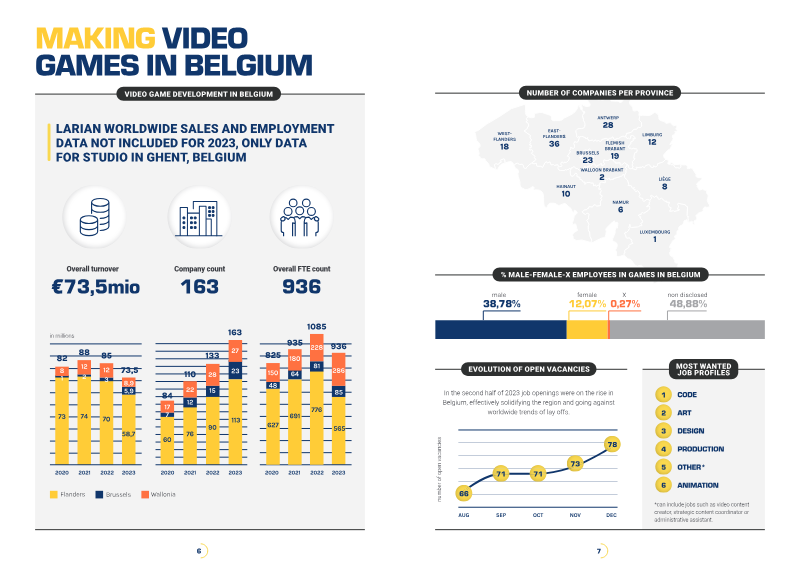
- Belgium's video game sector generated an estimated €73.5 million in turnover across 163 companies employing roughly 936 full-time equivalents, with Flanders hosting the largest share of studios, followed by Brussels and Wallonia.
- The economic value of video games in Belgium reached €708 million, a 21.6 percent increase, with PlayStation 5 sales rebounding strongly after chip shortages constrained supply in 2022.
- Job openings in Belgium's game industry rose in the second half of 2023, a notable contrast to global layoff trends.
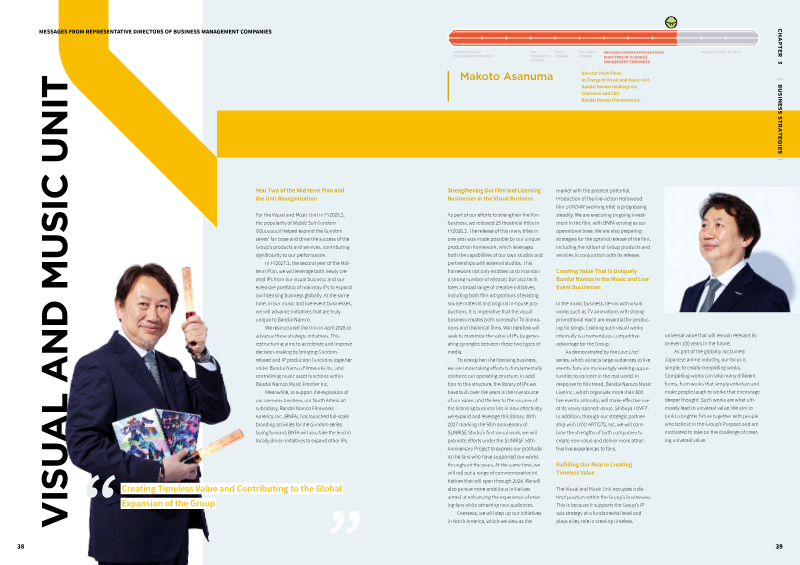
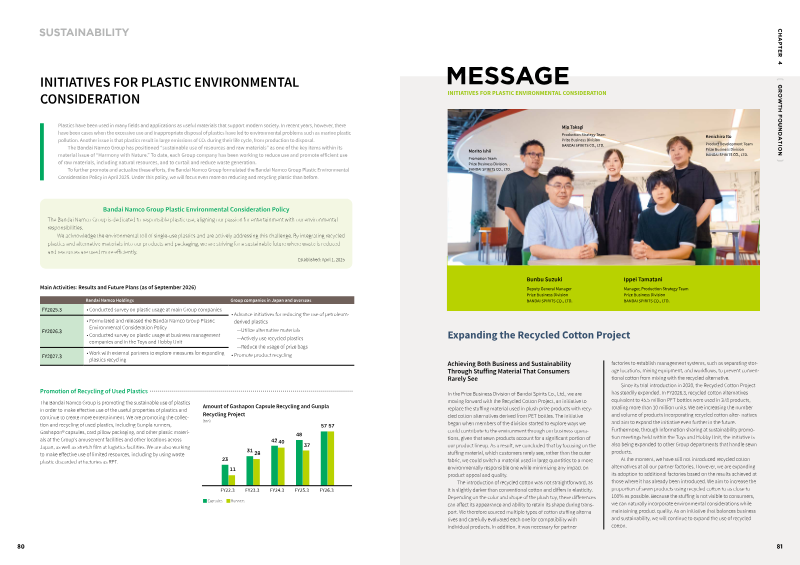
Bandai Namco Group Integrated Report 2026
Bandai Namco Group's Integrated Report for FY2026.3 outlines a period of record-breaking financial performance and a strategic vision for sustained global growth, centered on maximizing intellectual property (IP) value and deepening fan engagement.
- FY2026.3 net sales reached ¥1,348.2 billion (up 8.6% year on year), operating profit rose 5.2% to ¥189.5 billion, and ROE was 17.0%.
- The Gundam franchise is the central growth driver, with groupwide sales of ¥254.3 billion (up about 65.7%), exceeding ¥250 billion for the first time, and the company is building toward the franchise's 50th anniversary in 2029.
- The Mid-Term Plan (April 2025 to March 2028) targets ¥1,450 billion in net sales, ¥200 billion in operating profit, a 12% or higher operating margin, and an overseas sales ratio of 50% or more, versus an actual overseas share of roughly 42%.
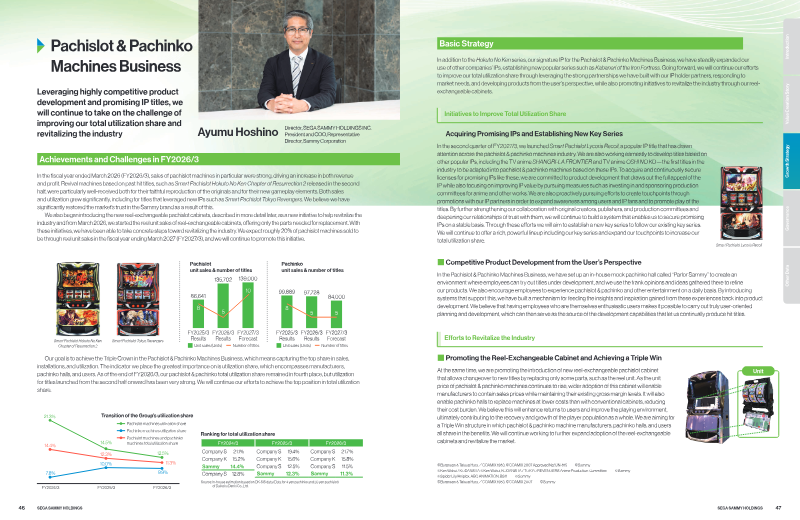
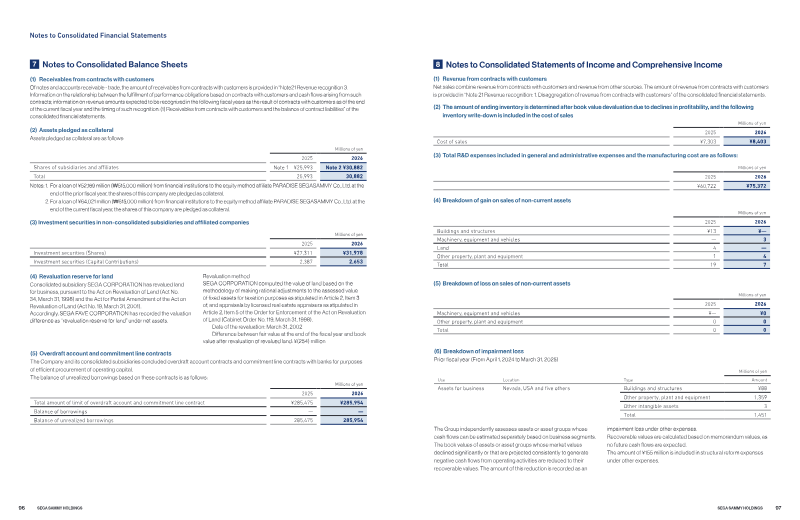
Integrated Report 2026
The "Integrated Report 2026" details SEGA SAMMY Group's financial performance and strategic adjustments following a challenging fiscal year ending March 31, 2026.
- SEGA SAMMY posted its first net loss in eleven years for fiscal 2026/3, at about ¥5.8 billion, driven by a ¥54.6 billion impairment charge tied to the Rovio and Stakelogic acquisitions and weak Full Game and new free-to-play performance.
- Despite consolidated net sales rising 13.7% to ¥487.5 billion, operating income slipped to ¥47.1 billion and ROE turned negative at -1.6%, leaving the Group below its medium-term plan targets.
- The forecast implies the three-year cumulative adjusted EBITDA and average ROE targets will be missed.
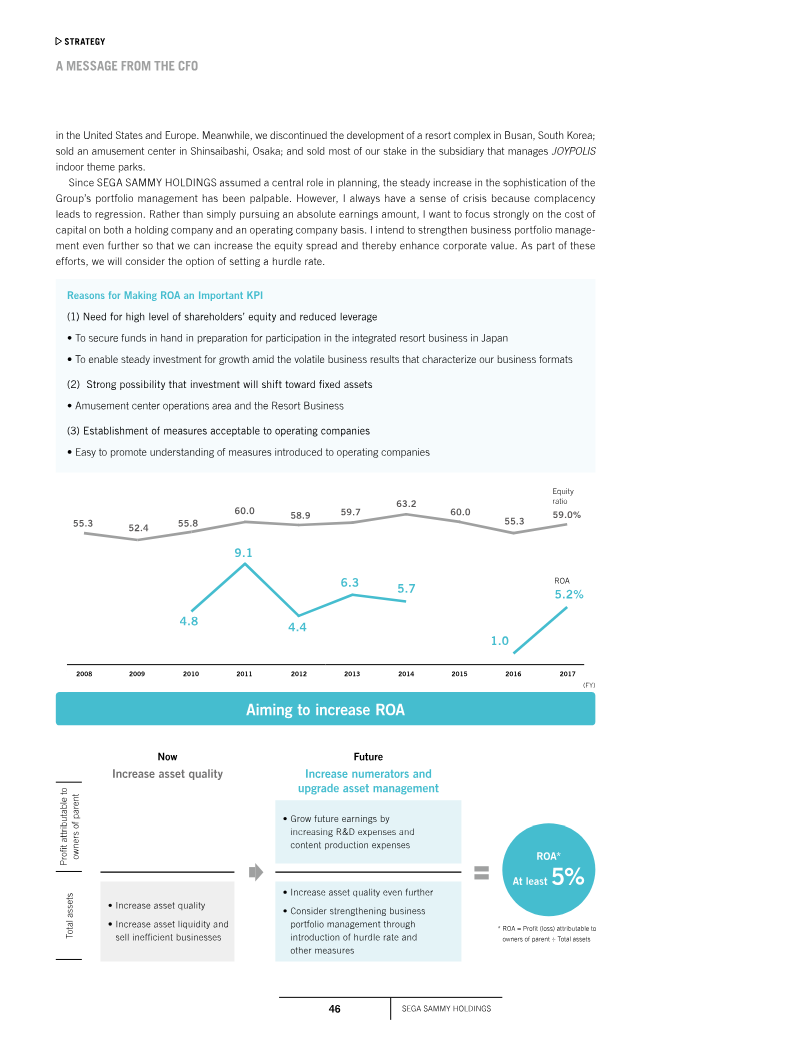
Integrated Report 2017: Sega Sammy Holdings
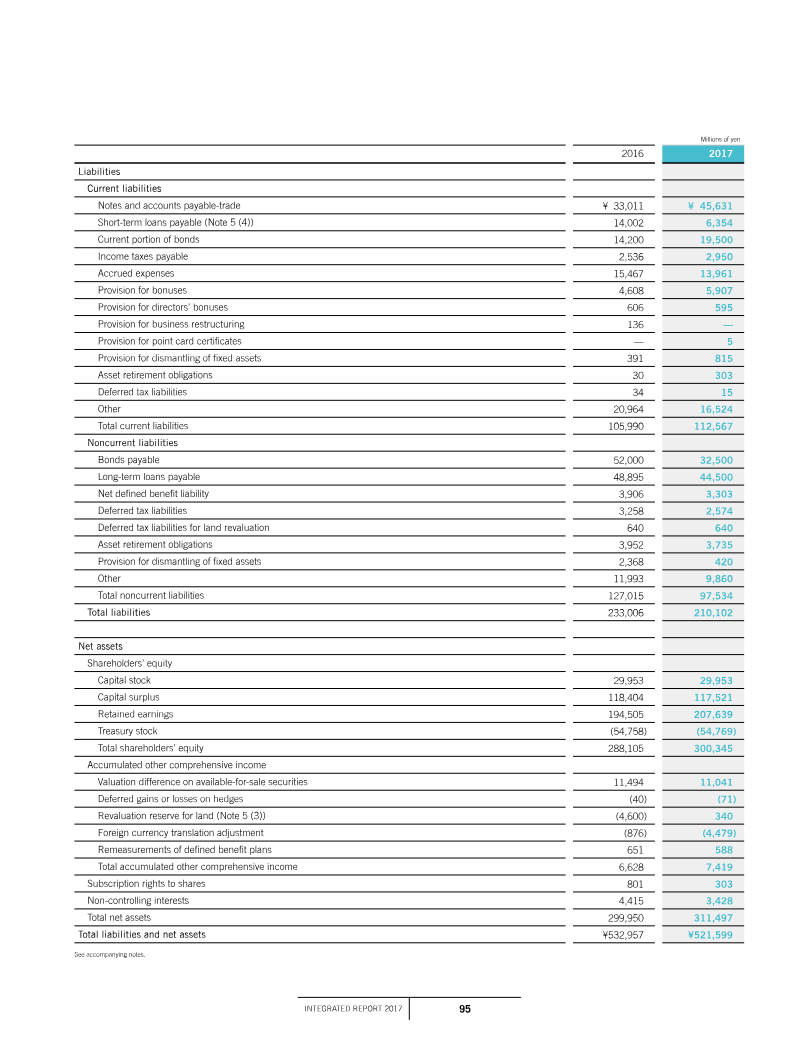
Sega Sammy Holdings' 2017 Integrated Report outlines the company's strategic pivot and strong financial performance, driven by its "Road to 2020" strategy.
- Sega Sammy is executing a 'Road to 2020' strategy to transition into an IP-centric organization, targeting a 15% operating margin and 5% return on assets by fiscal 2020.
- Fiscal 2017 financial performance showed strong growth, with net sales increasing 5% to ¥366.9 billion and operating income rising 68% to ¥29.5 billion.
- The company is diversifying revenue streams away from the declining domestic pachinko market by expanding into global digital gaming and integrated resort development.
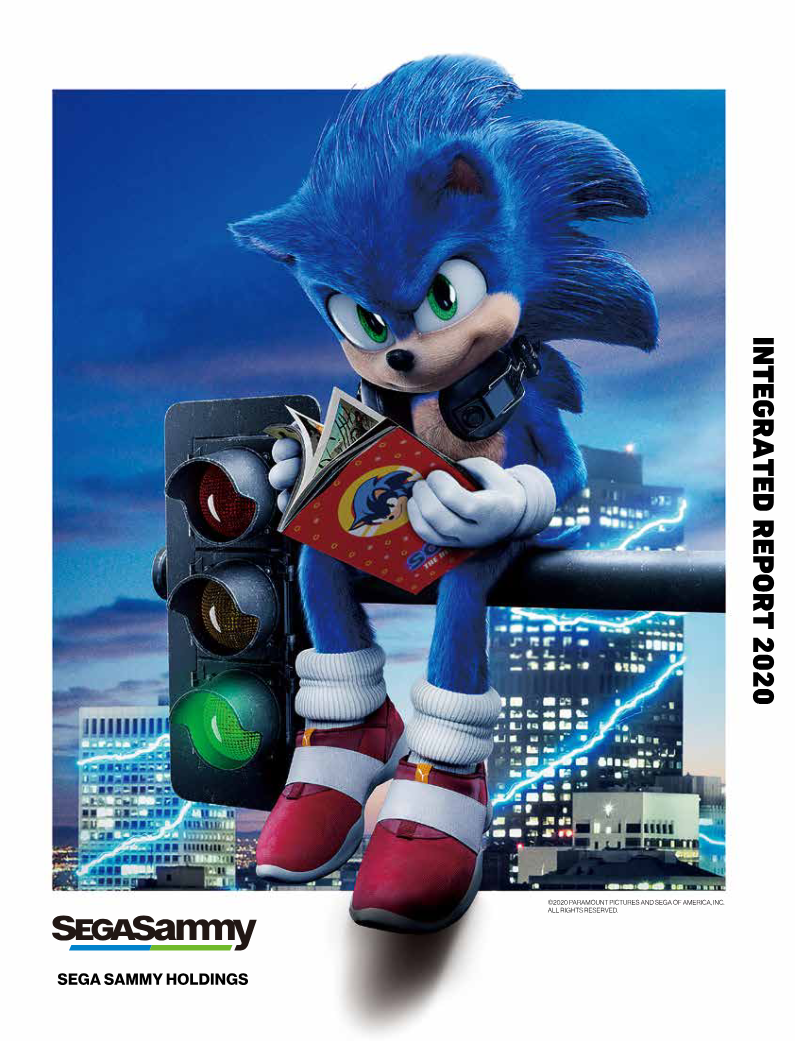
Sega Sammy Integrated Report 2020
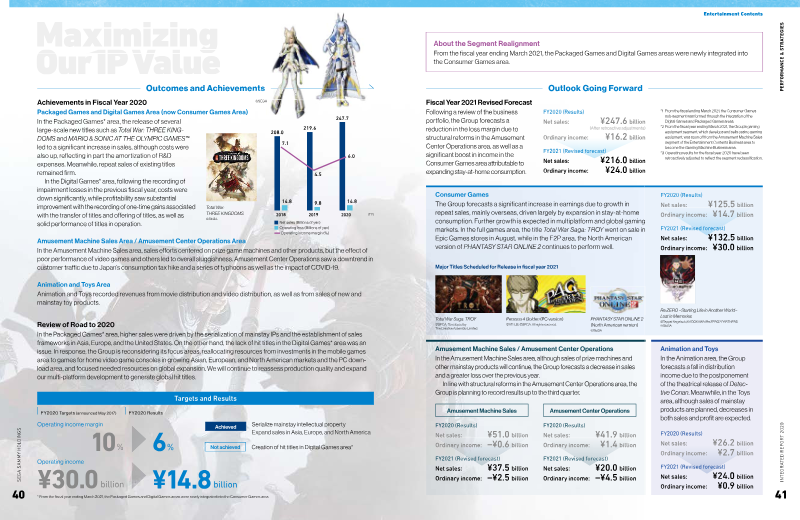
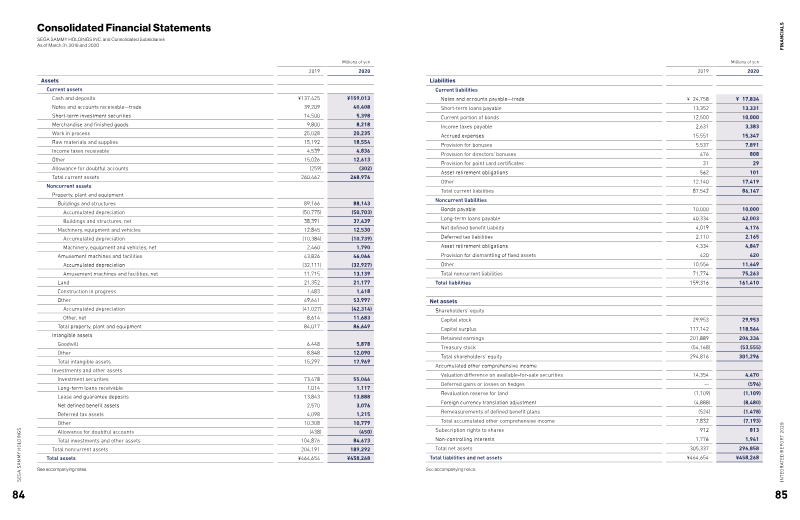
The Sega Sammy Integrated Report 2020 details the company's strategic response to the profound impacts of the COVID-19 pandemic across its diverse business segments, which include Pachislot and Pachinko Machines, Entertainment Contents (Consumer Games), and Resort operations.
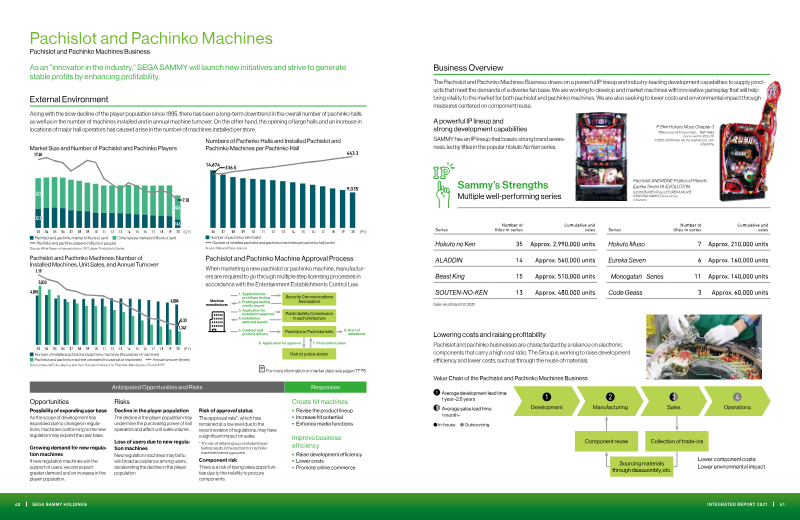
- Sega Sammy is pivoting from a reliance on domestic pachislot and pachinko operations toward a diversified, globalized business model centered on a unified consumer games division.
- For the fiscal year ending March 31, 2020, net sales grew 10.5% to ¥366.5 billion, while operating income more than doubled to ¥27.6 billion.
- The company is implementing ROIC-based management to improve capital efficiency and is prioritizing the development of global hit titles to enhance long-term corporate value.
Integrated Report 2021: Sega Sammy
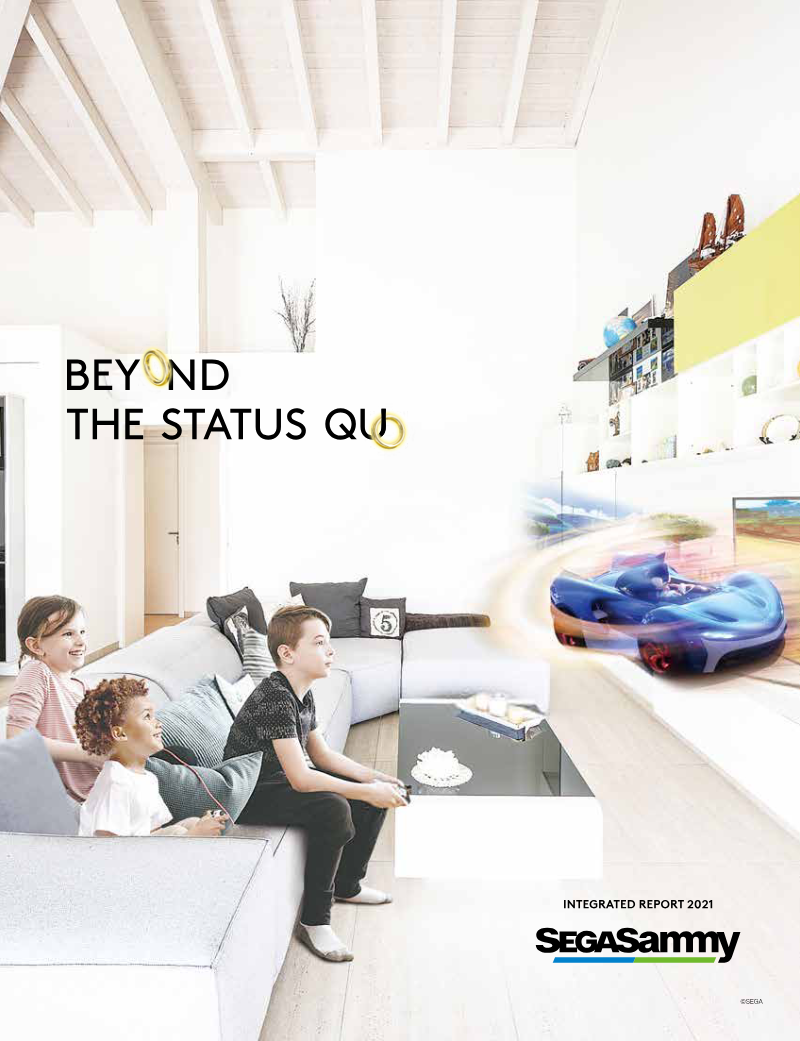
Sega Sammy's 2021 Integrated Report outlines a strategic pivot aimed at transforming the company into a sustainable global entertainment leader, moving "Beyond the Status Quo."
- Sega Sammy is targeting ¥500 billion in long-term net sales and an ROE exceeding 10% by fiscal year 2024 through a strategic pivot to become a 'Global Leading Contents Provider'.
- Fiscal year 2021 financial performance saw consolidated net sales decline 24.2% to ¥277.7 billion and operating income drop 76.4%, driven by contractions in the Pachislot/Pachinko and resort segments.
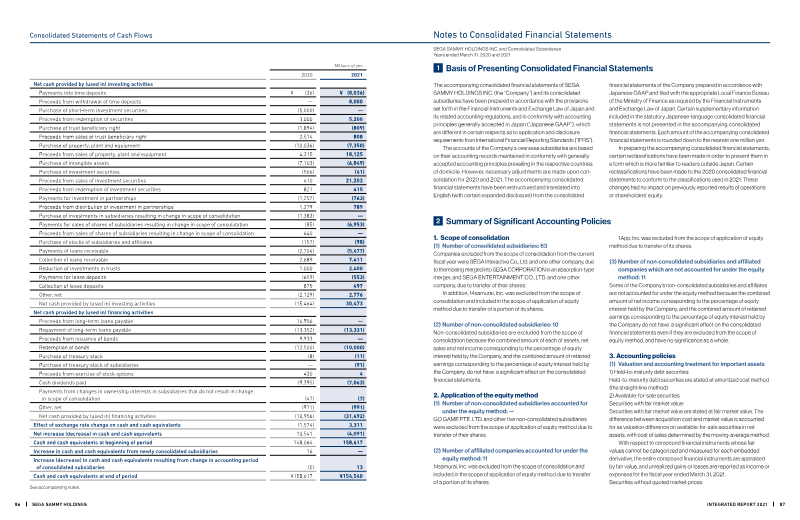
- The company executed aggressive structural reforms, including workforce reductions and the divestiture of amusement subsidiaries, resulting in ¥34.19 billion in reform-related expenses.
Sega Sammy Integrated Report 2022
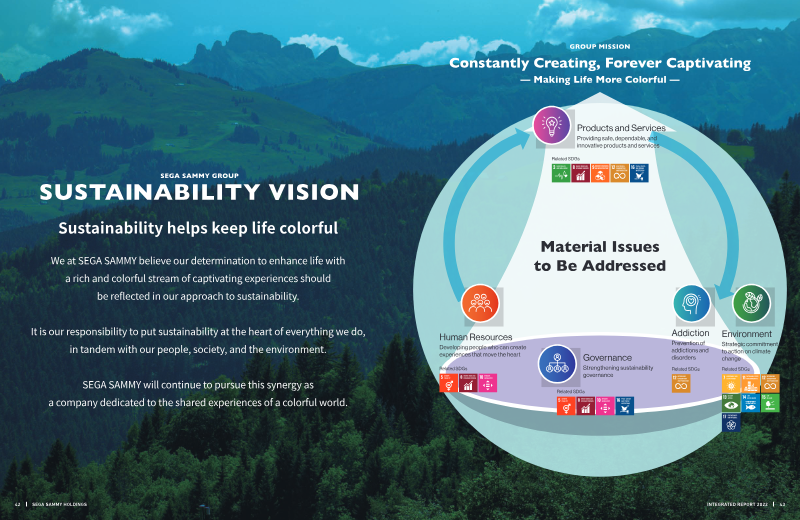
Sega Sammy's 2022 Integrated Report outlines a strategic vision to become a sustainable corporate group, driven by a new medium-term plan (FY2022/3-FY2024/3) and a "Sustainability Vision."
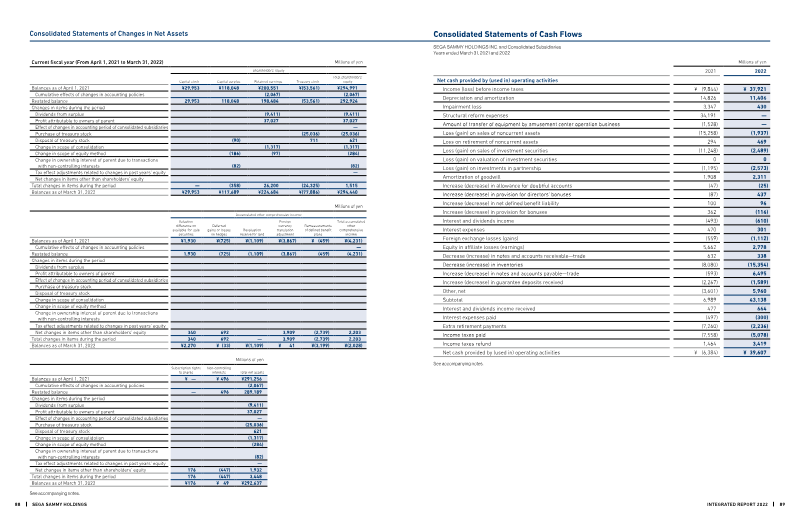
- Sega Sammy achieved a significant financial recovery in fiscal year 2022, reporting consolidated net sales of ¥320.9 billion and a 389% year-on-year increase in operating income.
- The company has set a medium-term target to achieve an ROE exceeding 10% and ordinary income above ¥50 billion by fiscal year 2026.
- A ¥250 billion investment plan is allocated through 2026 to strengthen development pipelines and transition to an ROIC-based management framework.
Sega Sammy Integrated Report 2023
Sega Sammy's Integrated Report 2023 outlines a period of significant strategic transformation and strong financial performance, achieving its medium-term plan targets a year ahead of schedule.
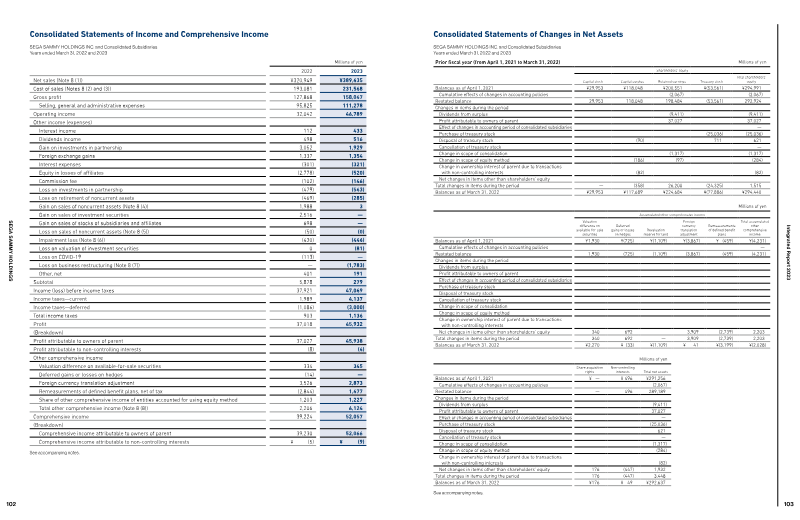
- Sega Sammy achieved its medium-term financial targets one year early, reporting net sales of ¥389.6 billion (a 21.4% increase) and operating income of ¥46.7 billion (a 45.9% increase) for the fiscal year ending March 2023.
- The company is executing a 'transmedia' strategy to leverage core intellectual properties like Sonic the Hedgehog, Like a Dragon, and Persona across gaming, film, animation, and merchandise to reach global leadership by 2030.
- Strategic growth initiatives include the development of 'Super Games,' the acquisition of Rovio Entertainment to bolster mobile gaming, and a focus on global talent acquisition.
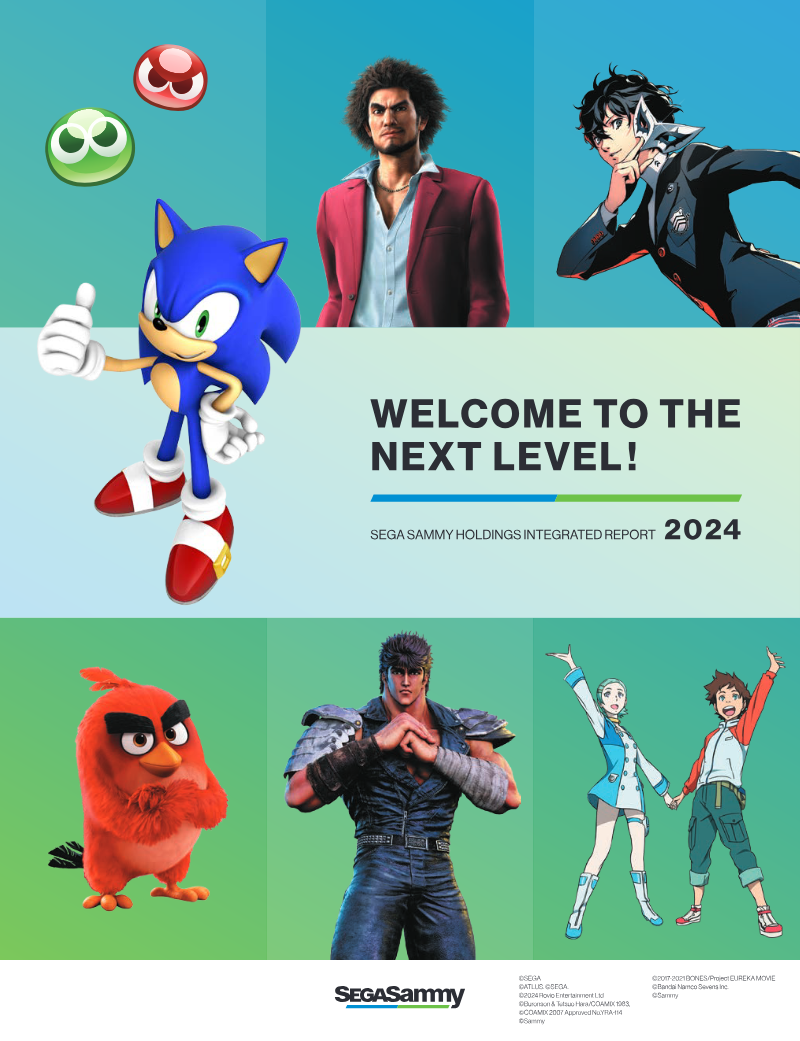
Sega Sammy Holdings Integrated Report 2024
Sega Sammy Holdings' Integrated Report 2024 outlines a strategic pivot and ambitious growth targets under its new medium-term plan, "Welcome to the Next Level!"
- Sega Sammy aims to achieve a three-year cumulative adjusted EBITDA of over ¥230 billion and an average return on equity exceeding 10% under its 'Welcome to the Next Level!' plan for fiscal years 2025–2027.
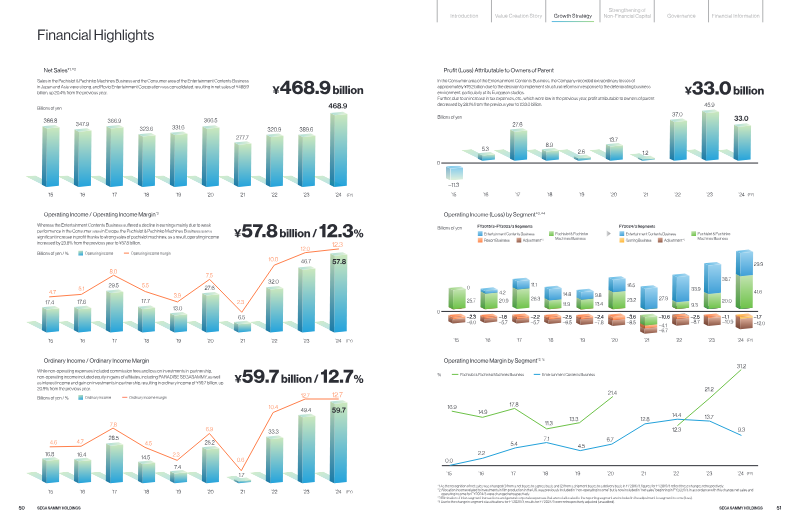
- Fiscal year 2024 financial performance showed strong growth, with net sales rising 20.1% to ¥467.8 billion and operating income increasing 21.6% to ¥56.8 billion, driven primarily by a recovery in the Pachislot and Pachinko segment.
- The company is allocating over ¥120 billion for development and ¥100 billion for strategic M&A, following recent acquisitions like Rovio and GAN and the divestment of its resort business.
AI Adoption in Video Games: Q2-Q3 2026
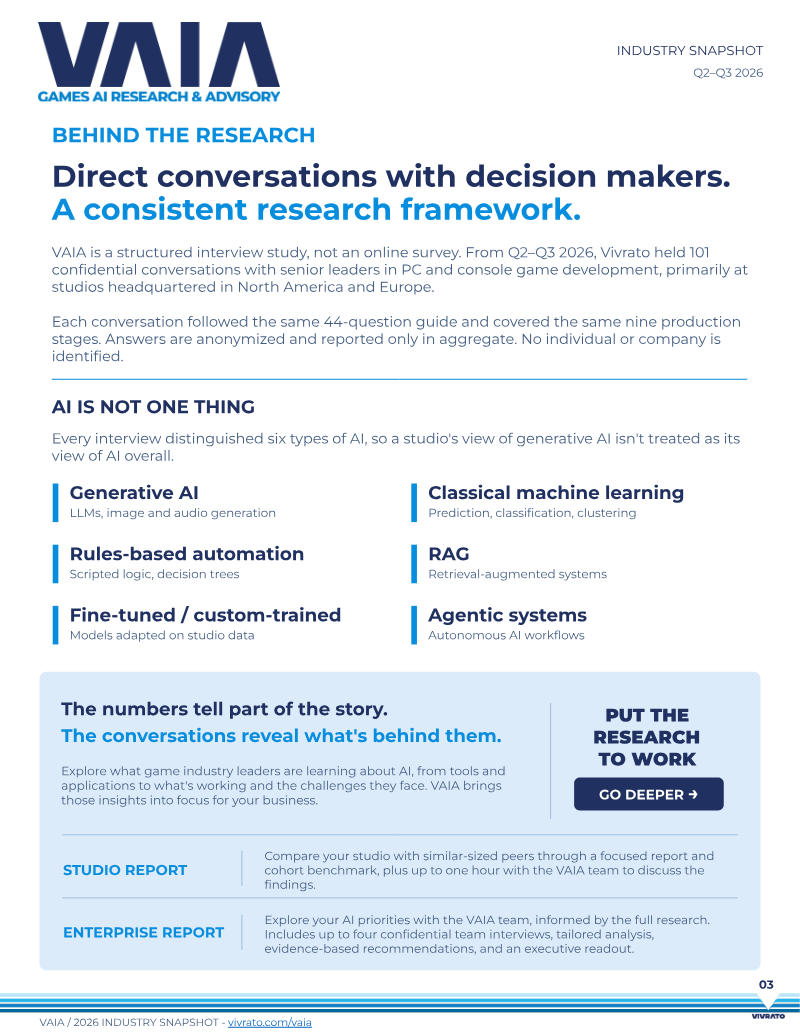
This document provides an industry snapshot of AI adoption in video game development during Q2-Q3 2026.
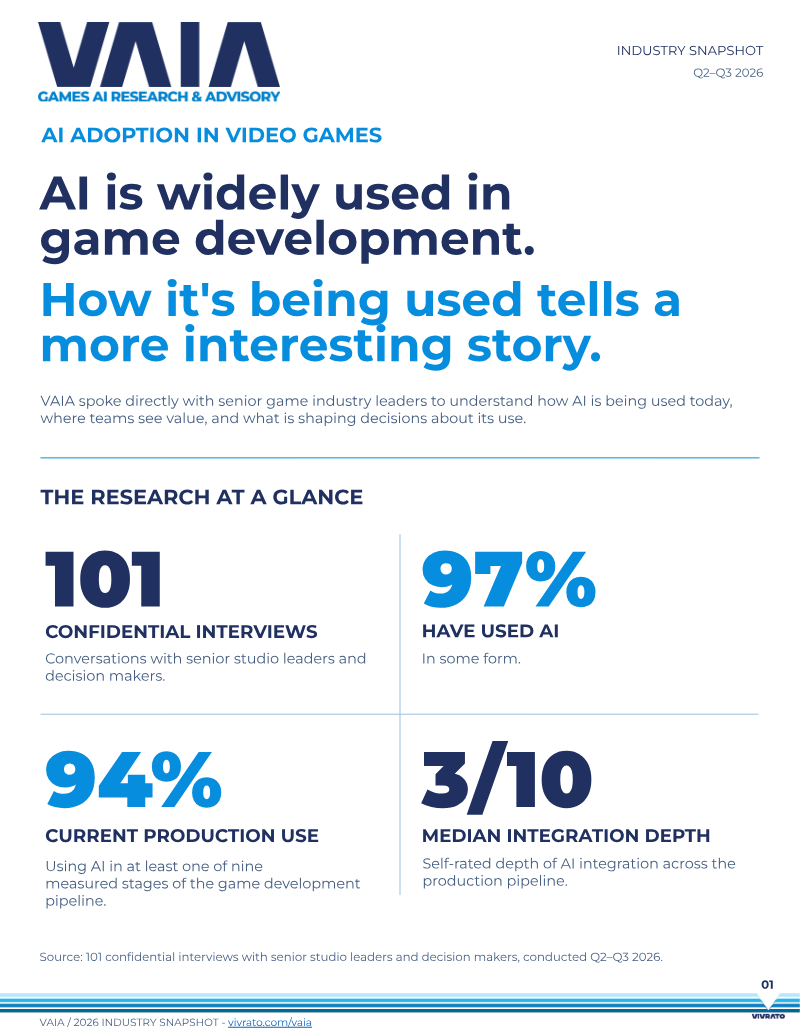
- AI adoption is nearly universal in the video game industry, with 97% of senior studio leaders reporting implementation as of mid-2026.
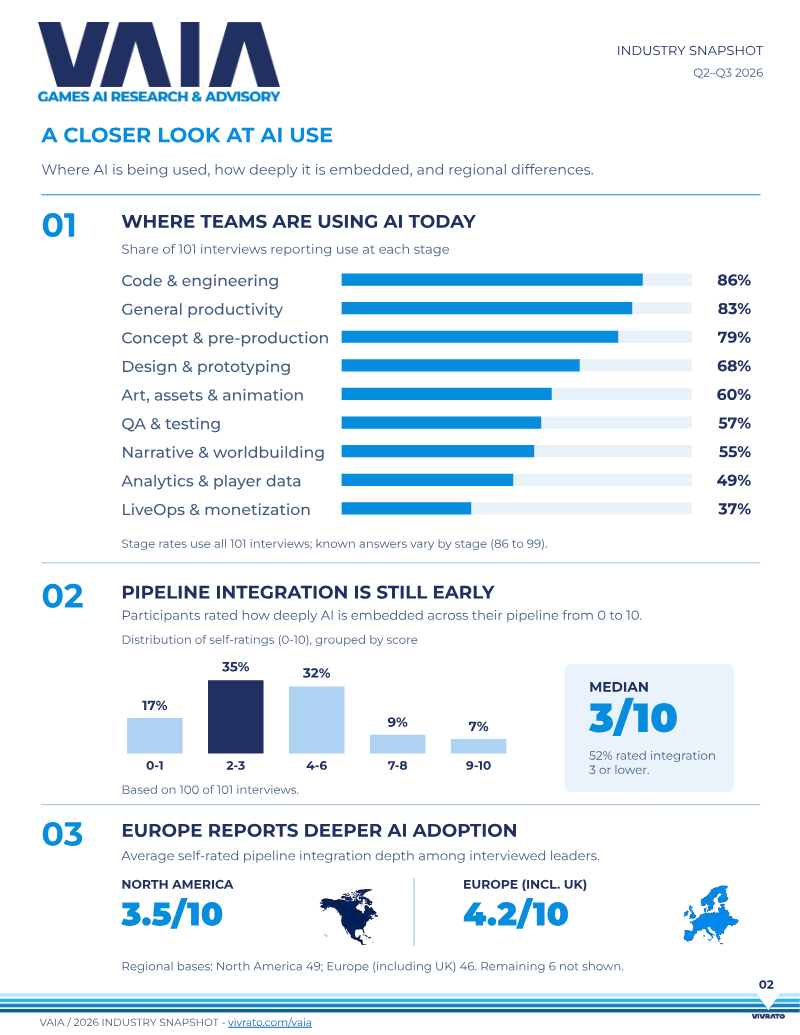
- Despite high adoption rates, AI integration remains shallow, with a median depth of only three out of ten across production pipelines.
- AI is primarily used for technical and administrative tasks, with 86% of studios using it for code and engineering, 83% for productivity, and 79% for concept and pre-production.