Key insights
4 slides
Widespread use
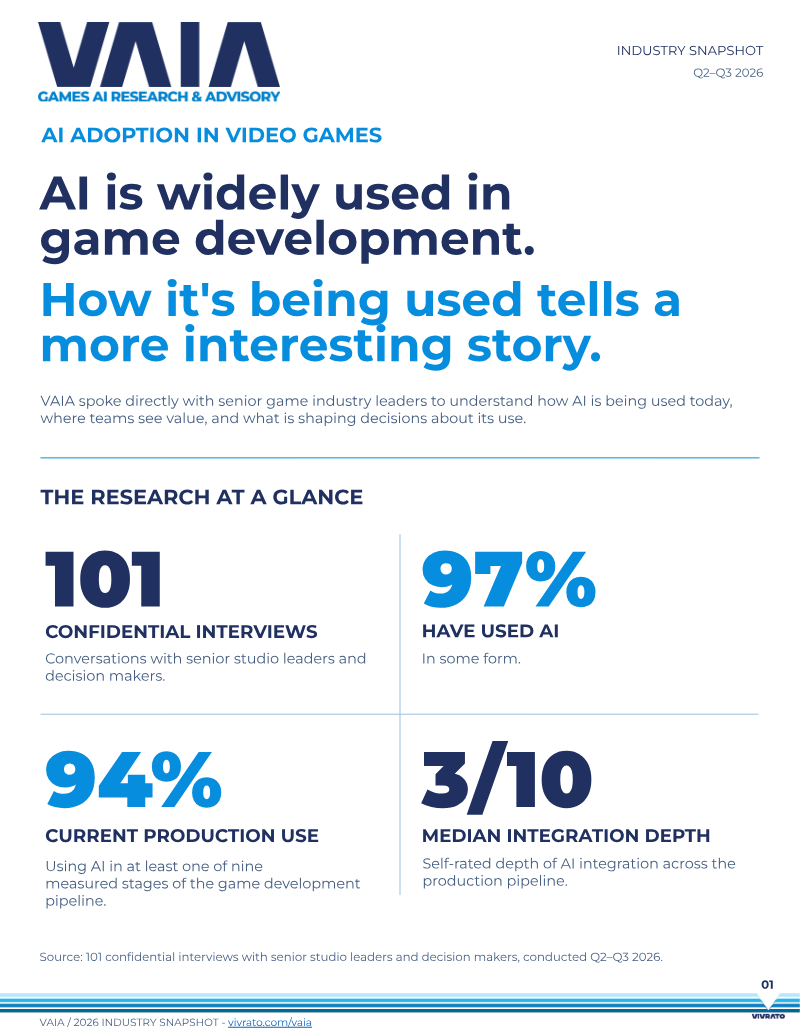
AI adoption is nearly universal in the video game industry.
As of mid-2026, 97% of senior studio leaders report some form of AI implementation.
1 / 4
- 01AI adoption is nearly universal in the video game industry, with 97% of senior studio leaders reporting implementation as of mid-2026.See it on page 1
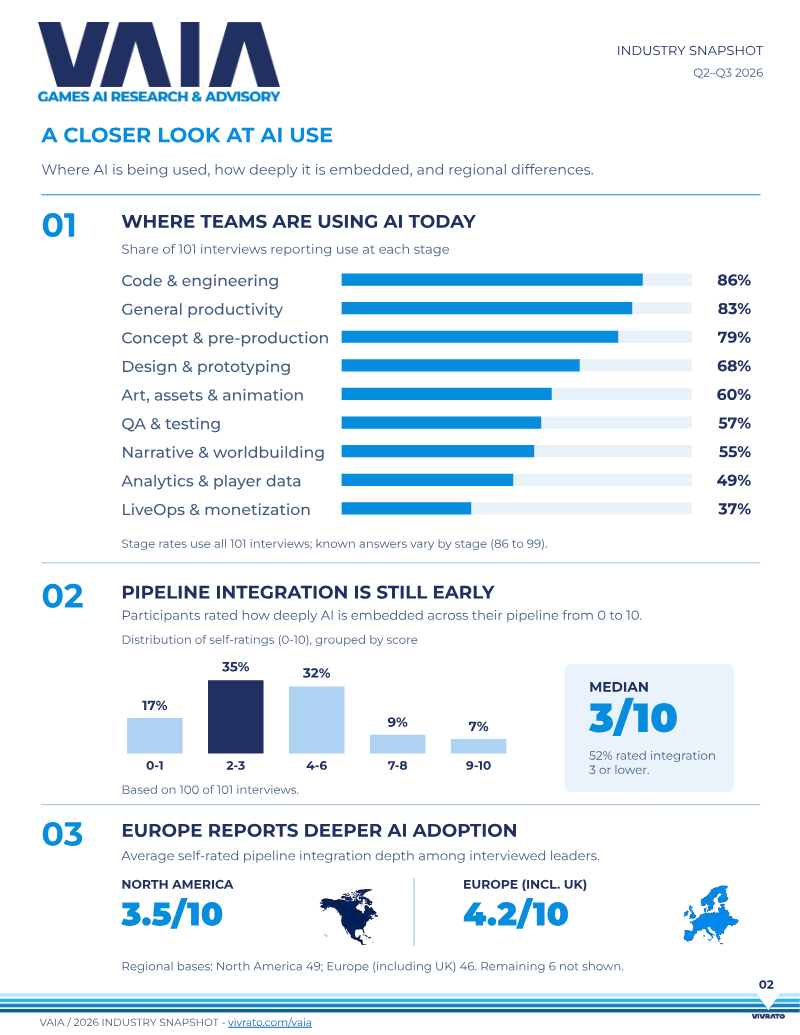
- 02Despite high adoption rates, AI integration remains shallow, with a median depth of only three out of ten across production pipelines.See it on page 2
- 03AI is primarily used for technical and administrative tasks, with 86% of studios using it for code and engineering, 83% for productivity, and 79% for concept and pre-production.See it on page 2
- 04Specialized areas like LiveOps and monetization lag significantly behind, with only 37% of studios utilizing AI in these domains.See it on page 2
- 05European studios currently show higher technological maturity, reporting an average integration depth of 4.2 out of ten compared to 3.5 in North America.See it on page 2
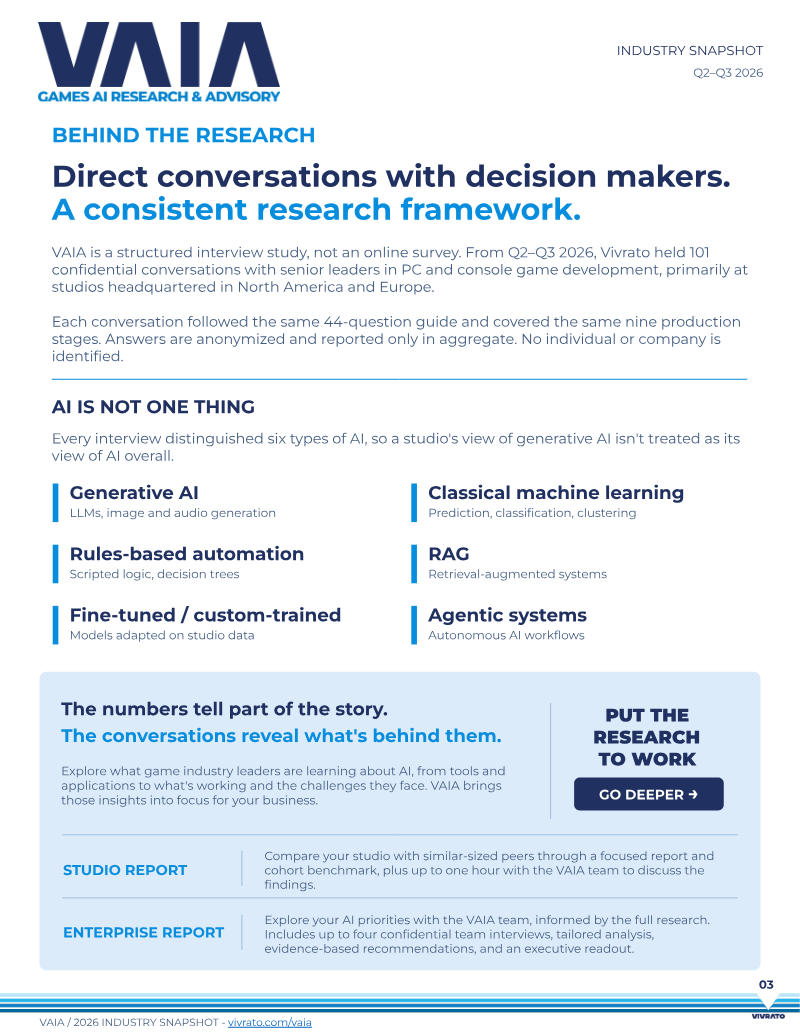
- 06Industry leaders treat AI as a multifaceted toolkit comprising six distinct categories, including generative models, agentic systems, and classical machine learning, rather than a single solution.See it on page 3
Ask AI about this report
Summary
Artificial intelligence has achieved near-universal adoption within the video game industry, with 97% of senior studio leaders reporting some form of implementation as of mid-2026. Despite this widespread usage, the integration of these technologies remains in its early stages. Most studios currently utilize AI to augment specific tasks rather than as a foundational element of their workflows, resulting in a median integration depth of only three out of ten across the production pipeline. Over half of the surveyed organizations report an integration depth of three or lower, suggesting that while AI is present, it has yet to be fully embedded into core development processes.
The research, based on 101 confidential interviews with senior decision-makers at PC and console studios across North America and Europe, reveals that AI application is most prevalent in technical and administrative domains. Code and engineering lead the adoption rates at 86%, followed closely by general productivity at 83% and concept and pre-production at 79%. Conversely, AI is less frequently utilized in specialized areas such as LiveOps and monetization, which see adoption rates of 37%. Regional analysis indicates a disparity in maturity, with European studios reporting a higher average integration depth of 4.2 out of ten compared to 3.5 in North America.
Methodologically, the study distinguishes between six distinct categories of AI, ranging from generative models and large language models to classical machine learning, rules-based automation, and agentic systems. By categorizing these technologies, the findings clarify that industry leaders view AI as a multifaceted toolkit rather than a monolithic solution. This nuanced approach highlights that while the industry has moved past the initial phase of experimentation, the path toward deep, systemic integration remains a primary focus for development teams navigating the evolving technological landscape.