Game Development reports and market data
Documents
Preserving Japanese Indie Games at BitSummit Drift 2024
This extended abstract, authored by Michael Pennington and James Newman of Bath Spa University, argues that Japan's contributions to videogame history are at serious risk of being lost, both because digital games are becoming unplayable and because English-language histories tend to privilege American and Eurocentric…
- Japan's videogame heritage is at serious risk of being lost, both because digital games are becoming unplayable and because English-language histories tend to privilege American and Eurocentric perspectives.
- A central finding is that many Japanese indie developers worry their games will become unplayable due to hardware breakage or financial constraints that prevent ongoing maintenance.
- The authors conclude that audiovisual documentation of gameplay and spectatorship is itself a meaningful form of preservation.
Exploring Collaborative Practices in Video Game Development: An Ethnographic Study
The study investigates interdisciplinary collaborative practices within medium-sized video game development studios, aiming to identify different visions of collaboration, associated challenges and opportunities, and their impact on development processes and team dynamics.
- The study identifies three collaboration models in medium-sized independent studios: object-centered ("design driven", designers act as conductors), process-centered (producers and project managers organize work), and actor-centered (interdisciplinary "strike teams" pairing specialists from different fields).
- Object-centered collaboration yields cohesion and a focus on final game quality but frustrates artists who want genuine creative input.
- Process-centered collaboration streamlines development through structured task and meeting management, but creates bottlenecks when decisions depend on a single leader.
Between Preservation and Nostalgic Fantasy: Approaches to Fanmade Remasters
This paper examines fan-made game remasters, extending existing perspectives on nostalgia and platform studies to include community modifications as a significant form of remastering, particularly for PC games.
- The paper argues that on PC platforms, file-level openness blurs the line between a mod and a remaster, letting fans produce visual and technical upgrades identical in form to official releases, and that grassroots remastering should be studied as its own practice with motivations distinct from industry work.
- More than 80% of pre-2010 games have disappeared from commercial circulation, and fan modders respond by adapting these titles to modern operating systems and hardware as a form of archiving.
- Fan projects such as Silent Hill 2: Enhanced Edition and the Echo-S 7 modification for Final Fantasy VII add high-resolution assets and full voice acting while preserving original game design, offering an alternative to official releases.
Towards Ethical Guidelines for Videogame Character Creation with GenAI
The document outlines a research initiative aimed at developing ethical guidelines for integrating Generative AI (GenAI) into videogame character creation, specifically focusing on character models and conversational AI.
- The paper argues that generative AI will play a major role in videogame development and gameplay, but that existing regulatory frameworks do not fully address the ethical challenges its use introduces.
- The authors focus on two applications: character model creation and conversational AI for non-player characters (NPCs), framing their work as a value-sensitive approach to help designers decide when and how to deploy GenAI.
- Four core values guide the proposed ethics: fairness, sustainability, transparency, and privacy protection, with fairness covering both the just distribution of AI costs and benefits and the mitigation of discriminatory bias.
Half Stress, Half Party: Play and Labor at Mattel in the Early Videogame Industry
This analysis examines the historical intersection of play and labor within the early videogame industry, specifically focusing on Mattel's operations from 1976 to 1984.
- The study argues that 'playbour' (the entanglement of work and play in contemporary game scholarship) has its roots in the toy industry, where managing creativity and commodifying fun were core business aims.
- It focuses on Mattel between 1976 and 1984, a period when the company was both the dominant toy manufacturer and an innovator in electronic and video games.
- Mattel Toys' Preliminary Design department, nicknamed the 'funny farm,' was physically and symbolically isolated from the rest of the company, combining bounded and unbounded creativity through marketing-guided brainstorming, prototyping, and evaluation.
Shaping Time in Games: Developer Approaches to Temporality
This research investigates how game developers approach and integrate temporality into video game design, aiming to understand the intersection of player experience and commercial objectives.
- The paper addresses a gap in game studies: while in-game temporal mechanisms and their manipulative effects have been analysed, the intentions and constraints behind temporal design decisions inside studios have been largely unexamined.
- The study is based on semi-structured interviews with 20 developers from AAA, mobile, indie, and live-service games across Europe, America, and Australia, each lasting roughly 45 to 60 minutes and conducted in a single round over Zoom.
- Interview topics covered pacing, player time metrics, flow, cooldowns, and menu systems, along with developers' personal experiences and views on broader industry practices.
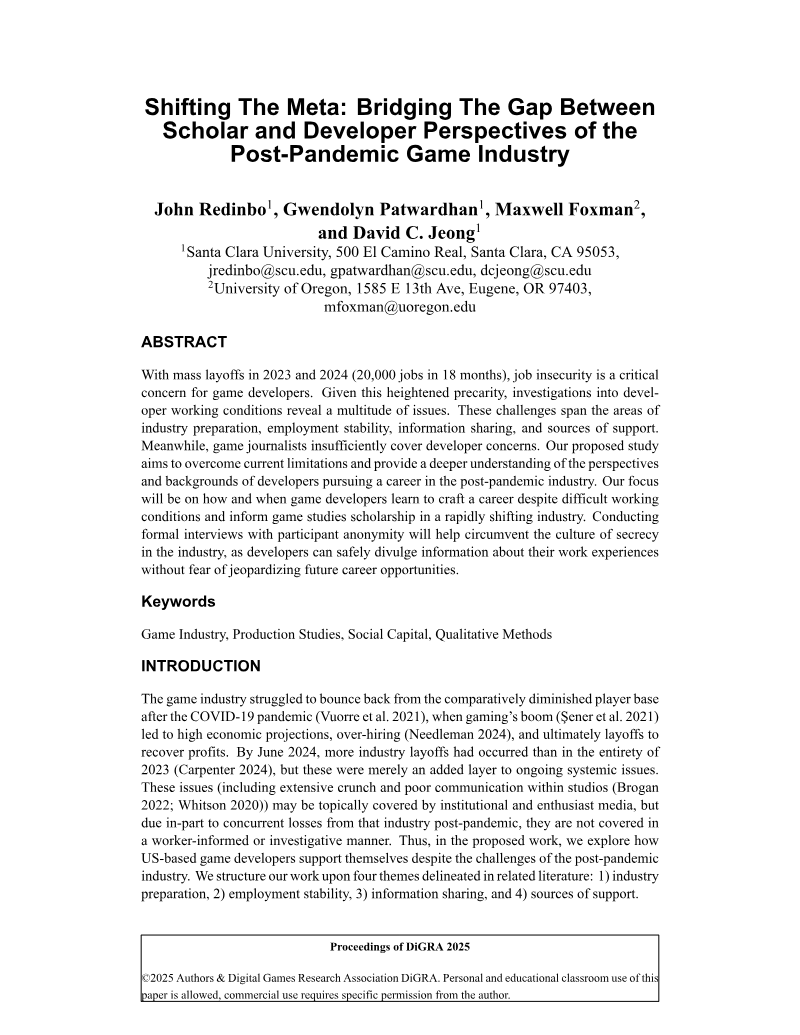
Shifting the Meta: Bridging the Gap Between Scholar and Developer Perspectives of the Post-Pandemic Game Industry
The document outlines a proposed study to investigate the perspectives and career navigation strategies of US-based game developers in the post-pandemic industry, focusing on the challenges of job insecurity and difficult working conditions.
- Mass layoffs in 2023 and 2024 eliminated roughly 20,000 game industry jobs over eighteen months, with more layoffs in the first half of 2024 than in all of 2023.
- The authors argue that persistent problems in game development, including extensive crunch, poor internal communication, and job insecurity, receive insufficient investigative coverage from institutional media, enthusiast outlets, and academic game studies.
- The proposed study is organized around four themes: industry preparation, employment stability, information sharing, and sources of support.
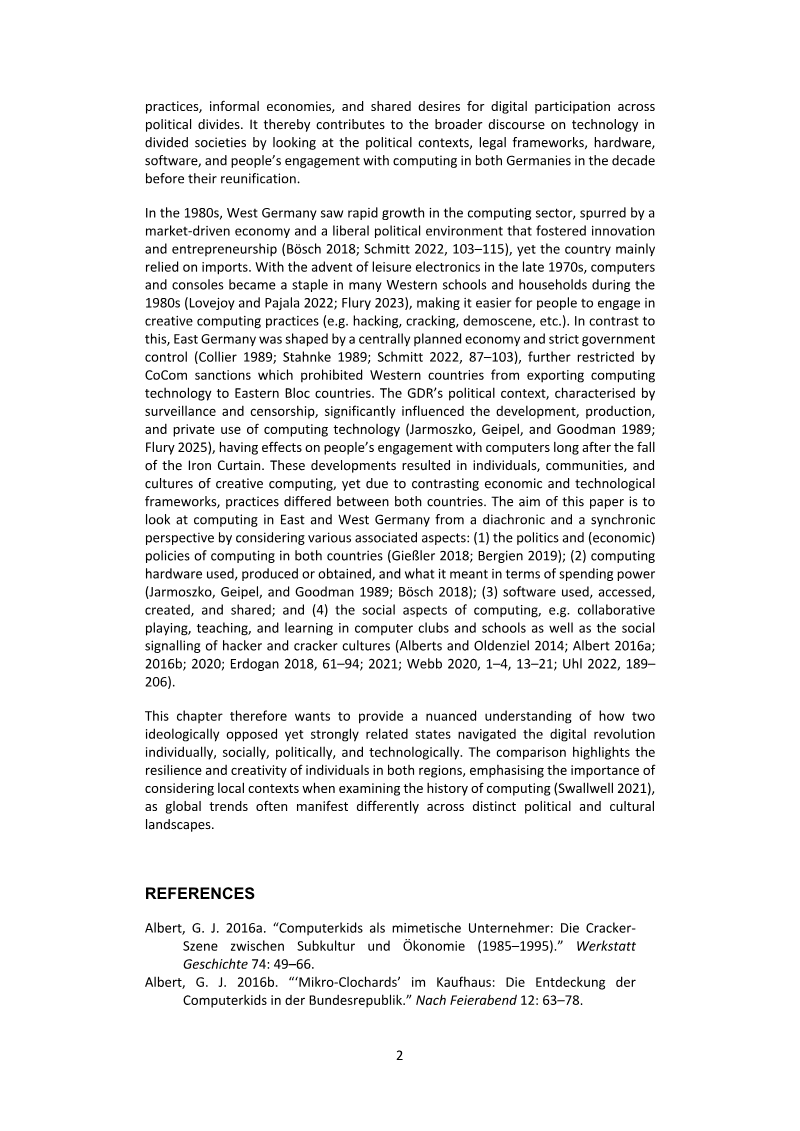
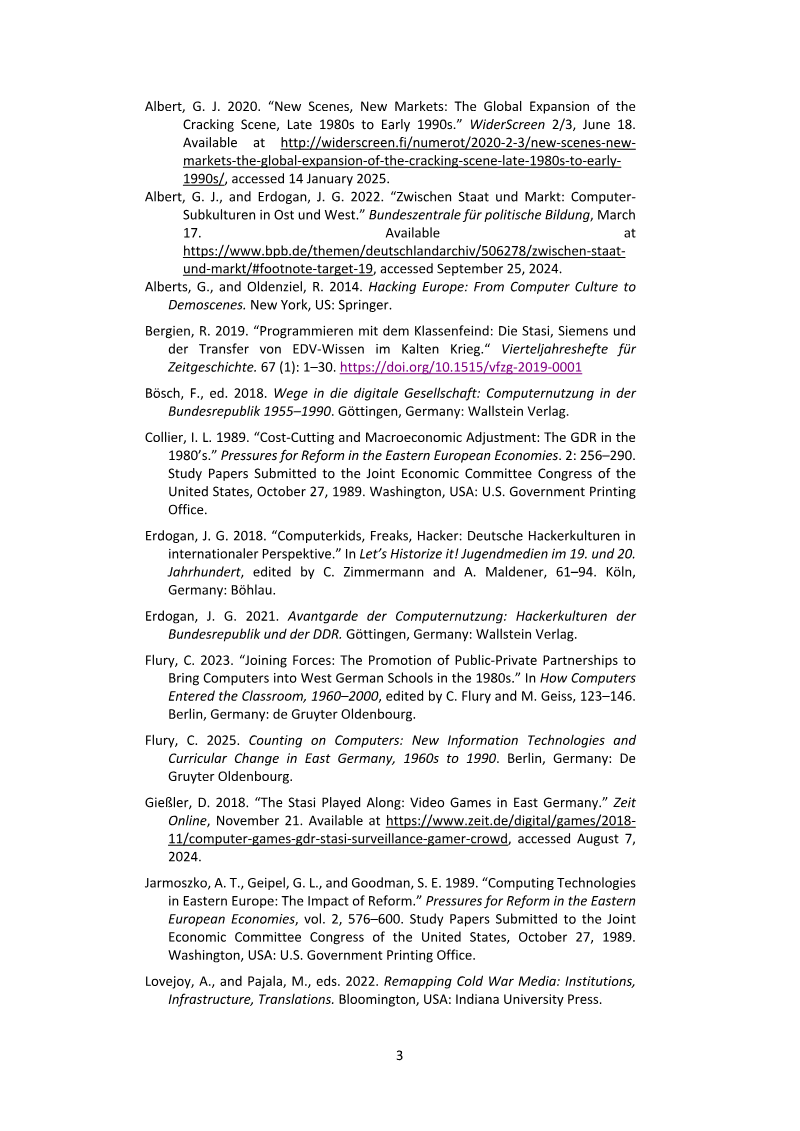
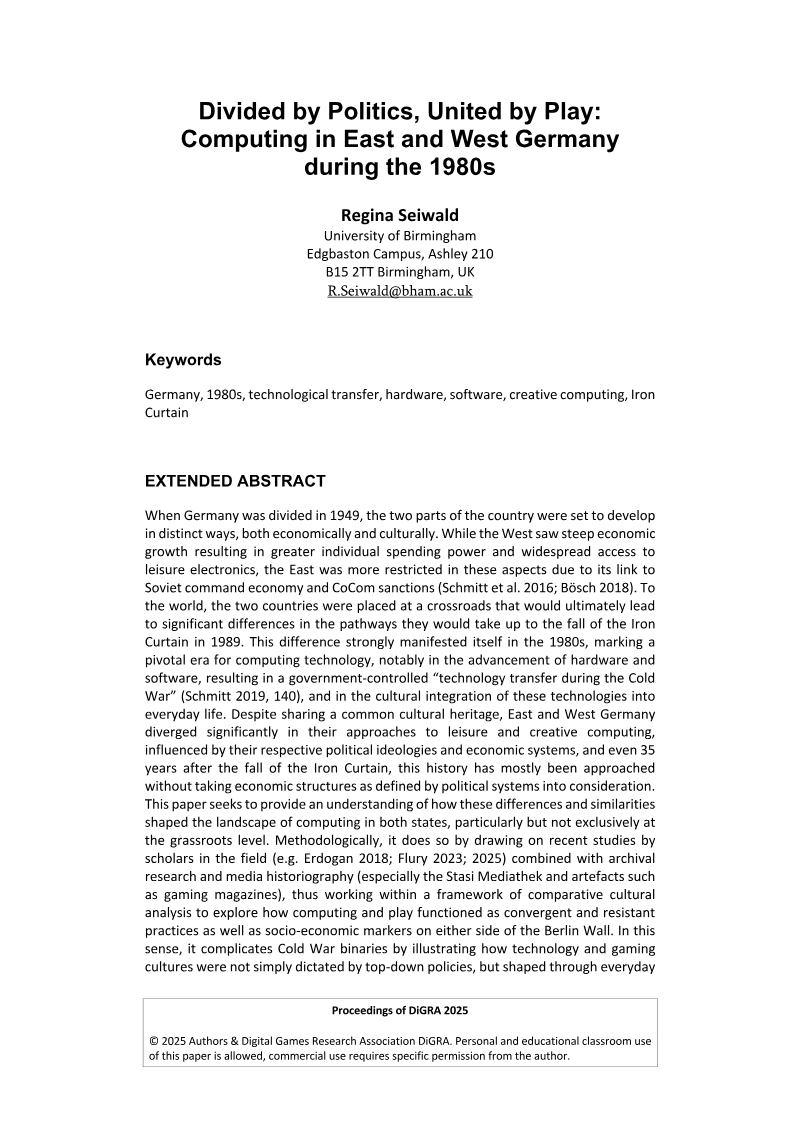
Divided by Politics, United by Play: Computing in East and West Germany during the 1980s
The document, "Divided by Politics, United by Play: Computing in East and West Germany during the 1980s," examines the divergent and convergent paths of leisure and creative computing in East and West Germany during the 1980s, a pivotal decade for computing technology.
- The paper argues that computing and gaming culture in 1980s East and West Germany diverged because of contrasting political and economic systems, yet both sides shared a desire for digital participation across the Berlin Wall.
- West Germany's market-driven, liberal economy produced rapid growth in the computing sector and widespread household and school adoption of consoles and computers.
- East Germany's centrally planned economy, strict state control, surveillance, censorship, and CoCom export sanctions on Western computing technology severely constrained access to hardware and software.
Feasible Antiquity: Ancient History in the Unity, Unreal, Godot and itch.io Asset Stores
The document examines the presence and representation of ancient history within prominent game development asset stores, specifically Unity, Unreal Engine, Godot, and itch.io.
- The paper argues that the online asset stores (Unity Asset Store, Unreal Engine Marketplace/Fab, Godot Asset Marketplace, and itch.io) act as museal spaces that present curated, individual historiographies of antiquity, functioning as 'infrastructures of imagination' and 'mediators of historical culture'.
- Greek, Roman, Egyptian, and Norse assets are abundant in these stores yet have received little scholarly attention, despite their relevance to historical game studies.
- The authors propose the concept of 'feasible antiquity' to describe how ready-made assets give small or resource-limited teams affordable routes to history-focused projects.
Planting World Seeds: Procedural Content Generation, Labour and Conceptual Art in Digital Games
The document "Planting World Seeds: Procedural Content Generation, Labour and Conceptual Art in Digital Games" analyzes the distinct forms of Procedural Content Generation (PCG) in digital games, differentiating between "Runtime PCG" and "Development PCG" to explore their implications for automation, aesthetics, and labor…
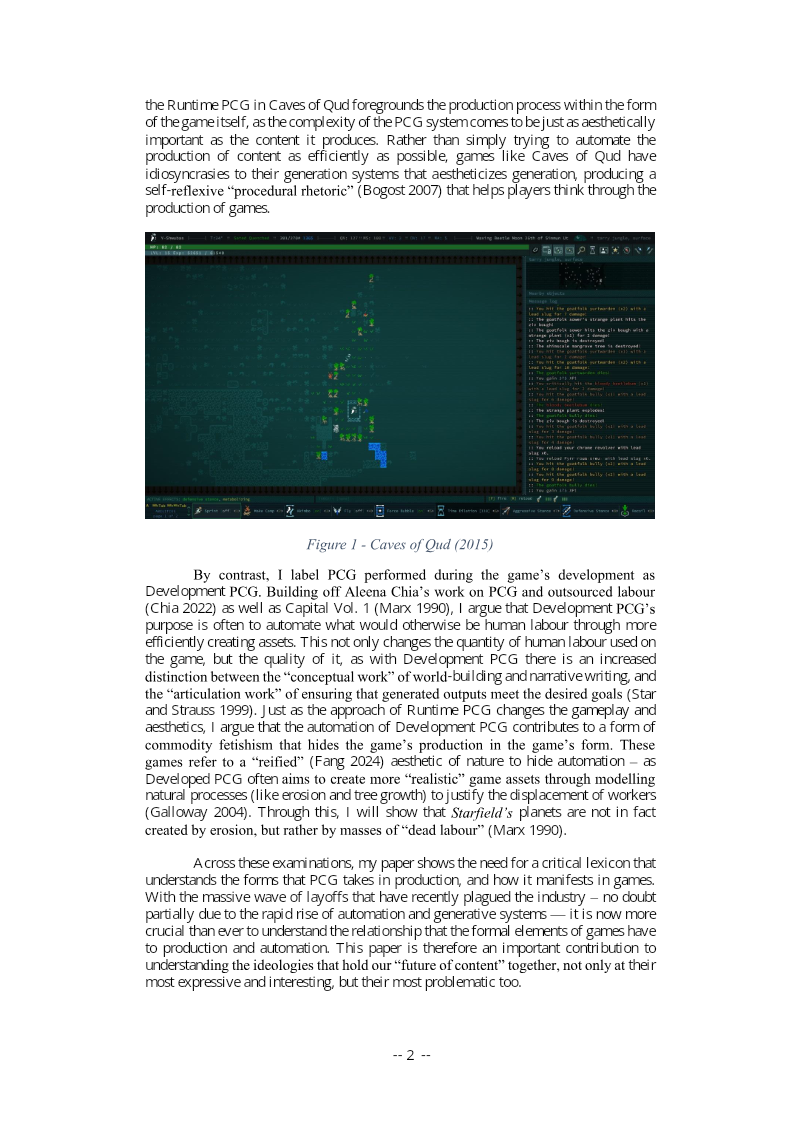
- The paper argues that 'procedural content generation' conflates two distinct forms: Runtime PCG, where worlds are generated during play and foreground the production process, and Development PCG, where assets are generated during production and never directly seen by players.
- The central claim is that Development PCG primarily automates human labour, separating conceptual world-building from the articulation work needed to make generated outputs meet production goals.
- Drawing on Marx and scholarship on automation and outsourced labour, the author contends that Development PCG often adopts a 'reified' aesthetic of nature, modelling erosion and tree growth so generated assets appear realistic and thereby concealing the labour involved.
"We'll Always Go with What's More Sustainable": Understanding the Financialised Logics of Game Development
This study investigates how monetisation decisions are made within the video game industry, focusing on the underlying financialized logics and precarious labor conditions that shape these choices.
- Monetisation decisions in game development are driven largely by economic sustainability, studio continuity, and employment security rather than profit maximisation alone, particularly in independent and small-scale studios.
- The study is based on semi-structured interviews with 20 industry professionals, including developers, publishers, funders, industry representative bodies, and union leaders, with most developer participants based in Australia and working at independent studios.
- Managers prioritise generating enough revenue to pay employees a living wage and fund future projects, while non-managerial developers prioritise stable employment in the industry.
Indie vs. AAA: A Model for the Educational Potential of Artificial Intelligence in Video Games
The document presents a work-in-progress model exploring the educational potential of artificial intelligence (AI) in video games, comparing indie and AAA game development approaches.
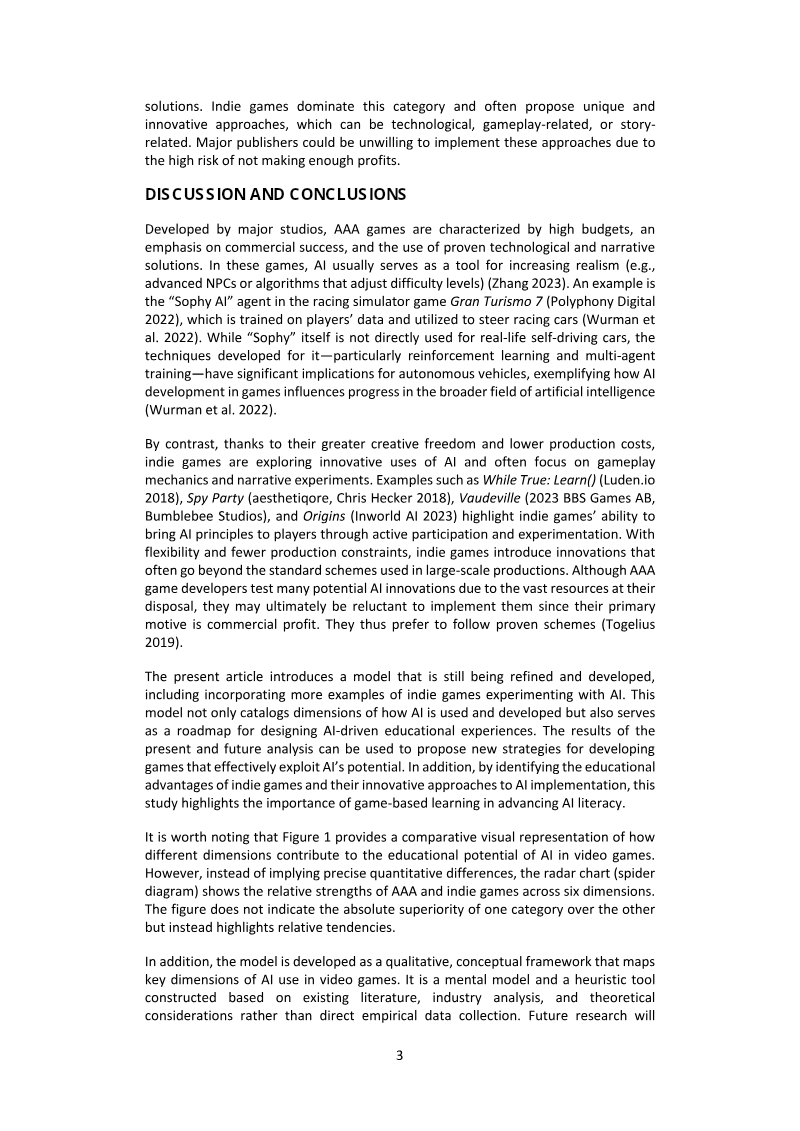
- The paper's central thesis is that indie games, owing to greater creative freedom, lower production costs, and willingness to experiment, offer stronger opportunities for players to learn AI principles through active engagement, while AAA productions excel in scale, resources, and sophisticated AI deployment.
- The work is a qualitative, heuristic, work-in-progress conceptual model built from existing literature, industry analysis, and theoretical reasoning, not from direct empirical data, so its radar-chart comparison indicates relative tendencies rather than precise differences.
- The model is organized around six interrelated dimensions: type of data used for AI training, degree of AI personalization, cost and resources, overall AI development focus, scale of AI application, and experimental approach.