Game Development reports and market data
Documents

How Hitman’s wasteful toilets taught IO Interactive to make sustainable AAA games
IO Interactive’s current strategic trajectory centers on achieving sustainable AAA game development by prioritizing production efficiency and long-term franchise value over rapid, wasteful expansion.
- IO Interactive transitioned to a modular 'brick system' for the World of Assassination trilogy, allowing the reuse of foundational technology and assets to significantly reduce development costs across sequels.
- The studio prioritizes sustainable AAA development by focusing on iterative, service-based single-player experiences rather than rapid, wasteful production cycles.
- IO Interactive is applying its efficiency-focused development model to the upcoming 007 First Light, scheduled for release in 2026.
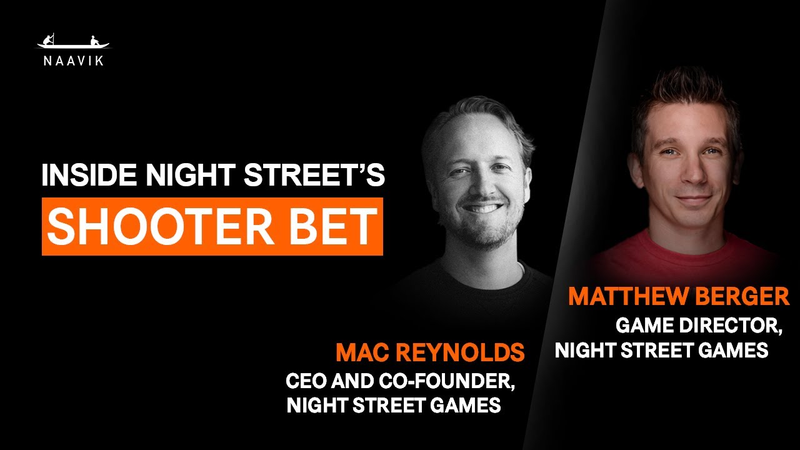
From Imagine Dragons Fame To Night Street’s Shooter: Last Flag
Night Street Games is carving a distinct niche within the competitive 5v5 hero shooter market through the development of its flagship title, Last Flag.
- Night Street Games has scaled from a small prototype team to a 50-person studio by fully integrating their outsourced partners into the core company structure to maintain cultural and creative alignment.
- The studio differentiates its 5v5 hero shooter, Last Flag, by prioritizing a capture-the-flag core loop over traditional shooter mechanics and embedding music into the gameplay to drive immersion.
- To compete in the oversaturated PC shooter market, the studio follows a strategy of avoiding direct competition with established titles like Overwatch, instead focusing on unique mechanics that appeal to a specific core player segment.

How Two of the Most Hyped Game Studios Became Cautionary Tales
The gaming industry is currently witnessing a wave of high-profile studio failures and performance struggles, driven by unsustainable spending, lack of oversight, and a misalignment between venture capital models and AAA game development.
- The venture capital model, characterized by rapid scaling and exit strategies, is fundamentally misaligned with the long, capital-intensive development cycles required for AAA gaming.
- The Believer studio closed in under two years after burning through $55 million in funding without delivering a viable product, demonstrating the risks of providing large capital injections without rigorous milestone-based oversight.
- Build A Rocket Boy, despite raising hundreds of millions in capital, failed to achieve market success due to poor execution, outdated gameplay, and the departure of key executive leadership.
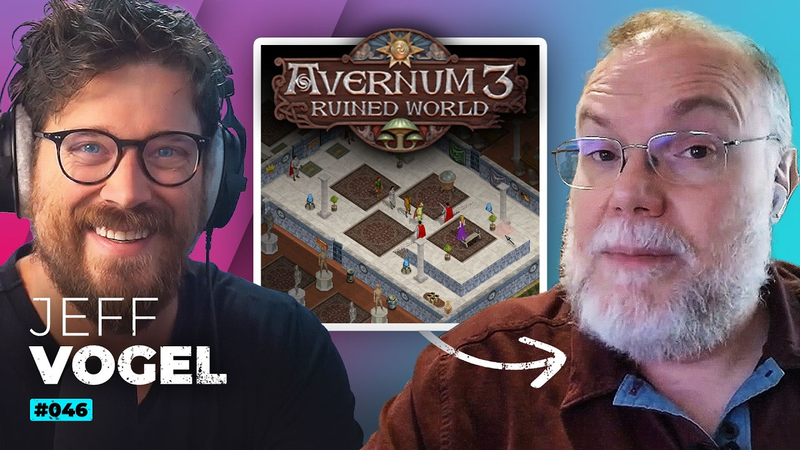
Jeff Vogel: Making Games Alone For 30 Years, Unity vs Custom Engine, Indie Survival | Ep. #046
Long-term survival in the independent game industry is best achieved by prioritizing sustainable business practices and niche creative focus over the pursuit of fleeting commercial trends.
- Survival as a solo indie developer for over 30 years is best achieved by cultivating a loyal, niche audience rather than chasing commercial hits.
- A sustainable indie business model relies on a large back catalog of titles and direct fan support through platforms like Kickstarter, which provides financial stability during industry downturns.
- Jeff Vogel’s studio, Spiderweb Software, has released 25 retro RPGs since 1994 by prioritizing consistent, manageable production over high-polish, high-risk projects.

Let's Review Your Games — Ep. 015
Independent game development success relies on a strategic balance between technical polish, atmospheric immersion, and aggressive marketing.
- The Steam store page acts as the primary 'book cover' for a game, and its quality is often more critical to commercial success than the game itself.
- Developers must capture player attention within the first 30 seconds of gameplay to prove the title is unique and engaging.
- Physics-based interactions, such as collecting items, require precise collision detection; using box or sphere colliders instead of complex mesh colliders improves player experience.

TWIG #336 Candy Crush Veterans Return as Marathon Runs Out of Steam
The global gaming industry is currently navigating a period of significant structural correction characterized by stagnant revenue growth, the collapse of over-leveraged studios, and a shift in consumer attention toward non-gaming entertainment.
- The mobile gaming sector has plateaued with a 4% year-over-year revenue increase, shifting the competitive focus from innovation to sophisticated monetization strategies.
- The traditional AAA development model is under severe pressure, as high-budget, single-title projects frequently fail to achieve market fit, leading to widespread studio closures and restructuring.
- Industry success is increasingly driven by a publishing-led model that mitigates risk through multiple product bets rather than the high-risk, single-title focus of the previous decade.

Are You Making Your First Game? Here's What A 30 Year Veteran Says...
The primary thesis for sustainable indie game development centers on the necessity of balancing artistic integrity with pragmatic business constraints.
- Prioritize project completion and financial viability by balancing artistic integrity with pragmatic resource management rather than pursuing perfectionism.
- Treat time as your most valuable asset by identifying which tasks require deep investment and which can be streamlined through asset reuse or simplified design.
- Define project success by your own internal standards of craftsmanship rather than attempting to meet external industry definitions of perfection.

The Legacy of Call of Duty
The Call of Duty franchise serves as a primary case study for long-term success in the gaming industry, driven by a transition from scrappy, small-team development to a disciplined, multi-studio powerhouse.
- Treyarch maintained high levels of team cohesion and motivation by fostering a culture where 50% of the studio staff had been employed for 10 years or more.
- The success of the Black Ops series was driven by a 'challenger' mindset, where the team intentionally took creative risks and innovated rather than simply iterating on existing mechanics.
- Treyarch's development success relied on a world-class production team that maintained constant visibility into project status and costs, allowing leadership to right-size development and avoid becoming 'underwater'.

291. AI in Games: Innovation or Ethical Time Bomb? With George Ng, CTO of GGWP
Artificial intelligence is fundamentally reshaping the gaming industry by acting as a powerful catalyst for operational efficiency while simultaneously introducing profound ethical risks.
- AI is currently serving as a supplementary tool for operational efficiency in prototyping, asset creation, and narrative design rather than a replacement for human creative vision.
- The industry expects only incremental efficiency gains over the next two years rather than a total paradigm shift in game development.
- AI-driven monetization strategies, such as hyper-personalized matchmaking and variable drop rates, pose significant ethical risks by potentially prioritizing engagement over player well-being.
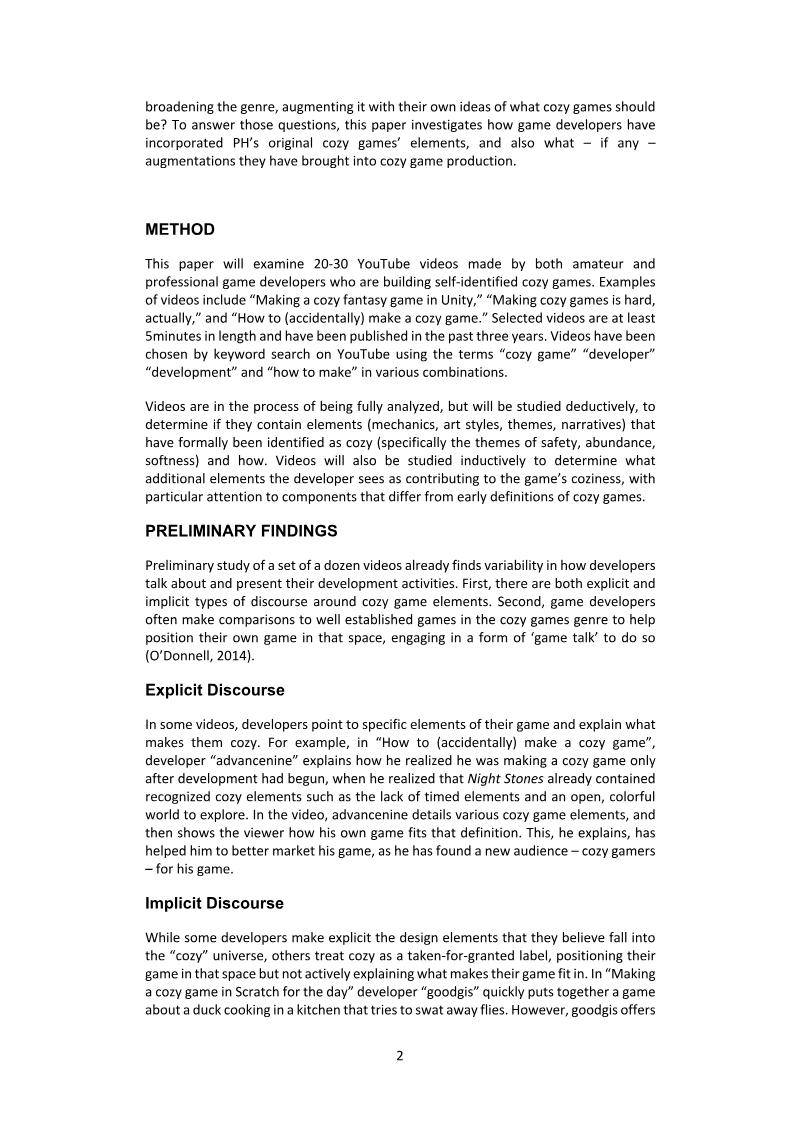
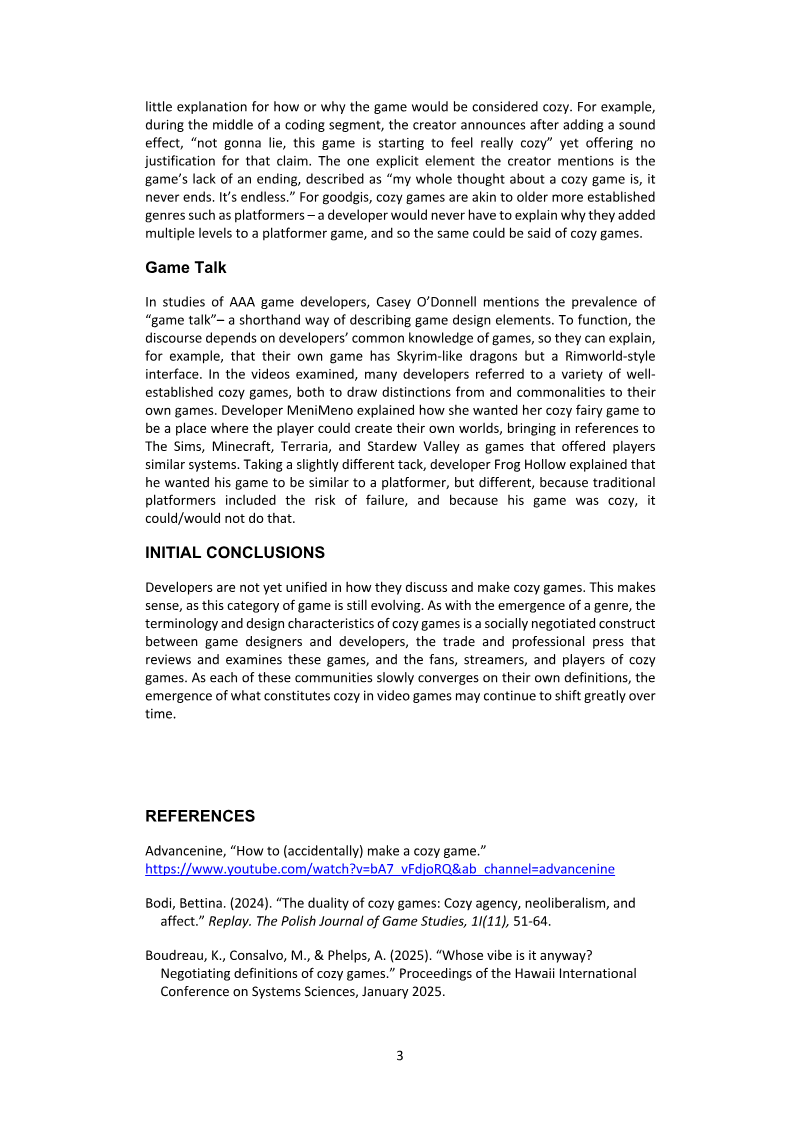
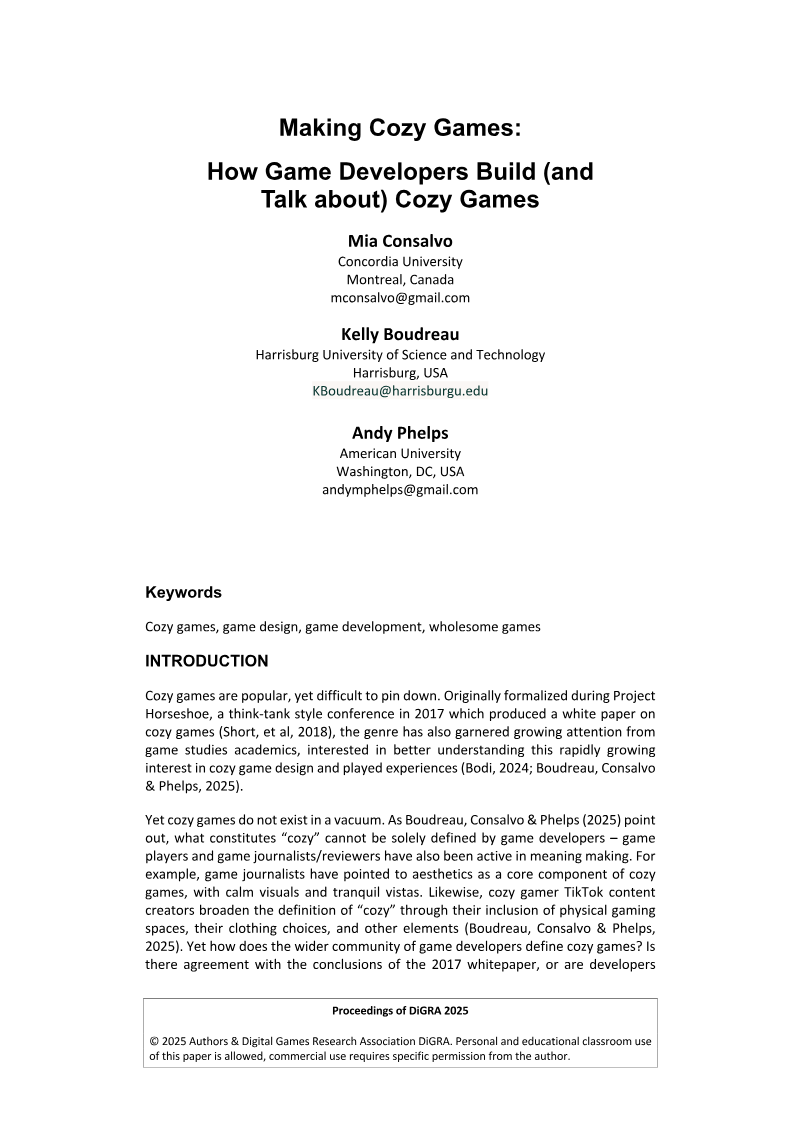
Making Cozy Games: How Game Developers Build (and Talk About) Cozy Games
The document investigates how game developers define and incorporate "cozy" elements into their games, building upon existing academic and industry definitions.
- The genre's cozy framework traces to a 2017 Project Horseshoe white paper that formalized the themes of safety, abundance, and softness, and the genre has since attracted scholarly attention.
- The study qualitatively analyzes 20 to 30 YouTube development videos (each at least five minutes long and published within three years), combining deductive coding against the established cozy themes with inductive analysis of additional elements developers cite.
- Preliminary findings from roughly a dozen videos show developers discuss cozy design in two modes: some explicitly name design elements such as the absence of timed pressure or an open, colorful world and use them in marketing, while others treat "cozy" as a self-evident label with little justification.
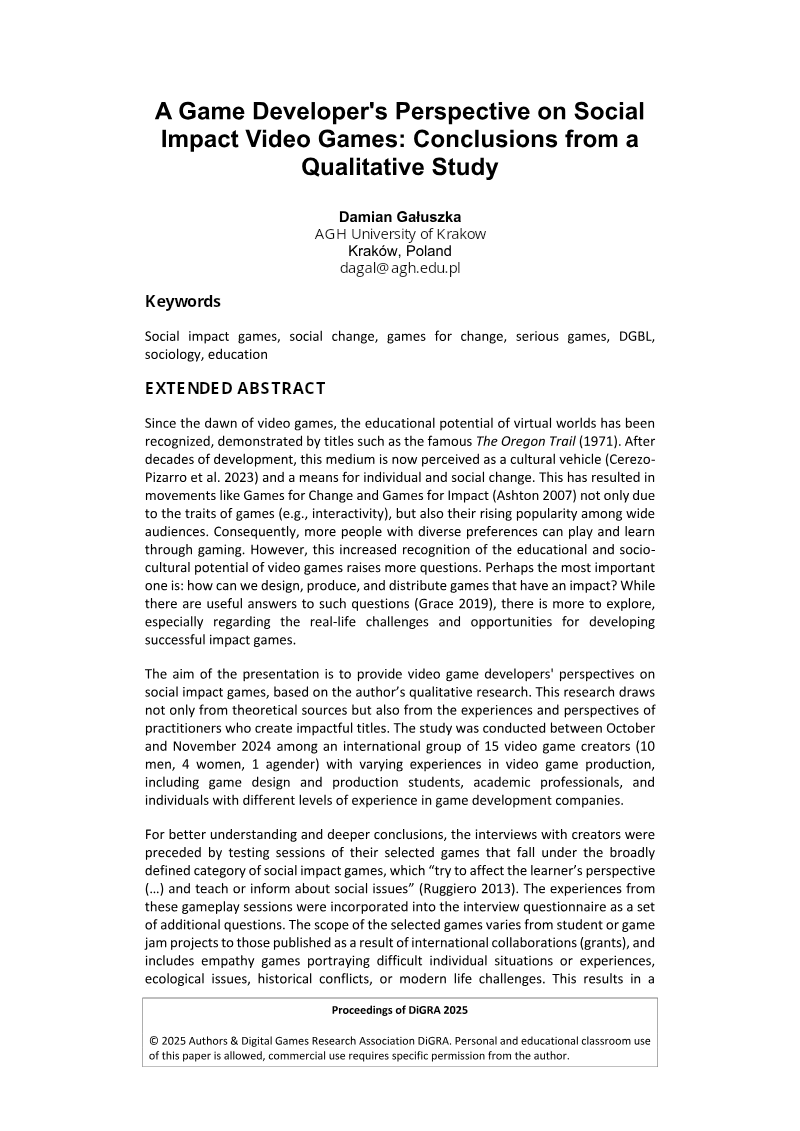
A Game Developer's Perspective on Social Impact Video Games: Conclusions from a Qualitative Study
The document outlines a qualitative study investigating video game developers' perspectives on social impact games.
- The study is a qualitative interview-based inquiry with 15 international game creators (students, academics, and industry professionals), conducted in October and November 2024.
- Participants' games were playtested before interviews, and observations from those sessions were incorporated into a questionnaire of more than forty questions.
- The games studied span student and game jam projects to internationally funded collaborations, covering empathy-driven portrayals of personal hardship, ecological concerns, historical conflicts, and contemporary social challenges.
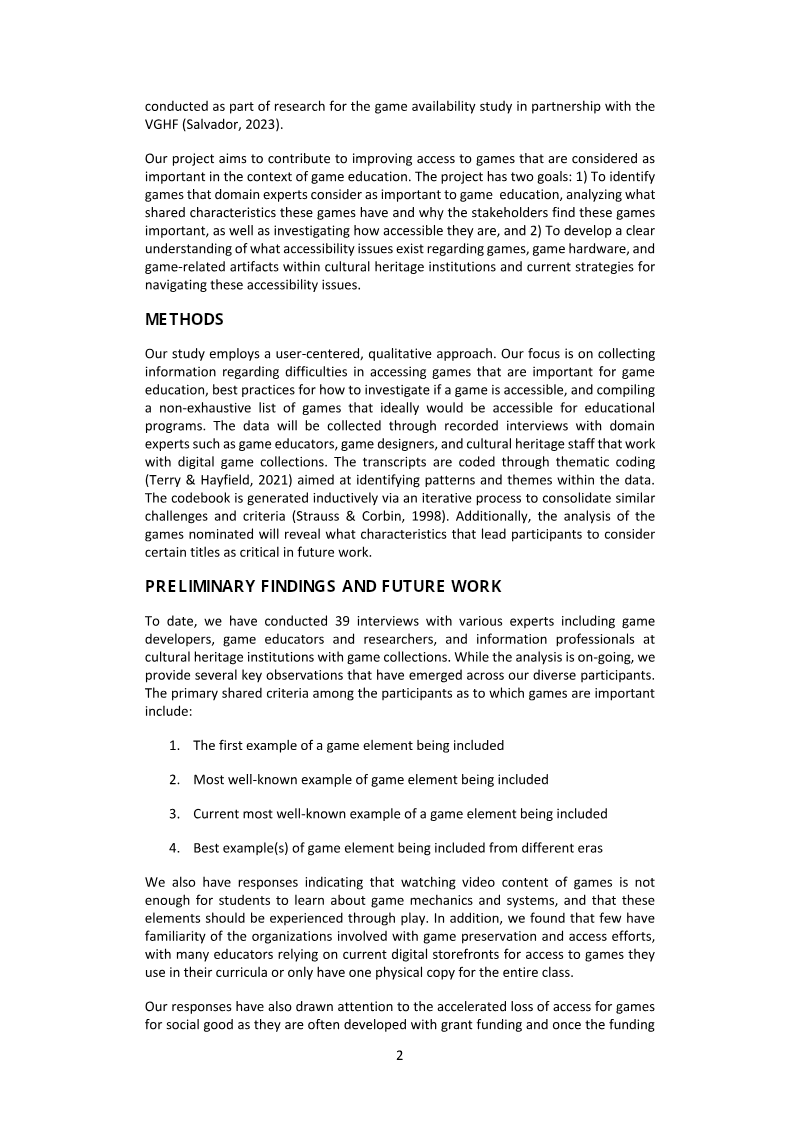
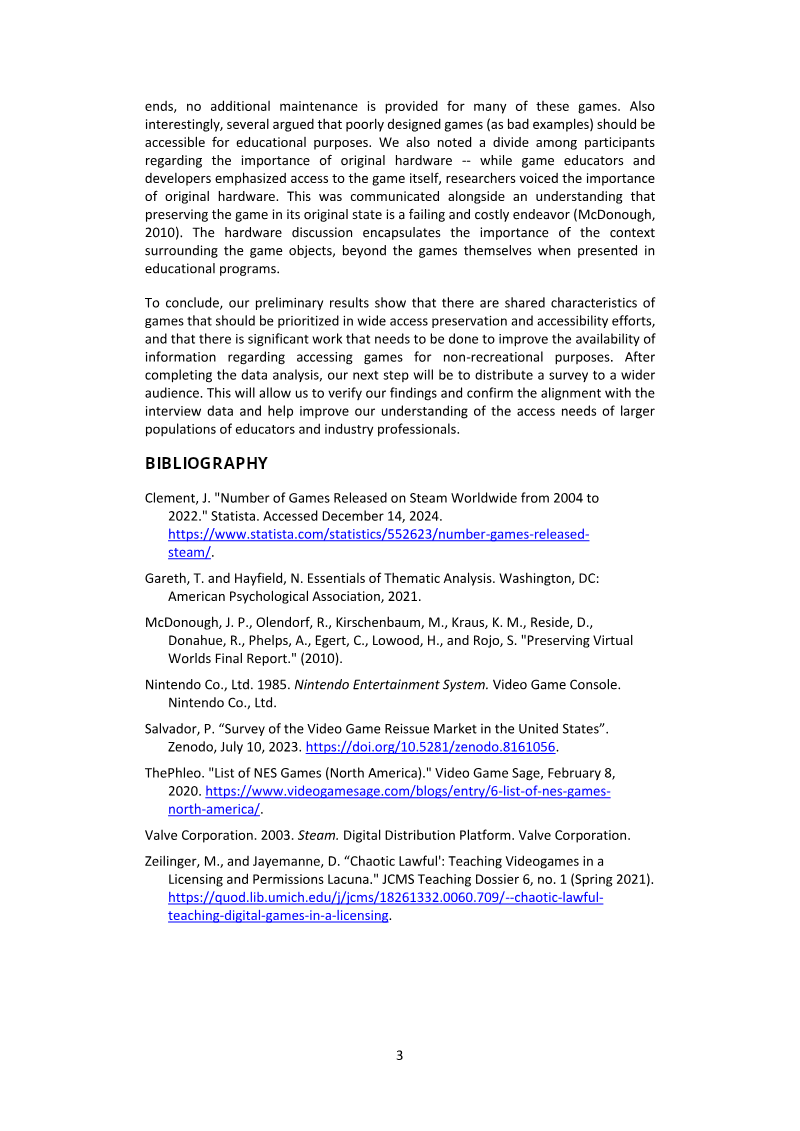
The Lost 87%: Towards Improved Access to Games for Game Design Education
The document addresses the critical issue of limited access to a diverse range of video games for game design education, highlighting that only 13% of legacy games are reasonably accessible.
- Access to legacy games for education is restricted in part by the Digital Millennium Copyright Act, which confines libraries and cultural heritage institutions to on-site digital access and pushes educators toward whatever games remain easily obtainable rather than the most instructive ones.
- The Video Game History Foundation found that only 13 percent of legacy games are reasonably accessible, while roughly 10,963 titles were released on Steam in 2022 alone, compared with an average of about 84 titles per year for the Nintendo Entertainment System.
- Based on 39 interviews with developers, educators, researchers, and cultural heritage professionals, experts prioritize games that were the first, best-known, current best-known, or best representatives of a given design element across eras.