1 free read left. Create a free account for unlimited reading + AI research.
Create free accountWhitepaper DiGRA
1 free read left. Create a free account for unlimited reading + AI research.
Create free accountWhitepaperDiGRA
Prior work has analysed in-game temporal mechanisms and their manipulative effects. The intentions and constraints behind those decisions inside studios have received far less attention.
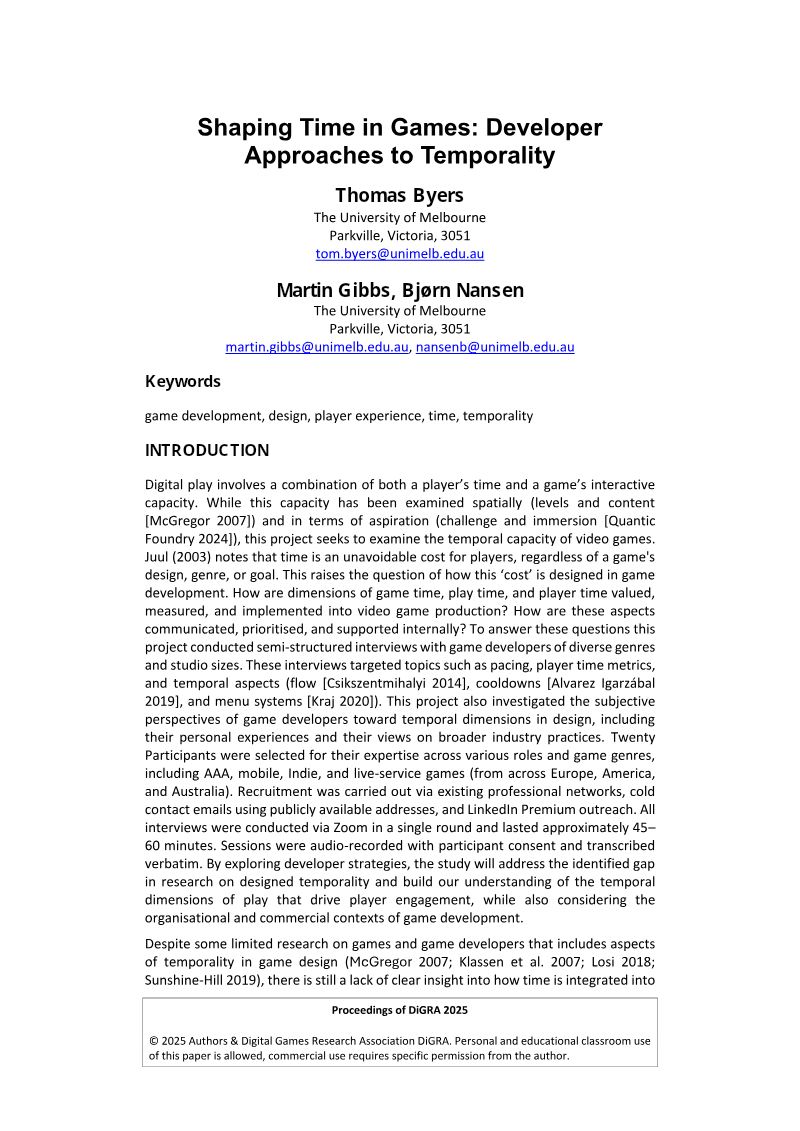
This paper, presented at DiGRA 2025 and authored by researchers at the University of Melbourne, investigates how game developers conceptualise, measure, and implement time in video game design. Its central premise is that while spatial and motivational aspects of games have received considerable scholarly attention, the temporal dimension, which Juul describes as an unavoidable cost to every player, remains under-examined from the perspective of production. The authors argue that existing work has largely analysed in-game temporal mechanisms or the potentially manipulative effects of design, whereas little is known about the intentions and constraints that shape temporal design decisions within studios.
The study is based on semi-structured interviews with twenty developers drawn from AAA, mobile, indie, and live-service games across Europe, America, and Australia. Interviews lasted roughly 45 to 60 minutes, were conducted over Zoom in a single round, and were transcribed verbatim. Topics included pacing, player time metrics, flow, cooldowns, and menu systems, as well as developers' personal experiences and views on broader industry practices. Recruitment drew on professional networks, cold outreach, and LinkedIn, and the paper does not report a formal sampling framework beyond participant expertise across roles and genres.
The authors frame their contribution around the tension between player experience and commercial objectives such as marketability, production efficiency, and team coordination. They cite prior industry accounts, including a Freemium-focused talk stating that time is the core currency of live games and an emphasis on qualitative engagement over retention metrics, to illustrate that these priorities often overlap and sometimes conflict within the same design process. The stated aim is to build a framework grounded in real-world practice that can inform ethical temporal design and serve both developers and researchers.

DiGRA · 2026

DiGRA · 2026



DiGRA · 2026



DiGRA · 2026



DiGRA · 2026



DiGRA · 2026



DiGRA · 2026



DiGRA · 2026

DiGRA · 2026



DiGRA · 2026



DiGRA · 2026

DiGRA · 2026
Extra Credits · 2026