Game Development reports and market data
Documents
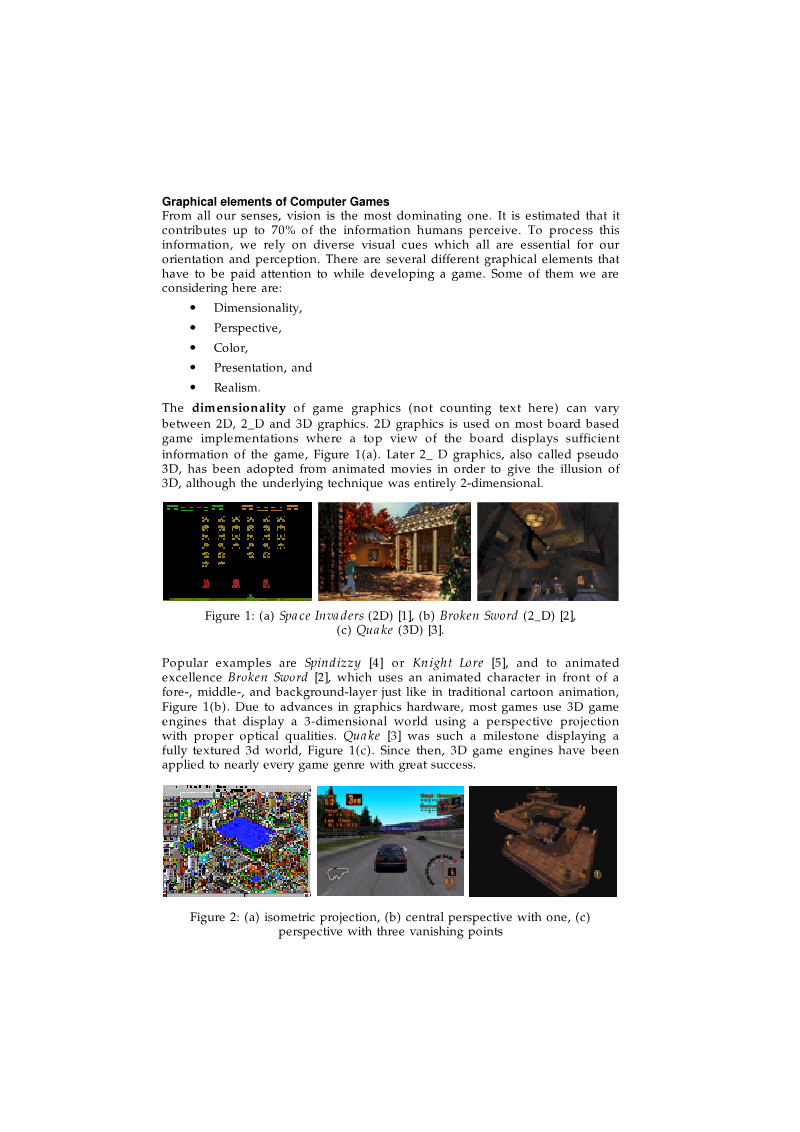
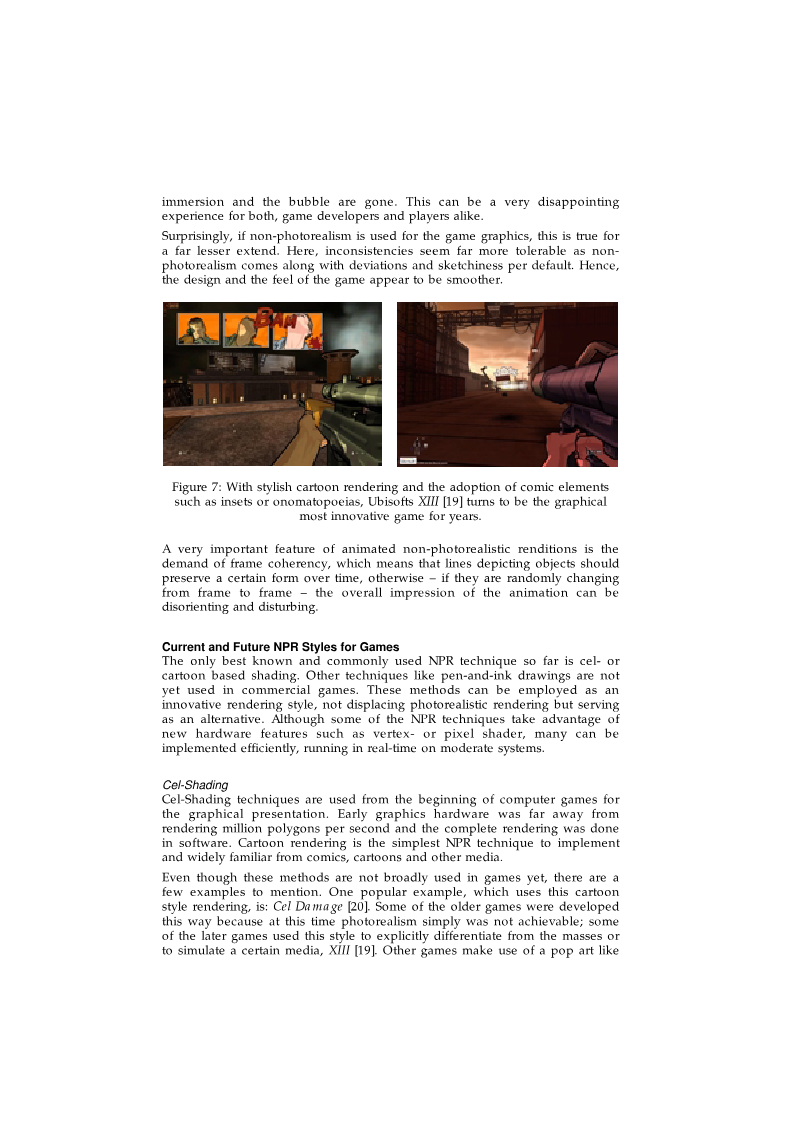
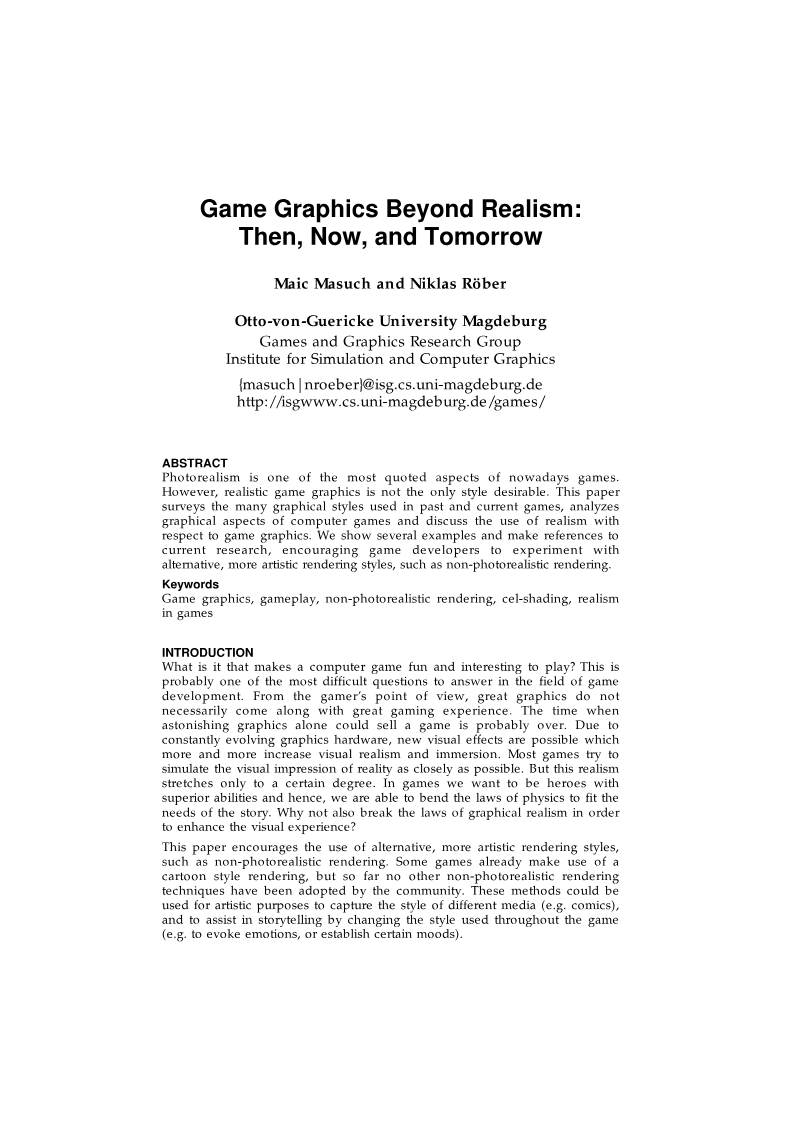
Game Graphics Beyond Realism: Then, Now, and Tomorrow
This paper, by Maic Masuch and Niklas Röber of the Otto-von-Guericke University Magdeburg, argues that game graphics should not be limited to photorealism and that developers should explore alternative, artistic rendering styles, particularly non-photorealistic rendering (NPR).
- The authors argue game graphics should not be limited to photorealism and that developers should explore non-photorealistic rendering (NPR) and other artistic styles.
- They contend that gameplay and story drive player enjoyment far more than graphical fidelity, and that as photorealism becomes costlier to achieve, graphics will lose effectiveness as a unique selling point.
- Immersion depends on believability and consistency rather than strict realism: small inconsistencies such as an incorrect shadow can break the illusion of a photorealistic game, while NPR styles tolerate such imperfections more readily.
Neomancer: An Exercise in Interdisciplinary Academic Game Development
The paper presents Neomancer, an interdisciplinary academic game development project that brought together roughly 50 participants from the University of Western Ontario and Seneca College of Applied Arts and Technology, with a lead designer based in Seattle.
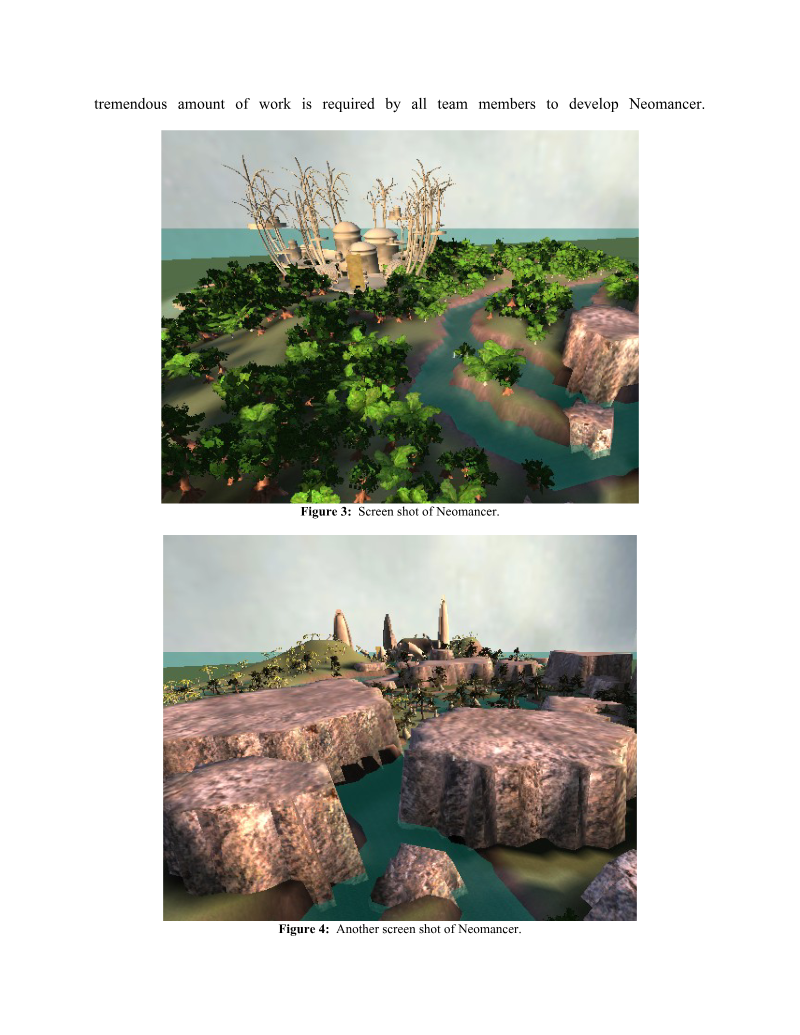
- Neomancer is an interdisciplinary academic action-adventure RPG built on Epic's Unreal engine, set in the fantasy archipelago of Kintorr, and sized to be comparable to a commercial title in its genre.
- The project involves roughly 50 participants from the University of Western Ontario and Seneca College of Applied Arts and Technology, with a lead designer based in Seattle, pooling Western's programming strengths with Seneca's artistic and design capabilities.
- The project began in fall 2004 with a planned two to three year timeline, and its first two milestones were reported as met.
Bringing New HOPE to Networked Games: Using Optimistic Execution to Improve Quality of Service
This paper introduces New HOPE, an adaptation of the optimistic execution framework originally developed for transaction-oriented systems, aimed at mitigating latency in real-time networked multiplayer games.
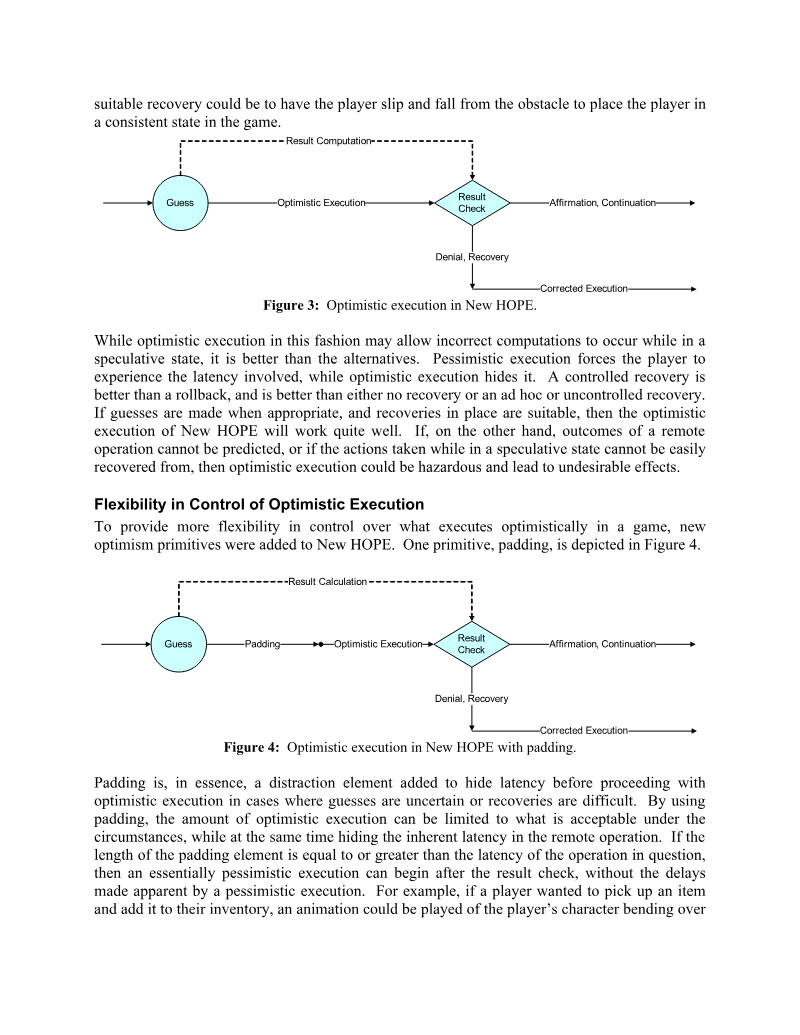
- New HOPE adapts optimistic execution, a framework originally built for transaction-oriented systems, to let predictable game actions proceed without waiting for remote confirmation, hiding synchronization delay from players.
- Unlike original HOPE, which relied on full rollback when predictions failed, New HOPE substitutes controlled recovery procedures that restore a consistent state while keeping gameplay moving forward.
- New HOPE introduces padding (distracting animation that masks latency) and synchronization points (limits on how far speculative execution can proceed) as core primitives.

Frame and Metaphor in Political Games
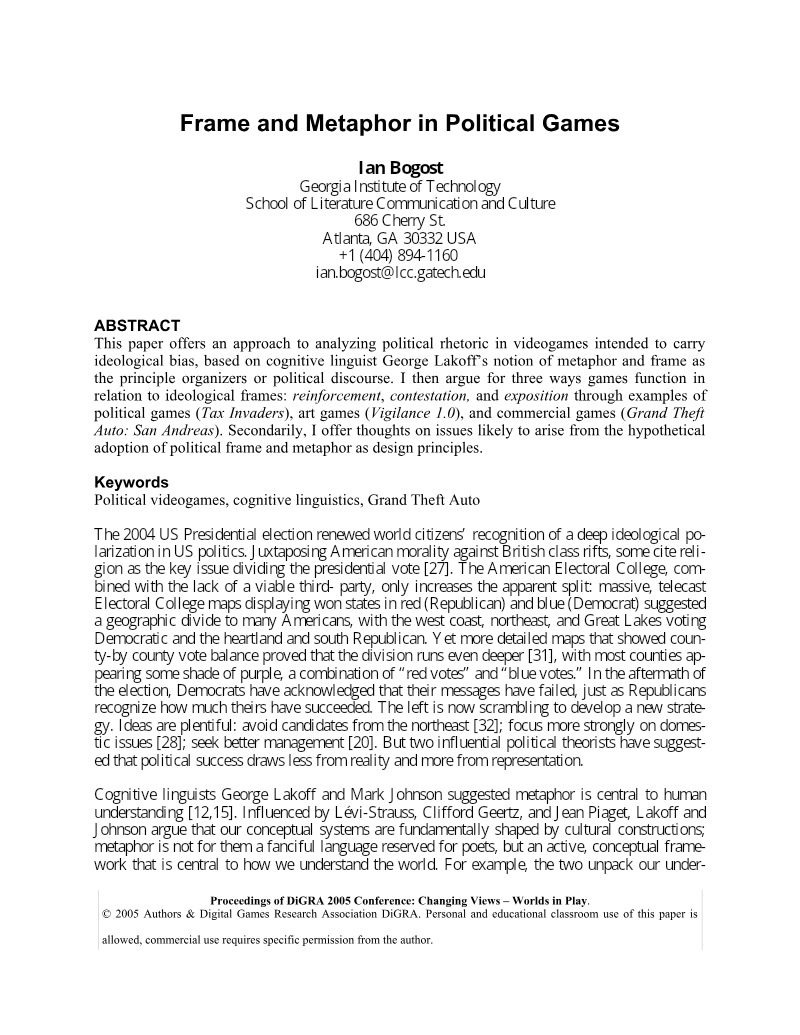
Ian Bogost's paper "Frame and Metaphor in Political Games," presented at the 2005 DiGRA conference, argues that videogames can carry ideological bias by operating through procedural rather than verbal rhetoric.
- Ian Bogost's 2005 DiGRA paper argues that videogames can carry ideological bias through procedural rhetoric, operating via rules and systems rather than verbal argument, drawing on George Lakoff's cognitive linguistics and Frank Luntz's message-development work for conservatives.
- Bogost classifies games' relation to ideological frames into three modes: reinforcing them, contesting them, or exposing them.
- The paper's reinforcement example is the Republican National Committee's Tax Invaders, a Space Invaders variant in which a Bush head fires at tax increases framed as invaders, turning the metaphor of taxation as theft into a playable form.
Shadowplay: Simulated Illumination in Game Worlds
This paper argues that game studies lacks a vocabulary for discussing simulated illumination, and that such a vocabulary can be built by surveying existing lighting practices from three sources: computer-generated animation and film, architectural lighting, and the interactive properties of games themselves.
- Light in games is argued to be far more than decoration: illumination shapes narrative meaning, directs player attention, modulates mood and risk, and can directly drive gameplay and NPC behavior.
- Silent Hill 2 and Thief serve as the paper's primary case studies, with Silent Hill 2 examined through its pre-rendered cut scenes and low-key horror lighting, and Thief through its tuned sensory system governing AI visibility.
- The author builds a lighting vocabulary by adapting Sharon Callahan's five objectives of digital animation lighting, while noting that free navigation in games exceeds the fixed-frame assumptions of film.



OceanQuest: A University-Based Serious Game Project
OceanQuest is a case study of a university-developed serious game designed to teach Grade 8 science concepts about hydrothermal vent ecosystems on the ocean floor, specifically the Endeavour field west of Vancouver Island.
- OceanQuest is a university-developed serious game teaching Grade 8 science about hydrothermal vent ecosystems at the Endeavour field west of Vancouver Island, built under a small budget and a four-month schedule to deliver by February 2004.
- The authors argue that a serious game can satisfy both traditional game goals and educational goals, and treat the difficulty of combining instructional and entertainment design as the central challenge.
- Rather than direct instruction, the design aimed for players to absorb science implicitly through a submarine scavenger hunt narrative in which they search for organisms that may contain a plague cure, mirroring how commercial games teach through play.
The GameCreator: Self-Created Mobile Games on the Internet
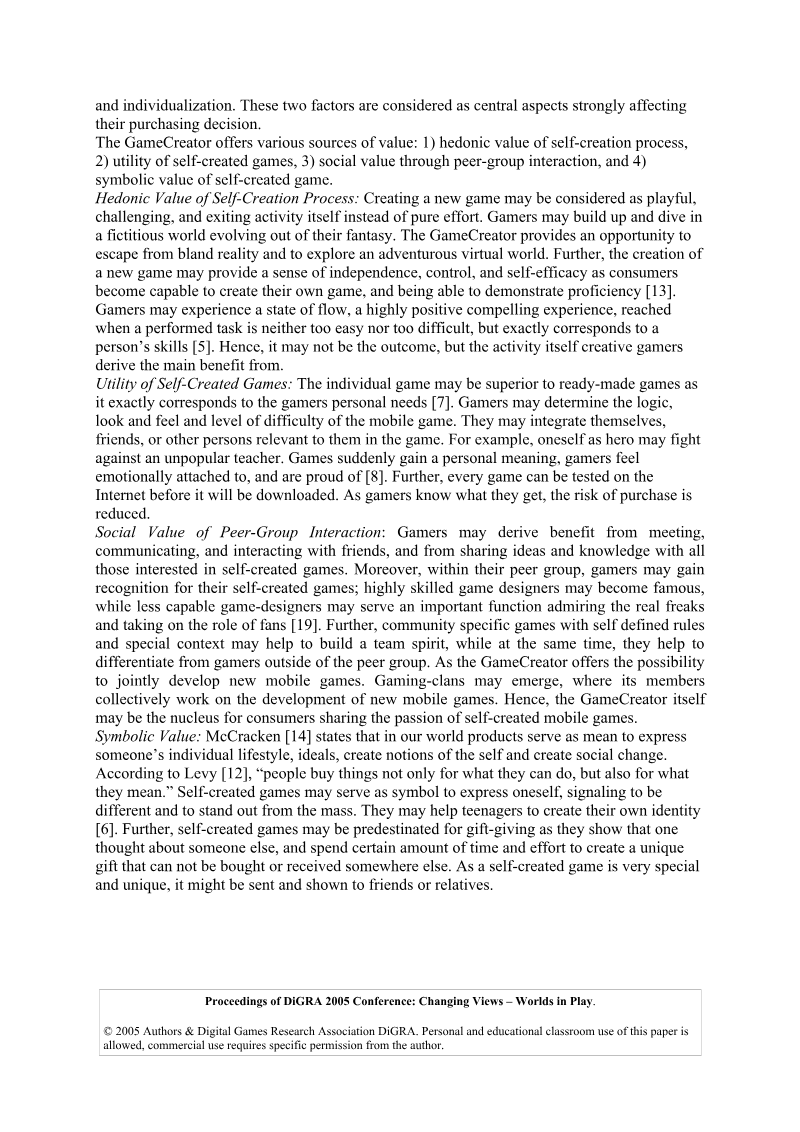
The GameCreator is an Internet-based platform, introduced in a 2005 DiGRA conference paper, that lets consumers build and download their own Java mobile games without programming skills, either from scratch or by modifying preconfigured templates.
- The GameCreator is a 2005 DiGRA-presented web platform that lets users with no programming skills build and download their own Java mobile games, either from scratch or by modifying templates, using a graphical wizard, live preview, server-side compilation into JAR files, and an embedded community for sharing and co-developing games.
- The paper argues that self-created games offer value beyond ready-made titles because the effort of creation is rewarded through hedonic enjoyment, personal utility, social recognition, and symbolic meaning, such as use as personalized gifts or messages.
- The platform targets three segments through easy, advanced, and master modes: Mobile Internet crossover users who have never downloaded mobile games, regular gamers aged roughly 9 to 18, and programming-literate users seeking top-tier games.
A Realistic Reaction System for Modern Video Games
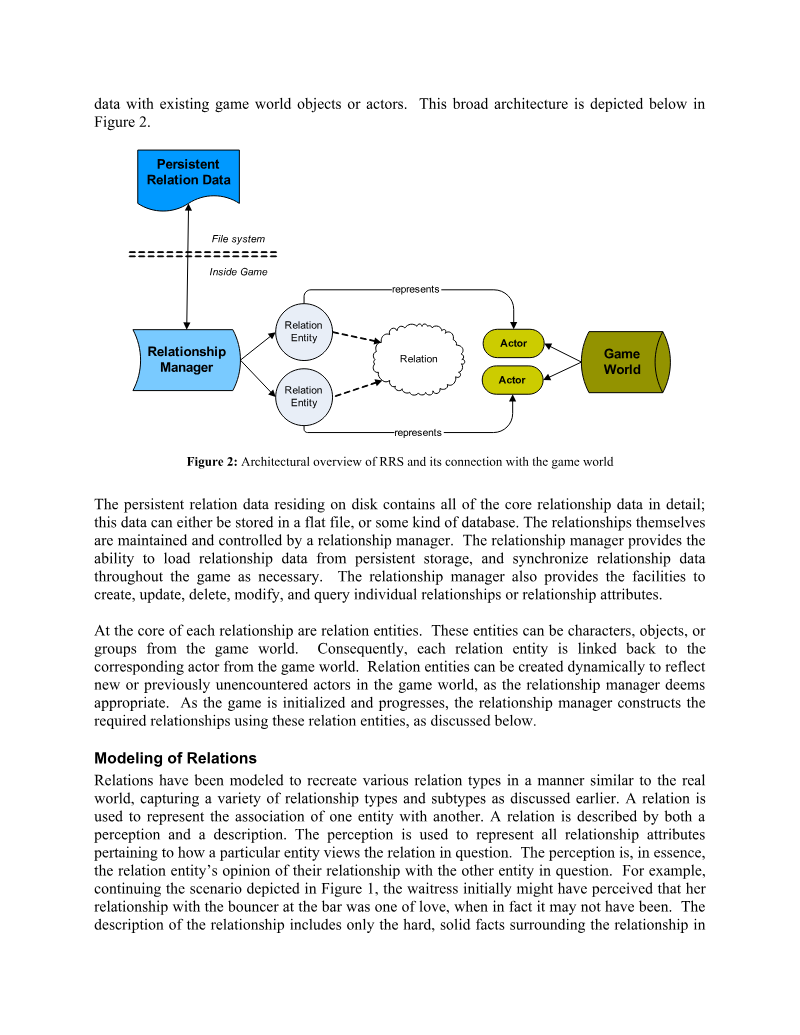
This paper, authored by researchers at the University of Western Ontario with a contributor from Horseplay Studios, presents a Realistic Reaction System (RRS) designed to give video game characters and objects dynamic, society-like relationships that evolve over time.
- The Realistic Reaction System (RRS) replaces scripted, event-driven reactions with a persistent relationship network in which characters, groups, and objects are nodes connected by typed, attributed edges that characters can query to shape behaviour and dialogue.
- Relationships are organized in a hierarchical taxonomy (emotional, familial, business, membership) and carry attributes such as origin, history, strength, polarity, and validity, and they decay toward neutrality over time unless reinforced.
- Game events affect the network directly, and their effects propagate indirectly through related entities, similar to reputation spreading through a community.

B.Sc. Computer Game Development: Why Not?
This paper, presented at the DiGRA 2005 conference, argues for a new four-year Bachelor of Science degree in Computer Science with a Game Development specialization at Grande Prairie Regional College in Alberta, Canada.
- The paper proposes a four-year B.Sc. in Computer Science with a Game Development specialization at Grande Prairie Regional College in Alberta, Canada, motivated by declining computing science enrolments in North America since around 2000.
- The authors argue the computer game industry, with global sales exceeding $30 billion, offers strong economic growth and largely unmet demand for qualified graduates.
- The central thesis is that a game development program can meet industry needs while preserving the integrity of a standard computing science education by blending ACM computing curriculum guidelines with the International Game Developers Association's curriculum framework.
History of Digital Games in Turkey
This paper, a DiGRA 2005 conference study by Erdal Yılmaz and Kürşat Çağıltay of Middle East Technical University, traces the history of digital games in Turkey and assesses the state of its game development industry.
- Turkish players' habits and play durations parallel global averages, but domestic game development has been extremely limited and poorly documented.
- Digital games reached Turkey in the early 1980s via arcade-style "Atari Salonu" halls, which prompted a 1985 regulatory response requiring local permits.
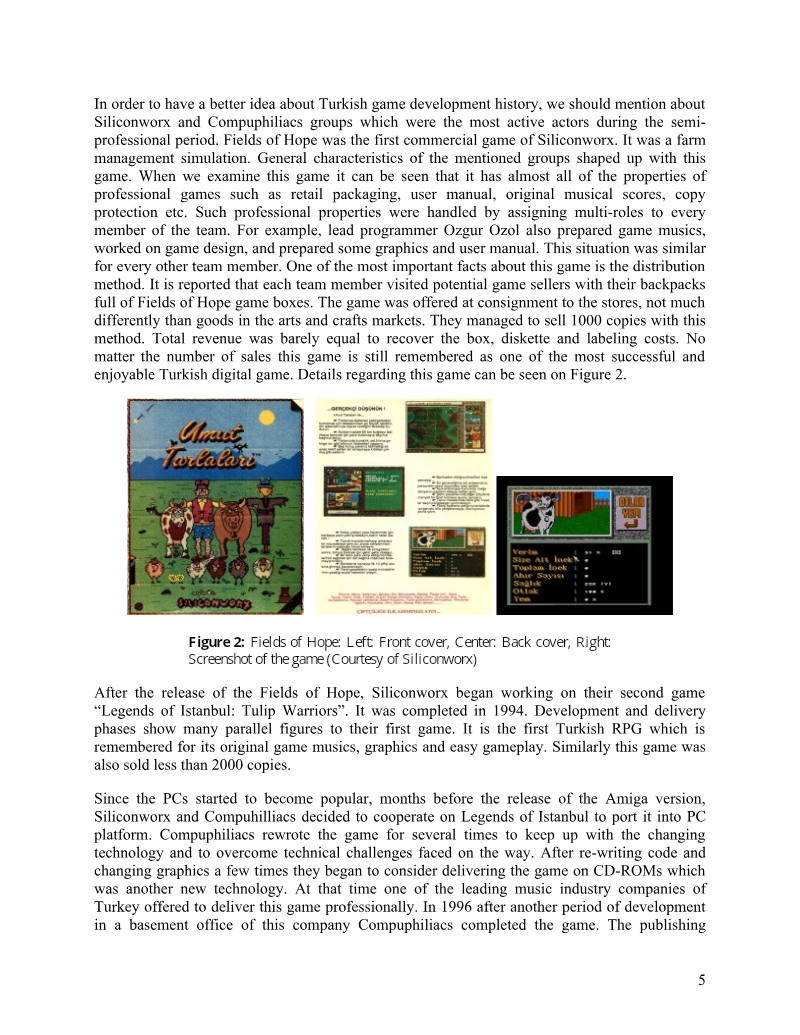
- Turkish home game development passed through three phases: an amateur 1980s period built on the Commodore 64 and magazine-published source code, a semi-professional 1990s period centered on Amiga and PC groups like Siliconworx and Compuphiliacs, and a professional stage from 2000 onward.
A Sociotechnical Conjecture About the Context and Development of Multiplayer Online Game Experiences
This conceptual essay argues that multiplayer online game experiences are sociotechnical constructions whose meaning is continuously co-produced by designers and players, and that development does not end at launch but extends into play itself.
- Multiplayer online game experiences are framed as sociotechnical constructions whose meaning is continuously co-produced by designers and players rather than fixed at launch.
- The central thesis is that 'playing is authoring': designers inscribe rules, roles, and arenas, while players reinterpret and rewrite these conditions through their actions.
- Game design sets up conditions for emergent experience rather than predetermining outcomes, making social interaction the principal driver of what unfolds in a match or community.


Mise-en-scène Applied to Level Design: Adapting a Holistic Approach to Level Design
This paper argues that mise-en-scène, the film concept of deliberately arranging everything visible within a frame to convey meaning, can be adapted to level design to deepen emotional engagement and communicate narrative and psychological subtext to players.
- Mise-en-scène, the film concept of deliberately arranging everything visible within a frame to convey meaning, is proposed as a framework for level design to deepen emotional engagement and communicate narrative and psychological subtext.
- The paper maps Robert Kolker's mise-en-scène elements (spatial arrangement, props, camera relationship, color, lighting, and framing) onto level designers' responsibilities such as set dressing, lighting, texturing, and object placement, noting that cinematography and costuming typically fall to other team members.
- Close readings of Kubrick's The Shining show how scale, the Overlook Hotel's labyrinthine architecture, shifting color temperatures from warm amber to cold blue, atmospheric effects like snow and haze, and repurposed props reinforce themes of isolation, decay, and supernatural dominance.