Game Development reports and market data
Documents


Issues and Approaches in Artificial Intelligence Middleware Development for Digital Games and Entertainment Products
This paper examines the design and development of artificial intelligence middleware for digital games and entertainment products.
- AI has shifted from a secondary concern to a priority in game development, yet developers still rely on a narrow set of techniques and lack flexible, reusable tooling.
- Dedicated AI middleware, a software layer that supplies agent behavior and decision-making services to game engines, is presented as the likely next step for improving game AI and freeing developers for creative work.
- Dominant practice relies on finite state machines, hierarchical and fuzzy state machines, A pathfinding, steering behaviors, decision trees, and rule-based systems, each trading off speed, expressiveness, and predictability.

Expressive AI: Games and Artificial Intelligence
Michael Mateas's paper argues that as graphical gains yield diminishing returns, game development is shifting its attention toward artificial intelligence, and that AI-driven art and entertainment forms a new interdisciplinary agenda linking games studies, design practice, and technical research, which he names "expressive AI."
- Mateas argues that as graphical gains yield diminishing returns, game development is shifting attention toward artificial intelligence, and proposes "expressive AI" as an interdisciplinary agenda linking games studies, design practice, and technical research.
- Game AI is defined as the production of behavior that players read as intentional, distinguishing it from game physics: Asteroids' asteroids and water simulations generate behavior without inviting psychological interpretation, whereas enemies like Pac-Man's ghosts invite readings of goals, desires, and moods.
- The paper positions game AI as a "white box" vocabulary for analyzing and designing games, complementing the "black box" vocabularies of design patterns and humanistic game studies that deliberately ignore implementation.


Participatory Design and Opposing Interests in Development of Educational Computer Games
This study examines a participatory design process in which a class of 11- and 12-year-old Danish children was invited to help design a mathematics-education computer game, with the aim of producing a game engaging enough that children would voluntarily play it outside school.
- The study examined a participatory design process in which 11- and 12-year-old Danish children helped design a math-education computer game meant to be engaging enough that they would voluntarily play it outside school.
- The children's ideas had little practical effect on the final design, mainly because the developers adopted their own time-travel concept early, where it was perceived as strong and hard to modify.
- A key organizational failure was that the developers did not attend the workshops, so insights from the children reached them only secondhand through researchers as general guidelines that were hard to integrate.

WADs, Bots and Mods: Multiplayer FPS Games as Co-creative Media
Sue Morris's paper examines multiplayer first-person shooter (FPS) games such as Quake, Half-Life, and Counter-Strike as "co-creative media," arguing that these games are not produced solely by developers or solely by players, but through the combined input of both.
- The paper argues that multiplayer FPS games such as Quake, Half-Life and Counter-Strike are 'co-creative media,' shaped jointly by developers and players rather than by either alone, extending beyond the participatory-media framing common in fan studies.
- Wolfenstein 3-D (1992) and Doom (1993) set the foundation for the genre, and Doom's source-code release and multiplayer capabilities enabled a durable mod scene.
- Player contributions materially influenced development: early public betas and leaked alphas produced bug reports and patches, volunteer-built anti-cheat tool PunkBuster was later adopted by publishers, and mod authors behind ThreeWave CTF and Counter-Strike were hired or commercially acquired.

Enchanting Reality: A Vision of Big Experiences on Small Platforms
Martin Ericsson's paper argues that mobile gaming has so far largely cloned or ported existing console and desktop titles, leaving the distinctive capabilities of handheld devices (mobility, GPS, and communications) underused.
- The paper argues mobile gaming has largely cloned or ported console and desktop titles, leaving handheld capabilities such as mobility, GPS, and communications underused.
- Its central thesis is that compelling physical-world games create immersion through "diegetic consistency," where the fictional world aligns with the player's sensory reality.
- The authors propose "enchanted reality" games, in which real-world actions meaningfully alter the virtual world rather than merely triggering isolated events.

Enhancing Gameplay: Challenges for Artificial Intelligence in Digital Games
Darryl Charles's paper argues that rapid growth in computing power gives game designers a timely opportunity to pursue radical advances in artificial intelligence rather than incremental refinements.
- The paper argues that rapid growth in computing power gives game designers a timely opportunity to pursue radical AI advances rather than incremental refinements, and that AI innovation is essential to avoid industry stagnation and establish games as a serious artistic medium.
- Current titles still rely largely on established techniques such as finite-state machines, A pathfinding, and scripting, with designers prioritizing the appearance of intelligence over realistic behavioral models.
- The paper identifies three priority areas for innovation: storytelling (especially player-driven narratives in MMORPGs), dynamic online learning (illustrated by the rare example of Black & White), and emotional expression, where real-time character animation lags well behind pre-rendered film.
Representing Users in the Design of Digital Games
Aphra Kerr's paper argues that digital game designers typically represent their users implicitly rather than through direct engagement, and that this tacit approach, often shaped by the designers' own tastes, can embed gender bias into game design.
- Digital game designers typically represent their users implicitly rather than through direct engagement, and this tacit approach, often shaped by designers' own tastes, can embed gender bias into game design.
- The study's Irish interviews covered digital game companies that were almost entirely male and targeted young men aged roughly 15 to 40, with industry factors such as risk-averse publishers, console manufacturers, and skilled-labour shortages shaping game types and design priorities.
- In the central case study of the fictional online multiplayer strategy game from games.inc, launched in Germany in December 2001 with about 1,000 subscribers, designers projected their own preferences as technologically literate male gamers aged 25 to 40 instead of conducting formal user research.



3Dxp: DirectSound 3.0 Extension API
The 3Dxp API, developed by the Interactive Audio Special Interest Group’s 3D Working Group in 1997, serves as a standardized extension to Microsoft’s DirectSound 3.0.
- The 3Dxp API was introduced in 1997 as a standardized extension to Microsoft’s DirectSound 3.0 to enable hardware-accelerated 3D audio positioning on Windows PCs.
- The API functions by appending a 132-byte data structure to standard DirectSound buffers, allowing developers to pass 3D parameters like position, velocity, and cone orientation to external renderers.
- A reference wrapper enables automatic detection of 3Dxp-compliant drivers, proprietary solutions such as Aureal’s A3D, or a fallback to standard DirectSound3D.



La Industria del Videojuego en España en 2021: Anuario 2021
The AEVI Anuario 2021 provides a comprehensive annual assessment of Spain's video game industry, positioning the sector as a significant economic, cultural, and educational force.
- Spain's video game sector generated €1.795 billion in 2021, up nearly 3% from 2020, with physical sales rising to €882 million while online sales (€913 million) declined 4.59% year-on-year.
- Spain counted more than 18 million videogamers in 2021, roughly 47–48% of whom were women, yet women make up under 20% of developers.
- Roughly two-thirds of Spanish developers' revenue comes from abroad, making internationalization a central strategic priority for the sector.
Australian Game Development Survey 2024
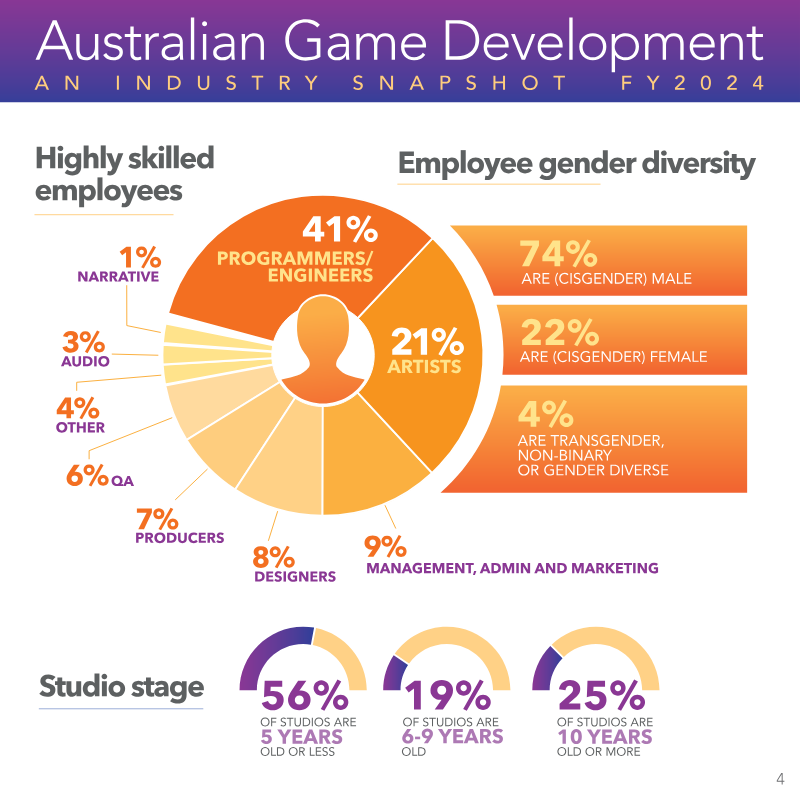
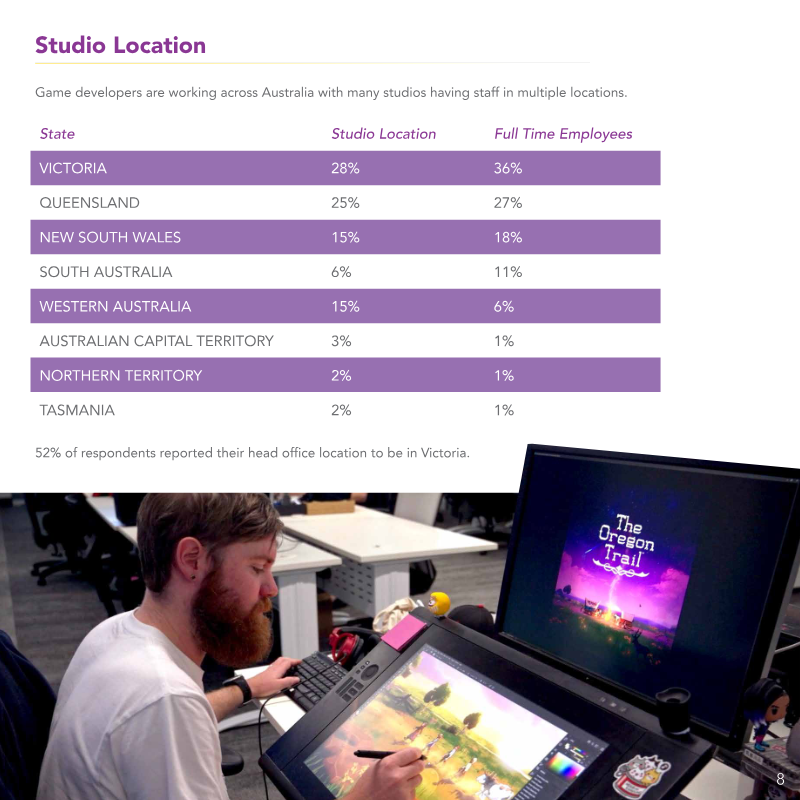
The Australian Game Development Survey 2024 provides an annual snapshot of the country's game development sector for the financial year running from 1 July 2023 to 30 June 2024.
- Australian game development revenue dipped 1.9% to $339.1 million in FY2024 (1 July 2023 to 30 June 2024), while employment held roughly steady at 2,465 people, signalling stability amid global headwinds.
- The sector is heavily export-oriented, with 93% of revenue generated outside Australia.
- Eighty-five percent of studios develop their own intellectual property, pointing to a sector with strong original content capability.

Costa Rica Exporta: Videogames and Animation
This promotional document from PROCOMER, Costa Rica's national export promotion agency, presents the country's video game and animation industry as a competitive export offering for international buyers.
- Costa Rica's video game and animation sector is promoted by PROCOMER, the national export promotion agency, as a competitive export offering for international buyers.
- The country is described as home to more than 20 studios focused on game development and digital animation.
- Costa Rica is ranked first in Latin America on the TOEFL English proficiency test and first in education in the region per World Economic Forum data for 2016–2017, which the document presents as a key differentiator.

Argentinean Video Game Industry: 2020 Relevant Data Report
The Observatory of the Argentinean Video Game Industry's 2020 Relevant Data Report, the third annual edition of a survey conducted with Universidad Nacional de Rafaela and the industry association ADVA, presents descriptive statistics on the country's video game sector.
- The Argentinean video game sector is young and geographically concentrated: 36% of the 71 surveyed studios are in Buenos Aires City, followed by Mendoza (24%), Córdoba (16%), Santa Fe (10%), and Buenos Aires Province (7%), and about 60% were incorporated between 2015 and 2020.
- The sector's estimated size for 2019 is at least USD 72,192,960, calculated conservatively from employment figures and average hourly costs, and it employed roughly 1,450 formal workers (1,284 full-time, 166 part-time) plus 508 freelancers.
- Gender gaps are pronounced: women average 21% of employee-status workers but only 6% of company partners, and 18% of studios report no female employees.