Game Development reports and market data
Documents
Team Structure in the Development of Game-Based Learning Environments
This study examines how development teams for digital game-based learning environments should be organized, arguing that such projects demand multidisciplinary expertise spanning learning theory, game design, art, programming, testing, and subject-matter knowledge, along with meaningful user participation.
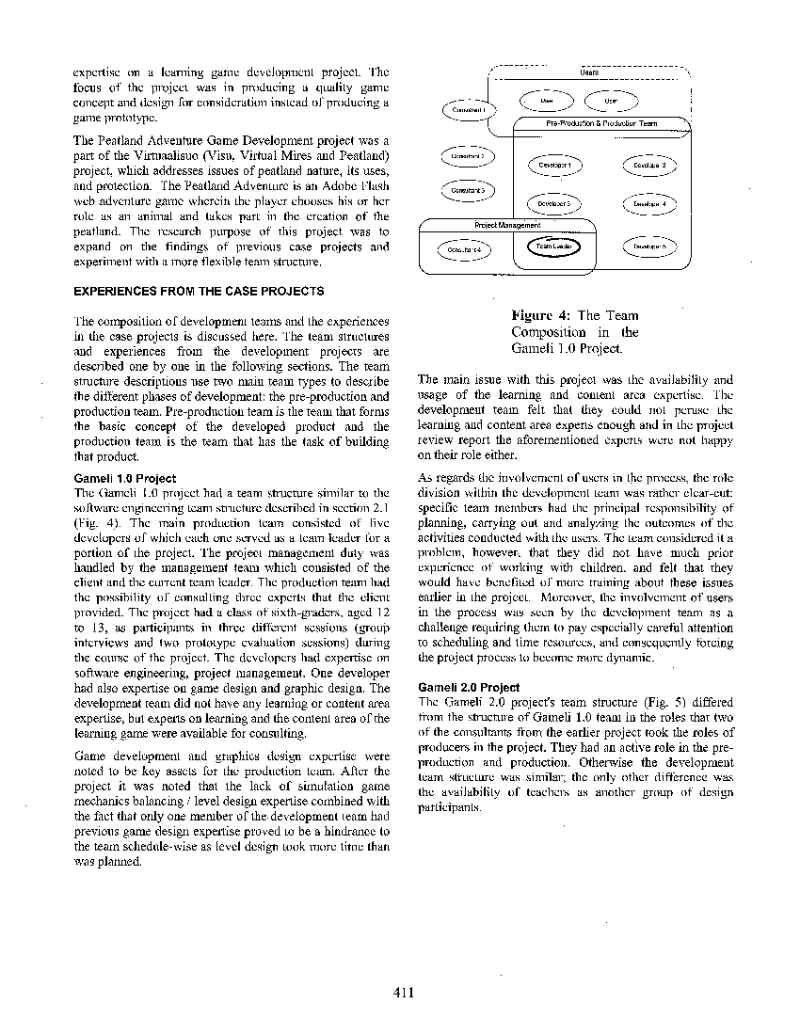
- Learning, content-area, and game-design expertise was frequently insufficient or underused across three case projects (Gameli 1.0, Gameli 2.0, and the Social Responsibility and Peatland Adventure projects), with learning and content experts often relegated to consultancy roles rather than responsible positions.
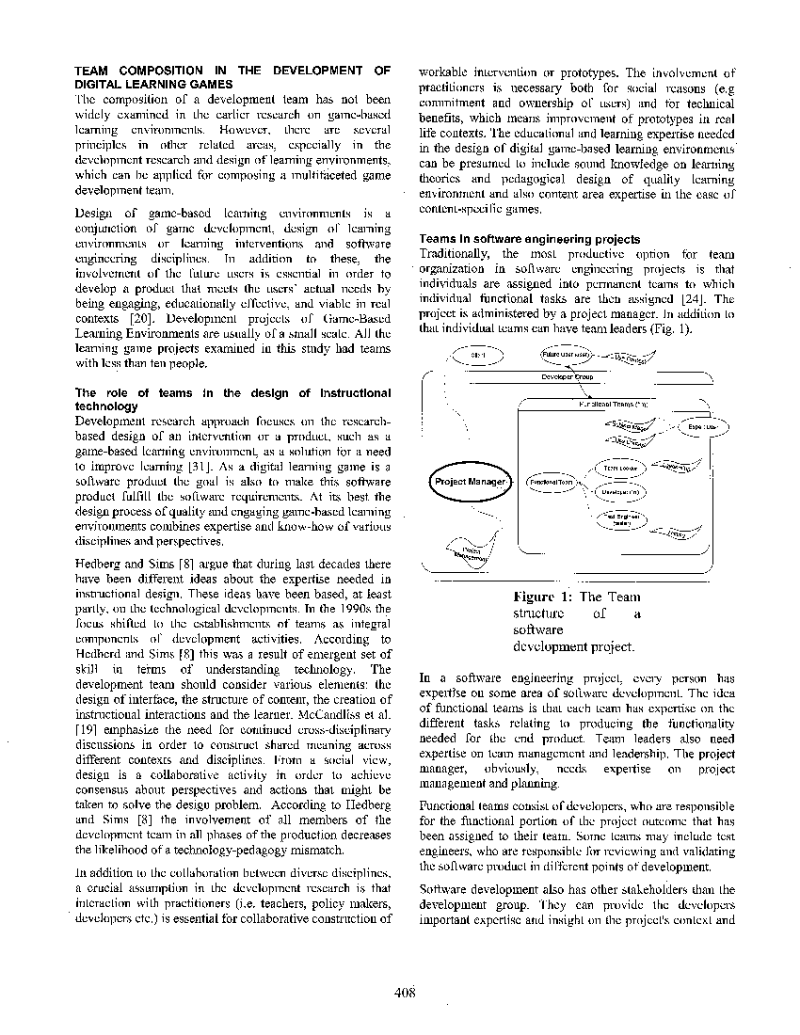
- The authors propose a general early-stage team structure comprising a management team, pre-production and production teams that include game design and software engineering expertise, and a design partner team representing end users.
- Pre-production is framed as the period for building shared understanding of project goals and common ground for implementing the final product, which underpins the argument for giving learning and content experts substantive roles from the outset.


What Videogame Making Can Teach Us About Literacy and Learning: Alternative Pathways into Participatory Culture
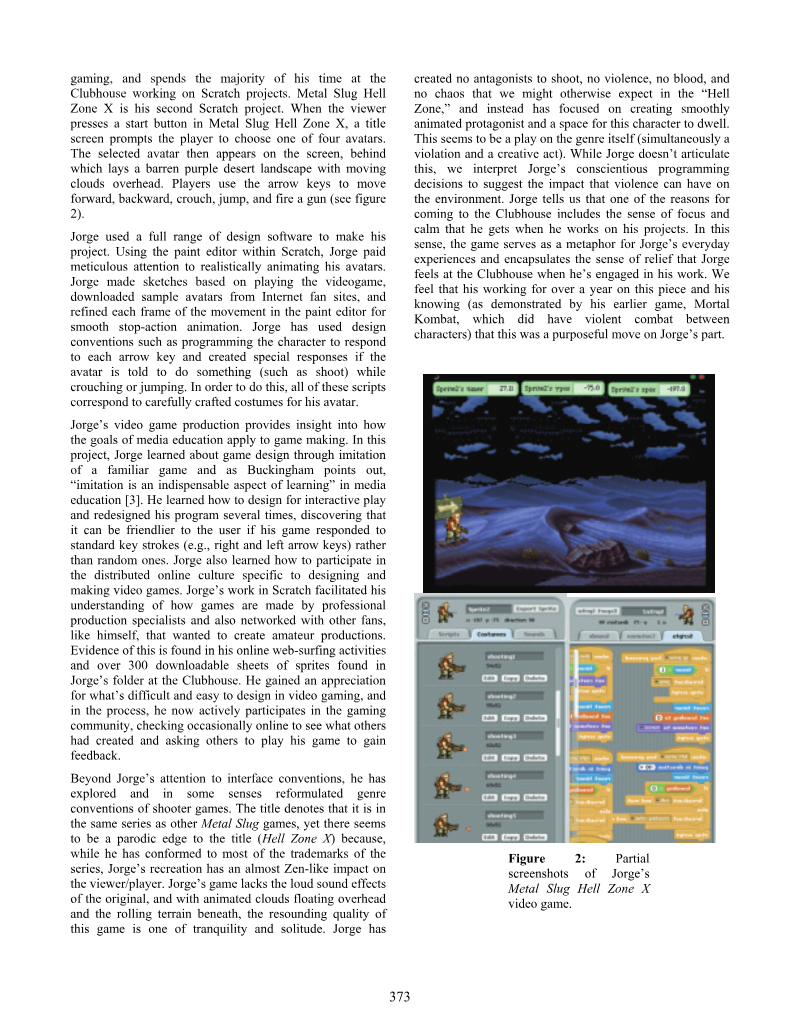
Youth video game making in a Los Angeles Computer Clubhouse serves as the basis for an argument that building games offers an alternative route into participatory culture, one that addresses the participation gap, the transparency problem, and the ethics challenge identified in Jenkins' work.
- The study argues that building video games offers an alternative route into participatory culture, cultivating design skills and critical awareness as a counterpoint to passive media consumption, and addressing the participation gap, transparency problem, and ethics challenge identified in Jenkins' work.
- An archival analysis of 11,926 files collected over two years at a Los Angeles Computer Clubhouse found Scratch was the most-used design software, accounting for 643 files or 5.3 percent of the total after excluding saved web images, which dominated the corpus.
- Preliminary indications suggest programming complexity and community expertise grew in the second year, though the authors stress these trends are provisional because analyses of programming sophistication remain ongoing.


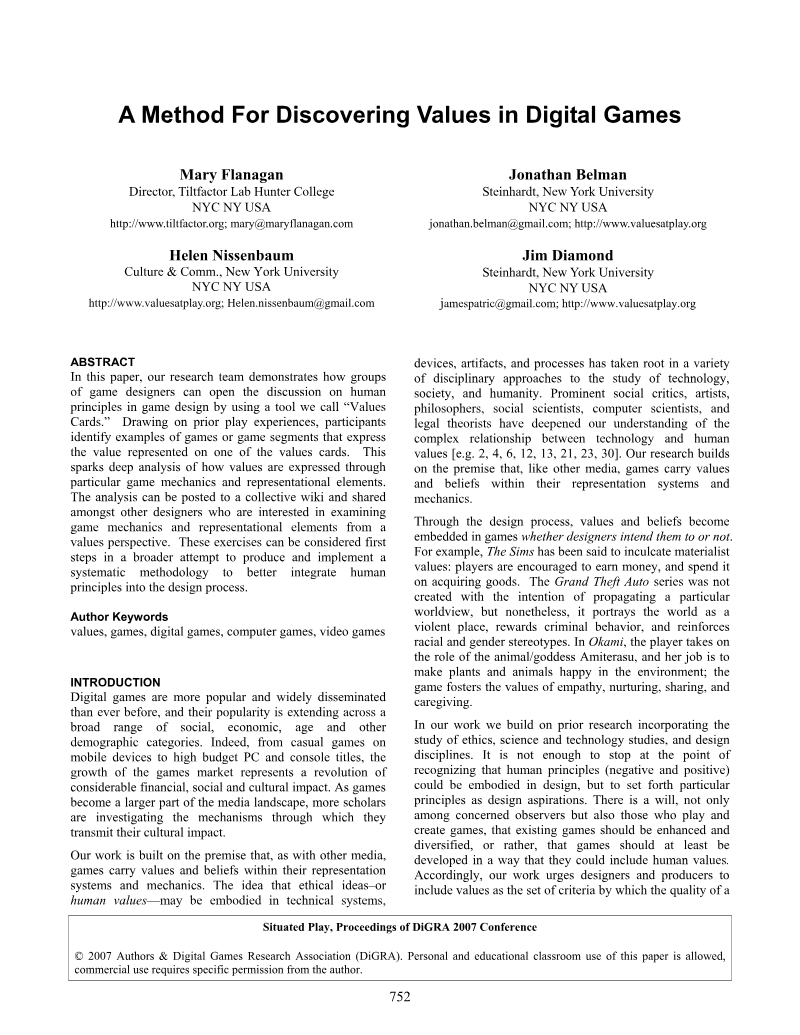
A Method for Discovering Values in Digital Games
"A Method for Discovering Values in Digital Games" presents the Values Cards exercise, a practical tool that helps game designers identify and discuss human values such as equality, justice, generosity, and competition that are embedded in game mechanics, representation, and players' prior experiences.
- Games inevitably embed human values such as equality, justice, generosity, and competition, in their mechanics, representation, and the prior experiences players bring, much as other media do.
- The Values Cards exercise is presented as a practical tool that lets game designers identify and discuss these embedded values, and it is positioned as the first step in the broader Values at Play methodology of discovery, translation, and verification.
- Designers can gain conscious control over the values their games convey by examining both the positive and negative expressions of those values.


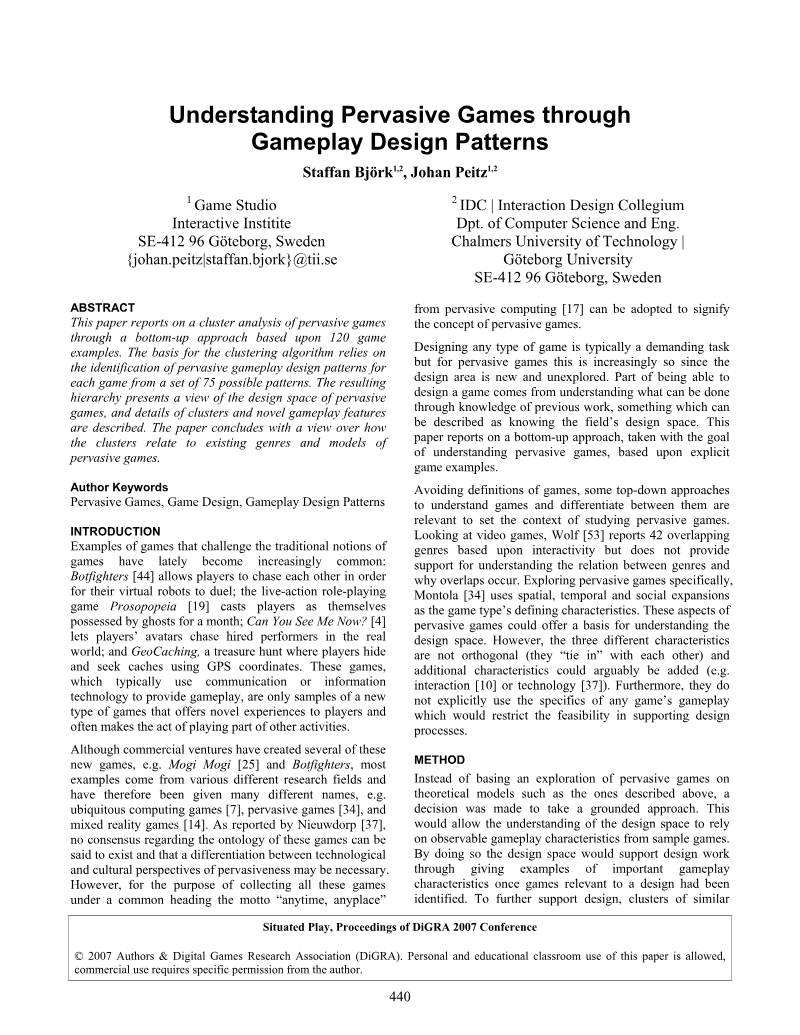
Understanding Pervasive Games through Gameplay Design Patterns
The 2007 study "Understanding Pervasive Games through Gameplay Design Patterns" examines how pervasive games, those that extend play into everyday physical and social spaces, can be characterized and organized through a shared vocabulary of design patterns.
- The study analyzed 120 pervasive game examples against 75 gameplay design patterns, of which 53 were newly developed for pervasive contexts and 24 carried over from an earlier study of mobile games.
- Rather than classifying games by genre, the authors used a bottom-up approach, grouping patterns with a custom clustering program and treating cluster names as hypotheses about each group's core character.
- The resulting cluster hierarchy maps the pervasive game design space, with GPS Games the most distinct grouping, separated mainly by its lack of social-interaction patterns.

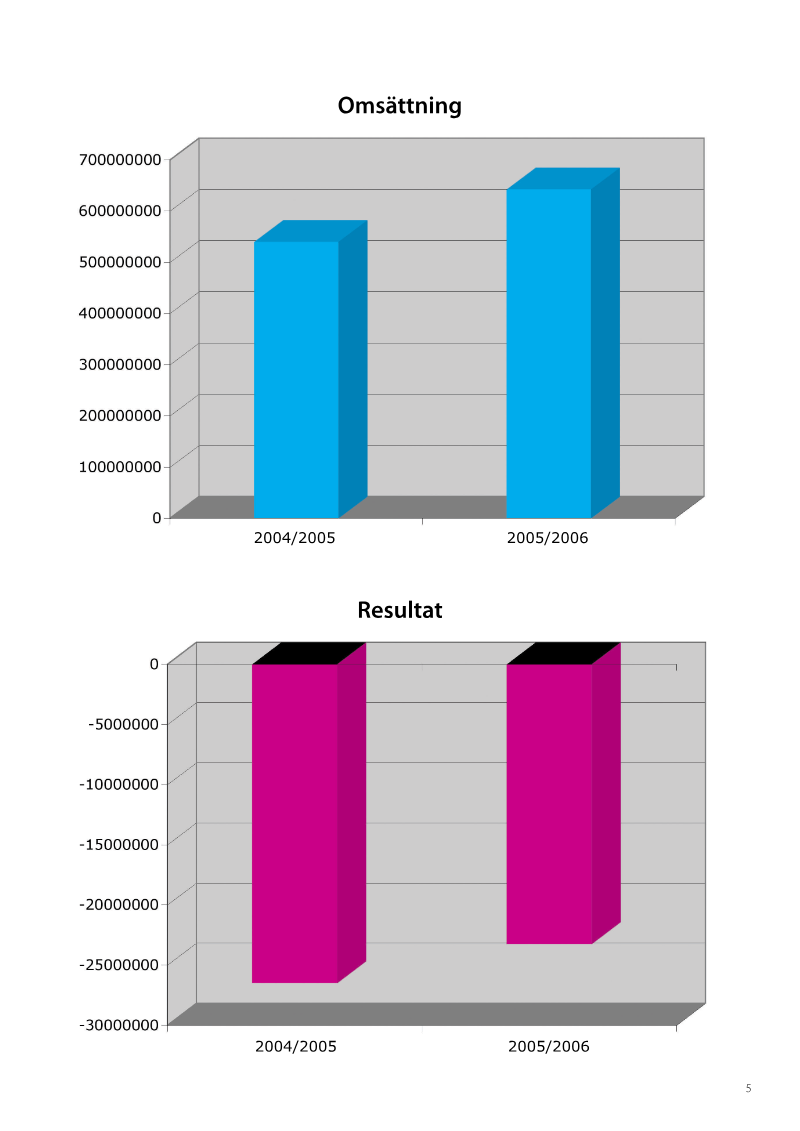

Spelutvecklarindex: Sweden 2005
The Swedish game development industry experienced significant growth and consolidation during 2005, characterized by rising revenues and an expanding workforce despite a reduction in the total number of active firms.
- The Swedish game industry generated 642 million SEK in total turnover in 2005, marking a 19 percent increase from the previous year.
- Market concentration is high, with five major studios—Avalanche Studios, EA DICE, Jadestone, Paradox Interactive, and Starbreeze—generating 59 percent of total industry revenue.
- The industry workforce grew by 14 percent to 812.5 full-time equivalents, though the gender balance remained stagnant with women representing only 15 percent of staff.

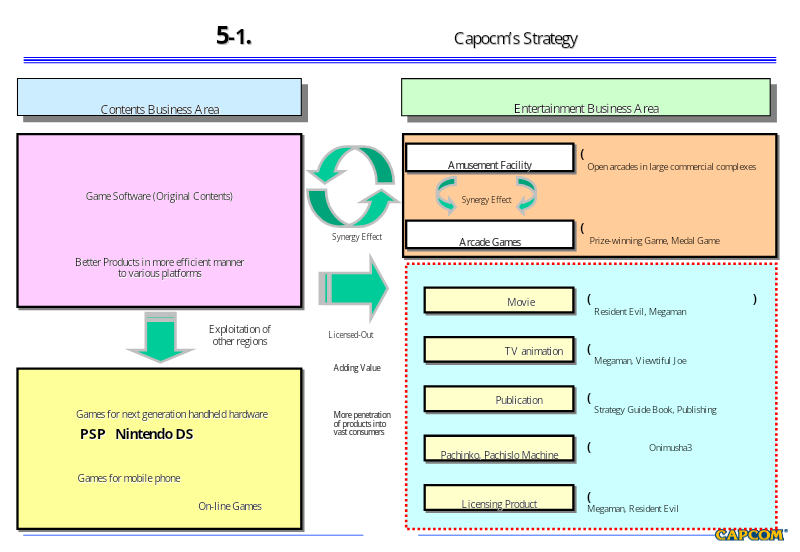
Company Profile: May 2005
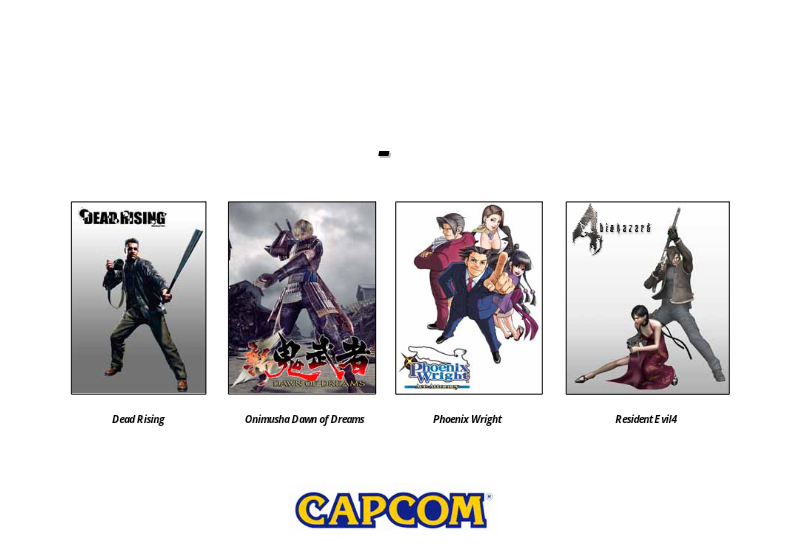
Capcom concluded the fiscal year ending March 31, 2005, with robust financial results, reporting net sales of 65.8 billion yen and an operating income of 7.7 billion yen.
- Capcom reported fiscal year 2005 net sales of 65.8 billion yen and an operating income of 7.7 billion yen, driven by Resident Evil 4, Mega Man, and the pachislo LCD business.
- The company projects net sales of 70 billion yen for the 2006 fiscal year, despite acknowledging volatility in the hit-driven home console market.
- Capcom is targeting a global sales distribution ratio of 2:5:3 across Japan, North America, and Europe to mitigate the maturity of the domestic Japanese market.



Early Games Production in New Zealand
Melanie Swalwell's paper examines the early digital games industry in New Zealand during the late 1970s and 1980s, a period that is largely absent from mainstream accounts of games history, which tend to focus on the United States, United Kingdom, and Japan.
- Early digital games reached New Zealand in the late 1970s and 1980s despite geographic isolation and restrictive import policies, yet this history is largely absent from mainstream games histories focused on the US, UK, and Japan.
- Major systems including Atari, Sinclair, Commodore, Sega, and Nintendo products did reach New Zealand, typically one to two years after their overseas release, with distribution uneven across platforms.
- Local manufacturers produced at least four early consoles, most prominently the Sportronic, a Pong-style clone, and around eleven companies were involved in arcade cabinet manufacture at some point.


Realistic Agent Movement in Dynamic Game Environments
This paper addresses the challenge of realistic agent movement in computer games, particularly pathfinding in dynamic environments where the game world can change in real time.
- The paper argues that traditional pathfinding methods such as A and navigation meshes rely on static, pre-processed map representations, which become inadequate once physics middleware lets players and agents alter level geometry in real time.
- The authors propose giving agents real-time awareness via four ray-casting sensors spanning a 90-degree field of vision, feeding an artificial neural network that controls movement, with weights evolved by a genetic algorithm guided by reinforcement-style scoring.
- The approach was implemented as a test bed on the Quake 2 engine using a custom C++ AI library, with graphical tools allowing users to adjust evolution and network parameters during training.
The Localization of Digital Games: A Case Study in China
This paper examines the challenges facing digital game localization, using China as a case study to explore why some foreign games succeed in the Chinese market while others fail.
- Game localization is more complex than general software localization because games function simultaneously as commercial and cultural products.
- The authors propose a three-dimensional model comprising the In-Game Environment (storyline, gameplay, engagement, interface), the External Environment (social, political, legal, ideological factors), and the Users, who link the two.
- The central contention is that all three dimensions should be considered throughout the entire game design process rather than treated as a late-stage adjustment.
Possibilities of Non-Commercial Games: The Case of Amateur Role Playing Games Designers in Japan
Kenji Ito's study examines amateur role-playing game designers in Japan who build games with Tkool 2000, a freeware toolkit whose simple 2D graphics and menu-based scripting lower the barriers of hardware and technical skill.
- The study surveyed 102 self-identified Tkool 2000 designers ("Tkoolers"), a freeware RPG toolkit with simple 2D graphics and menu-based scripting that lowers hardware and technical barriers; the author notes self-reported data and possible sampling bias as limitations.
- Tkoolers are predominantly young males, many not especially drawn to computers, and are motivated mainly by fantasy fulfillment, storytelling, and extending games they enjoyed rather than by financial reward.
- The internet is indispensable to amateur designers: online communities, graphics and music repositories, and sites and review boards such as 2ch enable collaboration, distribution, and feedback.

Playing in the Sandbox: Developing Games for Children with Disabilities
This study, presented at the DiGRA 2005 conference, argues that children with disabilities, particularly those with cerebral palsy, do not primarily need specially designed games; they want to play the same commercial titles as their peers.
- The principal barrier for children with disabilities, especially those with cerebral palsy, is physical rather than a lack of suitable content: console controllers for Xbox and PlayStation require two dexterous hands, and many of these children lack them.
- The author argues these children do not primarily need specially designed games; they want to play the same commercial titles as their peers, so the priority is accessible input hardware for mainstream multiplayer games.
- Informal interviews with cerebral palsy students aged 18 to 21 at a centre attached to a mainstream high school reported that games made them happier, improved self-esteem, and gave a sense of social belonging, with one student believing driving games helped him control a powered wheelchair.


Game Engineering for a Multiprocessor Architecture
This paper argues that future game consoles and personal computers are likely to adopt symmetric multiprocessor architectures, and that the traditional sequential game loop must therefore be replaced with a concurrent design.
- The authors argue future consoles and PCs will likely adopt symmetric multiprocessor architectures, so the traditional sequential game loop should be replaced with a concurrent design organised as a cyclic task-dependency graph run by a scheduler across worker threads.
- The model was implemented in a Concurrent Game Programming Framework providing synchronisation primitives, thread creation objects, and a task manager, and was tested by decomposing a nineteen-task sequential loop from a 3D capture-the-flag car game.
- On a Hyper-Threaded Intel Pentium 4 at 2.80 GHz (two logical processors), the framework with one, two, or four workers produced no performance gain over the sequential loop, which the authors attribute to the model needing roughly three processors before benefits appear.