1 free read left. Create a free account for unlimited reading + AI research.
Create free accountWhitepaper DiGRA
1 free read left. Create a free account for unlimited reading + AI research.
Create free accountWhitepaperDiGRA
The authors argue this method is inherently limited and often breaks player immersion.
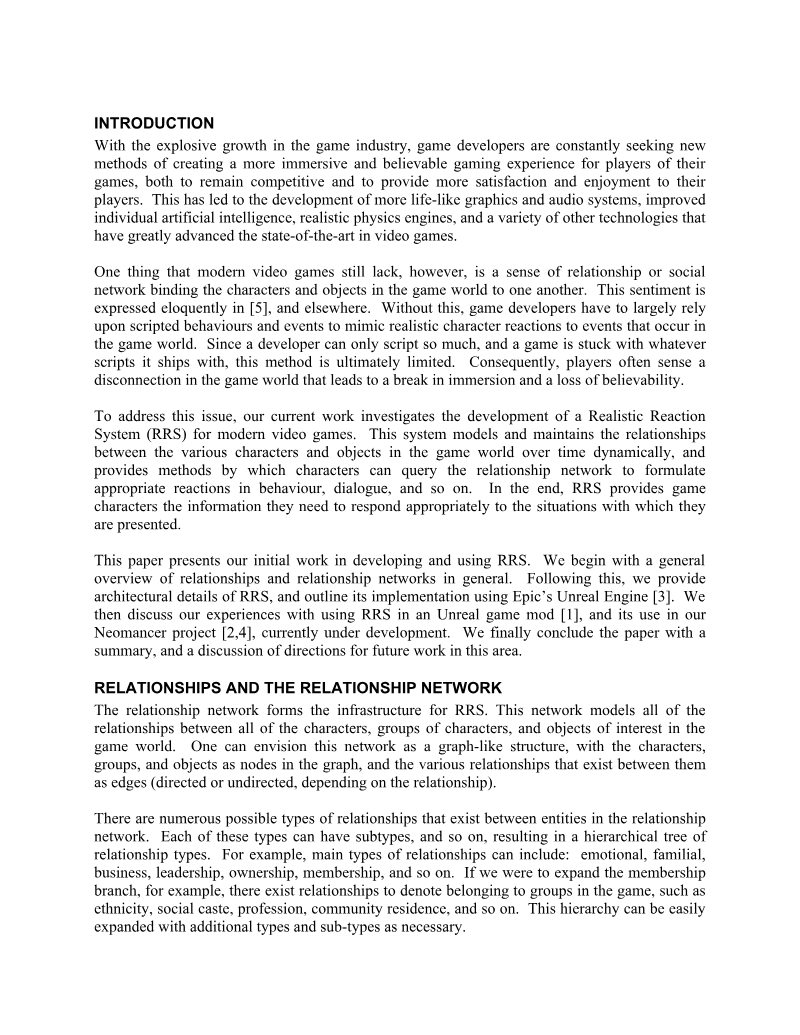
This paper, authored by researchers at the University of Western Ontario with a contributor from Horseplay Studios, presents a Realistic Reaction System (RRS) designed to give video game characters and objects dynamic, society-like relationships that evolve over time. The authors argue that current games rely heavily on scripted events to simulate reactions, a method that is inherently limited and often breaks player immersion. RRS addresses this by maintaining a relationship network in which characters, groups, and objects are nodes connected by typed, attributed edges, allowing characters to query the network and formulate contextually appropriate behaviour and dialogue.
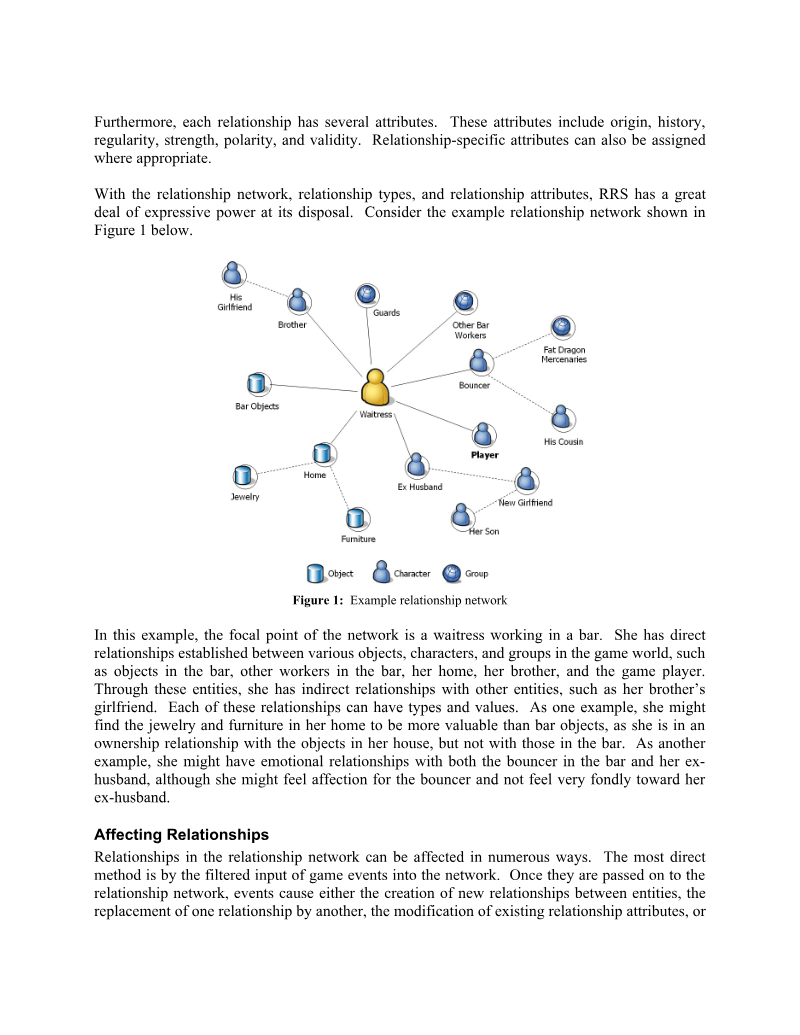
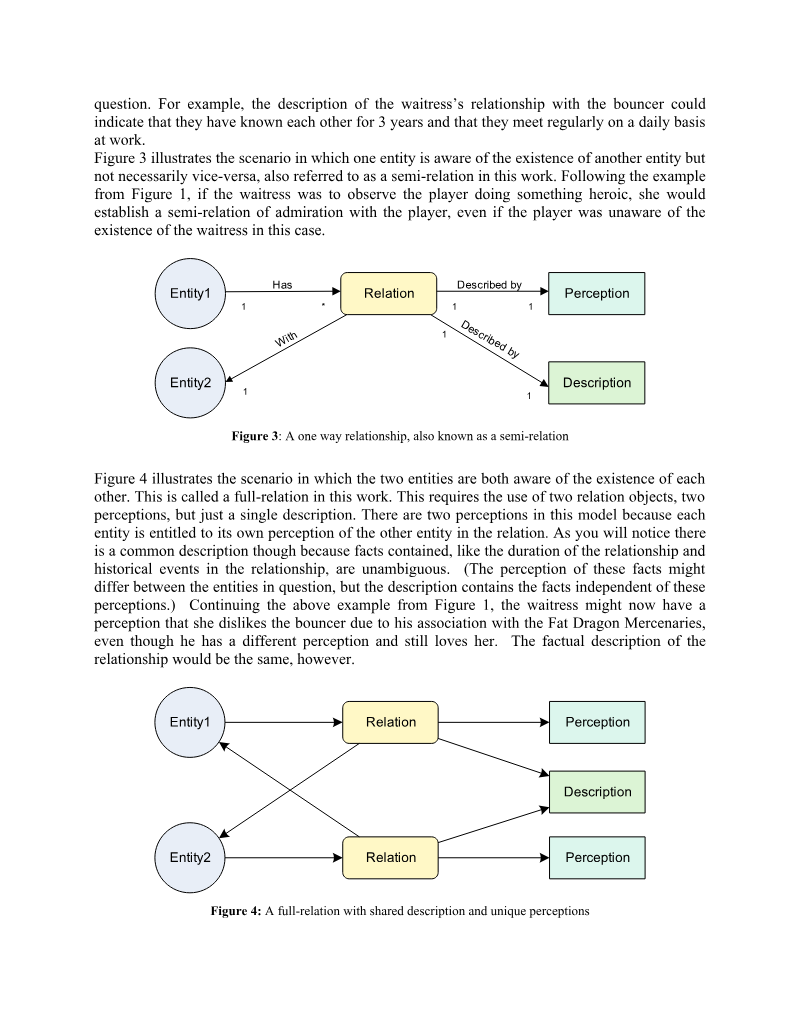
The system's design is organized around several core mechanisms. Relationships are arranged in a hierarchical taxonomy of types, such as emotional, familial, business, and membership, and each carries attributes including origin, history, strength, polarity, and validity. Game events influence the network directly, and their effects propagate indirectly through related entities, much like reputation spreading through a community. Relationships also decay toward neutrality over time unless reinforced. A key modeling feature separates each entity's subjective perception of a relationship from a shared, objective description, and supports one-way "semi-relations" as well as mutual "full-relations."
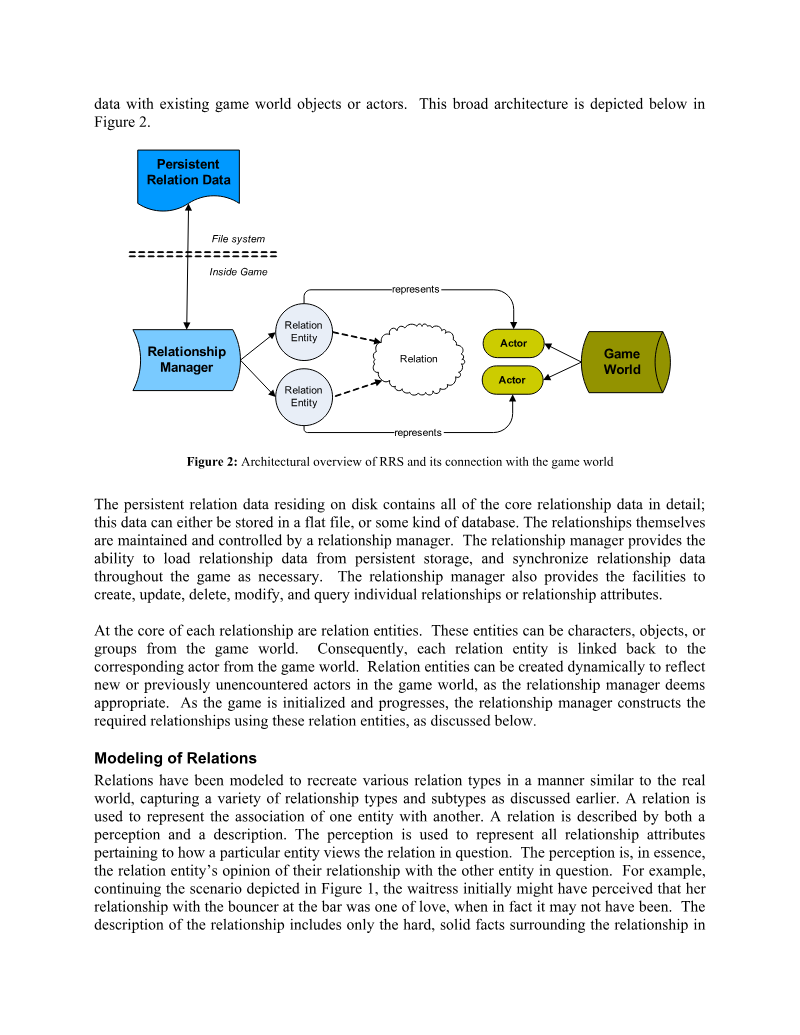
The architecture consists of persistent relationship data stored on disk, a relationship manager that loads and synchronizes this data, and relation entities linked to in-game actors. The authors implemented a prototype in UnrealScript for Epic's Unreal Engine and validated it first through individual test cases and then by extending the LawDogs modification for Unreal Tournament, whose bar setting suited the paper's running example. Demonstrations show contrasting "like" and "hate" perceptions held by the same pair of characters. The work is still in progress, with ongoing integration into the Neomancer project, and planned future efforts include performance optimization, porting to other platforms, and expanding the library of predefined relationship types.
Each row is a game or company this document names, each column a document, oldest first. A mark means that document names it. Select a row to see those documents.
DiGRA · 2020
DiGRA · 2020
DiGRA · 2020
DiGRA · 2020
DiGRA · 2020
DiGRA · 2020
DiGRA · 2020
DiGRA · 2020
DiGRA · 2020
DiGRA · 2020
DiGRA · 2020
DiGRA · 2020