Game Development
Documents
Model Scheme and Manual for Game Incubation Programming and Financing: Baltic Games Industry
VENTSPILS HIGH TECHNOLOGY PARK ERHVERVSAKADEMI DANIA TECHNOLOGY PARK This model scheme illustrates “how to run” an incubation programme for game development companies, drafted in form of a manual for business support providers and intermediaries working with Dania University of Applied Sciences Kaunas Science and Technology Park Ventspils High Technology Park für internationale Zusammenarbeit mbH Title page: © iStock.com-bedya, 1.
- Most game incubators in Europe, especially those for game creators, are primarily funded by public sources, with private initiatives being a minority.
- Establishing a sustainable game incubator often takes over 5 years to break even, with only 40.8% of business incubators aiming to break even as part of their business plan.
- Game incubation programs can be structured in various ways, including long-term incubation (1 year+ for medium-maturity startups) and short-term acceleration (3-4 months for high-maturity startups, often involving equity exchange for funding).
- Effective communication strategies for recruiting incubator participants include leveraging social media platforms like Facebook, Twitter, Instagram, and LinkedIn, and partnering with industry job portals like Skillshot.pl.
- The Ventspils High Technology Park GameDev Incubator, operating since 2018, offers free support tools like co-working spaces, coaching, workshops, and grants, focusing on PC, mobile, VR/AR platforms, and collaborates with Ventspils Digital Centre and University of Applied Sciences.
Guideline for Set-Up and Maintenance of a Mentoring System for Game Business Incubation
The guideline provides hands-on support regarding the whole process of set-up and maintenance of a mentor system (search for mentors, get in contact, motivate them to get engaged, integrate them in the programme, monitor their work and give feedback, promote their engagement, keep them on board, support further Metropolia University of Applied Sciences Swedish Games Industry (Association of Swedish Game Developers) – Dataspelsbranschen Ventspils High Technology Park für internationale Zusammenar...
- The game industry is highly competitive and unique, with revenues exceeding three times that of the movie industry, requiring specialized incubation support distinct from generic tech incubators.
- Effective game incubation systems need to tailor their offerings based on the local startup ecosystem, considering factors like founders' experience (e.g., fresh graduates vs. industry veterans) and community focus (e.g., hobby developers needing business skills).
- Mentoring in game incubation involves a continuous, supportive relationship with experienced industry professionals, ideally based on a flexible long-term development plan, and requires mentors with strong communication, listening, and industry understanding.
- Incubators like VHTP GameDev Incubator operate both on-site and remotely, leveraging external experts and national support networks (e.g., Latvian Game Developers Association) to provide services like free co-working spaces, legal/accounting advice, and conference opportunities.
- Feedback collection through surveys, interviews, and discussions is crucial for iterating and restructuring incubator offerings, as demonstrated by Farm League's shift to the Living Game Intelligence Network (LGIN).
Manual on International Cooperation for BSR-Wide Game Business Development
The manual summarises all the findings, lessons learnt and conclusions from the work on internationalisation, ideas for cooperation and recommendations to the different actors in game business. für internationale Zusammenarbeit mbH Hamburg Institute of International Economics für internationale Zusammenarbeit mbH Title page: © iStock.com-bedya, EXECUTIVE SUMMARY .4 1.
- The global game market is rapidly growing, with China leading in consumer spending, followed by the US and Japan. European countries, with smaller home markets, must focus on global markets, necessitating internationalization in game incubation.
- International cooperation is crucial for game incubators to stay updated on trends, tools, and opportunities, requiring resources like travel to events and partners, supported by sustainable business models or public funding.
- The Game Camps project (2017-2020), funded by Interreg Central Baltic, fostered cross-border startups by bringing together over 250 game enthusiasts from Finland, Sweden, Estonia, and Latvia, resulting in four new startups and support for over 15 existing ones.
- Establishing a common brand like 'Baltic Sea Games' for the BSR game industry involves questions about who creates and promotes it, their motivations, and target groups. The brand has a logo and social media presence, but its WordPress website is currently an initial landing page.
- Collaborative ecosystem activities, such as strengthening the incubation ecosystem, sharing expertise on specialized topics, and creating international environments for startups, are identified as key areas where transnational efforts can significantly boost quality and impact.
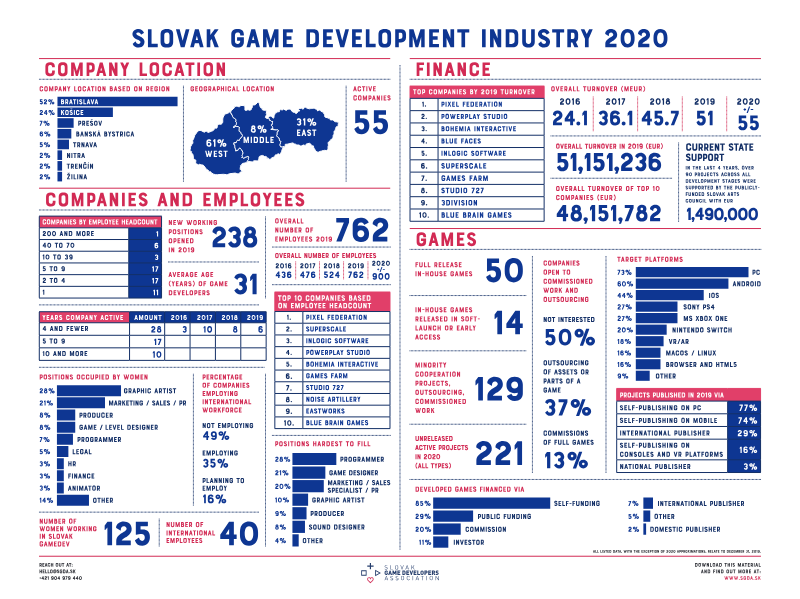
Slovak Game Industry Infographic
The Slovak game industry demonstrates consistent growth and professional maturation, characterized by a robust increase in both turnover and workforce capacity. As of the end of 2019, the sector comprised 55 active companies, with a significant geographic concentration in Bratislava, which hosts 52 percent of all firms, followed by Košice at 24 percent. The industry’s economic footprint is substantial, with the top ten companies generating over 48 million euros in annual turnover. Workforce development has kept pace with this expansion, as the total number of employees rose from 436 in 2016 to 762 by 2019, supported by the creation of 238 new positions in the final year of the reporting period.
Development activity remains diverse, with a strong emphasis on PC and mobile platforms. PC development leads the market at 73 percent, followed closely by Android and iOS at 60 percent and 44 percent, respectively. While self-publishing remains the dominant business model—utilized by 77 percent of companies for PC and 74 percent for mobile—the industry also leverages a mix of public funding, which supports 29 percent of projects, and commissioned work. Despite this growth, the sector faces talent acquisition challenges, particularly in filling roles for programmers, game designers, and marketing specialists.
The industry maintains a global outlook, with 40 international employees and a significant portion of the workforce engaged in outsourcing and international collaboration. Women represent a notable segment of the industry, occupying 129 positions, primarily within graphic arts, marketing, and production roles. With 221 active projects reported in 2020 and ongoing support from the Slovak Arts Council, the industry is positioned for continued development, balancing in-house creative output with strategic international partnerships and a diversified platform strategy.
- The Slovak game industry experienced significant workforce expansion between 2016 and 2019, growing from 436 to 762 employees.
- The top ten companies in the sector generated over 48 million euros in annual turnover as of 2019.
- The industry is geographically concentrated, with 52 percent of the 55 active companies based in Bratislava and 24 percent in Košice.
- PC development is the primary focus for 73 percent of companies, followed by Android at 60 percent and iOS at 44 percent.
- Self-publishing is the dominant business model, utilized by 77 percent of PC developers and 74 percent of mobile developers.
Slovak Game Industry Annual Report 2020/2021
04 Slovak Game Development Industry 2020 59 Outsourcing and Services To currently speak about the games industry without mentioning the unprecedented times we’re all living through is a neary impossible task. I would like to express a huge amount of gratitude towards every single studio’s and individual’s hard work and dedication - continuing not only to create, but also to support our association.
- Slovak game development includes studios like Tater Games (founded 2019, 7 employees, released Nunu Spirits, Cyber Forge), Atomic Realm (founded 2019, 4 employees, released Magnet Run, developing Squabble), and Fatbot Games (founded 2015, 6 employees, released Vaporum).
- Larger studios include Pixel Federation (founded 2007, 220 employees, titles like Diggy's Adventure, TrainStation 2) and Inlogic (founded 2005, 60 employees, titles like Football Championship 2020, Zombie Hill Race 3).
- Several studios focus on specific niches: Incidental Minds (founded 2018, 6 employees) develops 2D illustrated story-driven and strategic games, while Neutraworks (founded 2018, 6 employees) is an independent studio.
- MATSUKO (founded 2016, 10 employees) is a deep-tech company specializing in holographic communication and 3D video games, with experience collaborating with Ubisoft.
- Educational initiatives include OpenLab, a technological accelerator for high school students, and Summer Game Dev, a summer school for game development aimed at moderately experienced and advanced developers.
The Game Industry of Poland: 2020
Eryk Rutkowski Polish Agency for Enterprise Development Jakub Marszałkowski Indie Games Poland, Poznan University of Technology Sławomir Biedermann Polish Agency for Enterprise Development Edited by Sławomir Biedermann, Jakub Marszałkowski Ministry of Development Development Ministry of Culture and National Heritage Published by the Polish Agency for Enterprise Development Pańska 81/83, 00-834 Warsaw, Poland www.parp.gov.pl ...
- The Polish game industry has over 440 studios and companies, with 43 of them listed on the Warsaw Stock Exchange (12 on the main floor, 31 on NewConnect).
- Between 2017 and 2020, over 120 studios closed down while over 160 new ones were established, indicating a high variability in the sector, though the rapid growth observed before 2017 has slowed.
- 11 bit studios, founded in 2009 by former Metropolis studio members, developed 'This War of Mine' (the first video game on Poland's official school reading list) and 'Frostpunk', and has 140 employees.
- PlayWay, founded in 2011 by Krzysztof Kostowski, went public five years later and now has 55 subsidiaries incorporating 100 development teams, improving financial performance quarterly and paying out full dividends.
- All in! Games, a Cracow-based company, merged with Setanta in early 2020, went public, and has grown to nearly 60 employees; they are also the naming rights sponsor and strategic partner of the Wisła Cracow e-sport section since 2019.
The State of the Finnish Game Industry 2020
The Finnish game industry solidified its position as a cornerstone of the national economy in 2020, maintaining a turnover exceeding €2 billion for the sixth consecutive year. Despite a slight contraction in the total number of active studios to approximately 200, the sector experienced a maturation phase characterized by increased revenue stability and a rise in high-performing firms. With 46 studios now generating over €1 million annually and a collective net profit surpassing €500 million, the industry demonstrated remarkable resilience against the operational disruptions of the COVID-19 pandemic. This economic strength is supported by a workforce of 3,600 professionals, with a persistent demand for hundreds of additional hires, reflecting a healthy, expanding ecosystem.
The industry is currently undergoing a strategic transformation driven by technological shifts toward cloud gaming, artificial intelligence, and Games as a Service models. While developers benefit from a robust network of public funding, private investment, and professional associations, they face mounting pressures from market consolidation, rising user acquisition costs, and regulatory fragmentation. To remain competitive in a saturated global market, Finnish studios are increasingly prioritizing data-driven design, social integration, and the development of strong intellectual property. This shift is accompanied by a positive trend in workforce diversification, with female representation reaching 22 percent.
The Finnish landscape remains defined by a diverse array of entities, ranging from global mobile giants like Supercell and Rovio to specialized indie developers and B2B service providers. These companies successfully balance creative autonomy with sustainable business practices, leveraging both original IP and work-for-hire models. By integrating emerging roles such as content creators and streamers into the development lifecycle, the industry continues to evolve, ensuring that Finnish studios maintain their significant footprint in the global digital entertainment market through innovation in mobile, console, and emerging technology platforms.
- The Finnish game industry maintained a turnover exceeding €2 billion in 2020, marking the sixth consecutive year of achieving this milestone.
- Industry profitability remains strong with 46 studios generating over €1 million annually and a collective net profit surpassing €500 million.
- The sector employs 3,600 professionals across approximately 200 active studios, with a persistent demand for hundreds of additional hires.
- Strategic development is shifting toward cloud gaming, artificial intelligence, and Games as a Service models to combat rising user acquisition costs and market saturation.
- Workforce diversification is improving, with female representation in the industry reaching 22 percent.
Gaming Industry Report: Serbia 2020
The 2020 assessment of Serbia’s video‑game sector presents a rapidly expanding ecosystem that has moved beyond a modest, paper‑based association to become a central hub for nearly one hundred companies. In a single year the industry surpassed €100 million in revenue, a 20 percent increase over the previous period, while supporting 120 development teams and roughly 2 100 employees, about one‑third of whom are women. The market delivered 41 new mobile titles, with most studios concentrated in Belgrade and financing split between angel investors and state‑funded programmes, which together account for 45 percent of capital. A clear majority of firms intend to grow their staff in 2021, despite citing regulatory red‑tape, limited legal incentives and insufficient console support as persistent obstacles.
The sector is dominated by small‑to‑mid‑size studios, typically employing five to twenty‑five people, that provide full‑cycle development, consulting and backend‑as‑a‑service solutions. Companies such as Elbet and Tummy Games have already achieved notable market traction, with Elbet’s products operating on more than 130 operators across 30 countries. The pandemic forced a swift transition to remote work, exposing resource constraints and talent‑recruitment challenges, yet overall productivity remained stable and the community’s outlook stayed positive.
Industry networking was sustained through a dedicated Discord community of over a thousand members and forty channels, while the Serbian Games Association launched talent‑development initiatives including a “Shift 2 Games” job‑role series and a mentorship pilot for fifteen participants. Parallel to these efforts, game‑related education expanded dramatically: the Master 4.0 Hub in Gaming at the University of Kragujevac and a new master’s programme at the University of Arts in Belgrade will together serve more than 1 500 students, supported by over thirty professors and a dozen new degree and certificate programmes across ten institutions. Backed by partners such as Epic Games, Crater Training Center and Nordeus, this coordinated educational push is poised to supply a robust pipeline of world‑class talent for Serbia’s indie and mid‑size studios.
- Serbia’s video-game industry reached over €100 million in revenue in 2020, marking a 20 percent year-over-year growth across 120 development teams.
- The sector employs approximately 2,100 people, with women accounting for one-third of the workforce and a majority of firms planning to increase staff in 2021.
- Educational infrastructure expanded significantly with new programs at the University of Kragujevac and the University of Arts in Belgrade, supported by partners like Epic Games and Nordeus to serve over 1,500 students.
- The ecosystem is composed of nearly 100 companies, primarily small-to-mid-size studios of 5 to 25 employees, with 45 percent of capital sourced from angel investors and state-funded programs.
- Market output in 2020 included 41 new mobile titles, with companies like Elbet achieving international scale by operating on more than 130 platforms across 30 countries.
Catálogo de Servicios – Desarrolladores: España
The catalogue presents AEVI’s strategy to strengthen Spain’s video‑game development sector through a suite of collaborative services and targeted initiatives. Central to the effort is the celebration of the second anniversary of the association’s development area, which underscores a commitment to expand support for local studios, from established references to emerging independents.
Since the start of 2020, six new development studios have joined AEVI, bringing the total roster to more than thirty members, including Artax Games, Binary Box Studios, Blackmouth Games and others. Financial assistance is offered through a €10,000 grant programme, while an affordable annual membership fee of €150 eases entry for smaller firms. AEVI also operates a mentor network, a job‑matching platform, and a €10,000 aid scheme, and has conducted outreach across 15,000 km, meeting over 300 developers in cities such as Madrid, Barcelona, Bilbao and Seville.
Key partnerships extend legal, technological and commercial expertise to members. Bird & Bird provides free initial legal consultations on intellectual‑property, labour and tax matters; Tutelio supplies blockchain‑based IP protection services; B2Boost grants access to weekly market‑intelligence reports covering PSN, Xbox Live, Steam and Nintendo e‑shop sales; Sorastream enables cost‑free integration of games into its cloud‑gaming platform with revenue‑share terms for AEVI affiliates. Additional collaborations with Enumbers, Screenglitch, Make Good Art Agency and Gamingates deliver accounting tools, marketing support, digital‑strategy advice and visibility in professional networks.
Collectively, these measures aim to create a sustainable ecosystem for Spanish developers, fostering talent, facilitating market entry and enhancing the international profile of locally produced games.
- AEVI has expanded its development division to over 30 member studios since 2020, including firms like Artax Games, Binary Box Studios, and Blackmouth Games.
- The association provides direct financial support through a €10,000 grant programme and maintains a low barrier to entry for small firms with an annual membership fee of €150.
- Members receive specialized professional services, including free initial legal consultations from Bird & Bird and blockchain-based IP protection via Tutelio.
- Market intelligence is provided through B2Boost, which supplies weekly sales data from major platforms including PSN, Xbox Live, Steam, and the Nintendo e-shop.
- AEVI facilitates commercial growth and distribution through cloud-gaming integration via Sorastream and marketing support from partners like Make Good Art Agency and Gamingates.
Impact of Cloud Gaming and Other Trends in the Indie Ecosystem: Spain
The analysis evaluates how cloud‑gaming and emerging distribution models are reshaping the Spanish indie game ecosystem, arguing that while the broader gaming audience is expanding across new platforms and financing structures, cloud‑gaming remains experimental and will not achieve mass‑market penetration for several years due to bandwidth constraints and uneven consumer readiness. Console users, especially those who are price‑sensitive and less tied to a single PC ecosystem, are identified as the most promising segment for indie titles delivered via cloud, with subscription‑or‑free‑to‑play (GaaS) approaches offering the strongest revenue potential.
Current platform data show PlayStation Now operating in 19 high‑speed‑Internet markets and reaching more than 79 million PS4 owners—approximately 0.6 % of the console base—yet its relatively high subscription fee and overlap with PS Plus dilute its attractiveness. Google Stadia leverages extensive data‑center and AI resources, providing a free tier alongside a €9.99‑per‑month option, illustrating divergent pricing strategies within the nascent market.
Strategic recommendations for indie studios emphasize hybrid monetisation that combines subscriptions with direct sales, targeting latency‑tolerant mid‑core audiences, including a growing female demographic. Development pipelines should prioritise engines with broad cross‑platform support, notably Unreal for versatility and Unity for seamless Stadia integration, while adopting low‑cost, high‑quality marketing to compensate for the reduced role of traditional publishers. Cloud‑gaming’s principal advantage lies in creating a more level playing field, granting indie developers visibility and access to users lacking high‑end hardware, thereby expanding market reach in Spain and comparable European territories over the coming three to five years.
- Cloud gaming is currently an experimental niche that will not reach mass-market penetration for three to five years due to bandwidth limitations and consumer readiness.
- Indie studios should adopt hybrid monetization models that combine direct sales with subscription or free-to-play (GaaS) approaches to maximize revenue potential.
- The most viable target audience for cloud-based indie titles consists of price-sensitive console users and latency-tolerant mid-core players, including the growing female demographic.
- PlayStation Now currently reaches approximately 0.6% of the 79 million PS4 console base, with its growth hindered by high subscription fees and service overlap.
- Development pipelines should prioritize cross-platform engines, specifically Unity for its seamless Stadia integration and Unreal for overall versatility.
Finnish Game Industry Report 2018
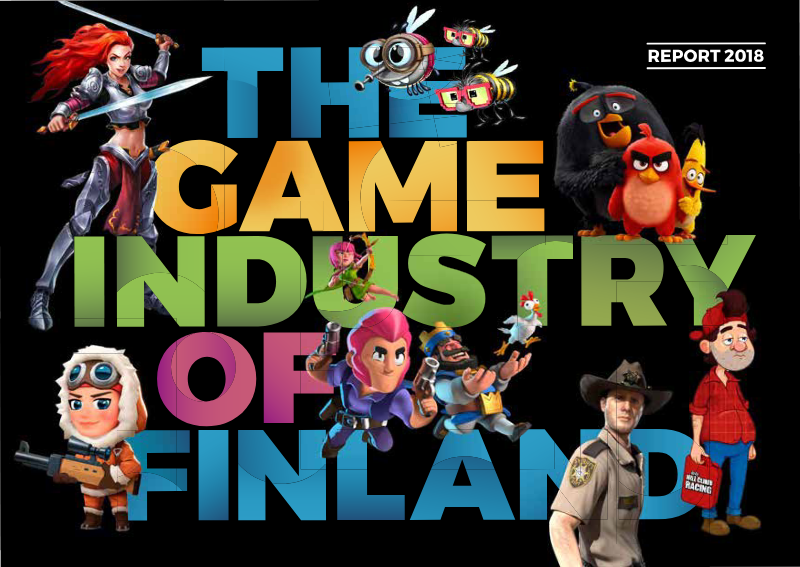
Fingersoft • Ηill Climb Racing 2 Futureplay • Battlelands Royale Next Games • Τhe Walking Dead: Our World Rovio Εntertainment • Angry Birds 2 Small Giant Games • Εmpires & Puzzles Supercell • Brawl Stars, Clash Royale, Clash of Clans and Ηay Day Remedy Εntertainment • Control Rival Games • Τhief of Τhieves: Season One Superplus Games • Ηills of Steel Nitro Games • Ηeroes of Warland Κukouri Mobile Εntertainment • Pixel Worlds Publisher Neogames Finland ry (2019) 2.
- The Finnish game industry has a strong history of significant international investments and acquisitions, including Softbank acquiring 51% of Supercell (2012-2014) and Tencent acquiring 80% of Supercell (2016), alongside numerous game studio acquisitions.
- Helsinki is a global leader in mobile game development, hosting over 80 companies, 1,600 employees (28% non-Finnish), and generating a 2018 turnover of 1.7 billion EUR, with 98.4% from exports.
- Finnish developers are rapidly adopting Nintendo (Switch) as a target platform, with its popularity growing from 4% in 2016 to 20% in 2018; chat games also emerged as a new focus (5% in 2018).
- Multiplatform development is common, with Android (75%), iOS (71%), and PC/PC online (50%) being the most popular platforms in 2018, while Windows mobile and Facebook are no longer targeted.
- Finnish game developers are actively exploring new market disruptions like blockchain, cross-platform games, cloud gaming, subscription models, HTML5 (including chat games), and XR technologies, demonstrating a strong ability to adapt.
Slovak Game Industry 2019
It’s said to be a small world, and the digital games world is smaller still. Yet nevertheless, without the right partner and guidance it’s easy to get disorientated. When we started the annual monitoring of Slovakia’s game development industry, we had a clearly defined vision and goal. And the results of the first Game Developer Census comprehensive report confirmed that we were on the right track.
- The Slovak game development industry is growing, with increasing numbers of studios, profits, project quality, and employed professionals.
- Self-funding is the primary source of funding for Slovak game companies (81%), followed by public funding (35%) and investors (22%).
- 42% of Slovak game studios self-publish their games, while 42% use a publisher (11% foreign, 8% Slovak) and 16% are publisher holders.
- Programmers (10%), Game Designers (10%), and Producers (13%) are among the least represented positions occupied by women, while Graphic Artists (29%) and Marketing/Sales (19%) are more common.
- Two vocational art schools in Košice and Trenčín offer specialized programs in digital painting, animation, and digital application design, including game environment and character design.