VideoThe Game Business
The D&D company is spending $1bn making video games, and none of them are games-as-a-service
19 May 202623 min video
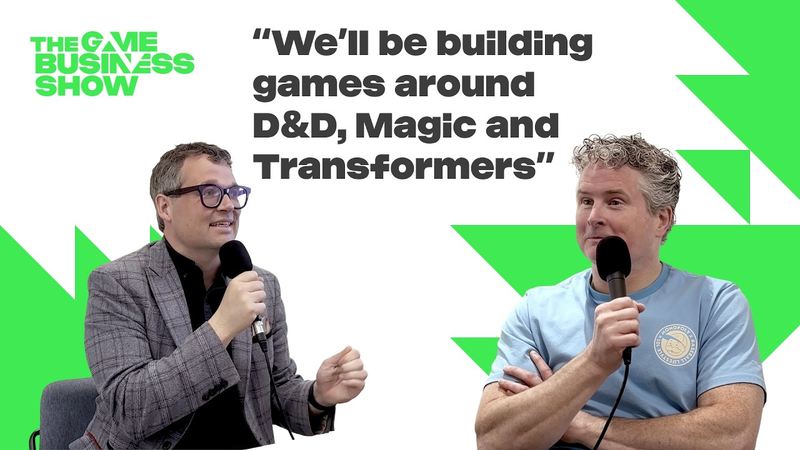
If you invest a fair amount of money and give a fair amount of time to a talented team to do a more traditional game,
Yeah.
yeah, you probably won't make billions of dollars, but your chances of being at least making your money back is much, much higher. There's always going to be demand for good games that deliver a nice 40 to 50 hours worth of content set at a fair price.
Hello and welcome to the Game Business Show with me, Christopher Dring. I am here at Hasbro's offices in the UK to discuss the company's video game strategy. Now, they've had huge success recently with titles like Monopoly Go and Baldur's Gate 3, and it is investing heavily in new studios, new talent, games in its established universes, but also new IP as well. And to tell us all about it, I'm here with Hasbro CEO Chris Cox. Hello Chris, welcome to the show.
Chris, thanks for having me.
Now, you've put a real focus on games, I mean video games, in recent years. I spoke to John Hight last year at Summer Game Fest. How much investment are you putting into this space at the moment?
Oh gosh, we started our investments under my tenure back in 2018. I would say over the course of a decade, we'll probably put in close to a billion dollars of investment.
All right, into video games specifically.
Yeah.
Oh, wow, that's a lot.
Yeah, building out our studios, building out content, building out publishing capability, making games.
How much emphasis are you putting on the first-party stuff, the stuff that you're making internally, compared to all the licensing and things like Monopoly Go and things like that?
Well, I'd say it's a balance. So, I actually think Hasbro is pretty unique in that we make games and that we're very focused on uh franchising and licensing. So, where we made our strategy and we made our choices was, okay, we've got some like big marquee brands, more casual games like Monopoly and Clue, and then, you know, like our entertainment brands like My Little Pony,
Mhm.
Dungeons the pig, and then we have some more kind of like core brands like D&D
and Magic, maybe Transformers and GI Joe I'd throw into that camp. And so that's a really broad portfolio of options.
Yeah.
So where were we going to place our bets versus where were you going to not place our bets? And we chose to place our bets in core games focused on PC and console and more traditional business models cuz there was kind of like this uh higher floor, but maybe a lower ceiling but a much higher floor. So it was like kind of a safer bet for us.
Yeah.
And for kind of like the higher floor, maybe lower ceiling kind of games as service bets which typically are more like mobile games, we chose to partner for those. So we'll be building games mostly around D&D, Magic, Transformers, maybe some of our other properties, maybe selectively some new stuff like we have with Exodus.
Yeah.
That'll be very focused on action adventure and role playing games for PC and console. And then we'll partner with the best in
the business on, you know, more casual games, more mobile games, new and emerging platforms like VR, etc. And that's been pretty good for us. So, you know, I think we're the number one digital games licenser in the world by a fairly large margin. That's pretty lucrative business for us. It also has super high reach. So it really helps us reach a lot of different gamers. And it really helps to fund kind of those efforts in building out our first-party capabilities.
It's quite unusual, I think, that a company, particularly a company outside of video games, to sort of go down the premium route, to sort of note cuz the opportunity, the exciting opportunity that you just quite say the high ceiling, is that live service model.
Sure.
So it's quite a it's quite a probably a it seems like a wise decision to sort of go down that other route, but it feels unusual to me.
Yeah, I mean it to me it just kind of comes back to um the binary nature of games as a service. I mean, you can invest you can invest a
hundred million dollars to build a really great mobile game or a really great games as a service, like a shooter or something like that. And the upside is you make billions and millions of dollars. But, how many people achieve that upside? It's very low single-digit percentages, if if even.
Yeah.
The downside is you don't make anything back, and it's basically a wash. Whereas, you know, if you look just like statistically and you know, that's kind of dangerous cuz it's a creative enterprise, but if you invest a fair amount of money and give a fair amount of time to a talented team to do a more traditional game,
Yeah.
yeah, you probably won't make billions of dollars, but your chances of being at least making your money back is much, much higher. And even if you fail, you know, you're probably making 50, 60, 70 cents on the dollar back. So,
you know, when we just looked at the risk-reward equation of that and we looked at like kind of the design sensibilities we have, frankly, the kind of games we like to play and I'm more of a traditional gamer,
Yeah.
we chose that to be the safer route.
It's interesting cuz the obviously the market shifted, particularly post-pandemic. So, you would have started this investment and where we got to an area where zeros are suddenly possible. It is possible to release a premium game and it it could be a good premium game. Could even have a license attached to it and it does nothing whatsoever. Have you had to adapt the your model based on the market?
Oh, sure. I mean, we started investing in 2018, 2018, 2019 is when we started Archetype, which was our first studio. Now, we have about five, maybe six studios that are kind of actively in production. Back then, the context was there were all of these companies kind of just snapping up promising game studios and valuations were sky-high and it was like this massive hot market. Then you have the pandemic and games as a service really started to take off and you know, the big question was why even charge for a game? Like you're just going to make it all up in kind of free-to-play and
microtransactions. And then of course the bloom came off the rose on all of that.
Yeah.
Like the valuations kind of came down and a little normalcy came back to business models. And then after the pandemic and you know, all of this is kind of happening simultaneously but I'm I'm being linear to tell a story. Then you have like the rise of Indies, you have you know, Roblox really kind of achieving hyper scale.
Mhm.
Minecraft of course has had that for a long time and so you just have this dispersion of all of these different kinds of genres and different kinds of ways to engage players. And so I think what we've done is you know, usually when you make a game it's a 7 to 10 year bet especially when you're starting a studio. We've just tried to be constant and focused on the thing that we think players want. And I think players there's always going to be demand for good games that deliver a nice 40 to 50 hours worth of content
Mhm.
set at a fair price. And so that's kind of our focus.
Yeah.
Now, you know, I think the biggest thing that's probably changed inside of that model is the cost to make those games has gone up quite a bit since 2018 2019.
Yeah.
But you know, that's something we'll be thinking about in the next round of games.
Yeah.
How do we you know, diversify where our studio locations are? Right now they're pretty North America based particularly US based. How do we use like great markets like Montreal? We build a lot of games in role-playing games and action adventure. Certainly there's awesome talent in Eastern Europe.
Yeah, of course.
So how do we just tap into that market? And then how also do we use like partners? So, you know, we announced a joint venture with Saber Interactive for a TBA game. And so, you know, I think we'll lean into all of the above as we evolve the model.
Cuz you've put these this investment into these games, there is an element of being able to build on top of it.
Sure. Hopefully, the the idea is that the sequel won't take as long as the
as the first one. Exodus is interesting to me because A, it's not based on a Hasbro brand. It's also the model it seems to be right now of the market seems to be that you start almost in double A in that sort of in those sort of games with a new IP and then maybe in time it could become moving into the triple A space possibly. But, it's quite an ambitious bet. I don't know if you'd have made that and if you were making that decision today. But, it's also quite exciting to see a big I know it's not till the beginning of next year, but a big play in that space with sci-fi adventure sort of thing. Um not that it was really a question there, but um
No, I mean I I'll I'll answer the I suppose the implied question, which is why did we make the bet. I I think it was a couple of things. First off, the team at Archetype, you know, founded by James Ohlen, but then Chris King and, you know, Jesse Sky and a lot of the team from BioWare, who made some of my favorite games ever.
Like, gosh, being able to acquire talent like that and gather them all in one place,
that doesn't happen very often. So, I think you take advantage of that.
Mhm.
So, that was thing one. Thing two was like, yep, it's a it's a new IP, but it it's not like it's unfamiliar ground to us.
Yeah.
I mean, Exodus is effectively D&D in space. So, we're kind of familiar with role-playing games and we're familiar with how to make good ones. So,
Yeah.
it was a genre that we understood. And then the last thing was, you know, in 2018 this was true, but it's I think it's even more true now in 2026, it's a space that hasn't had a good game in a long time.
Yeah.
You know, it's been a while since Mass Effect 2 and 3. And I think there's a big need in the marketplace for that and we're certainly seeing it with the fan response. So, while it's kind of a bold and maybe even a risky bet, my hope is that it'll be a good one.
Yeah.
You know, I get to play the game now and then and it's it's pretty good. So, I'm
pretty pleased with how it's coming together. You know, time will tell if it's a good financial bet.
It does seem like some of these bets might be because you want to play the game.
Well, I'd be lying if that wasn't true. But I I definitely think passion is an important ingredient in wanting to invest in things. So, you know, passion yields kind of a a player's understanding, a fingertip kind of touch and feel for the game. And I think it helps you guide your investments when used wisely.
John, almost at the coast last year mentioned that you're building out an internal group that can support both I think both your internal studios and potentially partners as well. Which is I think it's an interesting way of maybe joining those things together and ensuring certain levels of quality and and things like that. Is that the thinking behind that?
Yeah, so we're building out our Montreal studios quite a bit. So, we have a studio called Invoke that's based in Montreal and then we're building out,
for lack of a better word, like a publishing and a shared services capability in that market. And you know, Montreal has I think arguably some of the best games talent in the world. Um, they're specialists in action-adventure kind of kind of coming from like the Ubisoft school of game craft and design and I think Ubisoft makes fantastic games. And so, there's a lot of talent there. Uh, it tends to be a a lower cost market to acquire talent and attract talent. And so, I think we're building that out to be probably have 150-ish people today. I wouldn't be surprised if that was 250 to 300 people within the next couple years.
I'm interested obviously when we think of IP that would work very well in games. Some of them are so obvious, right? There's D&D and Magic and even things like Transformers stuff like that. Are there any Are there brands that perhaps people weren't thinking about that actually that you are that you think might be an opportunity in this space?
So brands that we have, I definitely think our board game portfolio is uh solid gold. I think Monopoly Go shows that you can
take like a classic and reinvent it for a new platform and just create a massive hit. So, you know, I think a lot of the same kind of fundamentals that Monopoly brings, which is hey, it's in everyone's kind of game closet, people are familiar with the rules, it's inherently social and fun, you could apply that to Candy Land, to the Game of Life, to Clue, heck even like Shoots and Ladders and Hungry Hungry Hippos. So, I think there's a lot of upside there. And then Hasbro has a lot of characters that are beloved that people interact with. And I also think there's an interesting opportunity and you know, it's going to take a bit of time and we're going to have to do it carefully and working with creators. But bringing our characters to life with things like AI, this going to be a really powerful opportunity that you know, maybe it's not a traditional
video game, but there's so much surface area in the world that could be gamified and lit up with a character that I think there's a a really interesting opportunity there that you'll probably hear more from us about over the next year or so.
I watched an interview of you, you were talking about how um because AI is potentially a threat to people IP owners in the user-generated content space that you're sort of going to lean in rather than try and resist. You think that's the best approach? I thought it was a It seems like a You don't uh Yeah, go go get the tide sort of thing.
I think you have to. So, you know, I I think characters and IP to a certain degree are at a similar moment as call it 25 years ago music was with like, you know, the dawn of digital music and, you know, platforms sharing platforms like Napster. And, you know, you got to police your content and you got to make sure that people aren't using it irresponsibly, but, you know, if you only live life playing defense, you're you're not going to score a lot
of goals. I think you have to lean in and take advantage of the opportunity.
And we've got a lot of characters. We've got a pretty sophisticated licensing engine, so we're used to working with partners.
Yeah.
And so, you know, I don't think we've fully figured out what the model is. It's going to emerge, but I think the only way you can figure that out is by leaning in and trying things.
You also have the other side of AI is its ability to potentially speed things up.
Mhm.
The AI is going to save you a million people hours over the next 12 months, which is a
Yeah.
I don't know how you work that out. But, do you anticipate sort of that similar translation to video games or is that sort of toys?
Yeah, the million people hours was just looking at the variety of initiatives that we have and, you know, in some things like order management and billing, which are kind of boring aspects of the business, but still important, we can save a lot. And then just like basic AI tools and the productivity they bring can, you know, basically going to pencil out to save about two to three hours a week for every employee we have.
And then also allow us to kind of take some of the things that we outsource and basically outsource it to an agent rather than, you know, a different company. In terms of creatively, we're using it pretty significantly, but also pretty selectively.
Okay.
Each of our teams has agency to use AI how they see it being best deployed. Our toy teams are using it quite significantly. It's a really powerful tool to help us with concepting and kind of taking like uh a license or a known character and building out a lot of ideas and going from basically a paper prototype to a fully visualized 3D render in kind of record time. You know, we're we're able to shave off over 80% off of the development uh of like collectibles and figures based on that.
Oh, really?
For like our video games and for studios like Magic and D&D, I think we're being way more selective. And you know, really I don't think those
teams are really using it much at all in terms of creative. You know, they have the option to be able to do that in the future, but I think that's going to be up to them.
Yeah.
And you know, I I I get that. You know, we work with uh a heck of a lot of creators. We work with a lot of artists. We work with a lot of writers.
Mhm.
I think human ingenuity is kind of at the core of games like that. And so, you know, we'll see what time brings. But uh we're giving them the ball and letting them figure out how to how to run with it.
I'll move away from my alley. I'll ask a couple more questions, but we in video games, and you know this as well cuz you you know the industry very well. We do get a lot of people coming from outside the industry trying to crack video games. Sometimes they're super ambitious and they scale it back. Sometimes they're more tentative. Whether that's in entertainment or toys or any other area of the industry. And every now and again you get it works out like worked out for PlayStation, worked out for Nintendo.
Yeah, they worked out pretty well for Sony.
Yeah, yeah. So so so so okay for them. But obviously there were countless examples of people jumping in and going actually no. Um
I guess the question is why are you going to be different?
Well, I mean I suppose we already start differently in that
Yeah.
most of Hasbro's reach, a lot of our revenue, a huge percentage of our profit, is based on games. And we've been making games 160 years since Milton Bradley made the checker game of life in 1860. So, I think we know games pretty well. We have had a history of making games like Hasbro Interactive was founded back in the '90s. We've been doing a digital version of magic since 2002. So, you know, we've at least dipped our toes into the water. I think it's just a natural evolution of the company. Like, you know, our mission is to inspire a lifetime of play. You know, we try to build a relationship based in play with consumers starting at the age of two and two or three and just aging it up through their lifetime and finding different relevant ways to deliver that that play to them. And, you know, I think we'd be operating
with our head in the sand if we didn't recognize that games are the dominant uh play platform of our age and likely for the future. You know, whether it's a kid starting to play Roblox at the age of seven or eight, you know, picking up uh a AAA game and a console at like 11, 10, 11, 12, mobile games throughout their lifetime. I think if you're a company that's based on play, you got to be able to figure out how to make your play be relevant on those platforms. And while we do a lot of partnership on those platforms and that's been pretty lucrative and pretty successful for us with games like Baldur's Gate 3 or Monopoly Go with Scopely, I think we need to have a piece of that and we need to understand it.
Historically, before your time, do you think there might have been some reluctance like video games as a threat to I mean, I think Games Workshop had this years a long time ago. They sort of were very concerned about video games impacting their tabletop business for instance. Do you think there might have been some of that concern in the past?
Oh, yeah, for sure. But, you know, I think anything a business considered a threat um more often than not is an opportunity in a different guise. And it's just what your mindset is.
If it's a threat and all you do is try to play defense, it's very difficult to win the game with just a defensive scheme. You know, if some threats kind of go away and they're temporal, I think, you know, with 60 years of video games, it's here to stay. And you know, perhaps you should lean in.
I'll ask one last question. What does success look like for you in video games?
Well, I think success in video games is kind of the same as success just in with anything in Hasbro. We reach a billion people per year. We bring a smile to their face. We bring friends and families together and fans together and in a shared joy for play and a shared love for characters. And I think digital just helps us accelerate that and it helps us
accelerate that in a bigger marketplace. Do I want to be profitable? Yeah. Would I like it to be kind of like the next big business for Hasbro? Of course. I think our shareholders want that, too. Are we going to be patient? Do we think it's a long-term investment? Yeah. You know, I think the near term is Exodus and Warlock come out next year. They get good feedback from fans. Hopefully a warm reception from the industry. A whole bunch of people have a chance to play it. It'd be great if they were profitable, but I think more importantly if we set the foundation of hey, Hasbro and Wizards of the Coast knows how to make great games. We've set up a couple new franchises for ourselves. You know, we have a nice long pipeline for, you know, the next decade of game development. I'd feel pretty good about that.
Put in. Thank you, Chris. Thank you for your time.
Yeah, thanks, Chris.
Thank you. That's it for today's episode of the Game Business Show. Thank you to Chris Cox for joining us today. We will, of course, be back with more news, analysis, insight, and interviews in the days and weeks ahead. If you want to
make sure you don't miss a single thing, head to the gamebusiness.com and subscribe to the Game business every time we have a podcast out, every time we do a new interview, we will email you to let you know. There's also a paid subscription option as well if you want to support the podcast, if you like this, please do consider becoming a paid subscriber. But, that's it for me today. Until next time, thank you for tuning in. What is your favorite video game?
Either Baldur's Gate 2 or Civilization.
Oh, wow.
Take anyone.
If you could work on any other IP that Hasbro doesn't own,
Scooby-Doo.
Scooby-Doo?
Yeah, I love Scooby-Doo.
Oh, wow. That That was not I was not expecting that.
Every year I do an annual Scooby-Doo D&D campaign and it's the best campaign I do. Yeah.
Oh, wow.
Yeah. Yeah.
I want to know more about that. Um if you could be the CEO of any other company in any sector, who would it be?
Um to follow on with my my Scooby-Doo thing, I suppose Warner Brothers would
be pretty cool.
Huh?
Or Hanna-Barbera if we could bring that back.
Best thing about your job?
Oh, bringing smiles to people's faces. Like if I can go into a toy aisle and I can see a mom and a child kind of leaning over a toy or I can watch people geeking out over cards at a Magic Con, that's by far the best thing.
And last question, what is your favorite film?
Oh, my favorite film, uh Dodgeball.
Ah. Yeah, I love this office.
Auto-generated captions from YouTube — names and numbers may be misheard.
Hasbro is currently executing a decade-long, $1 billion investment strategy to expand its footprint in the video game industry. The company’s primary thesis centers on a hybrid model that balances internal development of premium, traditional PC and console titles with a highly successful external licensing business. By focusing on high-quality, 40-to-50-hour single-player experiences, the company aims to mitigate the volatility associated with the games-as-a-service (GaaS) model. Leadership argues that while GaaS offers the potential for massive financial returns, the success rate is statistically low, making a traditional premium model a more reliable and sustainable path for their core brands, including Dungeons & Dragons and Magic: The Gathering.
The company’s portfolio strategy distinguishes between core brands, which are handled by internal studios, and casual or mobile properties, which are managed through partnerships. This approach has already yielded significant successes, such as Baldur’s Gate 3 and Monopoly Go. Looking ahead, the company is preparing for the 2027 release of major titles like the sci-fi RPG Exodus and a new D&D action-adventure game, Warlock. To support this growth, Hasbro is diversifying its development footprint beyond the United States, specifically expanding its presence in Montreal to leverage local talent and reduce production costs.
Methodologically, the company is integrating artificial intelligence to enhance operational efficiency and creative workflows. While AI is being used extensively in toy design to accelerate prototyping and 3D rendering, its application in game development remains highly selective, prioritizing human ingenuity for creative tasks. Ultimately, the company views video games as a natural evolution of its 160-year history in play, aiming to reach a global audience of one billion people annually while establishing a long-term pipeline of original and licensed intellectual property.

The Game Business · 2026

The Game Business · 2026

The Game Business · 2026

The Game Business · 2026

The Game Business · 2026

The Game Business · 2026

The Game Business · 2026

The Game Business · 2026

The Game Business · 2026

The Game Business · 2026

The Game Business · 2026

The Game Business · 2026
PCF Group
PCF Group

Deconstructor of Fun · 2026

CD Projekt · 2026

CD Projekt · 2026

Deconstructor of Fun · 2026
The Game Business · 2026
The Game Business · 2026
State of Delaware · 2026
PCF Group · 2026

The Game Business · 2026

The Game Business · 2025
Comments