Game Development reports and market data
Documents

Amateur devs score hits with 38-0, WWDC reactions, May's top games, Orna, jobs, data and more
The mobile gaming industry is currently witnessing a surge in amateur-developed hits, driven by the accessibility of AI-assisted coding tools.
- Amateur developers are achieving viral success with AI-assisted football drafting games like '38-0' and '38-0-0', which secured over 100,000 downloads each in a single weekend with zero marketing spend.
- Honor of Kings dominated May’s top-grossing charts with $161 million in in-app purchase revenue, while 'Last War Survival' saw a significant decline, dropping to 10th place with $82 million.
- Apple’s new developer policy offers free access to its AI foundation models for apps until they reach 2 million first-time downloads, a move aimed at supporting indie developers.

Why I Quit My AAA Job For The Indie Dream (w/ Mårten Stockhaus) — Ep 67
Game development is best approached as an iterative, archaeological process rather than a rigid construction project.
- Securing a publishing deal often requires demonstrating team capability through a playable prototype or vertical slice rather than just a concept, proving to the publisher that the team can execute the vision.
- Working as a contract studio for an established publisher like Coffee Stain on an existing project can provide a low-risk transition into full-time indie development by ensuring a salary while building studio credibility.
- Effective game design relies on 'contrast'—such as mixing fast and slow enemies or balancing pain points with relief—to create engaging combat loops and meaningful player progression.
Can PlayStation’s Housemarque repeat the FromSoftware story?
Housemarque is currently navigating a strategic evolution as a first-party PlayStation studio, aiming to elevate its historically niche, arcade-inspired design philosophy into the realm of major, top-tier gaming franchises.
- Housemarque is transitioning from a niche arcade developer to a major first-party PlayStation studio by scaling its high-intensity, flow-state gameplay for a broader, mainstream audience.
- The studio currently employs approximately 120 people and is leveraging Sony’s internal resources, user testing, and collaborative infrastructure to support this growth.
- Housemarque aims to replicate the success trajectories of established studios like Naughty Dog and Insomniac Games by treating new intellectual properties as long-term foundations for player engagement.

The Secret Behind The Final Fantasy VII Remake Trilogy's Success
The rapid development of the Final Fantasy VII remake trilogy, specifically the three-year production cycle for the upcoming third installment, Final Fantasy VII Revelation, serves as a case study in the critical importance of staff retention and team stability within the video game industry.
- The Final Fantasy VII remake trilogy achieved a three-year production cycle for its third installment by maintaining a 95% staff retention rate from the previous title.
- Retention of development staff grew from 80–90% between the 2020 release of Remake and the 2024 release of Rebirth to 95% for the final installment, Revelation.
- High team continuity allowed Square Enix to bypass traditional team-building phases and leverage established communication shorthands, effectively mitigating friction between artistic goals and technical optimization.

Summer Game Fest thoughts, Supercell kills US projects, Xbox chat, EA's mobile misstep, more
The mobile games industry currently faces a significant disconnect between its massive market dominance and its lack of visibility at major industry events.
- Supercell has effectively wound down its US-based game development operations, with the team behind a project in development for three and a half years disbanded and the remainder of the 2022-announced US team no longer with the company.
- Metacore, the developer of Merge Mansion, is cutting 159 jobs in Helsinki and closing its offices in Germany and Sweden as part of a major restructuring.
- Xbox Chief Strategy Officer Matthew Ball acknowledged that mobile is the largest and most valuable segment of the gaming industry, yet confirmed the company's primary focus remains on the console business, which he noted has the least growth potential.

The new Paramount Games: 'We are not looking to chase GTA'
Paramount Games has established an integrated business unit designed to transform the company’s intellectual property into a cornerstone of its broader entertainment strategy.
- Paramount Games has launched an integrated business unit that combines internal studios and a dedicated publishing arm to transition from traditional licensing to a sustainable, high-quality production model.
- The company is pursuing a 'responsible ambition' strategy that prioritizes narrative-driven AAA experiences over the high-risk, massive-budget development models used by industry giants like Rockstar Games.
- Creative authenticity is maintained by pairing specific intellectual properties with developers who have a genuine passion for the source material, exemplified by the partnership with PlatinumGames for 'Teenage Mutant Ninja Turtles: The Last Ronin'.

$500M in 2 Years: What Grand Games Knows About Scaling That Others Don't
Grand Games has achieved a $500 million annual run rate within two years by implementing a decentralized, multi-studio organizational structure.
- Grand Games achieved a $500 million annual run rate within two years by utilizing a decentralized organizational structure composed of small, autonomous teams of approximately ten people.
- The company leverages a talent-dense ecosystem in Turkey, utilizing government subsidies to mitigate financial risk during the early stages of development.
- Development strategy focuses on a 'sniper-like,' hypothesis-driven approach that validates specific market pain points before committing resources, rather than relying on high-volume prototyping.
Exploring A New Kind of Roguelite: Moonsigil Atlas | Design Club
The roguelite deckbuilder genre has reached a point of saturation following the success of titles like Slay the Spire, leading developers to seek innovation by moving away from traditional mana-based economies and linear resource management.
- Moonsigil Atlas differentiates itself from the saturated roguelite deckbuilder market by replacing traditional mana-based economies with a spatial, grid-based combat system.
- The core gameplay requires players to physically place and rotate cards on a board, shifting the strategic focus from damage output to geometry and tactical positioning.
- Players manage board presence through unique mechanics like sigils for ongoing effects, defensive wards for damage mitigation, and Eternal cards that remain on the board.

How Emerald City Games Stayed Independent And Kept Shipping
Emerald City Games, an independent studio founded in 2008 by cousins Derek Day and Jamie Young, has maintained its autonomy for over 15 years by balancing creative ambition with operational pragmatism.
- Emerald City Games, founded in 2008 in a basement, has maintained independence for over 15 years by prioritizing creative control and studio survival over acquisition offers.
- The studio balances its portfolio by mixing original IP with major licensed franchises like Star Trek and Tomb Raider, applying a consistent quality standard and visual identity across all projects.
- Long-term studio sustainability is driven by a focus on live operations and player retention, with the team planning engagement events months in advance to ensure title longevity.

Why Games Now Take 6+ Years To Make
The modern video game industry is characterized by a significant increase in development cycles, with major titles frequently requiring six or more years to reach completion.
- Major video game titles now frequently require six or more years to complete due to a combination of technical, organizational, and creative challenges.
- The demand for extreme graphical fidelity has forced a shift toward exponentially larger development teams, creating significant communication and management overhead.
- Systemic mismanagement, including frequent shifts in project direction and the ineffective use of pre-production phases, leads to substantial wasted effort and repeated revisions.
The 2026 State of Web Gaming Report: A Study of Developer and Gamer Perceptions
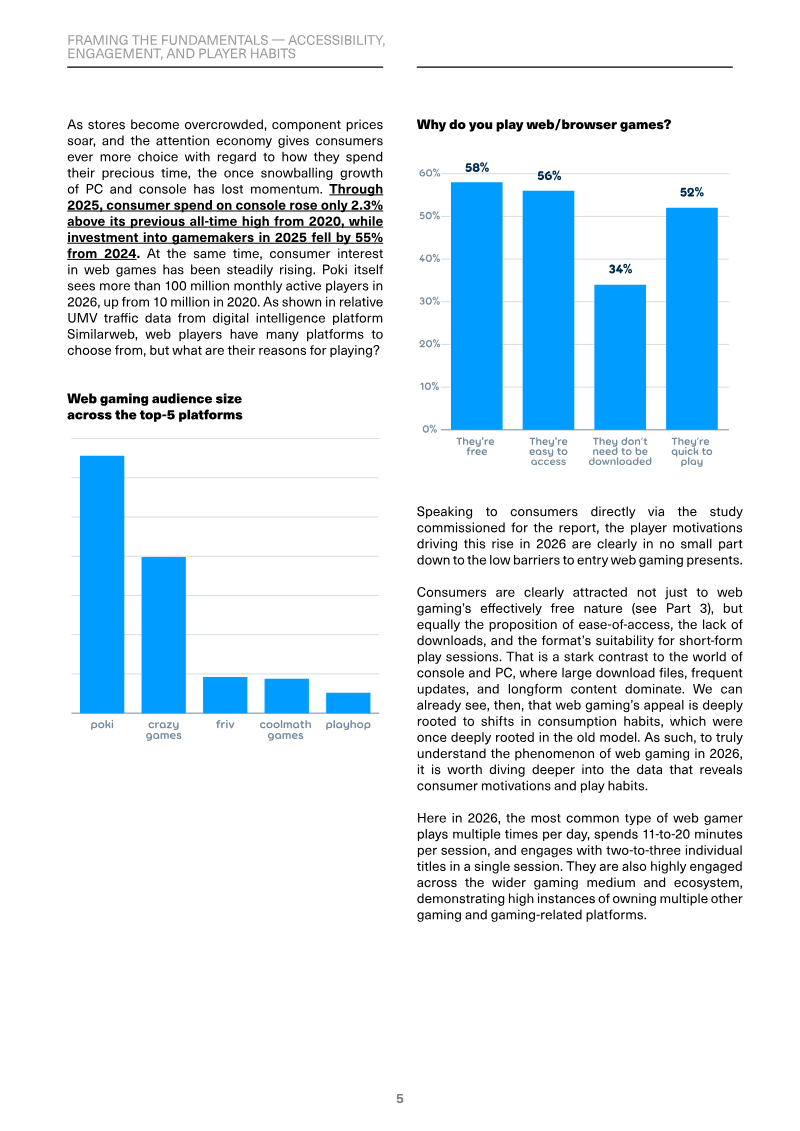
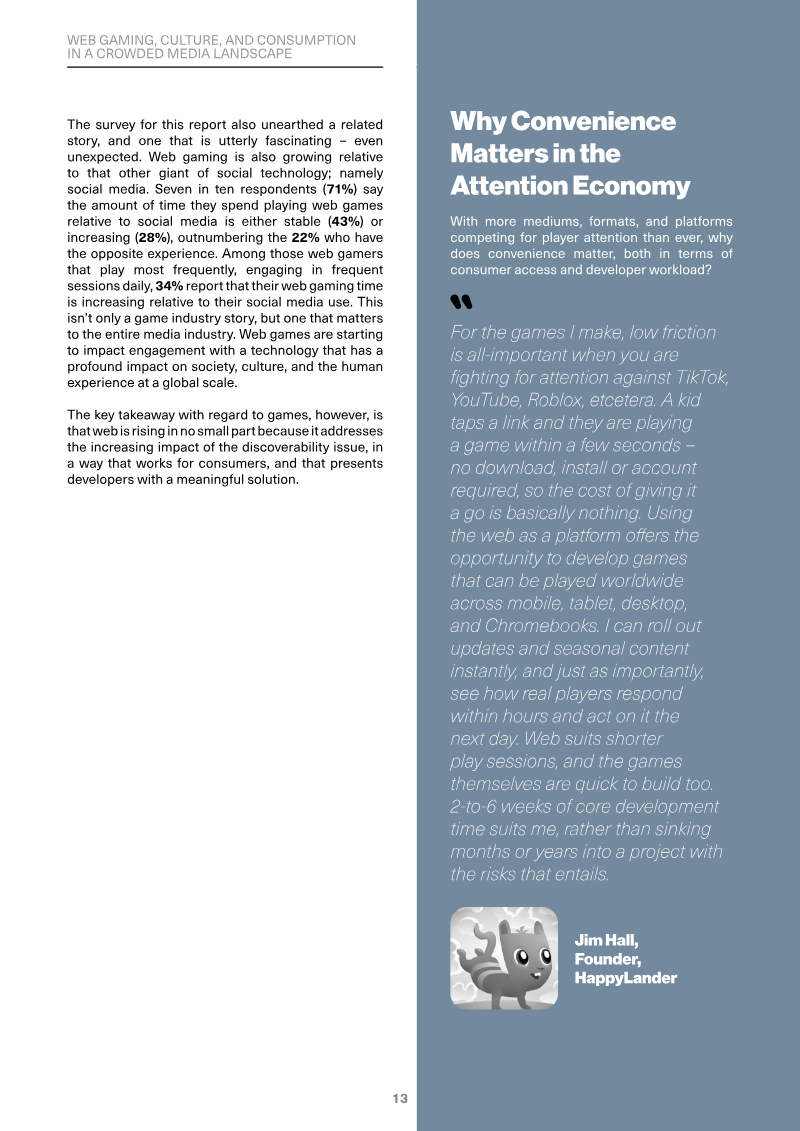
The study demonstrates that web gaming has evolved from a niche, low-quality outlet into a central discovery and revenue engine for the industry.
- Web gaming is a significant discovery channel: 62% of web gamers have downloaded or purchased a game after discovering it on the web, and 53% of developers see it as a means to reach new players.
- Web gamers are highly engaged and valuable: 37% play multiple times per day, 86% play at least a few times a week, and 53% spend over $50 on gaming purchases monthly.
- Developers are increasingly embracing web gaming, with 27% planning to port mobile games to browsers in the next 12 months, and 56% agreeing it's a growing channel.

How Mina The Hollower Became A 'Make Or Break' Moment For Yacht Club Games
The independent studio Yacht Club Games, known for the success of the Shovel Knight franchise, currently faces a critical juncture with the release of its latest title, Mina the Hollower.
- Yacht Club Games reached a critical financial juncture following a six-year development cycle for Mina the Hollower, forcing the studio to implement staff layoffs and consolidate resources to ensure future viability.
- Mina the Hollower has achieved strong commercial performance and a 92 Metacritic score, serving as a vital revenue source to replenish the studio's exhausted financial reserves.
- The studio's previous strategy of splitting its team to pursue multiple projects, including a shelved 3D Shovel Knight title, led to fragmented communication and hindered creative cohesion.