China reports and market data
Documents

State of Gaming 2026: What’s Really Winning Now
The global gaming landscape in 2026 is defined by a distinct bifurcation between the saturation of free-to-play mobile titles and the renewed dominance of premium, high-quality experiences.
- Chinese developers are currently the primary drivers of global industry growth, utilizing large-scale teams, proprietary AI tools, and aggressive user acquisition to dominate genres from strategy to interactive storytelling.
- The global gaming market is bifurcating, with free-to-play mobile titles experiencing stagnant revenue and declining downloads while premium, high-quality experiences see renewed dominance.
- Successful premium titles like Battlefield 6 are shifting marketing strategies by prioritizing traditional media channels over viral social media campaigns.

Mobile Gaming OG Akin Babayigit: The real truth about mobile gaming success
Mobile gaming success is defined by a sophisticated synthesis of analytical rigor and creative intuition, where superior execution consistently outperforms the reliance on established intellectual property or conventional genre wisdom.
- Mobile gaming success is driven by superior execution and innovative mechanics rather than reliance on established intellectual property or perceived genre saturation.
- A dual-revenue model combining in-app advertising and in-app purchases is essential for monetization, with rewarded ads serving as a bridge to convert non-paying users into a sustainable ecosystem.
- Long-term market viability requires aggressive, data-informed scaling and the operational capacity to sustain longer payback horizons in the face of rapid industry cloning.

Take Rates in China
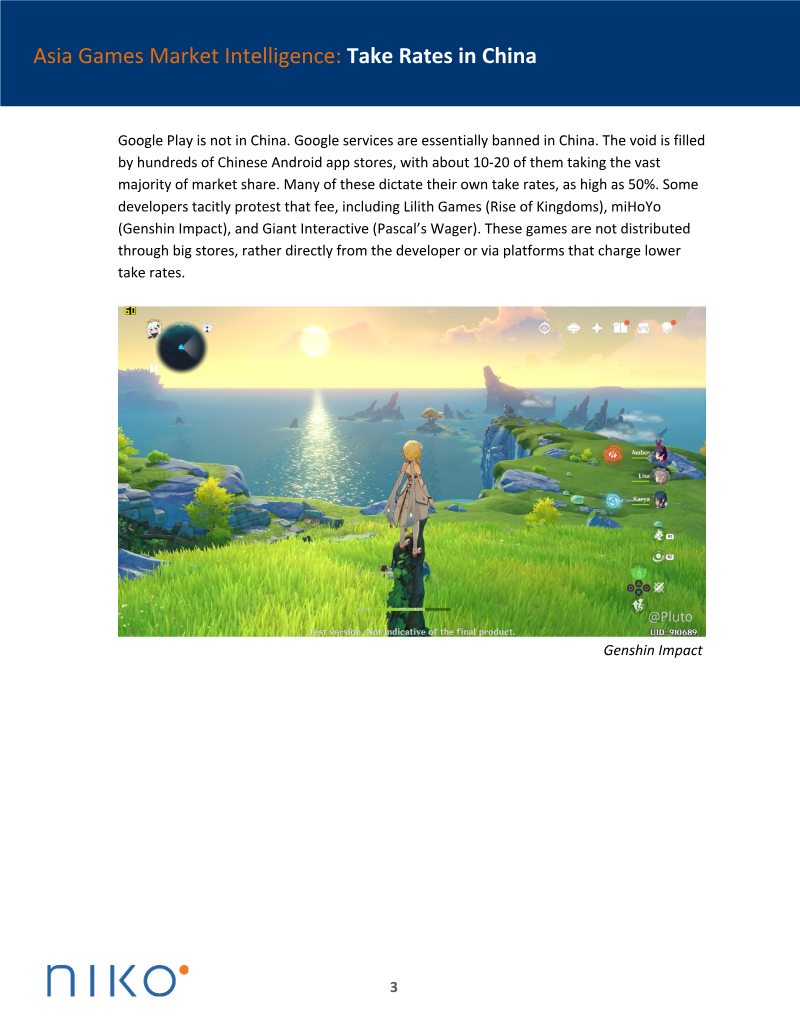
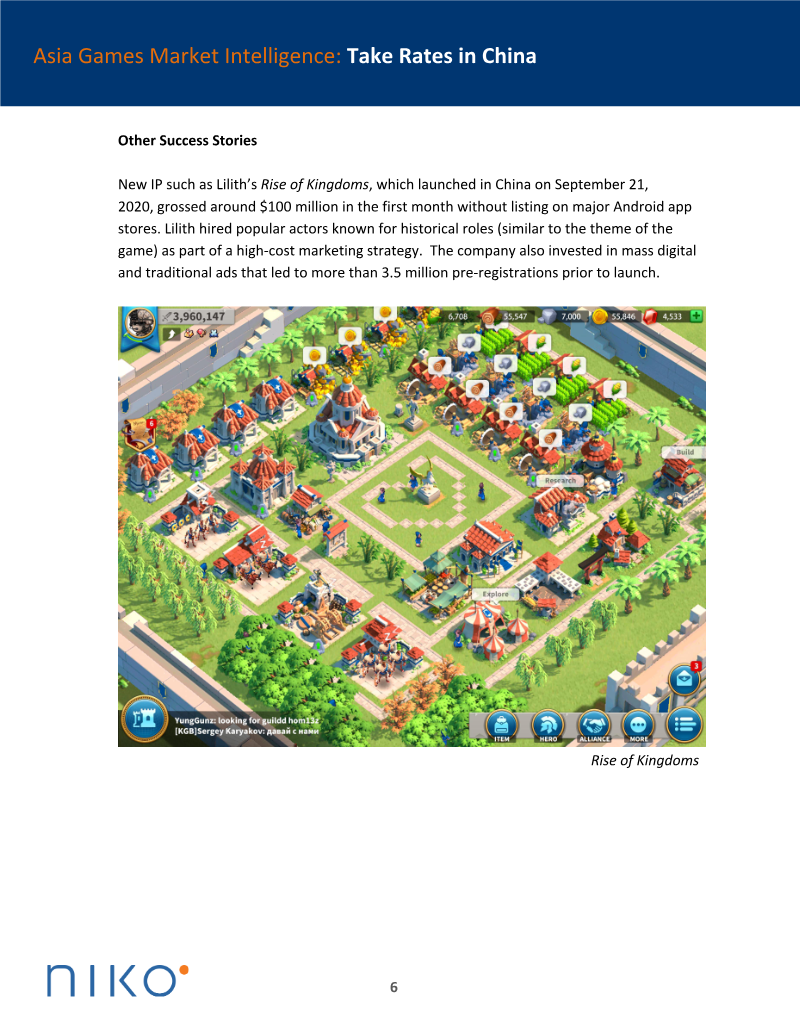
The analysis evaluates how take-rate structures shape mobile game monetisation in China and whether higher-quality development can outweigh the pressure of traditional distribution fees.
- Chinese Android app stores, dominated by manufacturers like Huawei, Oppo, and Vivo, typically charge a 50% commission on in-app purchases, significantly higher than Apple’s 30% rate.
- Hardware manufacturers rely heavily on these high take rates for profitability; for example, Xiaomi reports a 64.7% gross profit margin on services compared to only 7.2% on hardware sales.
- While iOS users account for only 25% of the Chinese gaming population, they generate approximately 40% of total mobile game revenue.

The state of video games with Matthew Ball – Part One
The global video game industry currently exists in a state of paradox, characterized by record-high consumer spending alongside widespread studio instability, mass layoffs, and a contraction in venture capital.
- The video game industry faces a paradox of record consumer spending coupled with widespread studio instability, mass layoffs, and a contraction in venture capital.
- The U.S. market is projected to see only 3% growth by 2026, a figure heavily reliant on major hardware cycles and tentpole releases like Grand Theft Auto 6.
- Surging demand for AI data center components is creating supply chain shortages for essential hardware like RAM and storage, threatening to increase production costs and delay future console generations.

Ares' gameplan, Honkai: Star Rail drama, Moonton's Savvy sale, Rovio's write-down, DICE awards, more
The mobile games industry is currently navigating significant shifts in investment, corporate restructuring, and geopolitical influence.
- Savvy is in negotiations to acquire Moonton, the developer of Mobile Legends: Bang Bang, for approximately $7 billion, signaling a potential exit from mobile gaming for ByteDance.
- Sega recorded a $200 million write-down for Rovio, citing intense market competition and a lack of recent successful titles.
- Financial performance across the sector is polarized: AppLovin reported a 70% revenue increase to $5.48 billion and Krafton reached $1.2 billion in mobile revenue, while Embracer Group saw mobile game sales decline by 66%.
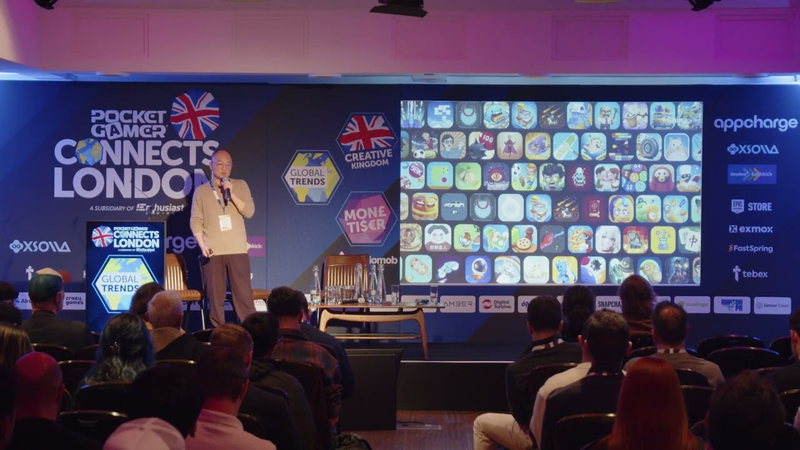
Session: Bring Your Games To China—Unity China Publish Service - Wang Wei, Unity.
The Chinese gaming market represents approximately one-quarter of the global industry, with a player base of nearly 700 million people.
- The Chinese gaming market represents approximately 25% of the global industry, with mobile games accounting for 70% of total revenue.
- Mini-games—playable directly within apps like WeChat and TikTok without downloads—are a major growth driver, with the sector expected to reach $10 billion annually by 2025.
- Entering the Chinese market requires navigating a fragmented ecosystem of local app stores (e.g., Huawei, Xiaomi, TapTap) and obtaining a government-issued ISBN number, which is mandatory for legal monetization.

2026 games industry predictions and trends | Week in Mobile Games podcast
The global games industry enters 2026 characterized by a strategic pivot toward operational efficiency and diversified revenue streams.
- The games industry faces potential hardware cost inflation in 2026, as the high demand for RAM and GPUs from AI companies drives up component prices, potentially delaying future console and mobile device manufacturing.
- Chinese publishers are exerting increased global dominance in specific genres, with Micro Fun leading in the merge category and First Fun and Century Games capturing significant market share in 4X strategy.
- Generative AI adoption is expected to become more brazen among large game companies, shifting from experimental use to the widespread integration of AI-generated assets in marketing and development workflows.
China WeChat Mini Games Industry Report 2026
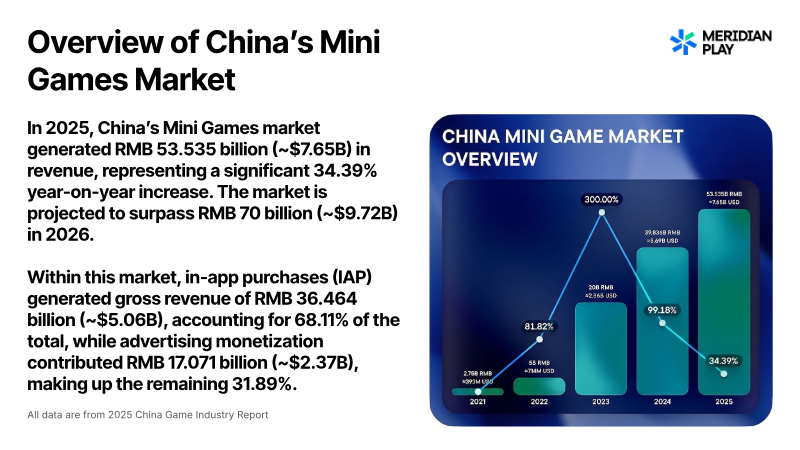
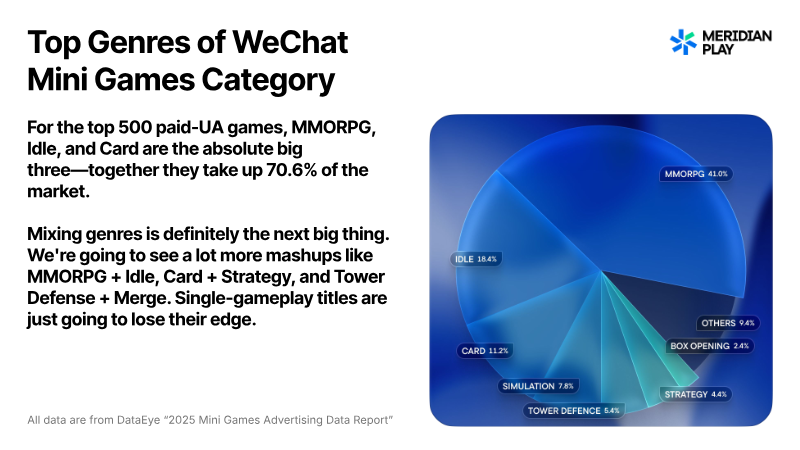
The WeChat Mini Games industry in China has emerged as a dominant, high-growth sector within the broader digital ecosystem.
- The WeChat Mini Games market reached RMB 53.535 billion in 2025, a 34.39% year-over-year increase, with projections exceeding RMB 70 billion for 2026.
- WeChat dominates the sector with a 51.5% platform penetration rate and 571 million monthly active users as of August 2025.
- Revenue is primarily driven by in-app purchases (68.11%), supplemented by advertising monetization (31.89%).
Games industry trends 2025 review | Week in Mobile Games podcast
The global games market is projected to reach $197 billion in 2025, with mobile gaming serving as the primary engine of growth at $108 billion, representing a 7.7% year-over-year increase.
- The mobile games market is increasingly dominated by Chinese publishers, who accounted for four of the top 10 grossing publishers in 2025, including Tencent, Century Games, and FunPlus.
- Top-performing mobile games in 2025 included Roblox, White Out Survival, and Royal Match, with all top 10 most downloaded titles exceeding 100 million downloads.
- The industry is shifting toward a more distributed revenue model, as evidenced by the fact that two of the top 10 grossing games were from outside Asia, compared to none in the previous year.

Analysis of K-Game Global Localization Strategies: Successful Market Expansion Models
The Korean gaming industry currently faces a structural crisis characterized by an over-reliance on mobile platforms and the Chinese market, coupled with mounting geopolitical and regulatory pressures.
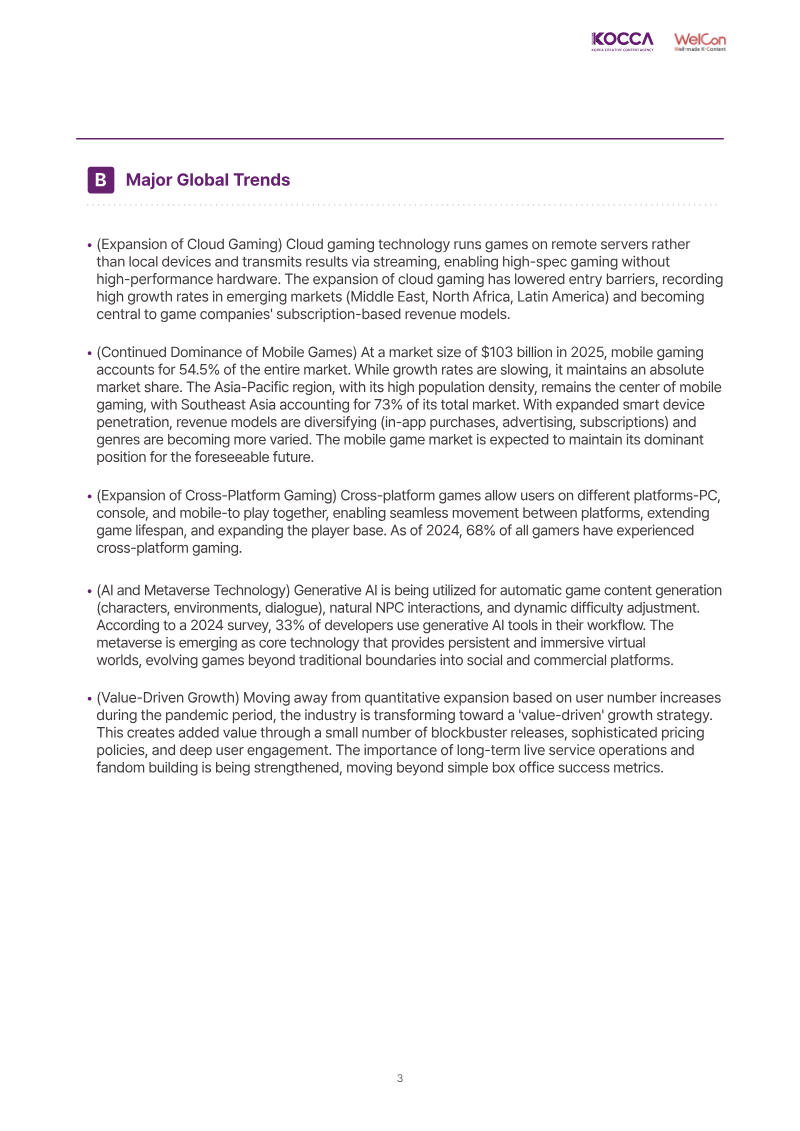
- The global gaming market is projected to grow at an average annual rate of 3.3% through 2028, reaching an estimated 3.95 billion players, with mobile gaming currently dominating at 83% of the total player base.
- Successful global expansion requires a shift from mobile-only strategies to multi-platform development across PC and console, as console gaming is experiencing high global growth despite localized declines in markets like Japan.
- To mitigate geopolitical and regulatory risks, developers must adopt 'China-specific builds' from the planning stage, as evidenced by the necessity of rebranding PUBG to 'Game for Peace' to satisfy Chinese censorship and licensing requirements.

Mini Game Gold Rush: How WeChat Turned Snackable Games into a $7B Market
The WeChat mini game ecosystem has evolved into a formidable $7 billion market, fundamentally reshaping mobile gaming through a frictionless, no-download architecture.
- The WeChat mini game market has reached a $7 billion valuation with 500 million monthly active players and 400,000 active developers, with top-performing titles generating over $1 million in daily revenue.
- Mini games function as an 'app store within a super app,' eliminating download friction and enabling instant play, which significantly lowers user acquisition costs compared to traditional app store models.
- Successful mini games prioritize deep meta-game systems and monetization design from the start, layering these over simple, accessible gameplay to ensure long-term lifetime value (LTV) and player retention.

TWIG #360 The Story of Two Steam Games, Where Winds Meet & The 4X Shake-Up
The modern gaming landscape is defined by a widening gap between vanity metrics and sustainable revenue, as developers struggle to balance high user acquisition costs with long-term retention.
- The 4X strategy genre currently generates approximately $700 million in monthly revenue, with growth driven by gender-neutral themes and casualized art styles rather than traditional hardcore aesthetics.
- The gaming industry is shifting away from complex, gear-heavy progression systems toward accessible, cross-platform experiences that utilize seasonal resets to improve retention.
- Rising user acquisition costs and high install prices are forcing studios to abandon traditional squad RPG models in favor of high-fidelity, broad-appeal titles.