AI reports and market data
Documents

S07, E16: AI and video games (with Julian Togelius)
Video games function as critical model organisms for artificial intelligence research, serving as sophisticated pedagogical environments that force agents to learn, adapt, and navigate complex, non-stationary action spaces.
- Generative AI tools will fundamentally shift game development by enabling shorter production cycles and lower costs, potentially making billion-dollar projects like GTA 6 the last of the pre-AI era.
- Video games serve as essential sandboxes for AI research because they provide structured environments for testing reinforcement learning and algorithmic theories, moving beyond simple win-loss mechanics to understanding player style and content generation.
- Consumer backlash against AI-generated assets, such as the reaction to placeholder textures in Crimson Desert, is often a proxy for broader societal anxiety regarding AI's impact on creative professions rather than a critique of the technical utility of the assets.

🌺Cozy Florist Deep Dive: 4,000 AI-Generated creatives in 30 Days
Cozy Florist represents a sophisticated Western-market adaptation of the established Chinese title My Garden Tale, blending traditional farming simulation mechanics with merge-based gameplay and gacha-style rarity systems.
- Cozy Florist, a Western-market adaptation of My Garden Tale, produced 4,000 unique AI-generated creatives in 30 days to support its user acquisition strategy.
- Despite high-volume creative output and features like guild systems and gacha mechanics, the title currently generates only $30,000 in daily revenue.
- Chinese development teams maintain a competitive advantage by using automated pipelines and open-source tools to iterate creatives rapidly based on real-time cost-per-install data.

The Attention Budget Rule: why tutorials should teach maximum 3 things at a time
The attention budget rule serves as a critical framework for game design, positing that players can effectively process no more than three new mechanics at a time.
- Players can effectively process a maximum of three new mechanics at a time, making this the upper limit for effective tutorial onboarding.
- Chaining passive experiences like loading screens, victory sequences, and dialogue dumps creates a 'boredom trap' that significantly degrades player retention.
- Effective onboarding requires a rhythmic oscillation between high-tension gameplay and brief periods of relaxation to maintain player momentum.

S07, E15: The modern mobile gaming economy (with Phil Black)
The mobile gaming industry is undergoing a structural transformation characterized by market consolidation and a pivot away from the unsustainable hyper-casual model.
- Direct-to-consumer (DDC) web shops are becoming a standard strategy for midcore games, particularly in the 4X genre, to bypass platform fees and increase LTV, with some third-party providers now offering fees as low as 5%.
- The competitive advantage in user acquisition (UA) has shifted away from creative output—which is easily cloned—toward sophisticated predictive infrastructure, such as cohort-level modeling and signal engineering.
- The mobile gaming market is experiencing a consolidation of revenue into puzzle and 4X genres, with hyper-casual games serving as a 'minor league' farm for testing mechanics that are later integrated into more complex, high-revenue core loops.

S07, E14: Re-evaluating agentic commerce (with Andrew Lipsman)
The retail industry is undergoing a significant recalibration regarding the role of autonomous AI, moving away from the initial hype of standalone agentic commerce toward a more pragmatic integration of AI within established ecosystems.
- Amazon has effectively dominated agentic commerce by integrating its AI assistant, Rufus, directly into its existing retail platform, with 40% of holiday transactions involving Rufus interactions.
- Independent agentic commerce models have largely failed because they cannot replicate the 'basket building' efficiency of established retailers like Amazon and Walmart, which are purpose-built to drive multi-item purchases.
- The 'super app' strategy in Western markets is viewed as a pipe dream because e-commerce, social, and mobile behaviors evolved independently, unlike in China where WeChat integrated them simultaneously.

Apple's undercooked games efforts, Google's big AI claims, Ilkka's BAFTA speech, data, jobs, more
The mobile games industry is currently navigating a period of significant transition, marked by shifting leadership at major platform holders, the pervasive yet often clandestine integration of artificial intelligence, and the ongoing evolution of indie development.
- Google Cloud's games division reports that approximately 90% of game studios are currently using AI tools in development, though many studios underreport this usage to avoid public backlash.
- Apple's leadership under Tim Cook has historically shown disinterest in the gaming sector, exemplified by the perfunctory nature of the Apple Games app and Cook's own admission of not being a gamer during the Epic trial.
- Leadership changes at Apple, including the promotion of John Ternus and new App Store management under Carson Oliver and Anne Thai, may signal a shift toward better developer relations and increased focus on gaming hardware.

The Prosperous Society, Part 3: The Collapse of the Pareto Principle
The traditional dominance of the Pareto Principle in commerce is undergoing a fundamental collapse as artificial intelligence dismantles the industrial constraints that once necessitated mass-market homogeneity.
- AI-driven personalization is dismantling the Pareto Principle by removing the industrial constraints that previously forced firms to prioritize mass-market homogeneity over niche preferences.
- The shift from standardized production to precision demand routing allows firms to profitably serve idiosyncratic consumer segments that were previously commercially unviable.
- Economic value is being unlocked through improved matching efficiency between specialized supply and individual demand, moving the market away from synthetic demand creation.

Building AI Tools for Roblox Creators
Lemonade functions as a specialized AI-powered coding agent designed to democratize game development within the Roblox ecosystem.
- The platform utilizes a complex layer of agents and routers to deconstruct user intent, addressing the challenge that young creators often struggle to articulate technical requirements through traditional prompting.
- Lemonade prioritizes a robust evaluation (evals) framework over post-training, allowing the company to rapidly swap underlying AI models as technology improves without sacrificing the quality of the user experience.
- Beyond basic coding, Lemonade is expanding into UI generation, noting that approximately 50% of Roblox game development is dedicated to 2D interface elements like inventories and leaderboards.

🤖 AI creatives are evolving faster than anyone expected (March 2026 trends)
The integration of artificial intelligence into game development pipelines has fundamentally transformed creative production, enabling studios to scale output to unprecedented levels.
- AI-assisted production pipelines now allow studios to generate over 10,000 asset variations per month, with automation handling up to 70% of creative output.
- The primary strategic challenge in 2026 is balancing high-volume AI asset production with core game mechanics to combat stagnant user acquisition and declining download numbers.
- Studios are shifting away from low-quality content toward high-production-value storytelling, utilizing AI to maintain character consistency and narrative depth across massive creative libraries.
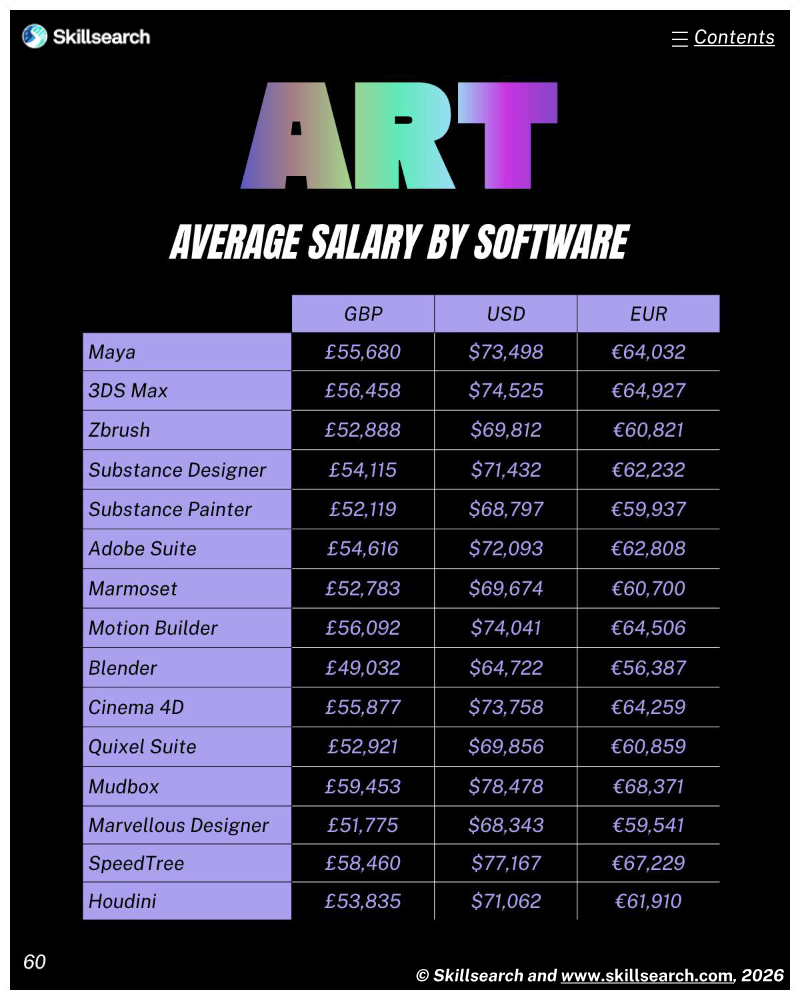
Games and Immersive: Salary & Satisfaction 2026 Report
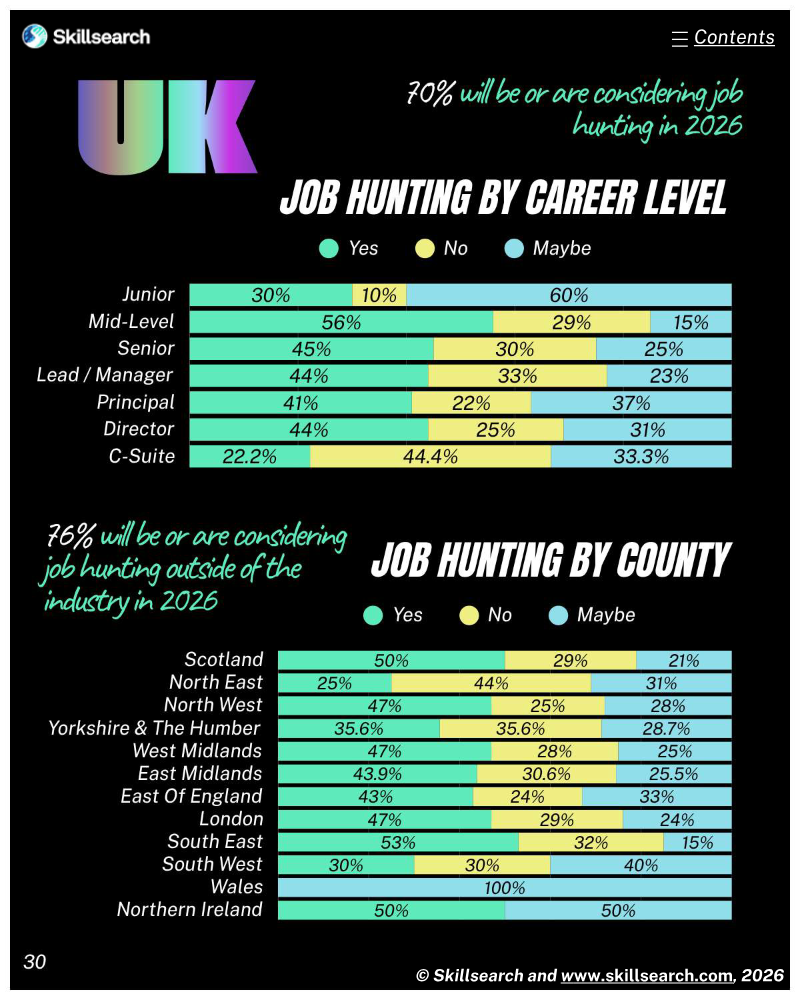
The global games and immersive technology industry is currently navigating a period of profound instability characterized by widespread redundancies, economic uncertainty, and a pervasive sense of professional dissatisfaction.
- Between 69% and 84% of industry professionals are actively considering new employment due to widespread job insecurity and inadequate compensation.
- The workforce is experiencing a significant mental health crisis, with 67% of employees reporting burnout and nearly 50% experiencing poor mental health over the past year.
- While over 50% of professionals have adopted AI tools, the industry remains deeply divided over concerns regarding creative authenticity, ethics, and job displacement.

Is Destiny doomed? King on AI, layoffs and more, plus March's top games, data, soft launches, more
The mobile games industry continues to navigate a complex landscape defined by shifting monetization strategies, the integration of artificial intelligence, and intense market competition.
- Microfun’s Gossip Harbor reached $100 million in monthly in-app purchase revenue for the first time in March, marking a significant increase from $82.5 million in February and positioning it to potentially overtake Candy Crush Saga as the top-grossing puzzle game.
- King VP Eva Ryott defended the company's use of AI as a supporting tool for level management rather than a direct replacement for staff, while noting that workforce adjustments following 200 layoffs were necessary to maintain competitive relevance.
- Candy Crush Saga has adopted a 2x2 matching mechanic, a feature King implemented within the last year to align with evolving market standards and compete against rivals like Royal Match and Gossip Harbor.

👾 Creative Trends March 2026: AI hooks, fake ads, and the infinite iteration machine
Mobile game marketing in early 2026 is defined by a strategy of infinite iteration, where developers prioritize the rapid, continuous remixing of proven creative concepts over original gameplay representation.
- Mobile game marketing in early 2026 is dominated by 'infinite iteration,' a strategy that prioritizes the rapid remixing of high-performing creative hooks over accurate gameplay representation.
- Top-grossing titles are increasingly utilizing stylized or misleading advertisements that bear little to no resemblance to the actual game experience to drive initial user engagement.
- The industry relies on a cycle of recycling proven tropes, such as wood-chopping mechanics, surreal animations, and failure-based puzzle loops, to maintain ad performance in a saturated market.