Report1 pages
Current Report No. 20/2022: Change of Date for the Submission of the Semiannual Report for H1 2022
The notice informs stakeholders that the publication date for PCF Group S.A.’s consolidated semi‑annual report covering the first half of 2022 has been postponed. Originally scheduled for September 26, 2022, the release will now occur on September 29, 2022. The change is issued under Article 80(2) of the Polish Ministry of Finance regulation dated 29 March 2018, which governs ongoing and periodic disclosures by issuers of securities. The announcement follows an earlier current report dated 20 January 2022, which had set the initial deadline. No additional data or financial figures are provided; the communication solely addresses the revised timeline for the semi‑annual report’s availability.
- PCF Group S.A. has changed the publication date for its consolidated semiannual report for H1 2022.
- The new publication date for the H1 2022 semiannual report is September 29, 2022.
- This change was announced on September 23, 2022, in Current Report No. 20/2022.
- The previously announced publication date for the H1 2022 semiannual report was September 26, 2022.
- The original publication date was set in Current Report No. 2/2022 on January 20, 2022.
PCF Group
Report1 pages
Szacunkowe wyniki finansowe za I półrocze 2022 r.
The report announces preliminary consolidated financial results for PCF Group S.A. and its capital group for the first half of 2022, following earlier interim reports. The key figures presented are revenue from sales at PLN 90.6 million, EBITDA of PLN 29.0 million, and net profit of PLN 25.5 million. These numbers are provisional and will be reviewed by an external auditor before finalization. The definitive half‑year financial statements, covering the six months ending 30 June 2022, are scheduled for publication on 29 September 2022. The scope of the data is limited to consolidated results for the entire PCF Group, with no breakdown by geographic region or individual business segments disclosed. The methodology is not detailed beyond the indication that an audit will verify the estimates; no survey or sample size information is provided. The report serves to inform shareholders and market participants of the group’s early performance, highlighting a strong profitability profile with EBITDA and net profit margins exceeding 30 % of sales. The forthcoming official report will provide audited confirmation of these figures and any adjustments made during the review process.
- PCF Group S.A. reported preliminary consolidated revenue of PLN 90.6 million for the first half of 2022.
- The company achieved a net profit of PLN 25.5 million and an EBITDA of PLN 29.0 million for the six-month period ending 30 June 2022.
- Profitability metrics remain strong, with both EBITDA and net profit margins exceeding 30% of total sales.
- These financial results are provisional and currently subject to an external audit.
- The final, audited half-year financial statements for the PCF Group are scheduled for publication on 29 September 2022.
PCF Group
Report2 pages
Current Report No. 1/2023: Publication Dates of Periodic Reports
The report announces the scheduled publication dates for PCF Group S.A.’s periodic financial disclosures in 2023, as required by Polish finance regulations. Annual reports for the fiscal year 2022—both individual and consolidated—are slated for release on April 27, 2023. Quarterly reporting will include a consolidated Q1 2023 report on May 29, 2023 and a consolidated Q3 2023 report on November 27, 2023. The first half‑year consolidated report is due September 21, 2023.
The board clarifies that the company will not issue individual quarterly or half‑yearly reports, in line with § 62 of the regulation. Instead, it will provide consolidated quarterly reports containing the required financial information and a consolidated half‑yearly report with a condensed financial statement. Additionally, PCF Group S.A. will forgo publishing the individual and consolidated Q4 2022 reports, as well as the consolidated Q2 and Q4 2023 reports, pursuant to § 79(2) of the regulation.
These disclosures cover PCF Group S.A.’s activities within Poland for the 2023 calendar year, focusing on compliance with statutory reporting obligations. The information is presented in a concise format, specifying exact dates and the nature of each report to ensure transparency for investors and regulators.
- PCF Group S.A. will release its 2022 individual and consolidated annual financial reports on April 27, 2023.
- The company is scheduled to publish its consolidated Q1 2023 report on May 29, 2023, and its consolidated Q3 2023 report on November 27, 2023.
- The consolidated half-year report for 2023 is slated for publication on September 21, 2023.
- In accordance with Polish financial regulations, PCF Group S.A. will only issue consolidated quarterly and half-yearly reports rather than individual ones.
- The company will forgo the publication of individual and consolidated Q4 2022 reports, as well as consolidated Q2 and Q4 2023 reports, as permitted by § 79(2) of the regulation.
PCF Group
Report2 pages
Current Report No. 22/2022: Agreement on Termination of Production and Publishing Agreement
The report announces that on October 1, 2022, People Can Fly U.S., LLC and its parent PCF Group S.A. entered into a termination agreement with Take‑Two Interactive Software, Inc., ending the 2020 production and publishing contract for Project Dagger. The termination agreement specifies how financial obligations will be settled depending on the eventual release model of the title. If Project Dagger is released through self‑publishing by People Can Fly U.S., the company will pay royalties to Take‑Two on a quarterly basis until cumulative payments equal a predetermined repayment amount of $20 million. If the game is released with a new publisher, People Can Fly U.S. will repay the same $20 million in two equal installments due six and twelve months after launch. No repayment is required if the game never reaches commercial release, regardless of model.
The agreement also confirms that Take‑Two did not exercise its option to acquire intellectual property rights under the original contract, and that the license granted to Take‑Two has expired. Consequently, People Can Fly U.S. retains exclusive ownership of Project Dagger’s intellectual property. Standard termination provisions accompany the agreement, covering general legal and procedural matters. The report covers a single geographic jurisdiction—both parties are headquartered in New York, USA—and pertains exclusively to the Project Dagger title within the video‑game development and publishing sector. No survey or external data sources are cited; the document is a straightforward corporate disclosure of contractual termination and financial settlement terms.
- People Can Fly U.S., LLC and Take-Two Interactive Software, Inc. terminated their 2020 production and publishing agreement for Project Dagger, effective October 1, 2022.
- People Can Fly retains exclusive ownership of the Project Dagger intellectual property, as Take-Two did not exercise its option to acquire the rights and its license has expired.
- If People Can Fly self-publishes Project Dagger, they must pay royalties to Take-Two on a quarterly basis until a total of $20 million is repaid.
- If Project Dagger is released via a new publisher, People Can Fly is obligated to repay the $20 million in two equal installments due six and twelve months after the game's launch.
- No financial repayment to Take-Two is required if Project Dagger fails to reach a commercial release.
+1
PCF Group
Report2 pages
Zwiększenie zaangażowania kapitałowego PCF Group S.A. w spółkę Incuvo S.A.
The report announces that PCF Group S.A., a Warsaw‑based company, has decided to increase its capital participation in its subsidiary Incuvo S.A., a Katowice‑based game developer. On 27 January 2023, the board authorized the issuance of 136,104 new ordinary shares (Series E) at an emission price of PLN 46.13 each, totaling PLN 6,278,477.52. These shares represent approximately 0.45 % of PCF’s share capital and voting rights, and will be fully subscribed by Incuvo’s CEO Andrzej Wychowańcy (87,820 shares) and Vice‑Chairman Radomir Kucharski (48,284 shares). In exchange, the two executives will transfer 1,128,450 Incuvo shares (≈7.90 % of Incuvo’s capital) and 620,428 Incuvo shares (≈4.34 % of Incuvo’s capital) to PCF, thereby raising PCF’s stake in Incuvo from 50.01 % to roughly 62.25 % of both capital and voting rights.
The emission price was calculated using a six‑month average market price of PCF shares (1 June–30 November 2022) and correlated with a fair‑value assessment of Incuvo’s shares by an external auditor. The transaction aligns with PCF Group’s strategy to diversify its game portfolio, expand into virtual reality leveraging Incuvo’s expertise, and enhance publishing capabilities.
Lock‑up restrictions apply to the new shares until the end of December 2024, mirroring conditions from PCF’s 2020 public offering. The board has requested supervisory approval for the pricing, waiver of pre‑emptive rights, and full allocation to the two executives. Further updates will be provided as required by law.
- PCF Group S.A. is increasing its stake in subsidiary Incuvo S.A. from 50.01% to approximately 62.25% of total capital and voting rights.
- The transaction involves PCF Group issuing 136,104 new Series E shares, valued at PLN 6,278,477.52, to Incuvo CEO Andrzej Wychowańcy and Vice-Chairman Radomir Kucharski.
- In exchange for the new PCF shares, the two executives are transferring a combined 1,748,878 shares of Incuvo to PCF Group, representing roughly 12.24% of Incuvo's capital.
- The issuance price of PLN 46.13 per share was determined using a six-month average market price of PCF stock and an external fair-value assessment of Incuvo.
- The newly issued PCF shares are subject to lock-up restrictions that remain in effect until the end of December 2024.
PCF Group
Report5 pages
Aktualizacja strategii PCF Group S.A. oraz Grupy People Can Fly
The update presents the revised growth strategy for PCF Group S.A. and its People Can Fly holding group, adopted by the board on 31 January 2023. The strategy had first been disclosed in the company’s prospectus approved by the Polish Financial Supervision Authority on 25 November 2020 and subsequently updated in a 43/2021 interim report dated 27 September 2021. The current update is attached to the present filing and outlines new assumptions, objectives, and operational priorities for both the parent company and its subsidiaries.
Key points include a renewed focus on expanding market presence, enhancing product development pipelines, and strengthening financial performance through cost optimisation and capital allocation. The strategy also highlights commitments to sustainability initiatives, digital transformation, and talent development across the group’s portfolio. While specific financial targets are not disclosed in this summary, the document stresses alignment with regulatory frameworks and adherence to EU prospectus regulations for any forthcoming equity offerings.
The update applies exclusively within the European Economic Area and the United Kingdom, targeting qualified investors and institutional participants. It is governed by EU Regulation (EU) 2017/1129 on prospectuses and related directives, ensuring compliance with disclosure obligations for non‑public offerings. The filing clarifies that it does not constitute a public offer, contains no promotional content for new shares, and is restricted from distribution in jurisdictions such as the United States, Australia, Canada, Japan, or South Africa. The document also includes standard legal and risk disclosures, emphasizing that forward‑looking statements are subject to uncertainty and should not be relied upon as definitive forecasts.
- On 31 January 2023, the board of PCF Group S.A. and People Can Fly adopted a revised growth strategy to update the previous objectives established in September 2021.
- The updated strategy prioritizes expanding market presence, enhancing product development pipelines, and improving financial performance through cost optimization and capital allocation.
- The group has integrated sustainability initiatives, digital transformation, and talent development programs as core operational priorities across its portfolio.
- The strategy is governed by EU Regulation (EU) 2017/1129 and is intended exclusively for qualified and institutional investors within the European Economic Area and the United Kingdom.
- The filing explicitly excludes the United States, Australia, Canada, Japan, and South Africa from distribution and does not constitute a public offer of shares.
+1
PCF Group
Report1 pages
Szacunkowe wyniki finansowe za rok obrotowy 2022
The report presents preliminary consolidated financial results for PCF Group S.A. for the fiscal year ending 31 December 2022, as required under Article 17(1) of the MAR regulation. The company’s management has decided to disclose these estimates publicly, following earlier interim reports 3/2023 and 4/2023. Revenue from sales is estimated at PLN 170 million, while EBITDA is projected at PLN 48.5 million. These figures are provisional and will be audited by an external auditor before finalization.
The scope of the estimates covers the entire PCF Group, encompassing all subsidiaries and operating units. The time period is strictly the 2022 fiscal year. No detailed breakdown by geographic region or business segment is provided in this preliminary disclosure; the figures represent group‑wide aggregates.
Methodologically, the estimates are derived from management’s internal projections and will undergo verification by a qualified auditor. The final audited results, both individual and consolidated, are scheduled for release in the 2022 annual reports on 27 April 2023. The report maintains a neutral tone, focusing solely on the announced revenue and EBITDA figures without additional commentary or analysis.
- PCF Group S.A. estimates its consolidated revenue for the 2022 fiscal year at PLN 170 million.
- The company projects an EBITDA of PLN 48.5 million for the 2022 fiscal year.
- These financial figures are preliminary, unaudited, and represent aggregate results for the entire PCF Group.
- The final audited individual and consolidated financial statements for 2022 are scheduled for release on 27 April 2023.
- The reported figures are subject to verification by an external auditor before finalization.
PCF Group
Report1 pages
Current Report No. 6/2023: Issuance of Shares as Part of Target Capital Increase
The report announces that on 10 February 2023 the board of PCF Group S.A., headquartered in Warsaw, approved a capital‑increase resolution. The increase will be executed through the issuance of new ordinary bearer shares, Series E, which will not grant existing shareholders a pre‑emptive right to purchase all new shares. The resolution also seeks approval for listing the new shares on the regulated market of the Warsaw Stock Exchange, dematerialisation of the shares, and a statutory amendment to incorporate the new share class. The decision follows earlier communication in report No. 2/2023, where the board disclosed plans to deepen PCF Group’s equity stake in its subsidiary Incuvo S.A., based in Katowice. The new capital injection is intended to support this strategic investment and enhance the group’s financial position.
Key points include: a targeted capital increase via Series E ordinary shares; denial of pre‑emptive rights to current shareholders; application for market listing and dematerialisation; statutory changes to the company’s articles. The resolution is governed by Polish financial regulation, specifically § 5(9) and § 14(1‑2) of the Minister of Finance regulation dated 29 March 2018. The report is a routine disclosure under the Polish regulatory framework, providing shareholders and market participants with timely information on significant corporate actions.
- PCF Group S.A. approved a capital increase on 10 February 2023 through the issuance of new Series E ordinary bearer shares.
- The capital injection is strategically intended to increase PCF Group’s equity stake in its Katowice-based subsidiary, Incuvo S.A.
- Existing shareholders have been denied pre-emptive rights to purchase the newly issued Series E shares.
- The board is pursuing the formal dematerialisation of the new shares and their subsequent listing on the Warsaw Stock Exchange.
- The issuance requires a statutory amendment to the company’s articles to formally incorporate the new Series E share class.
+1
PCF Group
Report7 pages
Current Report No. 11/2023: Disclosure of Delayed Inside Information
The report discloses that PCF Group S.A.’s board initiated negotiations on 19 March 2023 with Krafton, Inc. or its affiliated entity to acquire shares in a capital increase approved by an extraordinary general meeting on 28 February 2023. The proposed investment would grant Krafton a 10 % stake in the post‑issuance capital, and may include future collaboration on specific games. The board delayed public disclosure until 28 March to avoid adverse impacts on negotiation dynamics and potential market misinterpretation, citing MAR Regulation Article 17(4) and EU‑FCA guidance. The disclosure explains that the negotiations do not guarantee a completed transaction, and outlines risk factors such as uncertainty of deal completion and market reaction. The document is restricted to qualified investors within the EU‑EAA, UK, and certain US entities under Regulation S or Rule 144A; it contains no prospectus and is not a public offer. Methodologically, the report relies on internal board decisions and regulatory compliance checks; no external survey or statistical data are presented. The scope is limited to Poland, with implications for capital structure and potential strategic partnership in the gaming sector. The report concludes that any investment decisions must be based on independent research, as the information is not a recommendation or solicitation.
- PCF Group S.A. entered negotiations with Krafton, Inc. on 19 March 2023 regarding a potential capital increase that would grant Krafton a 10% stake in the company.
- The proposed deal includes the potential for future collaboration between PCF Group and Krafton on specific game titles.
- PCF Group delayed the public disclosure of these negotiations from 19 March to 28 March 2023, citing the need to protect negotiation dynamics under Article 17(4) of the MAR Regulation.
- The transaction is not guaranteed, and the company explicitly warns of risks regarding deal completion and potential market volatility.
- The information is restricted to qualified investors in the EU, EEA, UK, and specific US entities, and does not constitute a public offer or a prospectus.
+1
PCF Group
Report1 pages
Current Report No. 10/2023: Change of Date for Submission of Annual Reports for 2022
The report announces a revised deadline for the publication of PCF Group S.A.’s consolidated and individual annual reports for 2022. The change follows an earlier current report issued on 19 January 2023, which had set the release date for 27 April 2023. The updated schedule moves the publication forward to 28 April 2023, thereby shortening the interval between the original deadline and the new one by one day. The adjustment is made under § 80(2) of the Ministry of Finance regulation dated 29 March 2018, which governs ongoing and periodic disclosures required from issuers of securities. The notice confirms that both the group‑wide consolidated report and the individual entity’s annual report will be released on the same date, ensuring consistency across filings. No additional data or statistical findings are presented; the document’s sole purpose is to inform stakeholders of the date modification. The scope is limited to PCF Group S.A., covering its 2022 financial year, and the time frame is confined to the publication date change announced in March 2023. The methodology involves a straightforward administrative update, with no survey or external data sources referenced.
- PCF Group S.A. has rescheduled the publication date for its 2022 consolidated and individual annual reports to 28 April 2023.
- The new deadline represents a one-day delay from the previously announced date of 27 April 2023.
- The consolidated and individual reports will be released simultaneously to ensure consistency in financial disclosure.
- This administrative adjustment is compliant with § 80(2) of the Ministry of Finance regulation dated 29 March 2018 regarding periodic disclosures.
- The update applies exclusively to PCF Group S.A.’s financial reporting for the 2022 fiscal year.
PCF Group
Report6 pages
Raport Bieżący Nr 12/2023: Zawarcie Umowy Inwestycyjnej z Krafton, Inc.
The document announces that Krafton, Inc. has entered into an investment agreement to acquire shares of PCF Group S.A. under a capital increase authorized by the extraordinary general meeting, allowing up to 5 853 941 new ordinary shares of series F at a nominal value of PLN 0.02 each. The agreement obligates Krafton to purchase shares representing 10 % of the company’s capital and voting rights at an issue price of PLN 40.20 per share, with the company guaranteeing allocation upon fulfillment of Krafton’s subscription commitment. The investment contract grants Krafton rights of first negotiation and first refusal on future projects such as Project Victoria or Project Bifrost if released outside a self‑publishing model, and includes anti‑dilution, tag‑along, and drag‑along provisions. Both parties have executed lock‑up agreements lasting until 28 March 2024 and standard representations, warranties, and indemnity clauses. The agreement is governed by Polish law, has a ten‑year term with automatic renewal provisions, and allows Krafton to terminate under specific circumstances such as cancellation of the offer or failure to meet subscription deadlines; no penalties are stipulated. The report, prepared under EU Regulation MAR, is strictly informational and restricted to qualified investors within the European Economic Area, excluding public distribution in jurisdictions such as the United States, Canada, Australia, Japan, and South Africa. It contains forward‑looking statements subject to risks and uncertainties, and disclaims any investment recommendation or guarantee.
- Krafton, Inc. is acquiring a 10% equity stake in PCF Group S.A. through the issuance of 5,853,941 new series F ordinary shares.
- The investment is priced at PLN 40.20 per share, granting Krafton 10% of the company’s total voting rights.
- Krafton holds rights of first negotiation and first refusal on future PCF Group projects, specifically Project Victoria and Project Bifrost, if they are not self-published.
- The agreement includes protective shareholder provisions, including anti-dilution, tag-along, and drag-along clauses.
- Both parties are subject to a lock-up period for their shares that remains in effect until March 28, 2024.
+1
PCF Group
Report2 pages
Current Report No. 14/2023: Initiation of Negotiations for a Development and Publishing Agreement
The report announces that PCF Group S.A., a Warsaw‑based developer, has decided to enter negotiations for a Development and Publishing Agreement with a well‑known publisher. The decision follows receipt of the publisher’s proposal on 19 May 2023 and a detailed review conducted by the board. It aligns with the company’s strategy update issued on 31 January 2023, which states that the group will pursue attractive work‑for‑hire collaborations with reputable partners.
The proposed agreement is a framework contract, with detailed terms to be set out in an accompanying execution contract. This secondary document will outline the product description, production schedule, and payment terms for the developer. The work‑for‑hire model means PCF Group will develop the video game on behalf of the publisher in exchange for agreed remuneration. The terms are described as standard for similar projects and do not deviate significantly from typical industry practices.
The board clarifies that initiating negotiations does not guarantee a final agreement. Public disclosure of any eventual contract will be provided in a separate report. The scope is limited to the Polish market, covering the PCF Group’s development activities and its partnership with the identified publisher. No survey or external data sources are cited, as the announcement is based solely on internal board deliberations.
- PCF Group S.A. has entered formal negotiations for a development and publishing agreement with a prominent industry publisher following a proposal received on 19 May 2023.
- The proposed partnership follows a work-for-hire model, where PCF Group will develop a video game for the publisher in exchange for agreed remuneration.
- This initiative aligns with the company's strategic update from 31 January 2023, which prioritizes securing work-for-hire collaborations with reputable partners.
- The agreement is structured as a framework contract, with a secondary execution contract intended to define specific product descriptions, production schedules, and payment terms.
- The board has characterized the proposed terms as standard for the industry, noting they do not deviate significantly from typical market practices.
+1
PCF Group
Report1 pages
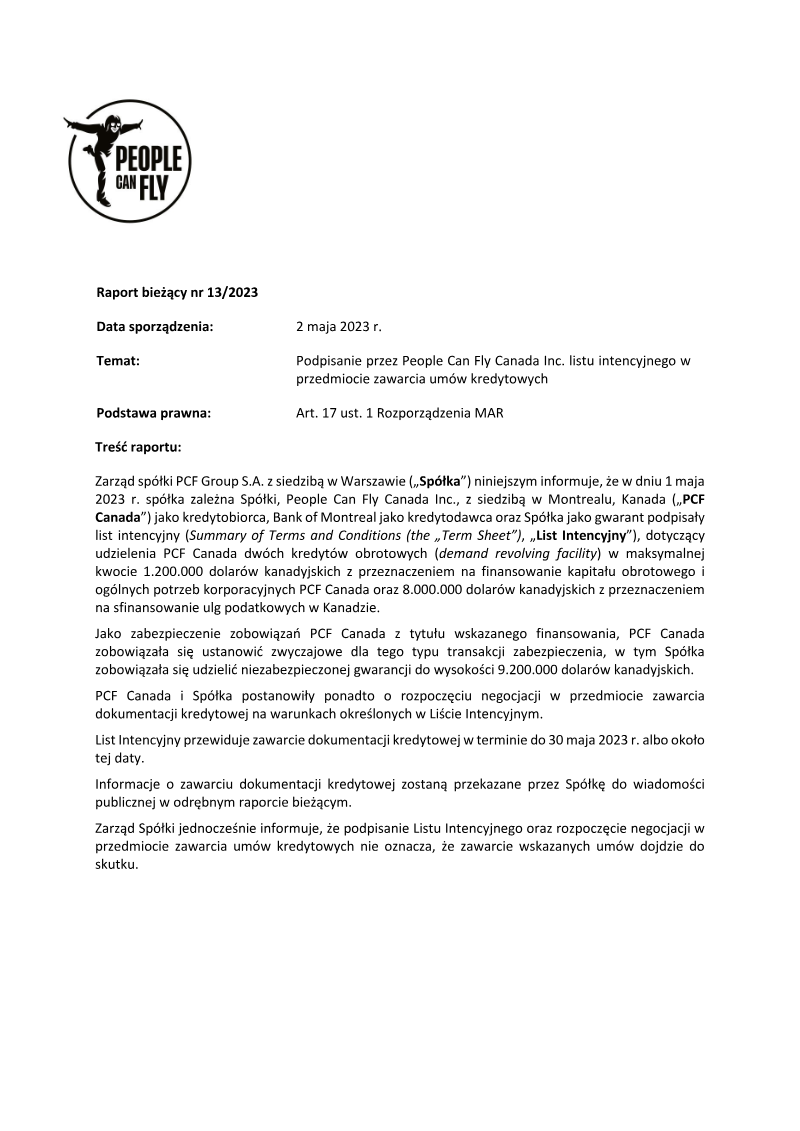
Raport Bieżący Nr 13/2023: Podpisanie Listu Intencyjnego w Przedmiocie Zawarcia Umów Kredytowych
The report announces that on 1 May 2023, People Can Fly Canada Inc. (PCF Canada), a subsidiary of PCF Group S.A., entered into an intent‑to‑borrow agreement with the Bank of Montreal and PCF Group as guarantor. The agreement outlines two revolving credit facilities: a demand facility up to 1 200 000 CAD for working‑capital and general corporate purposes, and a second facility of 8 000 000 CAD earmarked for tax‑relief financing in Canada. PCF Canada committed to provide customary collateral, while PCF Group pledged an unsecured guarantee of 9 200 000 CAD to secure the obligations. The parties agreed to negotiate definitive credit documentation by 30 May 2023, with completion expected around that date. The report clarifies that signing the letter of intent and initiating negotiations does not guarantee final execution of the credit agreements. The disclosure is limited to the Canadian subsidiary and its financing arrangements, covering a single fiscal year’s transaction. No survey or external data sources are cited; the information derives solely from internal corporate communications and regulatory filing requirements under Article 17(1) of MAR.
- People Can Fly Canada Inc. signed a letter of intent on 1 May 2023 to secure two revolving credit facilities totaling 9,200,000 CAD.
- The financing package includes a 1,200,000 CAD facility for working capital and general corporate purposes, plus an 8,000,000 CAD facility specifically for Canadian tax-relief financing.
- PCF Group S.A. acts as the guarantor for the full 9,200,000 CAD obligation, providing an unsecured guarantee to support its Canadian subsidiary.
- The parties have set a target date of 30 May 2023 to finalize and execute the definitive credit documentation.
- The agreement remains subject to successful negotiation, and the signing of the letter of intent does not guarantee the final execution of the credit facilities.
PCF Group
Report2 pages
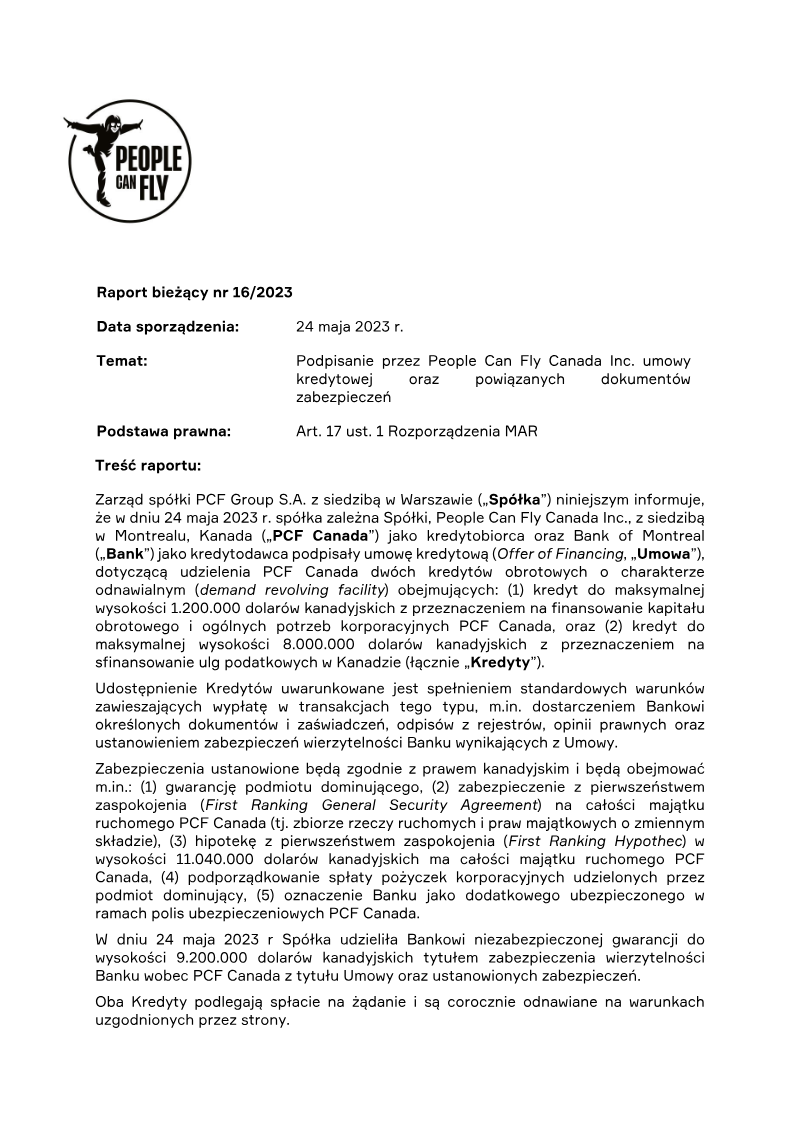
Raport bieżący nr 16/2023Podpisanie przez People Can Fly Canada Inc. umowy kredytowej oraz powiązanych dokumentów zabezpieczeń
People Can Fly Canada Inc., a subsidiary of PCF Group S.A. headquartered in Warsaw, entered into a financing agreement with the Bank of Montreal on 24 May 2023. The contract provides two revolving credit facilities: a $1,200,000 line for general corporate and working‑capital needs, and an $8,000,000 line to fund Canadian tax incentives. Both lines are renewable annually and repayable on demand. Interest rates combine a negotiated margin with the Canadian Prime Rate, and standard market‑based fees apply.
The agreement requires customary suspension conditions, including submission of legal opinions, registration extracts and other documentation to the bank. Security for the loans is structured under Canadian law and includes a parent‑company guarantee, a first‑ranking general security agreement covering all movable assets of PCF Canada, a first‑ranking mortgage valued at $11,040,000 on the same movable assets, subordination of corporate loans from the parent entity, and designation of the bank as an additional insured under PCF Canada’s insurance policies. On the same day, PCF Group issued a $9,200,000 unsecured guarantee to the bank covering the loan obligations and associated securities.
The agreement obliges PCF Canada to provide financial statements and other material information, imposes restrictions on changes in core business activities or additional borrowing, and grants the bank rights to terminate or suspend financing upon breach. The arrangement is confined to Canada, covers corporate finance and tax‑incentive funding, and reflects standard practices for revolving credit facilities in the Canadian market.
- People Can Fly Canada Inc. secured a financing agreement with the Bank of Montreal on 24 May 2023, consisting of a $1,200,000 general working-capital line and an $8,000,000 line for Canadian tax incentives.
- PCF Group S.A. provided a $9,200,000 unsecured guarantee to the bank to cover the loan obligations and associated securities of its Canadian subsidiary.
- The credit facilities are renewable annually and repayable on demand, with interest rates calculated based on the Canadian Prime Rate plus a negotiated margin.
- Security for the financing includes a first-ranking general security agreement on all movable assets of PCF Canada and a $11,040,000 mortgage on those same assets.
- The agreement restricts PCF Canada from changing its core business activities or incurring additional debt without consent, while requiring the submission of regular financial statements.
PCF Group
Report6 pages
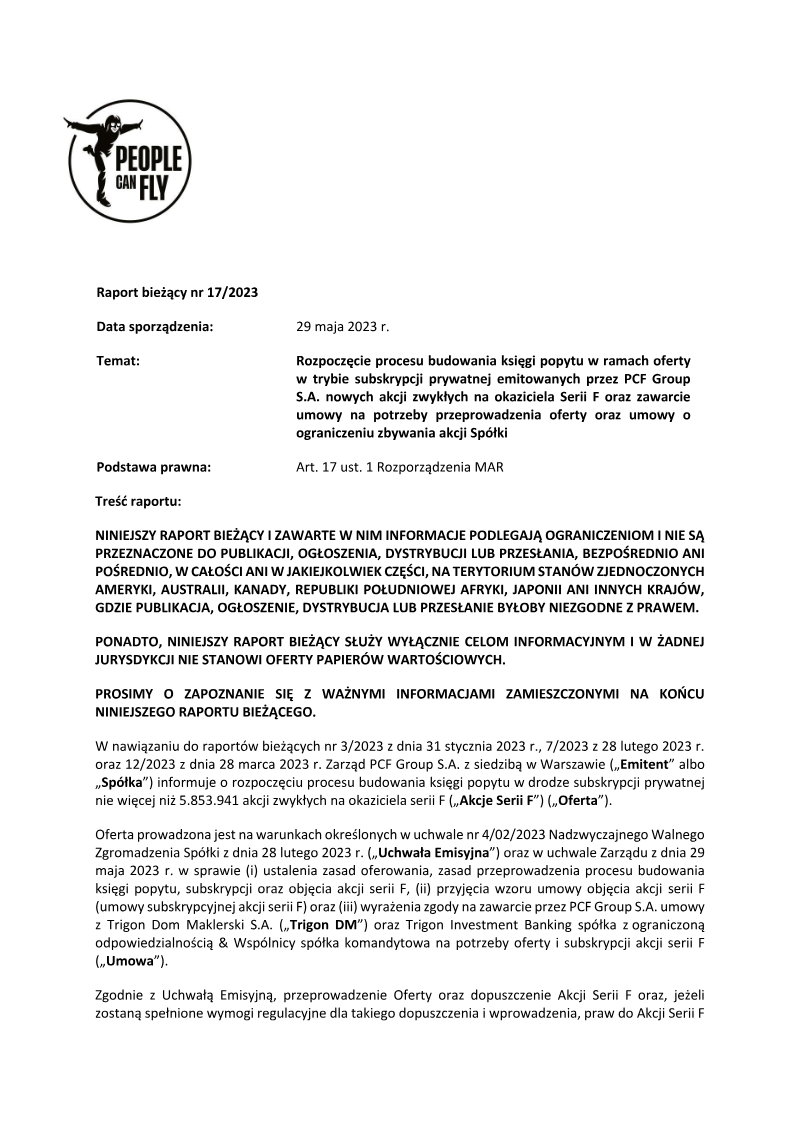
Raport bieżący nr 17/2023Rozpoczęcie procesu budowania księgi popytu w ramach oferty w trybie subskrypcji prywatnej emitowanych przez PCF Group S.A. nowych akcji zwykłych na okaziciela Serii F oraz zawarcie umowy na potrzeby przeprowadzenia oferty oraz umowy o ograniczeniu zbywania akcji Spółki
The document announces the initiation of a private subscription process for up to 5,853,941 Series F ordinary shares issued by PCF Group S.A. The offer is governed by the company’s 28 February 2023 Extraordinary General Meeting resolution and a subsequent board resolution dated 29 May 2023, which establish the terms of subscription, the engagement of Trigon Dom Maklerski S.A. and Trigon Investment Banking for execution, and the signing of a lock‑up agreement with key shareholder Sebastian Wojciechowski. The subscription will be limited to qualified investors, including those holding at least 0.25 % of voting rights as of the preference day or investors with a minimum €100,000 in eligible securities. The Series F shares are intended for offshore transactions only and will not be offered or sold within the United States, Australia, Canada, Japan, South Africa, or other jurisdictions where such distribution would violate securities law. The company plans to seek listing of the Series F shares on the Warsaw Stock Exchange under a prospectus exemption for up to 20 % of existing shares, contingent on regulatory approval. The report clarifies that no prospectus will be prepared and the offer is not a public offering outside Poland. The document includes extensive legal disclosures, risk warnings, and restrictions on distribution, emphasizing that it serves purely informational purposes for qualified investors.
- PCF Group S.A. has initiated a private subscription process for up to 5,853,941 new Series F ordinary shares.
- The offering is restricted to qualified investors, defined as those holding at least 0.25% of voting rights or possessing a minimum of €100,000 in eligible securities.
- Trigon Dom Maklerski S.A. and Trigon Investment Banking have been engaged to manage the execution of the subscription process.
- Key shareholder Sebastian Wojciechowski has entered into a lock-up agreement regarding his existing shares in the company.
- The company intends to list the Series F shares on the Warsaw Stock Exchange, utilizing a prospectus exemption for up to 20% of existing shares.
+1
PCF Group
Report9 pages
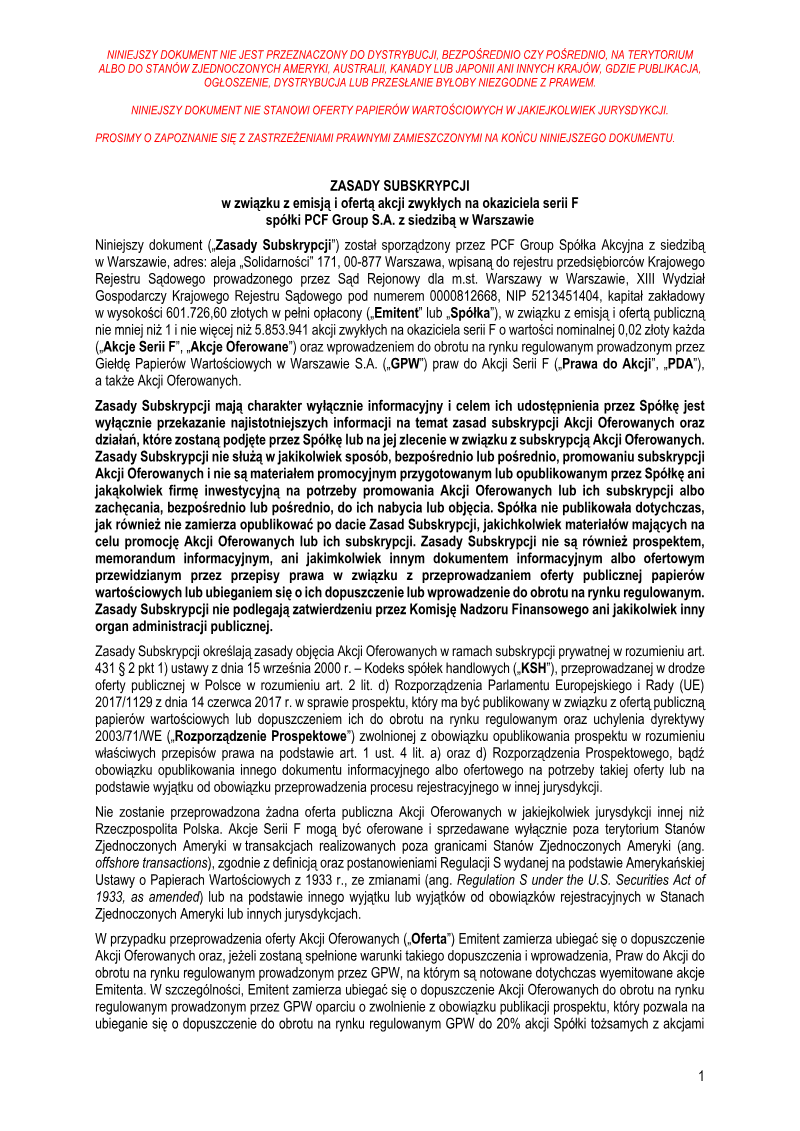
Załącznik do Raportu bieżącego nr 17/2023Zasady subskrypcji w związku z emisją i ofertą akcji zwykłych na okaziciela serii F spółki PCF Group S.A. z siedzibą w Warszawie
NINIEJSZY DOKUMENT NIE JEST PRZEZNACZONY DO DYSTRYBUCJI, BEZPOŚREDNIO CZY POŚREDNIO, NA TERYTORIUM ALBO DO STANÓW ZJEDNOCZONYCH AMERYKI, AUSTRALII, KANADY LUB JAPONII ANI INNYCH KRAJÓW, GDZIE PUBLIKACJA, OGŁOSZENIE, DYSTRYBUCJA LUB PRZESŁANIE BYŁOBY NIEZGODNE Z PRAWEM. NINIEJSZY DOKUMENT NIE STANOWI OFERTY PAPIERÓW WARTOŚCIOWYCH W JAKIEJKOLWIEK JURYSDYKCJI. PROSIMY O ZAPOZNANIE SIĘ Z ZASTRZEŻENIAMI PRAWNYMI ZAMIESZCZONYMI NA KOŃCU NINIEJSZEGO DOKUMENTU.
- PCF Group S.A. is conducting a public offering of 1 to 5,853,941 Series F ordinary bearer shares, each with a nominal value of PLN 0.02, and plans to introduce them to trading on the regulated market of the Warsaw Stock Exchange.
- The offering is a private subscription under Polish law, exempt from prospectus publication requirements, and is directed exclusively to qualified investors or those subscribing for at least EUR 100,000 worth of securities.
- KRAFTON has committed to subscribe for Series F shares that will represent 10.00% of PCF Group's share capital and 10.00% of votes at the General Meeting after the offering, at an issue price of PLN 40.20 per share.
- The subscription process includes a book-building phase, which began on May 29, 2023, and is scheduled to close by 3:00 PM on June 1, 2023, though the company may shorten this period.
- Existing shareholders who were shareholders as of February 28, 2023, and meet specific criteria, have a pre-emptive right to subscribe for Series F shares to maintain their proportion of voting rights in the company.
PCF Group
Report5 pages
Raport Bieżący Nr 20/2023: Ustalenie Liczby Oraz Ceny Emisyjnej Akcji Serii F
The report discloses that PCF Group S.A., following an extraordinary shareholders’ resolution, completed a demand‑building process for its Series F ordinary shares on 1 June 2023. The company will offer a total of 3,343,037 Series F shares to investors, with 3,342,937 of those directed specifically to Krafton, Inc. under a prior investment agreement. The emission price is set uniformly at 40.20 PLN per share for all investors, including Krafton.
The disclosure is limited to informational purposes only and does not constitute an offer or promotion of the shares. It applies exclusively within the European Economic Area, the United Kingdom, and other jurisdictions where such distribution is permitted to qualified or professional investors. The document contains extensive legal caveats, including restrictions on publication and distribution in the United States, Australia, Canada, Japan, South Africa, and other territories where securities law would prohibit such disclosure. It also clarifies that the shares are not registered under U.S. securities law and cannot be offered or sold in those jurisdictions without exemption.
The report outlines the regulatory framework governing the issuance, referencing EU Regulation 2017/1129 and Polish public‑company law. It emphasizes that no prospectus is required and that the information should be used only by eligible investors. The document concludes with standard risk‑disclaimer language, noting that future performance is uncertain and that investors should conduct independent due diligence before making any investment decisions.
- PCF Group S.A. is issuing 3,343,037 new Series F ordinary shares at a fixed price of 40.20 PLN per share.
- The majority of the issuance, totaling 3,342,937 shares, is allocated to Krafton, Inc. under a pre-existing investment agreement.
- The demand-building process for the Series F shares was officially completed on 1 June 2023.
- The offering is restricted to qualified or professional investors within the European Economic Area, the United Kingdom, and other permitted jurisdictions.
- The issuance is conducted under EU Regulation 2017/1129 and Polish public-company law, requiring no formal prospectus.
PCF Group
Report1 pages
Current Report No. 18/2023: Initiation of Negotiations for a Credit Agreement with Bank Polska Kasa Opieki S.A.
The report announces that on 30 May 2023 the board of PCF Group S.A. received financing terms from Bank Polska Kasa Opieki S.A., confirmed by the bank’s Credit Committee. The proposed facility is a revolving credit line capped at PLN 50 million, intended to cover production costs for commissioned games. The line is renewable and the repayment period extends up to three years from contract signing, with customary collateral for such transactions. The board has decided to enter negotiations to finalize credit documentation under these terms, while noting that receipt of the terms and initiation of talks does not guarantee a binding agreement. The company will disclose final documentation in a separate report once executed.
- PCF Group S.A. is negotiating a revolving credit facility of up to PLN 50,000,000 with Bank Polska Kasa Opieki S.A. (Bank Pekao).
- The credit facility is intended to finance the costs associated with contract game production.
- The proposed term for utilizing the credit line and the final repayment date is up to 3 years from the credit agreement signing.
- The company received the financing terms from Bank Pekao on May 30, 2023, following approval by the bank's Credit Committee.
- Customary collateral for such transactions is expected to secure the company's obligations.
PCF Group
Report5 pages
Raport Bieżący Nr 21/2023: Zawarcie Umów Objęcia Akcji Serii F PCF Group S.A.
The report discloses that PCF Group S.A., headquartered in Warsaw, entered into subscription agreements for 3 343 037 ordinary shares of Series F on behalf of investors, including a principal allocation of 3 342 937 shares to Krafton, Inc. All required cash contributions were fully paid. The disclosure is framed under Article 17(1) of the EU Regulation on Market Abuse and complies with Polish public‑offering regulations, emphasizing that it serves only an informational purpose and does not constitute a sale offer or promotional material. The document reiterates that the Series F shares are not registered under U.S. securities law and cannot be offered or sold in the United States, Australia, Canada, Japan, South Africa, or other jurisdictions where such distribution would violate local regulations. It clarifies that the offering is limited to qualified investors within the European Economic Area and the United Kingdom, excluding retail participants. The report also outlines that no prospectus is required under the EU Prospectus Regulation and that distribution is restricted to “qualified persons” as defined by relevant regulations. Legal liability for the information rests solely with PCF Group; managers and affiliated parties are expressly exempt from responsibility. The document contains forward‑looking statements subject to risks and uncertainties, advising readers not to rely solely on them for investment decisions. No recommendation or invitation to purchase the shares is made, and the information is restricted from further dissemination outside authorized recipients.
- PCF Group S.A. has finalized subscription agreements for 3,343,037 Series F ordinary shares.
- Krafton, Inc. is the primary investor in this issuance, acquiring 3,342,937 of the total 3,343,037 shares.
- All cash contributions for the Series F share issuance have been fully paid to PCF Group S.A.
- The offering was restricted exclusively to qualified investors within the European Economic Area and the United Kingdom, excluding all retail participants.
- No prospectus was required for this transaction under the EU Prospectus Regulation.
PCF Group
Report6 pages
Current Report No. 23/2023: Investment Agreement Supplement Between Krafton, Inc. and PCF Group S.A.
The report announces that on 14 June 2023, Krafton, Inc. and PCF Group S.A., together with key shareholder Sebastian Wojciechowski, entered into a side‑letter to the investment agreement dated 28 March 2023. The side‑letter stipulates that if PCF Group increases its share capital by issuing up to 2 510 904 new shares before 31 December 2023, Krafton will have the right of first refusal to subscribe for shares that would bring its total holdings to 10 % of the capital and voting rights. The subscription price is fixed at PLN 40.20 per share, independent of the price set for other investors. The agreement does not obligate Krafton to purchase any shares, and the allocation of new shares to other investors remains unaffected.
The document is a regulatory disclosure under EU Regulation 596/2014 and Polish securities law, intended solely for informational purposes. It contains extensive legal caveats restricting distribution outside the European Economic Area and prohibiting any promotional use of the information. The report clarifies that it is not an offer, does not constitute a prospectus, and is limited to qualified investors in the EU, UK, or U.S. under Rule 144A. No financial projections or performance guarantees are provided; the report includes forward‑looking statements subject to risk and uncertainty. The disclosure emphasizes that no manager or affiliated party assumes liability for the accuracy of the information, and any investment decisions must rely on independently verified data.
- Krafton, Inc. secured a right of first refusal to acquire up to 10% of PCF Group S.A.’s total share capital and voting rights.
- The option to subscribe for new shares is valid if PCF Group issues up to 2,510,904 new shares before the 31 December 2023 deadline.
- The subscription price for Krafton is fixed at PLN 40.20 per share, regardless of the pricing terms offered to other investors.
- The agreement is non-binding for Krafton, meaning the company is under no obligation to purchase any shares.
- This side-letter supplements the original investment agreement established between Krafton and PCF Group on 28 March 2023.
+2
PCF Group