Proprietary in-house engine usage has declined significantly, accounting for only 13 percent of new game releases by 2024.
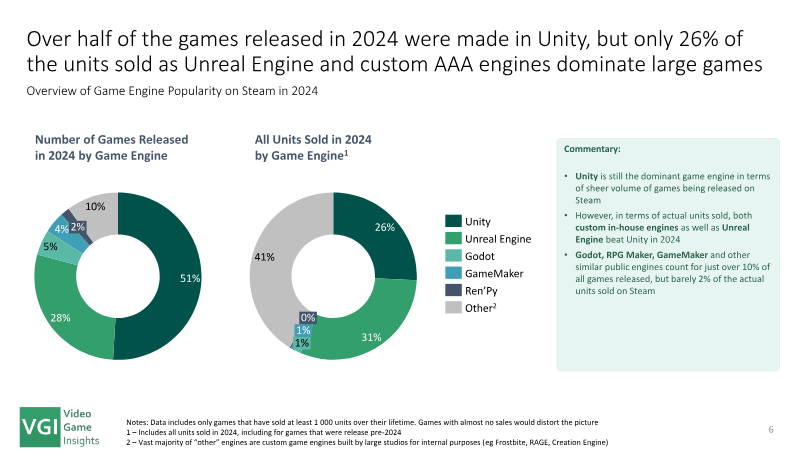
See it on page 6Unreal Engine has become the industry standard for high-budget AAA productions, particularly following the release of Unreal Engine 5.
See it on page 3Unity maintains the highest total volume of game releases, primarily driven by adoption among indie and smaller-scale developers.
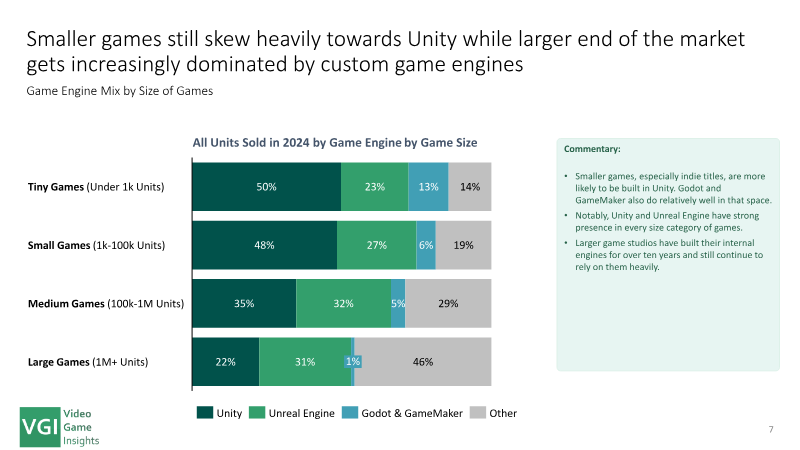
See it on page 7While Unity leads in release volume, Unreal Engine and custom AAA engines command a larger share of total units sold in the commercial market.
See it on page 6The open-source Godot engine has experienced notable growth since 2020, emerging as a competitive alternative to established platforms.
See it on page 17The industry is trending toward a standardized ecosystem, with reliance on third-party engines projected to continue increasing through 2030.
See it on page 11The game engine landscape is undergoing a significant structural shift, characterized by the decline of proprietary in-house technology in favor of established third-party platforms. While custom engines historically dominated the industry, their market share has eroded substantially over the last decade, falling to approximately 13 percent of new releases by 2024. This transition is driven by the increasing complexity of modern development, which makes the maintenance of internal engines cost-prohibitive and less efficient compared to the immediate, high-fidelity capabilities offered by public alternatives.
Unreal Engine has emerged as the primary beneficiary of this trend, particularly within the AAA segment. Following the release of Unreal Engine 5, the platform has successfully reclaimed market share lost during the pandemic, becoming the preferred choice for large-scale, high-budget productions. Conversely, Unity maintains a dominant position in terms of total volume of games released, particularly among indie and smaller developers, though it faces increasing competition from smaller engines like Godot, which has seen notable growth since 2020. Despite Unity’s high release volume, Unreal Engine and custom AAA engines continue to command a larger portion of total units sold, underscoring their prevalence in high-performing commercial titles.
The analysis relies on data from over 13,000 games released on Steam, utilizing proprietary estimation algorithms and tagging methodologies to categorize engine usage by game size, genre, and unit sales. The findings indicate that while the choice of engine is often dictated by project scale—with smaller titles favoring Unity and larger, graphics-intensive projects gravitating toward Unreal Engine—the industry is moving toward a standardized ecosystem. As studios weigh the benefits of third-party support, talent accessibility, and advanced graphical features against the loss of proprietary control, the reliance on external engines is expected to continue its upward trajectory through 2030.