Marketing·Updated Mar 17, 2026 by SocialPeta
Report · January 1, 2025
Published by SocialPeta
The 2025 Global Mobile Game Marketing Insights & Creative Breakdown provides a comprehensive analysis of the mobile advertising landscape, focusing on the evolution of ad creatives across more than 80 countries and 80 ad channels. Utilizing data from SocialPeta and Reforged Labs, the findings cover over 1.6 billion creatives and 10,000 tracked mobile games between January 2024 and October 2025. The primary thesis suggests that the mobile market is experiencing a significant surge in creative volume and a rapid shift toward AI-driven production to combat creative fatigue and rising competition. Key data points indicate that the average monthly creatives per advertiser rose to 123 in 2025, a nearly 20% year-over-year increase. New creatives now account for 58% of total monthly ads, peaking at over 60% in October. Geographically, North America and the Hong Kong, Macao, and Taiwan regions lead in total creative volume, while Europe maintains the highest refresh rate for new content. From a genre perspective, Strategy Games (SLGs) dominate advertising intensity with 325 monthly creatives per advertiser, while Casino games lead in creative turnover, with new assets making up 65.6% of their monthly output. The analysis highlights a clear platform divide, with Android hosting 77.6% of total creatives compared to 22.4% on iOS. Hard-core games represent the largest share of iOS creatives at 34.7%, whereas light games are more prevalent on Android. Video remains the dominant format, particularly for Puzzle games, where it accounts for 83.5% of ads. Furthermore, the industry has reached a tipping point in automation, with over 90% of advertisers now utilizing AI to generate scenes, characters, or scripts. Case studies of top performers like Royal Match and Monopoly GO! emphasize that successful marketing currently relies on "hook" innovation—such as diegetic sound, tactile satisfaction, and subverting brand expectations—to maintain high return on ad spend in an oversaturated market.
2025 Global Mobile Game Marketing Insights & Creative Breakdown
2 Contents Overall Trends of Creatives for Global Mobile Games in 2025 1 Analysis of Advertising & Creatives for Top Mobile Games 2 Analysis & Case Studies of Trending Mobile Game Ad Creatives 3
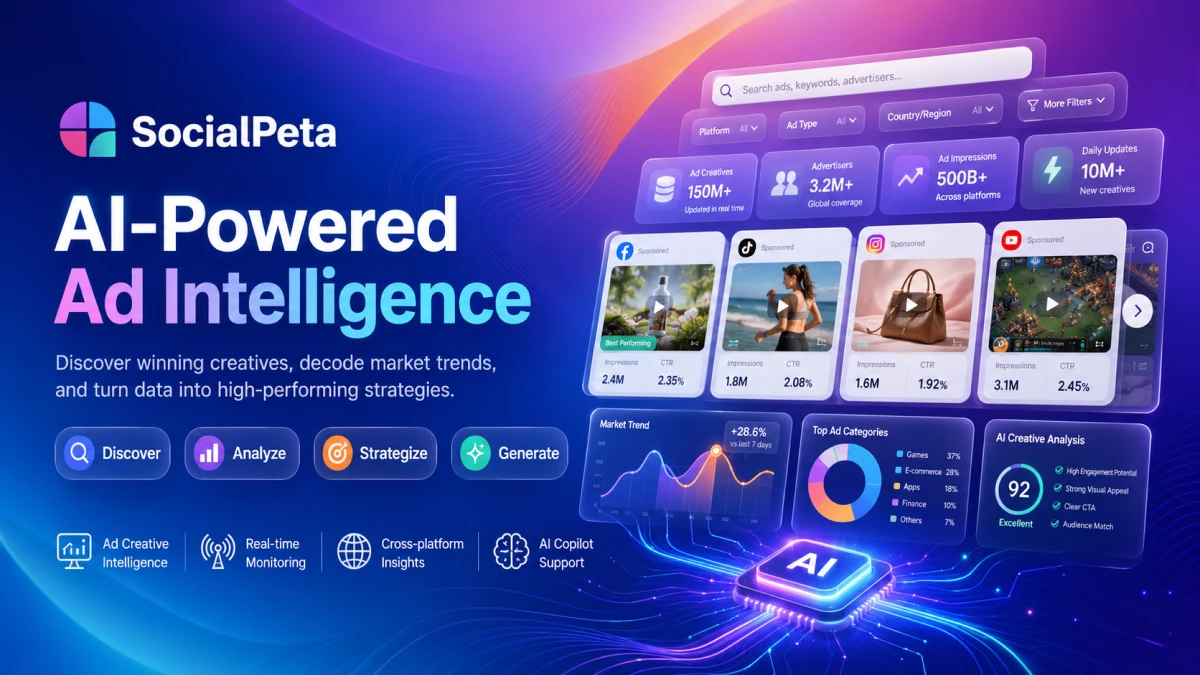
3 With SocialPeta, you can spy on your competitors' ad data, and get ad data from networks, media, and advertisers around the world to inspire you. SocialPeta covers more than 80 countries/regions and over 80 well-known ad channels worldwide, such as Facebook, Twitter, YouTube, TikTok, and Unity. We provide nearly 1.6 billion ad creatives, updating millions each day. Through duration, impressions, popularity, and interactions, we can quickly locate the active high-quality creatives which will be provided to you in real time to help with your marketing plan. As one of the world-leading advertising and marketing platforms, SocialPeta boasts a huge database and the experience of working with thousands of game companies and providing mobile game workers with more practical methods in order to develop more popular games. 6M APP Advertisers 1.6B APP Ad Creatives 1.20M Daily Updates www.socialpeta.com
4 Reforged Labs transforms the way mobile game studios approach creative strategy with Boa, the first creative intelligence platform purpose-built for mobile games. Using powerful AI agents and robust data sourcing, Boa helps mobile marketers turn intuition into insights. Search massive ad libraries to see which campaigns are winning. Analyze performance data to understand why they work. Generate instant insights and one-click creative briefs to launch your next winning campaign. With Boa, marketers can ship campaigns 2–3x faster and drive stronger ROAS with every launch. Built in partnership with three of the world’s largest game publishers, Boa is redefining creative strategy in mobile gaming. Based in San Francisco, the team is founded by AI, adtech, and gaming veterans on a mission to reimagine advertising and marketing using GenAI technology. 250K+Ads Creatives Analyzed https://reforgedlabs.com/ Data Points Mobile Games Tracked 10K+ 1B+
5 Ad Creatives Trends for Global Mobile Games in 2025 01
6 51.4% 46.9% 49.9% 50.7% 50.9% 59.1% 55.0% 52.3% 51.8% 53.0% 52.5% 52.7% 53.5% 52.4% 57.0% 59.1% 57.6% 56.7% 57.9% 57.0% 57.8% 60.9% 0 20 40 60 80 100 120 140 2024 Feb Mar Apr May Jun Jul Aug Sept Oct Nov Dec 2025 Feb Mar Apr May Jun Jul Aug Sept Oct Average monthly creatives per mobile game Share of monthly new creatives for mobile games Analysis of creatives Average monthly creatives per mobile game advertiser in 2025 123 Share of monthly new creatives for mobile games in 2025 58.0% In 2025, there were 123 average monthly creatives per mobile game advertiser, up nearly 20% YoY. New creatives accounted for an average of 58%. New creatives accounted for over 60% in October. Analysis of Creatives for Global Mobile Games Source: SocialPeta - Ad Creatives - based on data that were captured and analyzed. Date Range: Jan 2024 - Oct 2025 Max: 132 Min: 117 Max: 60.9% Min: 52.4% YoY: 19.4%↑ YoY: 5.0%↑
The first half of 2025 reveals a rapid shift in mobile‑game user‑acquisition toward AI‑driven creative production, with short‑form video, live‑action clips and in‑game audio ads now accounting for the majority of impressions. Generative‑AI tools and AI‑enhanced playable ads compress development cycles to under a week, allowing marketers to test multiple concepts at low cost while retaining retargeting as a core pillar of acquisition strategy. Genre competition intensifies, especially for role‑playing games, which generate an average of 224 new creatives per advertiser each month. Casino titles expand their share by 14.5 % year‑over‑year, becoming the second‑largest spend category. Europe hosts the largest pool of advertisers—over 43 000 monthly, a rise of 10 000 from the previous year—while North America exhibits the highest creative density, with roughly 119 assets per advertiser. In casual games, AI‑generated vertical video now consumes about 40 % of media spend, underscoring the dominance of automated formats across regions. Key operational challenges include limited reach to high‑value users, protracted creative rollout times, and declining engagement as mature audiences become ad‑fatigued. Lengthy or fragmented landing‑page experiences further erode trust, suppressing download conversion and long‑term retention. To counter these pressures, firms are advised to institute rapid‑iteration pipelines that move concepts to live within seven days, maintain a refresh cadence of two to three creative updates per month, and prioritize concise, transparent messaging that streamlines the post‑click flow. Embracing these practices is projected to improve acquisition efficiency and sustain user interest amid an increasingly saturated global mobile‑gaming market.
The global mobile gaming landscape underwent a significant transformation in 2023, characterized by a strategic shift toward the hybrid-casual model. This evolution combines the accessibility of hyper-casual mechanics with the monetization depth of mid-core titles, utilizing a mix of in-app advertising and in-app purchases to stabilize revenue. Marketing efforts were defined by a nearly 50% year-over-year surge in monthly active advertisers, exceeding 40,000 globally. While North America maintained its leadership in total advertiser volume, Southeast Asia emerged as the most competitive region for creative output. Concurrently, Android became the primary focus for volume-driven campaigns due to ongoing iOS privacy restrictions, though iOS remained the preferred platform for high-value mid-core and hard-core marketing. Creative strategies pivoted toward high-impact visual storytelling and the integration of generative AI to manage rising user acquisition costs. Although video remains the dominant format, accounting for over 76% of impressions, AI-generated image creatives gained significant traction, particularly in square formats. Developers increasingly utilized "mini-game" ad patterns—such as ASMR, dramatic narratives, and deliberate failure scenarios—to lower entry barriers for complex genres like Simulation and Strategy games. Meanwhile, RPG and Casino titles leaned heavily on influencer collaborations and live-action content to drive engagement in emerging markets across Southeast Asia and the Middle East. Sustainable growth in 2024 depends on a holistic integration of AI-driven production and programmatic transparency. The successful global expansion of Chinese-developed mini-games and the revitalization of legacy titles through trending ad mechanics illustrate a broader trend of creative agility. By analyzing over 1.4 billion ad creatives across 70 countries, it is evident that the industry is moving toward a data-driven future where high-engagement formats like rewarded ads and user-generated content are essential for navigating a fragmented and privacy-conscious global market.
The global mobile gaming industry is currently defined by extreme market concentration and a fundamental shift in monetization and marketing strategies. With the top 50 publishers generating 70% of total revenue, the sector is moving toward hybrid-casual models that blend ad-based revenue with in-app purchases to offset rising user acquisition costs. Strategic priorities for 2025 include the expansion of Direct-to-Consumer platforms to preserve margins and a resurgence in HTML5 web games. This evolution is occurring alongside a surge in marketing volume; in 2024, the industry saw over 250,000 advertisers and 46.2 million creative assets, representing a 60% year-over-year increase in advertising activity despite a declining rate of new market entrants. Geographically, the landscape is marked by rapid growth in Southeast Asia and Latin America, while the United States remains a dominant but maturing market. High-production, cross-platform free-to-play titles, particularly from Chinese developers, are raising consumer expectations and challenging traditional premium pricing models. To navigate privacy-related data limitations, marketers are increasingly adopting creative-level attribution and generative AI for both content production and data analysis. Short-form video has become the primary driver of engagement, accounting for up to 81% of impressions in genres like Puzzle and Simulation, often utilizing AI-generated imagery and demographic-specific hooks to capture niche audiences. Tactical trends reveal a widespread reliance on intellectual property and the integration of casual mini-game mechanics to market hardcore RPG and Strategy titles. Successful campaigns frequently leverage localized content and specialized creative formats, such as "stomp" transitions for social media or long-form puzzles to attract RPG players. This data, synthesized from over 1.6 billion ad records across 80 countries, underscores a transition toward high-volume, AI-enhanced marketing where deep user segmentation and creative variety are essential for maintaining player lifetime value in an increasingly competitive global environment.
Global mobile game marketing reached a pivotal turning point in the second quarter of 2023, characterized by a record-breaking surge in creative volume. Over 9.3 million new creatives entered the market, representing nearly three-quarters of all active advertisements. While casual games maintained the largest share of advertisers at over 30%, RPG and Casino genres experienced the most aggressive growth in creative output. Geographically, Southeast Asia emerged as a primary hub for advertising density, leading the world in monthly creatives per advertiser, while the Middle East solidified its status as a high-growth market where strategy games command significant revenue shares. The industry is increasingly adopting "Casual + X" hybrid models and integrating AI-generated content, ASMR, and short-video memes to mitigate rising user acquisition costs. Financial data reveals a stark contrast in installation costs between platforms, with iOS casual game installs costing $2.23 compared to $0.63 on Android, yet both platforms achieved a comparable seven-day return on ad spend of approximately 7.7%. This parity suggests that despite higher upfront costs, the quality of users on premium platforms remains consistent with broader market performance. Market leaders like Honkai: Star Rail and MONOPOLY GO! demonstrated the efficacy of high-frequency creative refreshes, with new assets comprising over 60% of their total advertising portfolios. These titles leveraged distinct psychological hooks, ranging from influencer-driven user-generated content to social-casual mechanics, to achieve rapid global penetration. Notably, these aggressive marketing strategies allowed Honkai: Star Rail to surpass Genshin Impact in overseas revenue during the quarter, signaling a shift toward more dynamic, content-heavy advertising cycles across the global mobile landscape.