Market (Mobile)·Updated Apr 30, 2026 by GameAnalytics
Report · January 1, 2025
Published by GameAnalytics
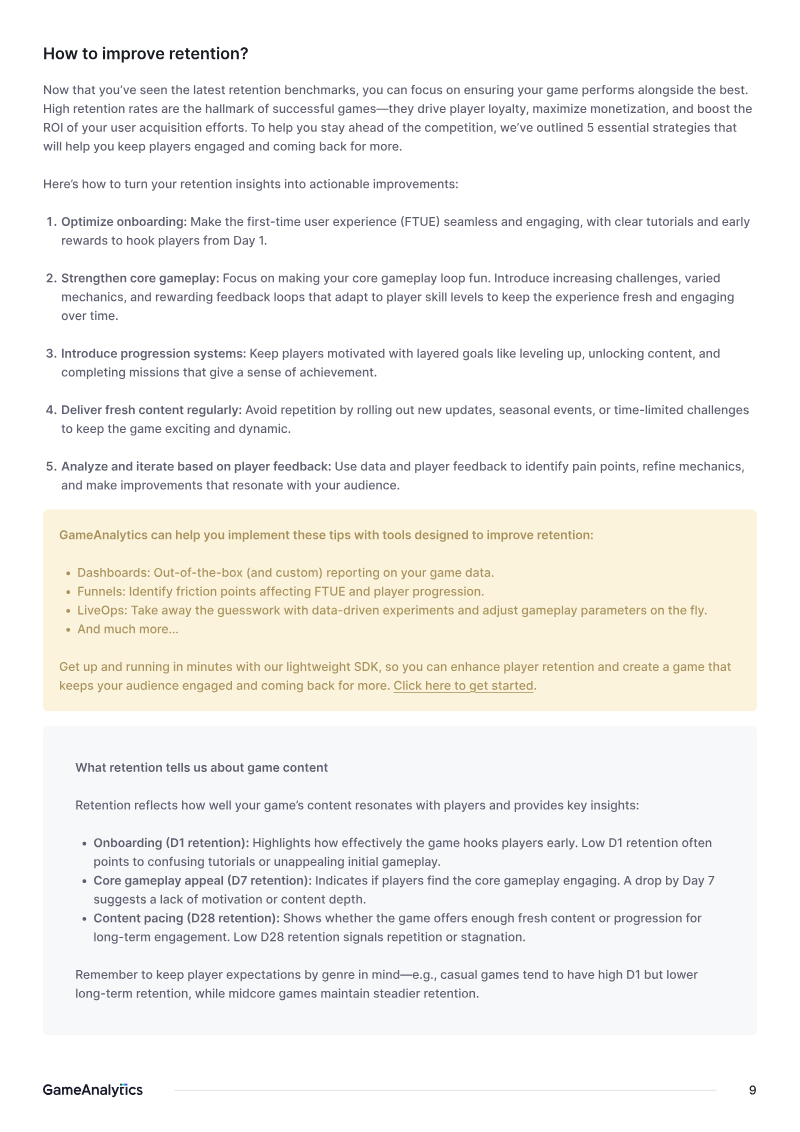
The mobile gaming landscape in 2024 faced significant challenges regarding player loyalty, as 75 percent of titles failed to maintain a 3 percent retention rate by the 28th day. This decline underscores a critical industry shift where long-term viability is increasingly tethered to sophisticated content pacing, refined progression systems, and seamless onboarding experiences. Because retention serves as the primary engine for both user acquisition return on investment and sustainable monetization, developers must prioritize data-backed strategies to mitigate rising churn rates across the global market. Engagement metrics reveal a nuanced performance gap between platforms and regions. While iOS continues to demonstrate superior early-stage engagement compared to Android, regional behaviors vary significantly; the Middle East currently leads in retention, whereas Africa and Oceania report the highest average playtime and session lengths, respectively. Genre-specific performance further complicates these trends, as Board and Card games exhibit robust long-term retention, contrasting sharply with Multiplayer titles that struggle to retain users despite commanding the longest average session durations of 8 to 9 minutes. These insights, derived from an expansive dataset of over 100,000 active games, highlight the necessity of granular performance benchmarking. By comparing individual game metrics—including monetization, engagement, and retention—against global standards filtered by genre and player spending habits, studios can effectively optimize their development cycles. Ultimately, the industry is moving toward a model where success is no longer defined by broad acquisition, but by the precise, data-driven calibration of the player experience to ensure longevity in an increasingly competitive mobile ecosystem.
2025 Mobile Gaming Benchmarks This report provides an in-depth analysis of key gaming metrics across different regions, genres, and platforms, offering valuable insights into player behavior and market trends.
Introduction 3 Key highlights 4 Methodology 5 Global benchmarks 6 Retention 6 Engagement 10 Regional insights 13 Retention 13 Playtime 14 Session length 15 Session count 16 Genre performance 17 Insights 17 D1 retention 17 D7 retention 18 D28 retention 18 Playtime 19 Session length 19 Session count 20 GameAnalytics’ Benchmarks 21 About GameAnalytics 22
GameAnalytics is uniquely positioned to provide mobile gaming benchmarks due to the scale, diversity, and quality of the data we analyze. With tens of thousands of games leveraging our platform to optimize their strategies and refine game mechanics, our vast and comprehensive dataset represents a broad cross-section of the mobile gaming industry. Each game in our dataset spans four to five regions on average, offering a global perspective on player behavior and game performance. The depth and breadth of data means we can identify trends and patterns that go beyond isolated markets or genres, making these insights both globally relevant and locally actionable. Our analytics platform captures key game metrics - like DAU, retention, session length and more - across regions and genres. This enables us to create benchmarks that accurately reflect real-world conditions and player preferences. This report serves as a comprehensive guide for game developers, publishers, and studios looking to optimize their games and stay ahead of the competition. With these actionable insights, you can: Evaluate game performance Benchmark your games against industry standards to identify strengths and areas for improvement. Drive better decision-making Inform decisions on user acquisition strategies, monetization models, and content updates based on databacked trends. Understand regional and genre-specific trends Highlight behavioral differences across regions and genres to localize strategies and explore new opportunities. Support game ideation and developmen t Provide insights for early ideation to align your game with proven player behaviors and preferences.
erstand regional and genre-specific trends Highlight behavioral differences across regions and genres to localize strategies and explore new opportunities. Support game ideation and developmen t Provide insights for early ideation to align your game with proven player behaviors and preferences. By leveraging these benchmarks, developers can make data-backed decisions to enhance user acquisition, engagement, and monetization strategies. Let’s dive into the data and explore the latest trends shaping the mobile gaming landscape.
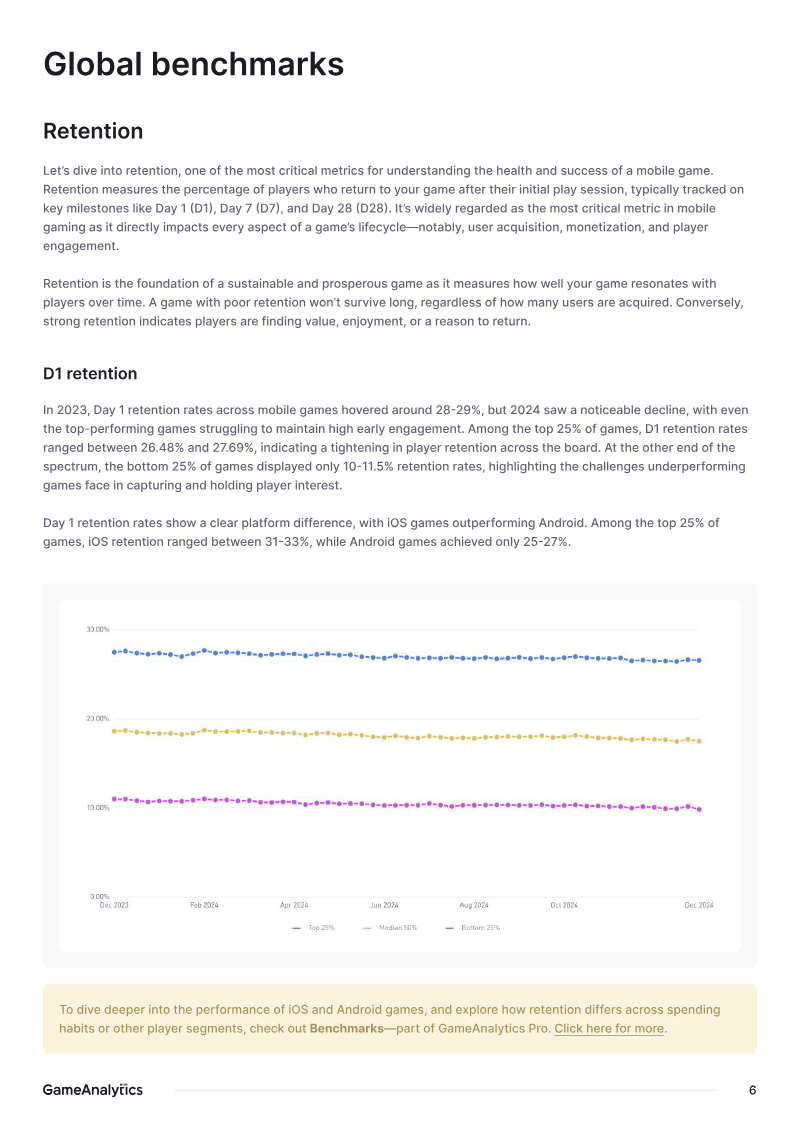
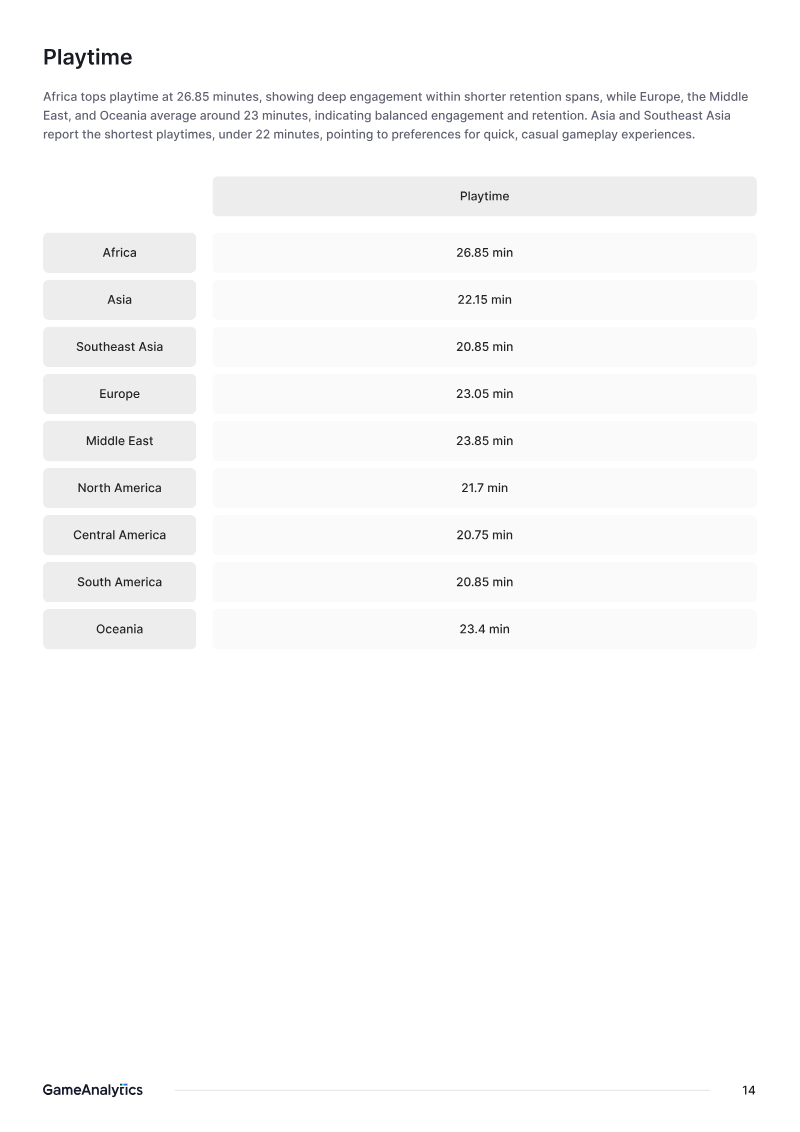
Retention is the cornerstone of success Retention remains the most critical metric for understanding game health and player loyalty. In 2024, D1 retention rates dropped slightly, with the top 25% of games achieving approximately 26-28%, and the bottom 25% struggling at 10-11.5%. Platforms show clear differences, with iOS outperforming Android in D1 retention. Long-term retention (D28) reveals even greater challenges, as 75% of games fail to exceed 3%, highlighting the importance of content pacing, progression, and long-term engagement strategies. Engagement patterns tell a clear story Playtime Sess ion leng th Sess ion count The median playtime in 2024 was Oceania leads with 6.85 minutes / Africa and the M iddle E ast show around 22 minutes, with the top session, indicating a preference the highest session counts (5.45 2% of games exceeding 4 hours, for fewer but immersive sessions, and 4. 71/ day), indicating fre quent driven by immersive platforms while Africa and Asia show re-engagement despite shorter like Roblox (mobile). Africa leads shorter sessions around 5 session lengths. Oceania and with 26.85 minutes, reflecting minutes, likely favoring quick N orth America favor fewer intense but short-lived gameplay bursts. sessions (3.75/ day) paired with engagement. longer game play. Regional differences matter Regional data shows diverse player behaviors:
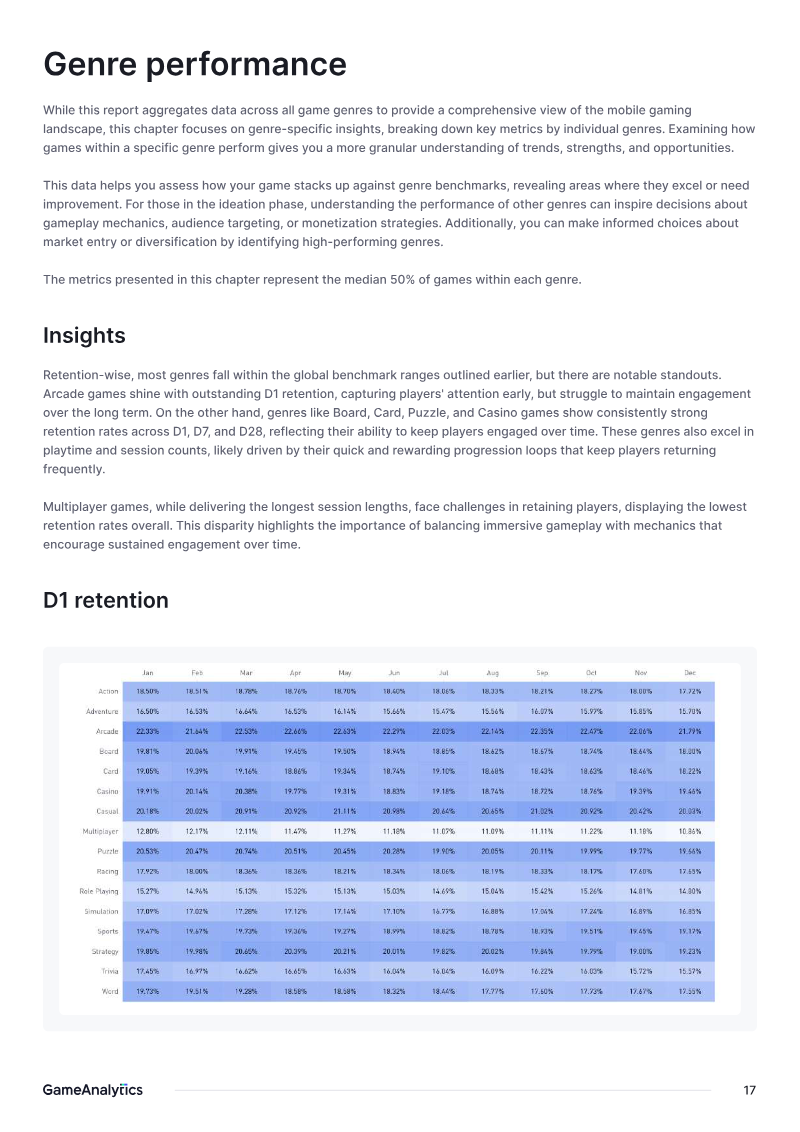
session lengths. Oceania and with 26.85 minutes, reflecting minutes, likely favoring quick N orth America favor fewer intense but short-lived gameplay bursts. sessions (3.75/ day) paired with engagement. longer game play. Regional differences matter Regional data shows diverse player behaviors: The M idd le E a st leads retention Afr ic a a nd As ia struggle with Europe and North America (D1: 22.64%, D7: 4.91 %, D28 : retention but lead in session perform consistently well, 1.4 9% ), offering a prime market counts, indicating short-term reflecting strong retention, for long-term engagement. engagement opportunities. playtime, and session lengths. Player behavior varies by genre From a genre perspective, this is what we see: Board, Card, and Puzzle games Mu lti play er gam es face Cla ss ic gam es overall continue display highest short and long- challenges retaining players. engaging players the most, term retention, with playtime and H owever, they deliver the longest consistently displaying good session count also ranking high. session lengths across all genres. retention and engagement.
The Mobile Gaming Loyalty Report examines the drivers of player engagement, retention, and spending across the mobile landscape. By combining a longitudinal benchmark of 500 games with a survey of 3,000 mobile gamers in the US and Canada during 2023, the analysis establishes a Loyalty Index based on six key monetization and engagement KPIs. The findings emphasize that while user acquisition remains expensive, maximizing the lifetime value of existing players through loyalty-centric design is essential for sustainable growth. Role-Playing Games (RPGs) emerge as the most loyal genre, scoring 75 out of 100 on the index due to deep gameplay loops and compounding monetization systems that encourage high-value, frequent spending. Strategy games follow closely, excelling in repeat purchases and session frequency. Conversely, Lifestyle games lead in average sessions per user, utilizing bite-sized tasks and emotional storytelling to drive incremental spending. Data indicates a significant gap between average and top-quartile performers in genres like Casino and Sports, suggesting substantial room for optimization in retention and spender conversion. Consumer behavior insights reveal a disconnect between play and spend habits; while over 77% of spenders rotate between two to seven games weekly, 53% concentrate their spending on a single title. Progression is the primary motivator for both continued play and in-app purchases, whereas "pay-to-win" mechanics and poorly received updates are leading causes of churn. Notably, 39% of players will abandon a game if a bad update is not corrected within a week. High-value spenders, defined as those spending over $100, exhibit more demanding standards for app store ratings and customer service. Marketing effectiveness is heavily influenced by authenticity and social proof. Over 71% of gamers demand real gameplay footage in advertisements, and 60% consider app store ratings and reviews crucial for downloads. While digital ads remain the primary discovery tool, word-of-mouth ranks as a top-three acquisition source. Additionally, there is a strong interest in play-and-earn mechanics, with 84% of respondents open to trying games that offer tangible rewards.
Global app engagement experienced a significant upward trend between 2018 and 2021, catalyzed by the COVID-19 pandemic. Monthly active users (MAU) for the top 500 apps grew at a compound annual growth rate of 12 to 14 percent, with the average top app gaining approximately 10 million MAU annually. While a spike in engagement occurred during 2020 lockdowns, growth rates and time spent largely normalized by the second quarter of 2021, though they remained above pre-pandemic levels. The analysis covers worldwide usage on iOS and Android across various categories and game genres. Business, Education, and Medical apps emerged as the fastest-growing categories due to shifts in remote work and remote learning. Conversely, Travel and Navigation suffered the most significant declines, though they began a slow recovery as restrictions lifted. In the gaming sector, Hypercasual titles dominated MAU and weekly active user metrics, while the Shooter genre led in daily active users. Engagement depth varies significantly by category and platform. Social Networking apps see the highest frequency of use, averaging nearly 10 sessions per day on Android, whereas Entertainment apps lead in daily time spent at approximately 30 minutes. Within gaming, mid-core genres like Strategy and RPG command the highest engagement, with users averaging about one hour of play per day. A strong correlation exists between time spent and revenue per download, particularly in mid-core and Casino genres. Retention trends reveal a divergence between games and non-games. While non-game retention improved during the study period, overall game retention—specifically day 30 metrics—was dragged down by the proliferation of Hypercasual titles, which prioritize high user acquisition over long-term loyalty. Tabletop games remain an outlier in the gaming category, maintaining the highest long-term retention and daily time spent among casual genres. Data for this analysis was sourced from Sensor Tower’s Usage and Store Intelligence platforms, benchmarking the top 100 to 500 apps per category.
I W w k o A look A T k T ATT o - l W x l M l v l l . I l l v w l ll l w l w ll w . W w ll ll v l k v v lv k l . A l w l l 2 l .
The global gaming landscape in 2026 reflects a challenging environment for player retention, as metrics across Day 1, Day 7, and Day 30 continue a downward trend established in previous years. Data indicates a widening performance gap between average titles and the top 10% of performers. While the industry has historically relied on the 40/20/10 rule for retention percentages, current benchmarks suggest a shift toward a more realistic 35/15/5 standard. Median Day 1 retention currently sits at approximately 22%, while the top tier of games maintains a 40% threshold. This decline becomes more pronounced over time, with median Day 7 retention dropping to 4% and Day 30 retention falling to a mere 0.7%. The analysis emphasizes that early engagement is the primary driver of long-term success, noting that players typically churn within the first five to fifteen minutes if the value proposition is not immediately clear. Effective onboarding must transition from functional tutorials to demonstrations of core gameplay pleasure to mitigate this early loss. Despite the seemingly low median figures, the data is influenced by a high volume of indie and early-stage projects. Established studios often utilize in-house data solutions, meaning the highest-performing titles are frequently absent from public benchmarks. Geographic and genre-specific contexts remain vital for interpreting these statistics, as hybrid-casual and midcore games exhibit vastly different long-term retention profiles. While the mobile market faces significant headwinds in maintaining a loyal player base, the situation is viewed as an evolution of player expectations rather than a fundamental failure of the platform. Success in this climate requires developers to focus on immediate engagement and recognize that the widening gap between median and top-tier performance necessitates more sophisticated retention strategies than those used in previous cycles.