Market (Mobile)·Updated Apr 8, 2026 by Unity
Report · January 1, 2025
Published by Unity
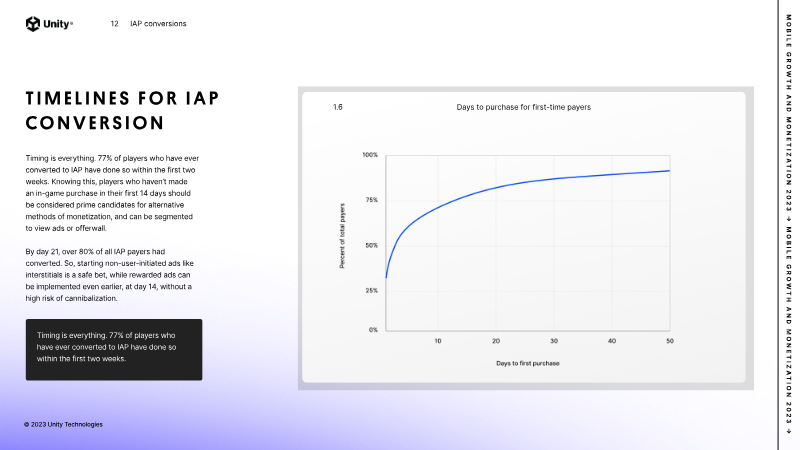
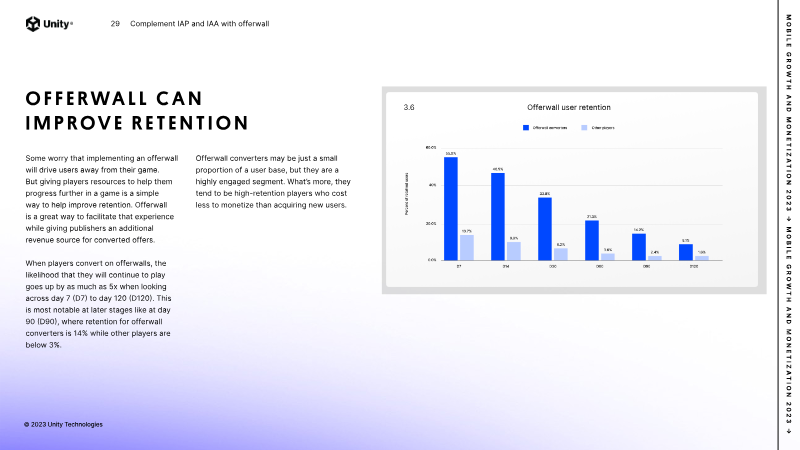
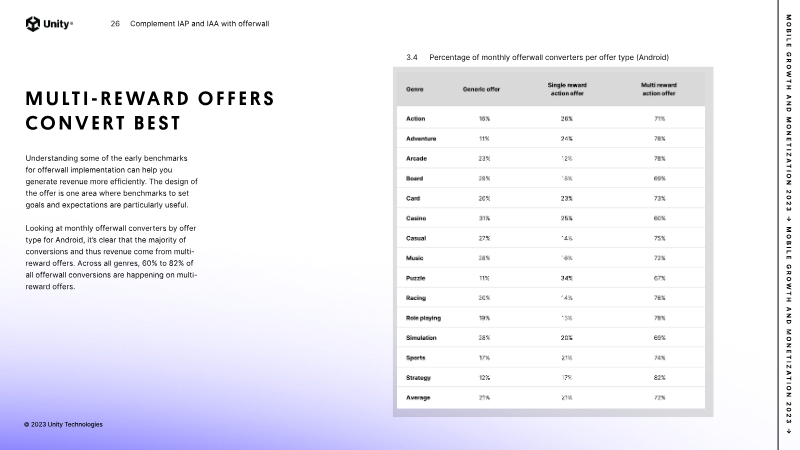
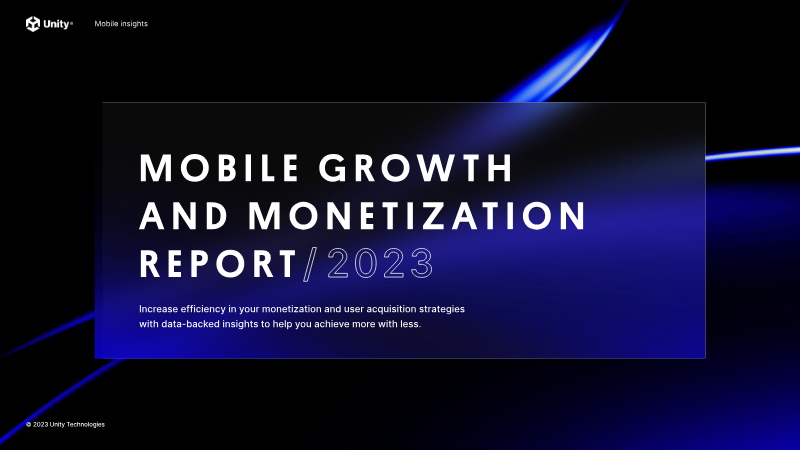
The report establishes that mobile game monetization is most effective when focused on early‑stage conversion and strategic ad placement. Analysis of 31 billion in‑app purchase events shows that 77 % of players who convert do so within the first two weeks, with currencies and limited‑time sales accounting for 22–23 % and 15–20 % of revenue respectively. Pricing the first purchase between $1 and $5 maximizes conversion efficiency, while targeting tier‑2 markets and deploying offerwalls can further enhance retention. Rewarded‑ad data, derived from 31 billion monthly impressions and 158 million installs, identifies high‑engagement placements between levels, in the IAP store, and lobby screens. Extra‑reward, currency, and gacha offers drive the greatest engagement. Offerwalls contribute roughly 33 % of total ad revenue, delivering about $4.68 per converted user; multi‑reward offers generate 60–82 % of conversions and can yield up to $68 per completion. These insights suggest that placing high‑visibility rewarded ads and integrating offerwalls can simultaneously boost retention and monetization. Complementary tactics such as custom store pages further improve player engagement. Offerwall conversions can increase day‑7 to day‑120 retention by up to fivefold, especially for high‑engagement segments. Custom store pages allow developers to align in‑game messaging with ad creatives, reducing resource costs and enhancing conversion rates. Targeting genre‑specific markets—sports in Japan or trivia in South Korea—can lift click‑through rates above tier‑2 averages, underscoring the importance of data‑driven audience and creative optimization. Overall, the findings emphasize a focused strategy: early conversion pricing, strategic rewarded‑ad placement, offerwall integration, and tailored store experiences. These combined tactics deliver measurable gains in retention, revenue, and campaign efficiency across iOS and Google Play platforms worldwide.
Mobile insights 1 Mobile Insights MOBILEGROWTH ANDMONETIZATION REPORT / 2023 Increase efficiency in your monetization and user acquisition strategies with data-backed insights to help you achieve more with less. with data-backed insights to help you achieve more with less. 1MoMb1ilens1ghtTlafaceh2 3 2 0 2 N O ITAZ ITENOMDNAHTWORGEL IBOM → 3 2 0 2 N O ITAZ ITENOMDNAHTWORGEL IBO
> **[Chart page]** This page contains visual data — view in PDF for the best experience. 2 Table of contents ABOUT THE DATA The data in this report is drawn from the Unity We take data privacy seriously and have omitted portfolio of products, and specifically games that and anonymized information from this report use monetization and user acquisition services. that would individually identify any single game, developer, or publisher. Games are broken out It leverages original data from over 31 billion into publicly available categories as defined on ads served each month, 250 million average the iOS and Google Play stores where available users reached each day, and 158 million average The data shown in the charts and graphics is 06-13 GETTOFIRSTIAP 14 MONETIZEEXISTING - average monthly in-app purchases (IAPs) 1 7 enabled by Unity. CONVERSIONSFASTERPL AY ERBASES 18- 29 COMPLEMENTIAP 30 ADVERTISE - ANDIAAWITH 35 EFFICIENTLY OFFERWALL © 2023 Unity Unity Technologies Technologies 3 2 2 0 0 2 2 N N O O I I T T A A Z Z I I T T E E N N O O M M D D N N A A H H T T W W O O R R G G E E L L I I B B O O M M → → 3 3 2 2 0 0 2 2 N N O O I I T T A A Z Z I I T T E E N N O O M M D D N N A A H H T T W W O O R R G G E E L L I I B B O O
3 Introduction ACHIEVINGMORE In this year’s Unity Gaming to be more efficient with WITHLESS → Report, we shared that while monetization and user The data in this report is drawn from the Unity player growth continues for acquisition investments. portfolio of products, and specifically games that mobile gaming, there’s been a use monetization and user acquisition services. that would individually identify any single game, softness for in-app purchase This report provides data- It leverages original data from over 31 billion into publicly available categories as defined on ads served each month, 250 million average (IAP), and the in-app ads (IAA) backed insights on how the iOS and Google Play stores where available users reached each day, and 158 million average market faced challenges in the to get more out of your monthly installs. It also looks at 47 million original to Unity. average monthly in-app purchases (IAPs) second half of 2022. resources for a better return enabled by Unity. on investment from money, When revenue slows, it can time, or other costs. put pressure on resources throughout the business. Monetization and user acquisition are no exceptions. In a tougher year, it’s critical for studios to find ways 3 2 0 2 N O ITAZ ITENOMDNAHTWORGEL IBOM → 3 2 0 2 N O ITAZ ITENOMDNAHTWORGEL IBO
4 Introduction ACHIEVINGMORE Our experts have analyzed Unity data for WITHLESS → unique insight on: The data in this report is drawn from the Unity We take data privacy seriously and have omitted portfolio of products, and specifically games that → IAP payer and conversion trends use monetization and user acquisition services. that would individually identify any single game, → Recommendations for ad placement and reward design It leverages original data from over 31 billion → Diversifying monetization with new revenue sources ads served each month, 250 million average the iOS and Google Play stores where available users reached each day, and 158 million average → The best genres to run user acquisition campaigns in The data shown in the charts and graphics is monthly installs. It also looks at 47 million original to Unity. → Leveraging custom landing pages average monthly in-app purchases (IAPs) enabled by Unity. By increasing efficiency in your monetization and user acquisition activities, you can achieve more with less. 3 2 0 2 N O ITAZ ITENOMDNAHTWORGEL IBOM → 3 2 0 2 N O ITAZ ITENOMDNAHTWORGEL IBO
5 Key findings 01 02 KEYFINDINGSGETTOFIRSTIAPIMPROVEIAASUCCESS CONVERSIONSFASTERWITHBETTERPLACEMENTS The data in this report is drawn from the Unity The majority of players who will ever convert ANDREWARDS portfolio of products, and specifically games that to IAP will do so within the first two weeks, so and anonymized information from this report More than half of rewarded ad placements are use monetization and user acquisition services. make sure your item and pricing strategy is set found between levels, with top-engaging reward up for success. developer, or publisher. Games are broken out types being currencies, gacha mechanics, and It leverages original data from over 31 billion into publicly available categories as defined on additional rewards. ads served each month, 250 million average the iOS and Google Play stores where available users reached each day, and 158 million average The data shown in the charts and graphics is monthly installs. It also looks at 47 million original to Unity. average monthly in-app purchases (IAPs) 03 04 enabled by Unity. OFFERWALLCANHELPTARGETINGTACTICSANDNEW DIVERSIFYREVENUESOURCESSOLUTIONSCANIMPROVEUSER ANDIMPROVERETENTIONACQUISITIONCAMPAIGNS Offerwalls are complementary to both in-app purchases and in-app advertising. Implementing this ad unit doesn't just increase revenue, but can also lead to a significant lift in retention for players who engage with it. Targeting tier-2 markets or specific genres that have stronger performance can give advertisers a competitive advantage. While custom store page solutions give new opportunities to improve conversion for early adopters.
n also lead to a significant lift in retention for players who engage with it. Targeting tier-2 markets or specific genres that have stronger performance can give advertisers a competitive advantage. While custom store page solutions give new opportunities to improve conversion for early adopters. 3 2 0 2 N O ITAZ ITENOMDNAHTWORGEL IBOM → 3 2 0 2 N O ITAZ ITENOMDNAHTWORGEL IBO
The interim filing presents the fourth‑quarter 2025 financial results for a midcore‑casual gaming group, emphasizing a record‑setting revenue run and the successful execution of a transformation agenda that includes the integration of the Plarium acquisition and the rollout of a new district structure in early 2026. Revenue reached SEK 3,123 million, reflecting 108 % organic growth year‑on‑year and a 25 % increase on a constant‑currency basis, while adjusted EBITDA rose to SEK 717 million, delivering a 23 % margin that matches the full‑year figure. Unlevered free cash flow amounted to SEK 878 million, with a cash‑conversion rate of 66 % and a leverage ratio of five times EBITDA, underscoring robust liquidity and disciplined capital management. User‑acquisition spending accelerated, representing 38 % of quarterly revenue—up from 37 % in the prior quarter—and grew 76 % on a reported basis, driven by heightened investment in original studios, new casual titles, and the racing franchise. The direct‑to‑consumer channel expanded by 600 basis points to 32 % of total revenue, reflecting a strategic shift toward higher‑margin in‑app purchases. Across the fiscal year, the company posted a 9 % organic revenue increase, with word‑games, racing, and RAID franchises delivering the strongest quarter‑end performance. Operating cash flow for the quarter stood at SEK 840 million, while adjusted net income was SEK 1,390 million, translating to an adjusted EPS of SEK 11.33. The financial outcomes exceed guidance and position the firm to meet its medium‑term outlook, with a pre‑IPO study for PlaySimple concluded and the midcore transformation progressing as planned.
The mobile gaming industry is entering a period of strategic recalibration, projected to reach $126.1 billion in revenue by 2025. This growth is underpinned by a transition toward hybrid monetization models and the integration of AI-powered personalization to combat persistent retention challenges. While global install volume grew by 4% in 2024, the market exhibits a distinct geographic divide; North American and European markets face stagnation, whereas Latin America and the Middle East and North Africa regions demonstrate robust expansion. Success in this evolving landscape requires developers to move beyond traditional acquisition, favoring diversified channels such as Connected TV and localized, player-centric engagement strategies. Data from early 2025 indicates that user tracking remains a pivotal operational hurdle, with global App Tracking Transparency opt-in rates hovering at 37.9%. Although arcade games have seen notable improvements in opt-in performance, the United States remains relatively static at 32%, underscoring the necessity for refined messaging strategies to maintain visibility. Concurrently, the industry is grappling with a complex financial environment characterized by rising costs per install and declining average revenue metrics. These headwinds are forcing a shift in marketing tactics, as developers increasingly rely on a broader array of acquisition partners and data-informed creative experimentation to sustain growth. Ultimately, the path to profitability in 2025 lies in prioritizing long-term player value over short-term acquisition metrics. By leveraging AI-driven optimization and fostering community-building initiatives, developers can mitigate the impact of declining revenue per user. The industry is clearly moving toward a more sophisticated, data-reliant ecosystem where the ability to measure performance across fragmented channels—including mobile and Connected TV—is essential for maintaining a competitive advantage in a maturing global market.
The analysis tracks the state of the global mobile‑gaming market through 2024 and projects its trajectory toward 2025, emphasizing how emerging AI‑driven personalization will shape growth. It establishes that the sector is recovering from the volatility of 2023, with worldwide app installs climbing 4 % year‑over‑year in 2024, even as average session length contracted. Core user engagement metrics, however, show modest decline: day‑1 retention fell from 28 % to 27 % and median revenue per active user dropped from $0.31 to $0.28, indicating pressure on traditional monetization models. In contrast, advertising efficiency improved, reflected in higher installs per mille (IPM) and stronger ad‑performance indicators across major markets. The report’s geographic scope is global, encompassing all major mobile‑gaming regions, and its temporal frame spans the 2023‑2025 period. It integrates data from app stores, ad networks, and cross‑platform measurement tools to deliver a comprehensive view of user acquisition, retention, and revenue trends. The central thesis posits that the next wave of growth will be powered by AI‑enabled, culturally tailored experiences that adapt difficulty, blend monetization formats, and deploy live events to boost lifetime value. Developers and marketers who adopt a metrics‑focused, AI‑augmented approach—identifying pivotal in‑game moments and steering users toward optimal pathways—are projected to achieve the most scalable expansion. Cross‑platform analytics suites are highlighted as essential for delivering the visibility required to implement these strategies effectively.
The mobile puzzle game market is undergoing a significant structural evolution, characterized by a shift in product models and a notable rise in hybridcasual gaming. This analysis, covering global data from January 2018 through June 2023, examines the performance of various puzzle sub-genres, including swap, blast, chain, and pair mechanics. By leveraging store intelligence and download estimates from the Apple App Store and Google Play, the findings highlight how developers are increasingly integrating meta-features and diversified monetization strategies to sustain revenue in a maturing landscape. A central finding is the remarkable growth of the hybridcasual product model, which saw a 430% increase in revenue between early 2022 and early 2023. While traditional casual games continue to dominate overall market share through consistent operations and robust meta-features, they have experienced modest declines in both downloads and revenue. Conversely, hybridcasual titles—particularly within the pair sub-genre—have successfully captured user interest by blending accessible gameplay with more sophisticated monetization tactics, such as in-app purchases, which were previously less common in hypercasual-leaning segments. The data indicates that sub-genres like pair have emerged as high-growth areas, with hybridcasual revenue in this category rising from $7 million in the first quarter of 2022 to $40 million by the first quarter of 2023. Meanwhile, other established sub-genres, such as merge and physics, have seen download declines as their reliance on hypercasual models wanes. Successful top-tier games across all categories now frequently employ a combination of live operations, season passes, and social clans to drive engagement. Ultimately, the puzzle market is moving toward a hybrid approach, where the simplicity of casual mechanics is increasingly supported by the deeper monetization and retention frameworks typically associated with mid-core titles.