Updated Mar 17, 2026 by Korea Creative Content Agency
Report · January 1, 2025
Published by Korea Creative Content Agency
The Japanese character market has evolved from a niche subculture into a mainstream value chain driven by a diverse demographic of high-spending fans. While male consumers maintain a strong presence in the traditional collectible figure segment, women in their 20s and 30s have emerged as a dominant force, shifting market demand toward lifestyle goods, customizable plush toys, and shareable social media content. This transformation is fueled by the global reach of streaming platforms, the normalization of fandom culture through K-pop, and an increasing consumer preference for immersive offline experiences such as pop-up stores and collaboration cafés. Strategic success in this landscape requires a dual-track approach that balances mass-market accessibility with premium, limited-edition offerings. Current growth is heavily concentrated in cross-category collaborations where character intellectual properties intersect with fashion, digital goods, and the music industry. Navigating this market necessitates a deep understanding of multi-tiered licensing structures and a commitment to protecting the narrative integrity, or worldview, of each IP. Establishing long-term credibility through disciplined execution remains a prerequisite for international partners seeking to enter this competitive ecosystem. Looking toward 2026, the industry is moving toward a hybrid model that prioritizes experiential content and convergence-driven trends. To remain competitive, businesses must develop the agility to identify these shifts early and execute initiatives swiftly. The integration of character IPs into broader cultural sectors like exhibitions and music suggests that the future of the market lies in creating holistic brand experiences rather than simple product manufacturing. This evolution underscores the necessity for strategic flexibility and rapid response to the changing tastes of a globalized fandom.
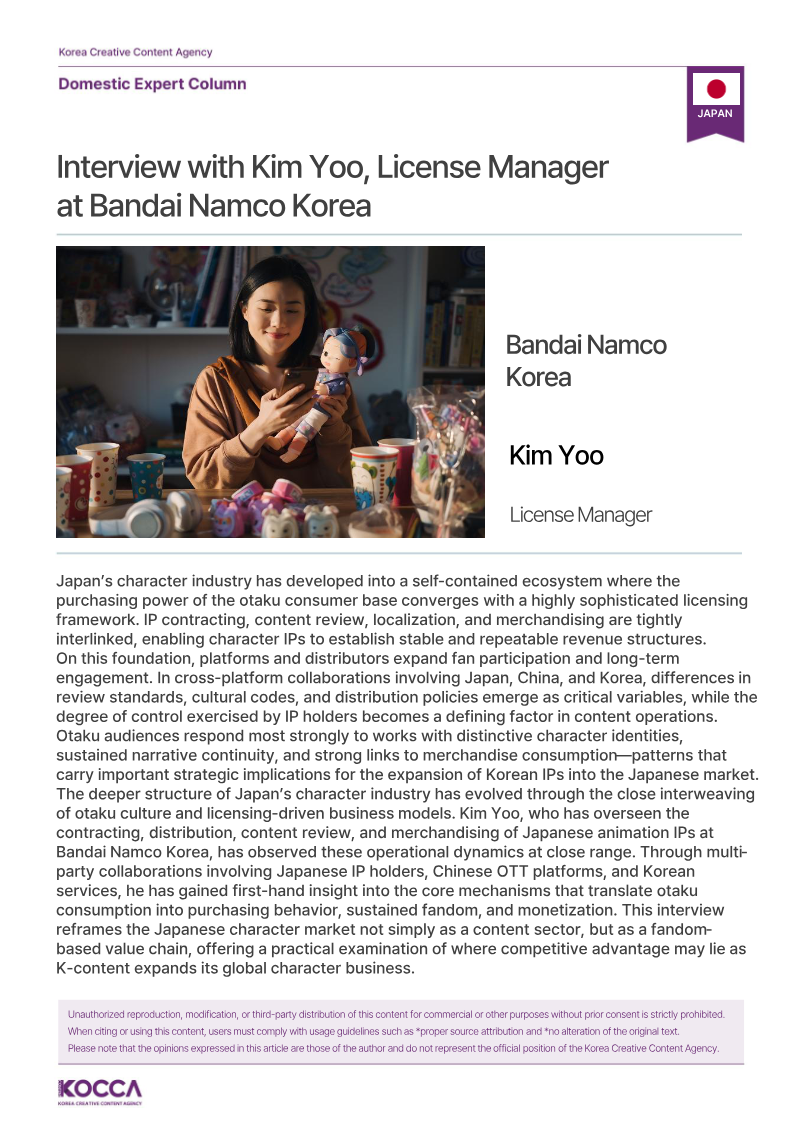
JAPAN JAPAN Interview with Kim Yoo, License Manager at Bandai Namco Korea exhibitions, and experiential content. As these hybrid formats gain traction, there is a growing need to recognize these signals early and move quickly to develop and execute business initiatives. For Korean companies and institutions looking ahead to 2026, the ability to respond VS요청) Bandai Namco 귀여운 캐릭터가 그려진 컵, 책, 헤드폰, 키링 등 Korea 다양한 굿즈로 가득 찬 방 안에서 30대 여성이 새로 구매한 인형을 사진 찍어 SNS에 업로드하는 모습을 이미지화 해주세요. License Manager Japan’s character industry has developed into a self-contained ecosystem where the purchasing power of the otaku consumer base converges with a highly sophisticated licensing framework. IP contracting, content review, localization, and merchandising are tightly interlinked, enabling character IPs to establish stable and repeatable revenue structures. On this foundation, platforms and distributors expand fan participation and long-term ~~engagement. In cross-platform collaborations involving Japan, China, and Korea, differences in~~ review standards, cultural codes, and distribution policies emerge as critical variables, while the degree of control exercised by IP holders becomes a defining factor in content operations. Otaku audiences respond most strongly to works with distinctive character identities, sustained narrative continuity, and strong links to merchandise consumption—patterns that carry important strategic implications for the expansion of Korean IPs into the Japanese market. The deeper structure of Japan’s character industry has evolved through the close interweaving of otaku culture and licensing-driven business models.
strong links to merchandise consumption—patterns that carry important strategic implications for the expansion of Korean IPs into the Japanese market. The deeper structure of Japan’s character industry has evolved through the close interweaving of otaku culture and licensing-driven business models. Kim Yoo, who has overseen the contracting, distribution, content review, and merchandising of Japanese animation IPs at Bandai Namco Korea, has observed these operational dynamics at close range. Through multiparty collaborations involving Japanese IP holders, Chinese OTT platforms, and Korean services, he has gained first-hand insight into the core mechanisms that translate otaku consumption into purchasing behavior, sustained fandom, and monetization. This interview reframes the Japanese character market not simply as a content sector, but as a fandombased value chain, offering a practical examination of where competitive advantage may lie as K-content expands its global character business. Unauthorized reproduction, modification, or third-party distribution of this content for commercial or other purposes without prior consent is strictly prohibited. When citing or using this content, users must comply with usage guidelines such as *proper source attribution and *no alterationof the original text. Please note that the opinions expressed in this article are those of the author and do not represent the official position ofthe Korea Creative Content Agency. Unauthorized reproducti
, users must comply with usage guidelines such as *proper source attribution and *no alterationof the original text. Please note that the opinions expressed in this article are those of the author and do not represent the official position ofthe Korea Creative Content Agency. Unauthorized reproduction, modification, or third-party distribution of this content for commercial or other purposes without prior consent is strictly prohibited. When citing or using this content, users must comply with usage guidelines such as *proper source attribution and *no alteration of the original text.
JAPAN JAPAN How would you assess the current position of otaku culture within the Japanese character market, and in what ways have the scale and influence of fandom changed compared to the past? exhibitions, and experiential content. As these hybrid formats gain traction, there is a growing In the past, Comics and animation were widely perceived as content consumed primarily by children or a narrow group of enthusiasts. Today, the most significant change is that they are increasingly recognized as mainstream cultural content that can be enjoyed regardless of age or swiftly to these convergence-driven opportunities will be an increasingly important competitive gender. Consumption of Comics and animation has expanded notably among younger audiences, factor in the Japanese character market. particularly those in their teens and twenties, and as fandom culture has become more widespread, the term “otaku,” once viewed negatively, no longer carries a stigmatized connotation. As the strong purchasing power driven by otaku audiences’ loyalty to IPs has been demonstrated through measurable market data, the industry itself has shifted in a more otaku-friendly direction. Otaku consumers are now regarded as a central force in driving demand, positioning them at the core of today’s market. Do you believe otaku culture is now being accepted more broadly within society? If so, what factors do you see as driving this shift in perception and its wider diffusion?
ction. Otaku consumers are now regarded as a central force in driving demand, positioning them at the core of today’s market. Do you believe otaku culture is now being accepted more broadly within society? If so, what factors do you see as driving this shift in perception and its wider diffusion? Otaku culture has gained broader social acceptance largely due to the expansion of K-pop fandom culture, the impact of the COVID-19 pandemic, and the growing influence of content platforms. During the pandemic, increased time spent indoors coincided with a weakening of boycott movements, while the rapid development of OTT services and digital reading platforms made animation and Comics far more accessible. This environment aligned with the emergence of mega-hit IPs such as Demon Slayer: Kimetsu no Yaiba, which significantly accelerated mainstream exposure. Strong audience support for theatrical releases during the pandemic further reinforced this shift. Animated features based on popular IPs—including Demon Slayer: Kimetsu no Yaiba – The Movie: Mugen Train, Suzume, and The First Slam Dunk—achieved major box-office success, helping animation gain recognition as entertainment for the general public rather than a niche audience. As a result, terms such as “fashion otaku,” referring to people who identify as otaku after engaging with only a handful of high-profile hits, have also emerged. Unauthorized reproduction, modification, or third-party distribution of this content for commercia
al public rather than a niche audience. As a result, terms such as “fashion otaku,” referring to people who identify as otaku after engaging with only a handful of high-profile hits, have also emerged. Unauthorized reproduction, modification, or third-party distribution of this content for commercial or other purposes without prior consent is strictly prohibited. When citing or using this content, users must comply with usage guidelines such as *proper source attribution and *no alteration of the original text.
**Market Insights: Japan** *Prepared for Korean Game Developers & Publishers* *Date: March 2026* --- ## Executive Summary Japan’s mobile gaming ecosystem is undergoing a rapid shift. While heavyweight, long‑session RPGs once dominated the charts, lighter‑weight genres—puzzle, strategy, and simulation—now account for roughly **30 % of all downloads**. At the same time, **39 % of Japanese gamers are already active on two or more platforms** (iOS, Android, console, PC), opening fertile ground for cross‑platform titles and ecosystem‑wide monetisation strategies. Korean “sub‑culture” games have captured a disproportionate share of this evolving market. Collectible RPGs such as **Blue Archive** and **Goddess of Victory: NIKKE**, together with the MMORPG **Lineage W**, resonate because they blend **moe‑style character designs, high‑polish visuals, short‑session playability, and tightly localized narratives**. Success in Japan now hinges less on raw production values and more on **deep cultural localisation, storytelling that aligns with Japanese sensibilities, softer monetisation cues, and design that respects short‑session habits**. Empowering local Japanese partners to co‑create content, operations, and marketing is essential. The most promising near‑term opportunities are: * **AAA‑grade mobile RPGs** with cross‑platform integration (mobile ↔ console ↔ PC). * **Casual or hybrid titles** that combine low‑barrier gameplay with collection‑progression loops. Conversely, **sports** and **Web3** genres face high entry barriers due to entrenched local preferences and regulatory uncertainty. Sustained growth will require **long‑term IP stewardship, fan‑centered brand building, and continuous alignment with Japanese user preferences**, rather than relying solely on technical excellence. --- ## 1. Market Landscape – From Heavyweight RPGs to Light‑Weight Genres ### 1.1 Shift in Genre Preference - **Download Share (Q4 2025):** - Puzzle/Strategy/Simulation: **≈ 30 %** - Traditional heavyweight RPGs (e.g., turn‑based, open‑world): **≈ 22 %** - Collectible/Idle RPGs: **≈ 18 %** - Other (social, casual, AR): **≈ 30 %** - **Drivers of the shift** 1. **Time‑scarcity:** Japanese commuters and office workers increasingly favor games that can be enjoyed in 5‑10‑minute bursts. 2. **Platform diversification:** With smartphones as the primary device, developers are optimizing for quick load times and low‑memory footprints. 3. **Monetisation fatigue:** Players are gravitating toward titles that reward skill and collection rather than pure spend‑to‑win mechanics. ### 1.2 Multi‑Platform Play - **Cross‑platform adoption:** 39 % of gamers regularly switch between at least two devices (e.g., mobile ↔ console, mobile ↔ PC). - **Implications:** - **Data continuity** (cloud saves, shared progression) is now a baseline expectation. - **Cross‑play events** and **seasonal
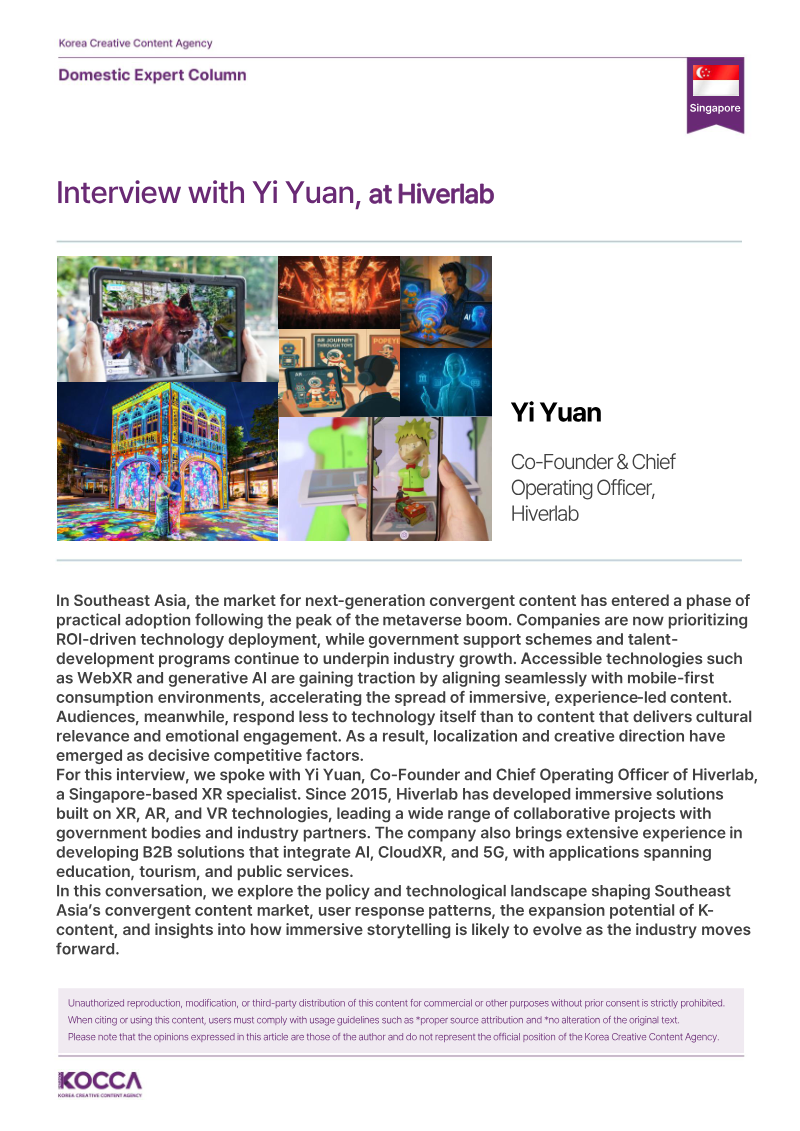
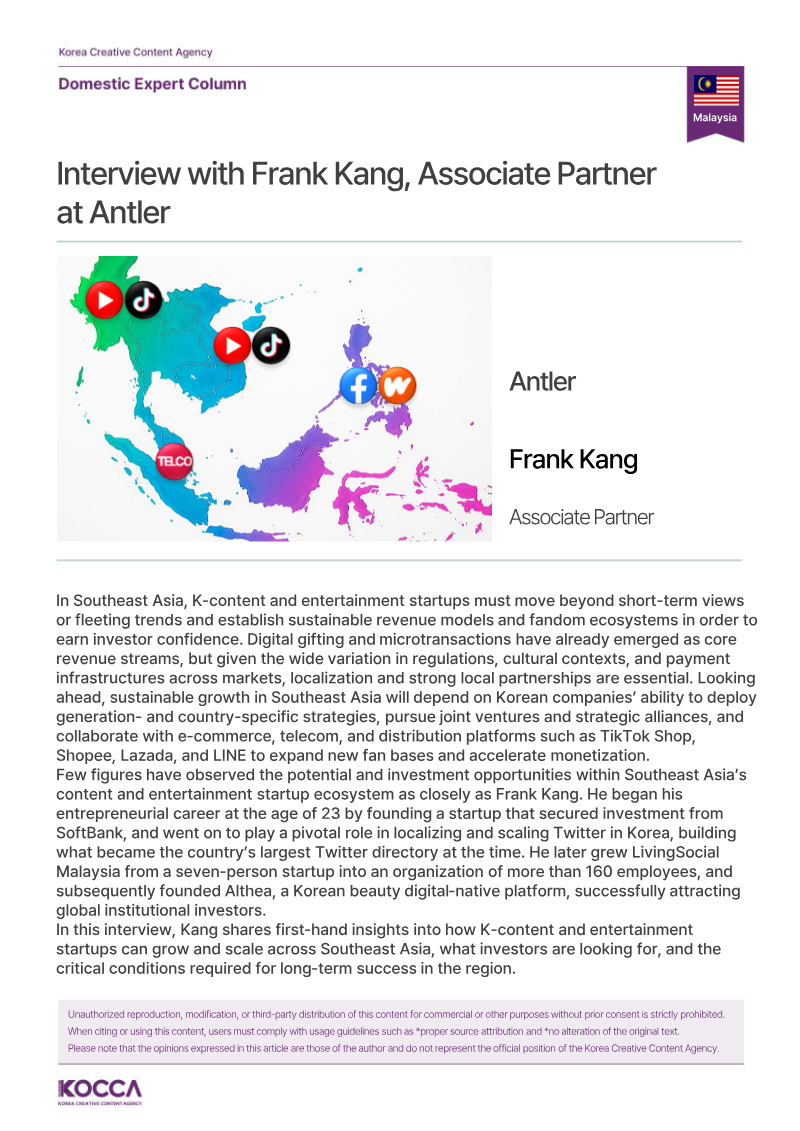
Korean content and entertainment startups are being urged to treat Southeast Asia as a primary growth engine rather than a peripheral market. Success hinges on deep localisation that goes beyond subtitles, requiring partnerships with local “co‑pilots” that can navigate fragmented linguistic, regulatory and payment landscapes in cities such as Jakarta, Manila and Bangkok. By embedding region‑specific monetisation schemes—micro‑transactions, live‑commerce, and hybrid free‑plus‑premium models—companies can align with the mobile‑wallet‑driven habits of Southeast Asian fans and convert grassroots enthusiasm into sustainable revenue streams. The region’s fandom operates as a decentralized, grassroots network where fans act as unpaid marketers, driving earnings through digital stickers, low‑priced concert tickets and other micro‑purchases that often outpace traditional subscription revenues seen in Korea or Japan. Promising niches include short‑form video, webtoons and IP‑centric ecosystems, mobile‑first games, and live‑commerce platforms, all of which benefit from early community testing and strong local alliances. Trust capital built by global Korean acts such as BTS and BLACKPINK demonstrates the willingness of Southeast Asian audiences to pay for authentic, culturally resonant experiences. Investors now demand proven revenue traction and genuine localisation before committing capital, and scalable startups are expected to adopt modular, locally adapted business models. Exits are likely to occur through mergers and acquisitions rather than public listings, underscoring the strategic importance of establishing a resilient foothold in Southeast Asia as a launchpad for broader global expansion.
The Korean emoticon market has evolved from a peripheral messaging feature into a multi‑billion‑won character‑IP industry, now valued at roughly KRW 1.5 trillion (≈US$1.2 trillion). This transformation is anchored by KakaoTalk, whose emoticon platform expanded from an initial KRW 100 billion base in the early 2010s to a dominant revenue stream that underpins a broader ecosystem of licensed characters and digital content. Over the past fourteen years, more than 850 000 distinct emoticons have been released, generating in excess of 300 billion individual sends, illustrating both high user engagement and the low‑sensitivity nature of the market’s cash flow. The core of this growth lies in the development of unique intellectual‑property (IP) assets such as KakaoFriends and LINE Friends. These brands have transcended simple sticker usage to become central brand assets that are licensed across a spectrum of media, including merchandise, mobile games, animation, and information‑communication‑technology services. By converting emoticons into high‑value IP, companies have created diversified revenue channels that extend well beyond the messaging platform itself. Export potential is accelerating, driven by corporate collaborations and strategic international expansion. Partnerships with established IP owners enable Korean firms to tap into global distribution networks, while the modular nature of emoticon‑based branding facilitates rapid adaptation to foreign markets. The overall trajectory suggests that the emoticon sector will continue to serve as a catalyst for the broader K‑character industry, reinforcing Korea’s position as a leading exporter of digital cultural content.
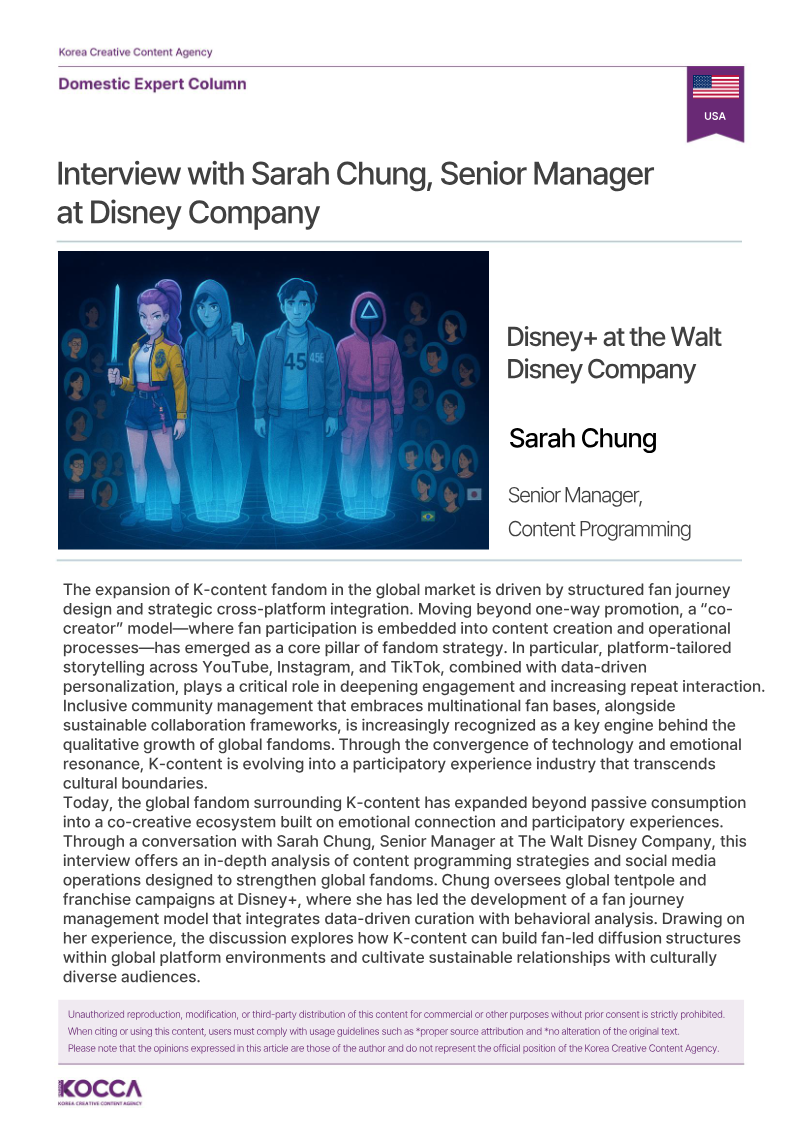
The interview underscores that the worldwide surge of Korean content is rooted in a “cocreator” fandom model, where streaming services offering seamless subtitle and dubbing options enable audiences to engage directly with material and co‑produce cultural moments. This participatory dynamic is amplified by nostalgia‑driven “comfort viewing” and the rapid diffusion of fan‑made short‑form clips on TikTok, which together reshape attention spans and create a feedback loop that fuels further consumption. A key finding is that Korean productions are breaking out of traditional genre boundaries, as illustrated by titles such as *The Glory*, *D.P.*, *Sweet Home* and *Gyeongseong Creature*. These series now contend not only with other OTT platforms but also with short‑form ecosystems like TikTok and YouTube, as well as user‑generated content. To secure global reach, Korean studios must prioritize distribution channels that combine extensive international footprints with aggressive off‑platform promotion, while exploiting AI‑driven recommendation engines to surface relevant titles amid an oversupply of options. Looking ahead to 2026, success will depend on a balanced strategy that merges technological adaptability, clear conceptual storytelling, and format experimentation. Integrating nostalgia‑centric comfort viewing with cross‑platform interactive campaigns will allow Korean creators to navigate a fragmented global content landscape and maintain competitive relevance across both long‑form and short‑form media environments.