Key insights
7 slides
Market size
The mobile gaming DTC market has reached $17 billion.
Publishers are shifting away from traditional app store ecosystems. This transition has established a $17 billion market.
Data ownership
DTC models allow publishers to secure first-party player data.
Publishers use this data to drive long-term retention.
Performance gap
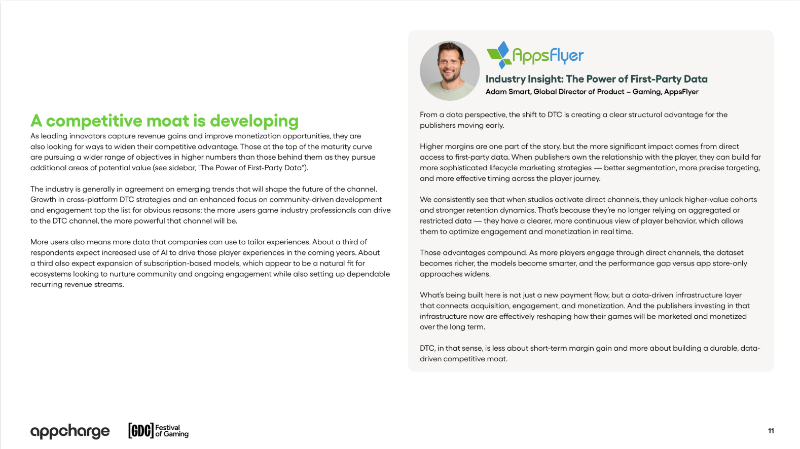
Early DTC adopters are outperforming competitors on revenue growth.
Early adopters demonstrate superior revenue growth. They also show improved engagement metrics.
Performance gap. Early adopters of DTC frameworks are currently outperforming competitors.
Hybrid approach
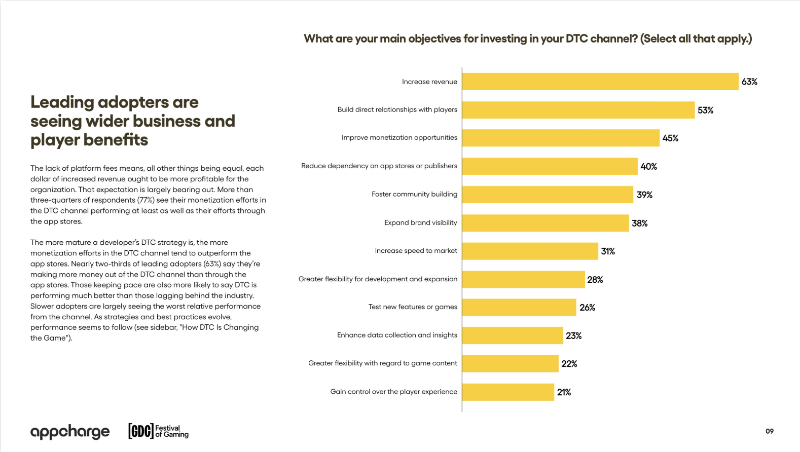
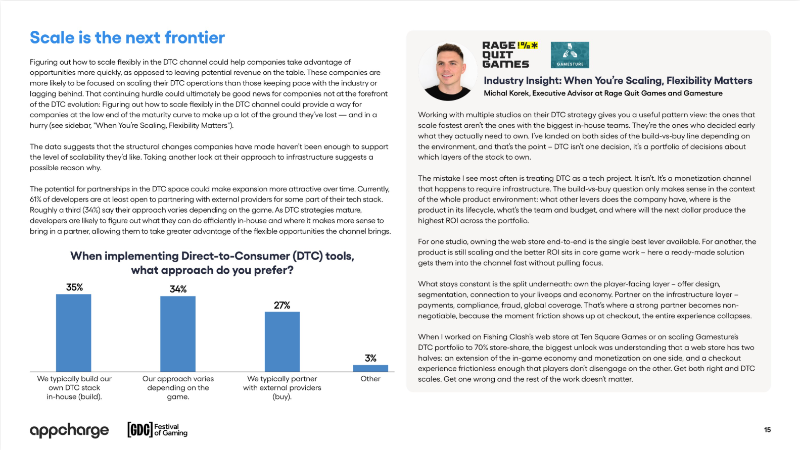
Developers are adopting hybrid models for DTC distribution.
These models combine internal player-facing strategies with external partnerships. Partnerships handle payment processing and regulatory compliance.
Page 12 of the report- 01Internal strategiesDevelopers use internal player-facing strategies.
- 02External partnershipsSpecialized partners handle payment processing.
- 03CompliancePartners manage regulatory compliance.
Scalability
DTC strategies are a scalable imperative for all developers.
DTC is no longer a large-enterprise luxury. It is now a scalable imperative for developers of all sizes.
Long-term outlook
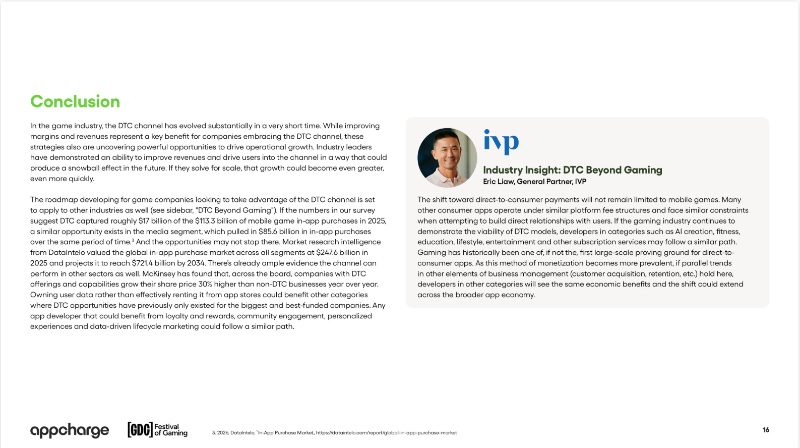
Global in-app purchase market is projected to reach $721.4 billion by 2034.
The broader digital economy is poised to mirror mobile gaming's success.
Strategic pivot
Publishers are pivoting to active, data-driven player relationships.
This is a shift from passive reliance on third-party storefronts. It fosters long-term retention and competitive differentiation.
1 / 7
Ask AI about this report