Updated Jun 10, 2026 by IIDEA – Italian Interactive Digital Entertainment Association
Report
Published by IIDEA – Italian Interactive Digital Entertainment Association
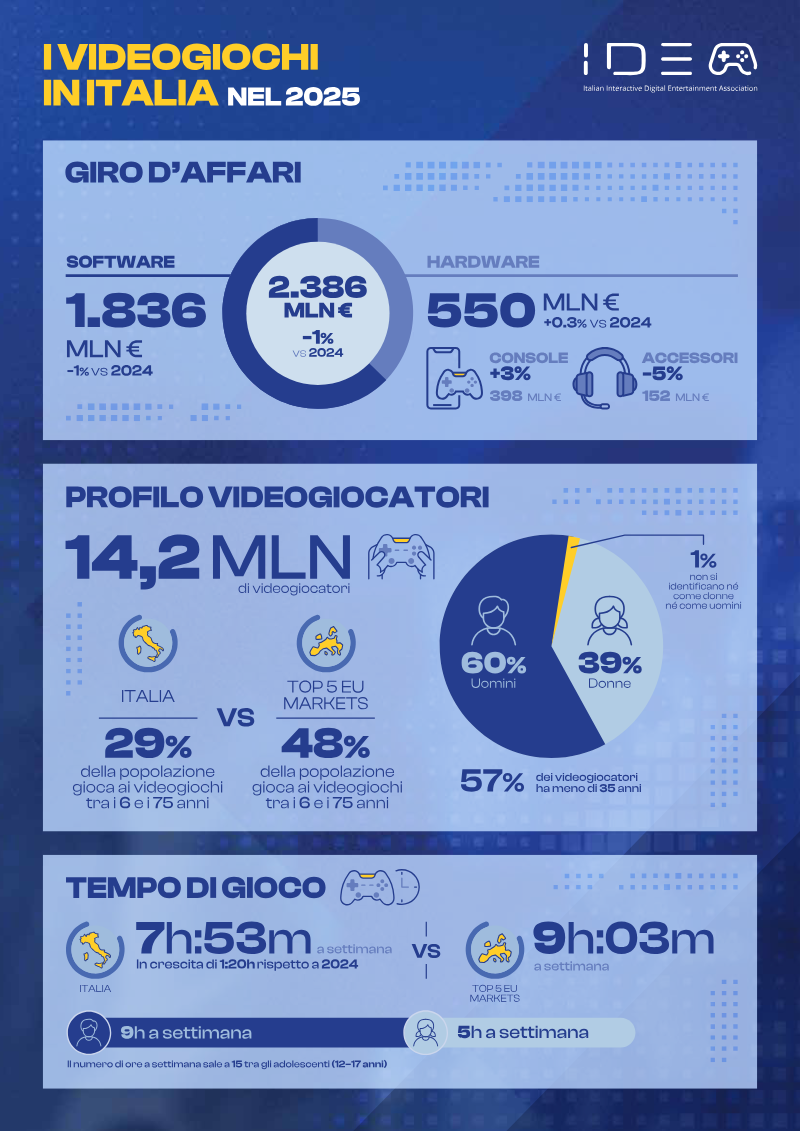
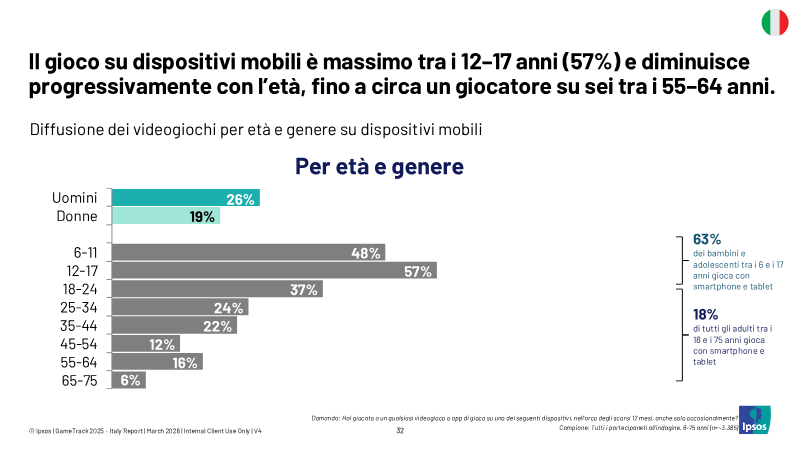
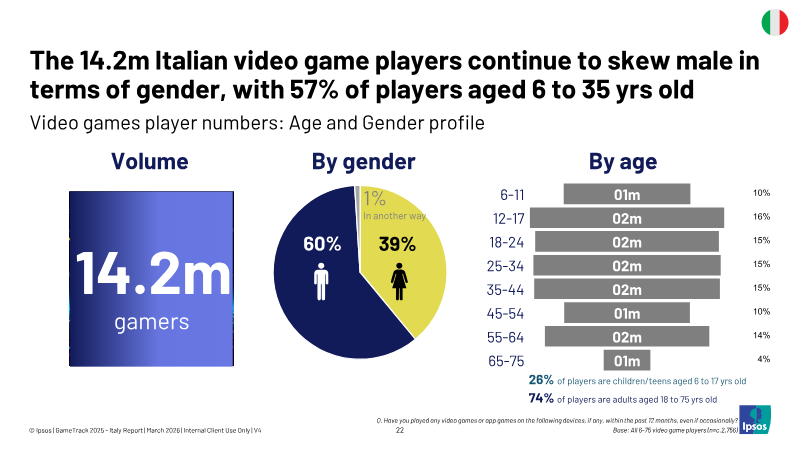
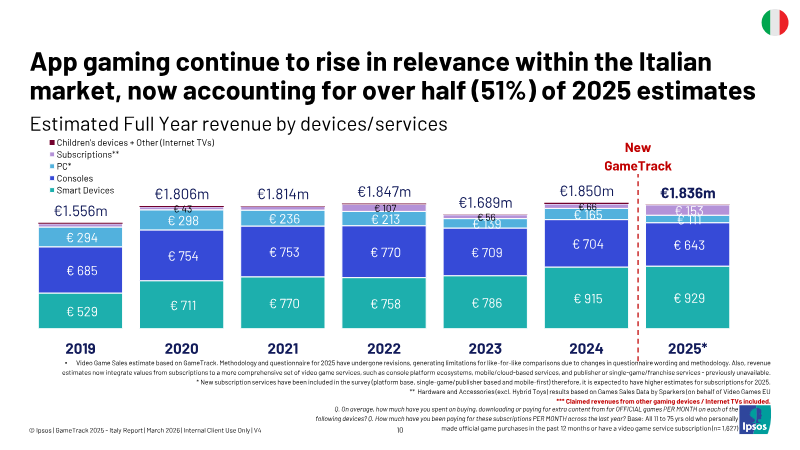
In 2025, roughly 14.2 million Italians—about a third of the population aged six to seventy‑five—engage in video gaming, with a pronounced male bias and a concentration of players under 35. The industry’s total revenue remains steady at €2.4 billion, of which game sales account for 77 percent (€1.8 bn). Gaming time has risen to nearly eight hours per week, driven primarily by smart‑device play (22 percent reach, €929 m revenue) and console gaming (13 percent reach, €643 m). App‑based games now represent more than half of the market, dominated by freemium monetisation; only one percent of app revenue comes from upfront purchases. Revenue distribution varies by platform. Smart‑device earnings are almost entirely from in‑app purchases (ARPU €84), while console sales lean heavily on digital downloads—65 percent of new game revenue comes from full‑game downloads (€502 m) and 21 percent from DLC (ARPU €99). PC revenue is largely driven by DLC (43 percent) and full‑game downloads (98 percent of console sales). Subscription services are pivotal: console ecosystem subscriptions contribute 59 percent of total gaming‑subscription revenue (€153 m), with mobile and single‑game franchises accounting for 6 percent and 35 percent respectively. Player demographics reveal that smart devices attract a younger, male‑skewed audience (31 percent of 6–17‑year-olds), whereas console and PC gaming remain niche but heavily male‑skewed, concentrated among teens. Casual and sports titles dominate sales across all platforms, with subscription services such as PlayStation Plus and Xbox Game Pass driving a significant share of paid play. Engagement patterns show males spending the most hours on consoles (average seven hours per week), while PC gaming remains steady across age groups. Approximately one‑quarter of players follow gaming news on YouTube or vlogs, and 20 percent rely on social media or family discussions for information. The data derive from a nationally representative online survey of 3,000 respondents, weighted against an offline omnibus sample and calibrated to industry sales figures.
DA Italian Interactive Digital Entertainment Association ESSENTIAL FACTS ABOUT VIDEO GAMES IN ITALY IN 2025 Italy Report Report | March | | --- | | March |2026 2026 | Internal | | --- | | Client |
GAMEIRACK Total understanding of the video VIDEOGAMESEUROPE game market $±€ VIDEO GAME PLAYERS ENGAGEMENT REVENUE (REACH & SIZE) (GAMING TIME) (VIDEO GAME SALES) ONLINE All devices All formats APPS PAID DOWNLOAD PACKAGED Consoles, PCs, Smart Devices, Physical, Online, Apps & PAID APPS IN-GAME CONTENT BRAND NEW Children devices & Internet TVs Subscriptions PAID EXTRAS (DLC/MICRO) SECOND HAND SUBSCRIPTIONS SOCIAL Broader demographic Larger geographic coverage (MOBILE) BROWSER SUBSCRIPTIONS (PLATFORM/GAME/PUBLISHER) 6-75 yrs old population 16 markets within Europe Online + Offline method 13 years of results c3,000 yearly online surveys + long lasting tracking study c1,000 F2F surveys every three years (Europe5) EXTERNAL DATA FROM VIDEO GAME SALES GameTrack 2025 methodology has undergone revisions, generating limitations for like-for-like comparisons due to GSD Sensor Tower changes in sample definitions, questionnaire and methodology. Revenue estimates now integrate a wider set of subscriptions to video game services.
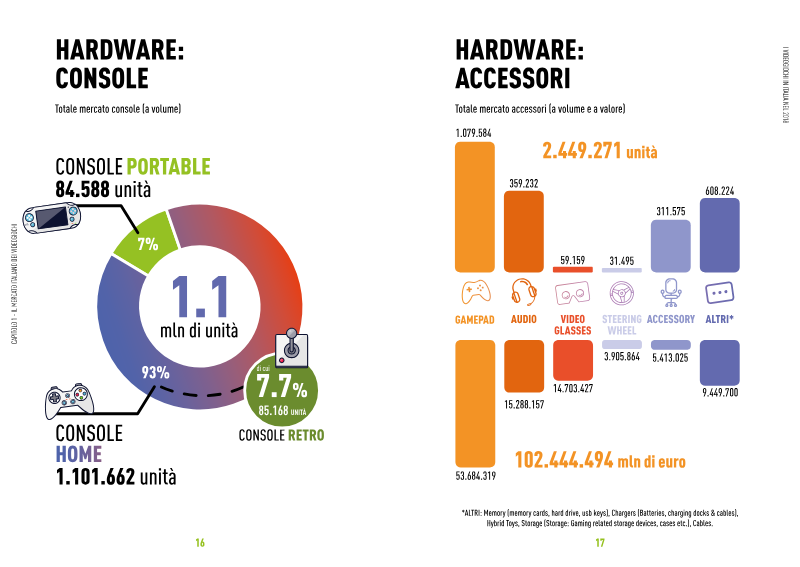
1 3 IN 10 (29%) OF ALL 6 TO 75 YRS OLD ITALIAN POPULATION PLAYED VIDEO GAMES DURING 2025 – VERY CONSISTENT VS 2024. There is an estimated 14.2m video game players at the end of 2025 in Italy (32% amongst 6 to 64 yrs old, consistent vs 33% 2024- Q4). Reach is far higher amongst males (35% vs 22% amongst women) and strong but concentrated amongst younger 6 to 24 yrs old (ranging from 52% to 62%). Consequently, Italian player profile is heavily skewed towards men (60% vs 39% women) and younger, with 3 in 5 being under 35s. 2 REVENUE FROM VIDEO GAME HARDWARE (INCL. ACCESSORIES) AND VIDEO GAME SALES (INCL. SECOND-HAND SALES) REACHED €2.4 BILLION BY 2025. THIS FIGURE INDICATES A RELATIVELY STABLE POSITION COMPARED TO 2024, WITH ONLY A MARGINAL YEAR-ON-YEAR DECREASE OF 1%. Hardware sales from consoles saw a YoY increase of 3%, reaching nearly €400 million in 2025, while accessory sales dropped by 5% compared to 2024, resulting in €152 million. Video game sales constituted more than three-quarters (77%) of the overall video game industry, generating a substantial €1,8bilion. 3 ON THE OTHER HAND, GAMING TIME HAS INCREASED OVER TIME WITH PLAYERS NOW INVESTING 7HRS 53MIN PER WEEK GAMING ACROSS DEVICES. DESPITE THIS HIGHER ENGAGEMENT, YEARLY ESTIMATES FROM VIDEO GAME SALES IS FAIRLY FLAT vs 2024 AT €1,837M. Video game player’s gaming time rise during 2025, now playing for nearly 8HR on average per week. Male players tend to engage more heavily than female players, dedicating more than 9HRS per week compared to over 5HRS for women.
ARLY ESTIMATES FROM VIDEO GAME SALES IS FAIRLY FLAT vs 2024 AT €1,837M. Video game player’s gaming time rise during 2025, now playing for nearly 8HR on average per week. Male players tend to engage more heavily than female players, dedicating more than 9HRS per week compared to over 5HRS for women. Gaming time peaks among teenagers aged 12 to 17 at 15HRS 31MIN but then declines abruptly to around 4-6HRS among adult players aged 18 to 75 yrs old. 4 THE MOST POPULAR GAMING DEVICES ARE SMART DEVICES, REACHING MORE THAN 1 IN 5 (22%) 6-75 YRS OLD POP – 11.1M PLAYERS. 8 in 10 (78%) Italian players game on smart devices with the consistently high device reach across ALL ages. Smart device players play for nearly 5HRS per week (stronger for men and younger 6-17s, and consistent for adults 18-75s). Estimated revenue from smart device now drives over half of total video game sales revenues, standing at €929M with freemium dictating YoY increased monetisation via in-app purchases. 5 CONSOLE GAMING REACH OVER 1 IN 10 (13%) OF 6-75 YRS OLD POP – 6.5M CONSOLE PLAYERS. Consoles are the most engaging video game devices played by nearly half (46% of players) who also invest nearly 6HRS per week on average on console games. Estimated 2025 video game sales revenue stands at €643M, with nearly two thirds (64%) being digital, via FGD and additional in-game content DLC directly to their console devices. New packaged console games still contributing with 27% of 2025 revenue. 6 LESS THAN 1 IN 10 (7%) OF 6-75 POP PLAY GAMES ON A COMPUTER/PC, REACHING 3.7M PC PLAYERS. PC gaming has become niche gaming devices, but with a strong hold within players dedicating 4HRS 27MIN per week to play PC games.
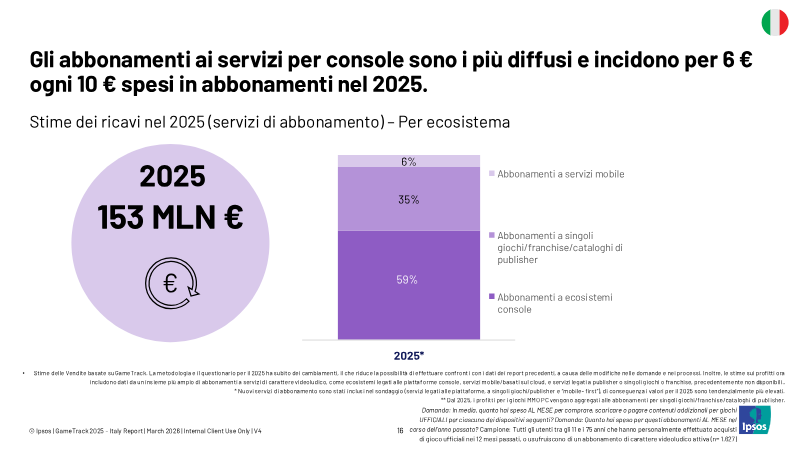
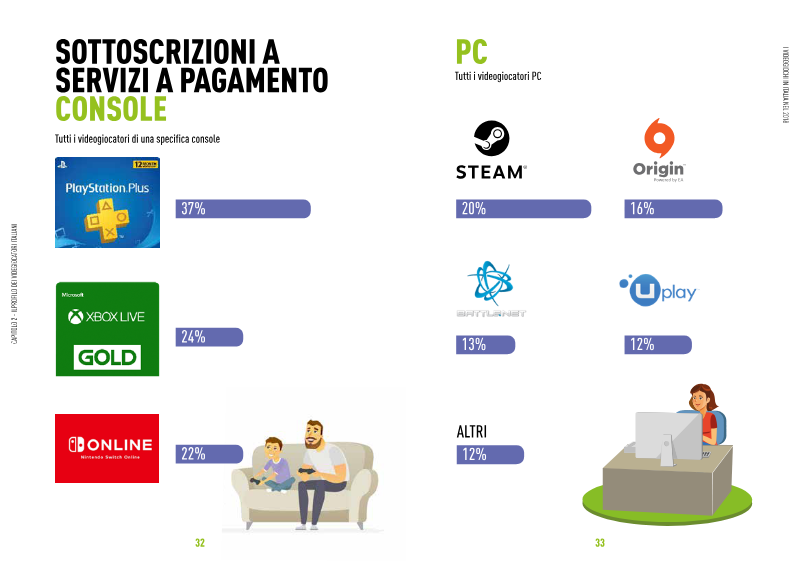
ices. New packaged console games still contributing with 27% of 2025 revenue. 6 LESS THAN 1 IN 10 (7%) OF 6-75 POP PLAY GAMES ON A COMPUTER/PC, REACHING 3.7M PC PLAYERS. PC gaming has become niche gaming devices, but with a strong hold within players dedicating 4HRS 27MIN per week to play PC games. Engagement is, again, stronger amongst males (stronger incidence and PC gaming time). Estimated PC revenue for 2025 is at €111M – fully digitalised with half of this revenue generated by additional in-game content DLC. 7 SUSCRIPTIONS TO VIDEO GAME SERVICES DRIVE AN ESTIMATED REVENUE OF €153M FOR 2025 – UPDATED DEFINITION ACROSS DEVICES. Most of these revenues (59%) are driven by console ecosystem subscriptions, offering access to multiplayer services and/or access to video game libraries. 35% of these revenues are also driven by subs to single-game/franchise/publisher catalogues (e.g. WoW, Fortnite Crew / GTA+, EA Play/Ubisoft+). Mobile subs services also contribute with a small proportion of this revenue at 6% (Google Play/Apple Arcade).
Overall, 2025 video game revenue from hardware (incl. accessories) and software (incl. second hand) is broadly stable YoY at €2.4bn Estimated Full Year Revenue – Video Game Industry (Hardware/Accessories**/Software) 2024 -1% F 2025* €2,407m €2,386m • Video Game Sales estimate based on GameTrack. Methodology and questionnaire for 2025 have undergone revisions, generating limitations for like-for-like comparisons due to changes in questionnaire wording and methodology. Also, revenue estimates now integrate values from subscriptions to a more comprehensive set of video game services, such as console platform ecosystems, mobile/cloud-based services, and publisher or single-game/franchise services - previously unavailable. * New subscription services have been included in the survey (platform base, single-game/publisher based and mobile-first) therefore, it is expected to have higher estimates for subscriptions for 2025. ** Hardware and Accessories (excl. Hybrid Toys) results based on Games Sales Data by Sparkers (on behalf of Video Games EU Q. On average, how much have you spent on buying, downloading or paying for *** Claimed revenues from other gaming devices / Internet TVs excluded. extra content from for OFFICIAL games PER MONTH on each of the following devices? Q. How much have you been paying for these subscriptions PER MONTH across the last year? Base: All 11 to 75 yrs old who personally
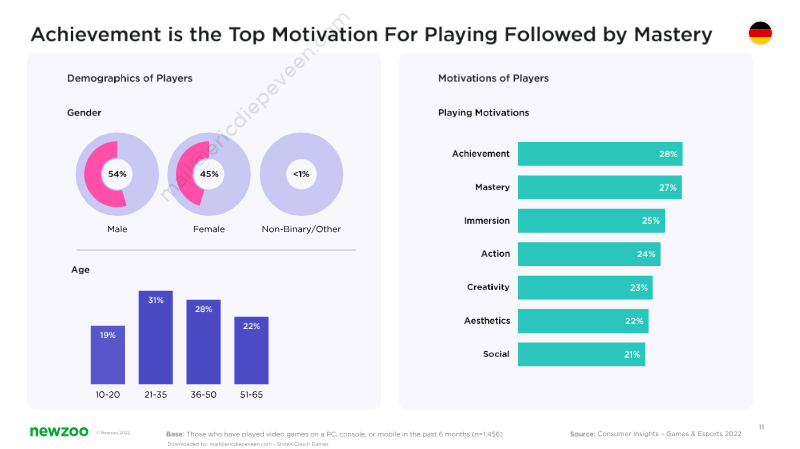
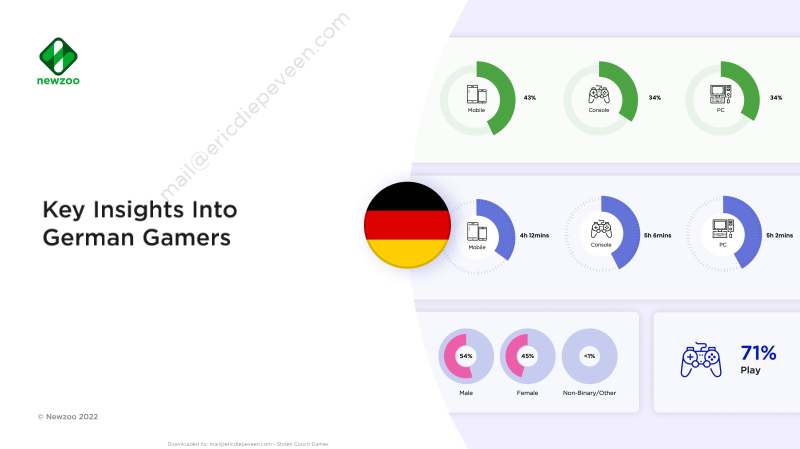
The Consumer Insights: Games and Esports 2022 report provides a comprehensive analysis of global gaming behaviors, motivations, and market engagement. The primary purpose of the research is to equip game developers, publishers, and industry stakeholders with actionable data to benchmark titles, understand player demographics, and identify growth opportunities across 36 diverse international markets. By examining over 100 key performance indicators, the analysis offers a granular view of how players interact with PC, console, and mobile platforms. The research is underpinned by a robust methodology, drawing on survey data from over 75,000 consumers worldwide. The findings highlight distinct engagement patterns, such as the prevalence of specific gaming personas—notably Time Fillers and Mainstream Gamers—and the interplay between playing and viewing habits. For instance, data from the German market indicates that while playing remains the dominant activity, a significant portion of the population also engages with gaming video content and esports. Furthermore, the report identifies key drivers for consumer spending, noting that price sensitivity, the desire for exclusive content, and social connectivity are primary motivators for financial investment in games. Covering a broad geographic scope that includes North America, Europe, Latin America, the Middle East, and the Asia-Pacific region, the report serves as a strategic tool for navigating the complex global gaming landscape. By synthesizing metrics such as monthly active users, daily active users, and lifetime player value, the analysis facilitates a deeper understanding of the motivations driving player behavior. Ultimately, the findings emphasize that a nuanced approach to audience segmentation and platform-specific engagement is essential for companies seeking to reach and retain diverse gaming populations in an increasingly competitive entertainment market.
1. Market trajectory What direction is the PC and console market heading in 2026? 8 What direction is the PC and console market heading in 2026? 2. Attention & value allocation Where do players spend time and money on PC and console? 17 3. Market concentration What happens if you are not a top-20 game? 45 4.
The global games market is entering a period of moderate maturation, with total revenue projected to reach $188.8 billion in 2025, a 3.4% increase over the previous year. The industry now serves 3.6 billion players, reflecting a 4.4% year-over-year expansion. While mobile gaming maintains its dominance, accounting for $103.0 billion or 55% of total revenue, console gaming is poised for the strongest growth at 5.5%, reaching $45.9 billion. PC gaming remains a stable pillar with $39.9 billion in revenue. Despite the growth in player counts, average spend per payer is experiencing a slight decline, signaling a strategic pivot toward maximizing engagement and retention within saturated markets rather than relying solely on aggressive monetization. Strategic success in this environment increasingly depends on long-tail engagement and the effective management of post-launch content. Data indicates that releasing single-player titles during the second quarter yields 34% higher engagement compared to the saturated holiday season. Furthermore, simultaneous multi-platform launches significantly outperform staggered releases, and titles exiting Early Access after a six-month window demonstrate superior acquisition results. Developers are also increasingly leveraging remakes and remasters to mitigate rising development costs, while user-generated content platforms like Roblox continue to expand as foundational ecosystems for daily active users. Geographically, the market continues to diversify, with Latin America emerging as a notable growth region projected to reach $8.3 billion, driven primarily by mobile adoption. The industry’s analytical framework, which focuses on consumer spending on software and services, highlights that player attrition typically stabilizes after 12 weeks. Consequently, long-term commercial viability is now inextricably linked to aligning content updates and discounting strategies with this post-launch retention curve, ensuring that community support remains as critical as initial sales performance.
The French video game market demonstrated significant resilience in 2025, generating €5.856 billion in total revenue, a 2.9% increase over the previous year. This performance marks the second-highest in the industry’s history, solidifying its position as a cornerstone of the national cultural economy. Growth was primarily fueled by a rebound in console hardware sales and a record-breaking 11% surge in the mobile sector, which reached €1.792 billion. The market maintains a balanced ecosystem, with consoles commanding a 44% share, followed by mobile at 31% and PC gaming at 26%. Software remains the primary revenue driver, accounting for over two-thirds of the total market. While physical game sales faced a double-digit decline, this was effectively mitigated by the expansion of digital content, including microtransactions and downloadable content. Electronic Arts emerged as the leading publisher across console and PC platforms, while the mobile landscape remains almost entirely dominated by free-to-play models, which now represent 94% of mobile revenue. The industry’s reach expanded to 40.2 million players, characterized by a maturing demographic where adults comprise 88% of the base. High engagement levels persist, with 76% of players gaming on a weekly basis and a growing trend toward cross-platform usage. Alongside this growth, there is a heightened emphasis on responsible gaming. Parental involvement has reached new heights, with 67% of parents actively monitoring gaming habits through PEGI classifications and standardized parental control tools. This commitment to safety, supported by organizations like the SELL and events such as Paris Games Week, ensures that the industry continues to thrive as a mature, socially responsible, and culturally significant sector within France.