Star Wars
Game
Documents about Star Wars
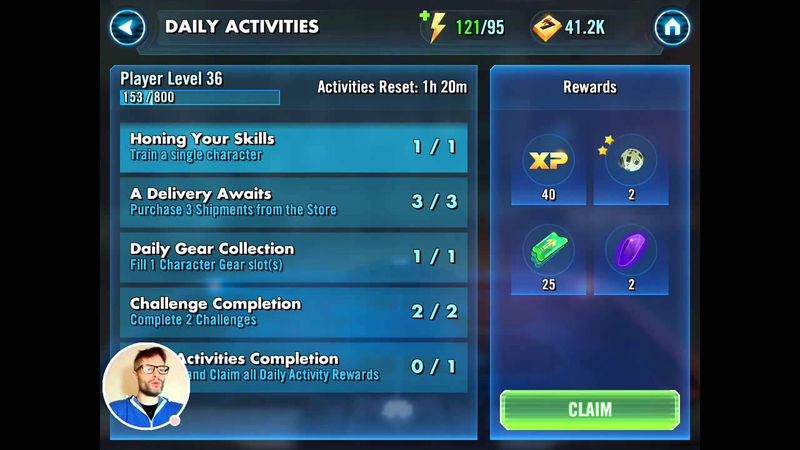
How Star Wars: Galaxy of Heroes' Daily Activities boosts retention
Daily activities serve as a foundational retention mechanism in free-to-play mobile RPGs, specifically within the context of Star Wars: Galaxy of Heroes.
- Daily activities in Star Wars: Galaxy of Heroes function as a foundational retention mechanism by establishing a structured, 24-hour recurring checklist that incentivizes consistent player engagement.
- The system utilizes a tiered reward structure—including experience points, soft currency, and premium gems—to create a feedback loop that encourages players to complete tasks even when they are not pursuing deeper progression.
- A final bonus awarded for completing the entire daily list acts as a psychological nudge, compelling players to return to the game to finalize their progress.
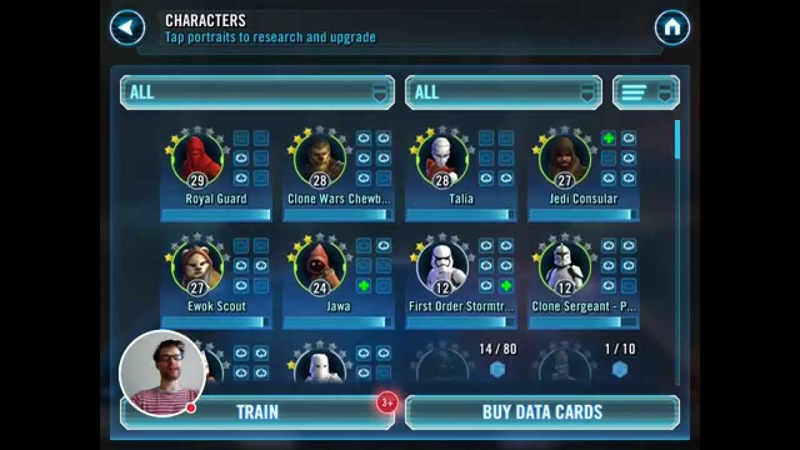
Star Wars: Galaxy of Heroes' character upgrade system
Star Wars: Galaxy of Heroes utilizes a multi-layered character progression system to drive player retention within the free-to-play mobile RPG market.
- Star Wars: Galaxy of Heroes utilizes a three-tiered progression system—gear upgrades, star-level promotions, and experience-based training—to drive long-term player retention.
- The gear upgrade system requires players to collect specific components from mission rewards to enhance base statistics and increase gear levels.
- Star-level promotions function as a primary long-term engagement goal, requiring players to accumulate character-specific shards and in-game credits to improve iconic units.
The 3 gameplay modes of Star Wars: Galaxy of Heroes
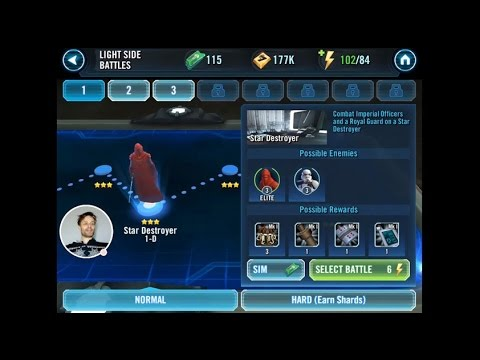
Star Wars: Galaxy of Heroes utilizes a three-tiered gameplay structure—manual, automatic, and simulated—to prioritize long-term character progression over individual mission engagement.
- Star Wars: Galaxy of Heroes prioritizes long-term character progression and resource management over tactical combat engagement.
- The game utilizes a three-tiered structure—manual, automatic, and simulated—to allow players to bypass repetitive combat and efficiently farm upgrade materials.
- The simulation mode is a critical retention mechanic that provides immediate access to rewards once a mission is cleared, supporting the game's grind-heavy progression loops.
Monetizer: Star Wars: Galaxy of Heroes
Star Wars: Galaxy of Heroes, developed by EA Mobile, utilizes a card-collection and squad-battling framework to engage a mass-market audience.
- Star Wars: Galaxy of Heroes prioritizes meta-game loops, such as resource management and character progression, over manual tactical combat to drive user retention.
- The game utilizes automated battle modes and simulation features to shift player focus toward optimizing rewards rather than active gameplay execution.
- Monetization is driven by free-to-play mechanics, including energy systems, soft and hard currencies, and randomized loot drops that allow players to bypass progression grinds.
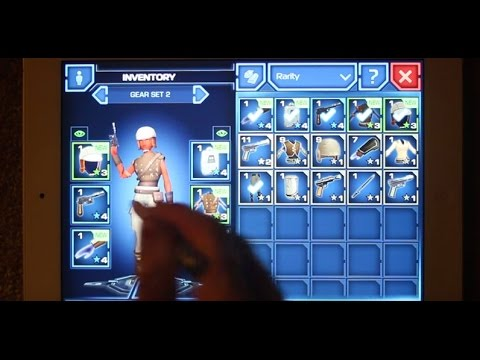
Monetizer: Star Wars: Uprising
Star Wars: Uprising, a mobile RPG developed by Kabam, utilizes a complex monetization strategy centered on character progression and gear acquisition.
- Star Wars: Uprising utilizes a dual-currency model featuring soft currency earned through gameplay and hard currency, known as chromium, available for purchase.
- The game employs a tiered in-app purchase structure that restricts access to higher-value spending options until after initial transactions are completed to prioritize player retention.
- The primary monetization driver is the Premium Crane, a gacha-style mechanic where players spend hard currency to acquire high-rarity gear and crafting materials.
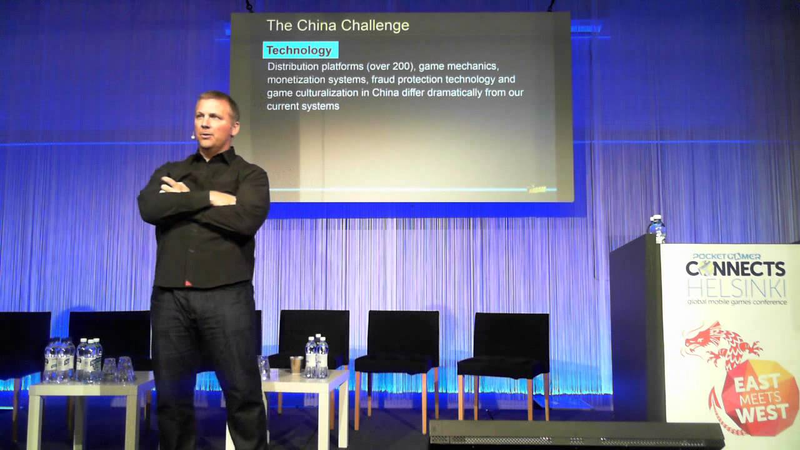
How Kabam is looking to crack China
Kabam’s strategy for navigating the global mobile gaming market centers on the necessity of "culturalization"—the deep adaptation of game systems to fit local preferences—rather than simple localization.
- Asian markets including China, Japan, and Korea now account for over 50% of global mobile gaming revenue, yet remain dominated by local developers due to high barriers to entry.
- Kabam’s strategy for market penetration relies on 'culturalization'—deeply adapting game systems like VIP features to local preferences—rather than simple translation.
- To succeed in China, Kabam leverages local partnerships for distribution and regulatory compliance while utilizing its Beijing studio to maintain internal control over code and IP.
Technobabble - Bad Writing Makes Bad Sci-Fi - Extra Credits
Effective science fiction writing requires a commitment to either rigorous internal logic or a clear embrace of fantasy, rather than the use of superficial jargon.
- Technobabble—the misuse of scientific terminology to mask narrative gaps—undermines audience immersion and violates fundamental design principles.
- Effective science fiction requires a commitment to either rigorous internal logic or a clear embrace of fantasy, rather than using superficial jargon to simulate credibility.
- Creators should either perform the necessary research to ground their universes in accurate scientific principles or abandon the pretense of realism to focus on the narrative freedom of fantasy.
Pacing - How Games Keep Things Exciting - Extra Credits
Effective game design relies on the strategic management of pacing, defined as the deliberate oscillation between periods of high intensity and necessary rest.
- Effective game pacing requires a rhythmic oscillation between high-intensity peaks and periods of rest to prevent player fatigue and sensory acclimation.
- Designers should avoid maintaining constant high excitement, as this leads to diminishing returns where intense moments lose their impact through routine.
- The pacing model functions as a fractal, requiring a consistent structure of build-up and resolution across the three layers of the arc, the scene, and the individual action.

Electronic Arts Inc. Q2 FY24 Results
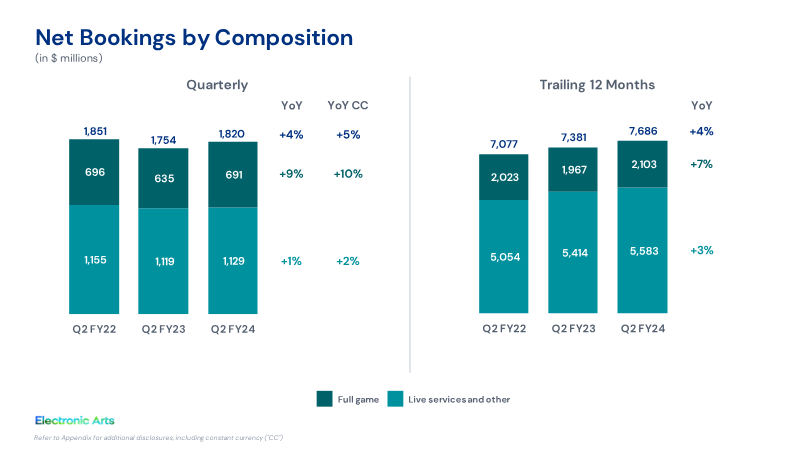
Electronic Arts’ second-quarter fiscal year 2024 results demonstrate steady financial growth, characterized by a 4% year-over-year increase in total net bookings, which reached $1.82 billion for the quarter.
- Electronic Arts reported $1.82 billion in total net bookings for Q2 FY24, a 4% year-over-year increase, with trailing twelve-month net bookings reaching $7.69 billion.
- Console platforms drove growth with a 12% year-over-year increase in quarterly net bookings, while PC and mobile segments declined by 10% and 6%, respectively.
- Live services and digital offerings remain the primary revenue engine, contributing $1.13 billion to the quarterly total.
Companies behind it

As the documents state it.