
Crusader Kings
GameBy Paradox Development Studio · Released Jul 15, 2004
Documents about Crusader Kings
Paradox Interactive Interim Report: January – March 2019
Paradox Interactive experienced a period of financial contraction during the first quarter of 2019, characterized by an 11 percent decline in revenue to SEK 238.3 million and a 55 percent reduction in operating profit to SEK 62.7 million compared to the same period in the previous year.
- Paradox Interactive reported a revenue decline of 11% to SEK 238.3 million and a 55% drop in operating profit to SEK 62.7 million for Q1 2019 compared to the same period in 2018.
- The financial downturn was driven by a lighter release schedule for major titles and a strategic shift toward record-high investments in marketing, organizational expansion, and game development.
- The company reached a milestone of over ten million registered users across its platform during the first quarter of 2019.
Year-End Report 2018
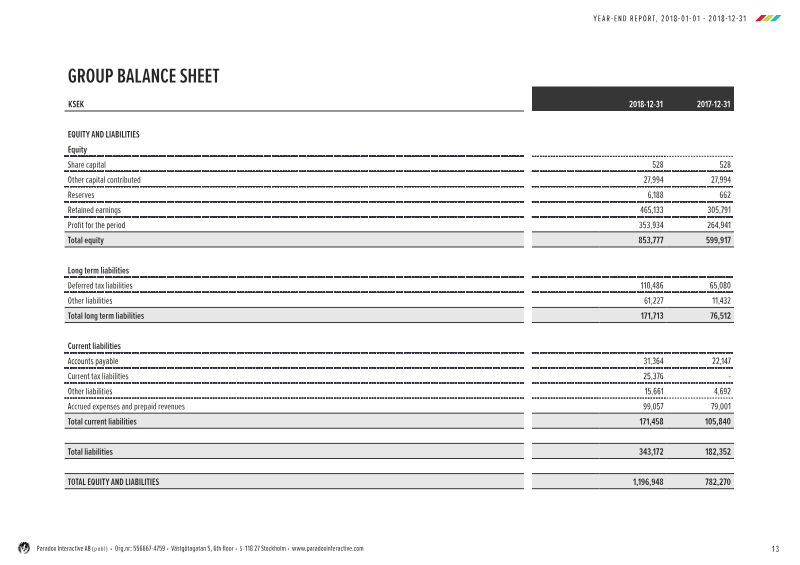
Paradox Interactive achieved significant financial growth throughout 2018, characterized by a 39 percent increase in annual revenue to SEK 1,127.7 million and a 34 percent rise in operating profit to SEK 455.1 million.
- Paradox Interactive achieved a 39% increase in annual revenue to SEK 1,127.7 million and a 34% rise in operating profit to SEK 455.1 million during 2018.
- The company’s business model relies on long-term lifecycle management and consistent content updates for established franchises rather than rapid release cycles.
- The firm recorded its most profitable quarter to date in Q4 2018, despite launching no new games during that period, proving the resilience of its back-catalog strategy.
Year-End Report 2017: Paradox Interactive
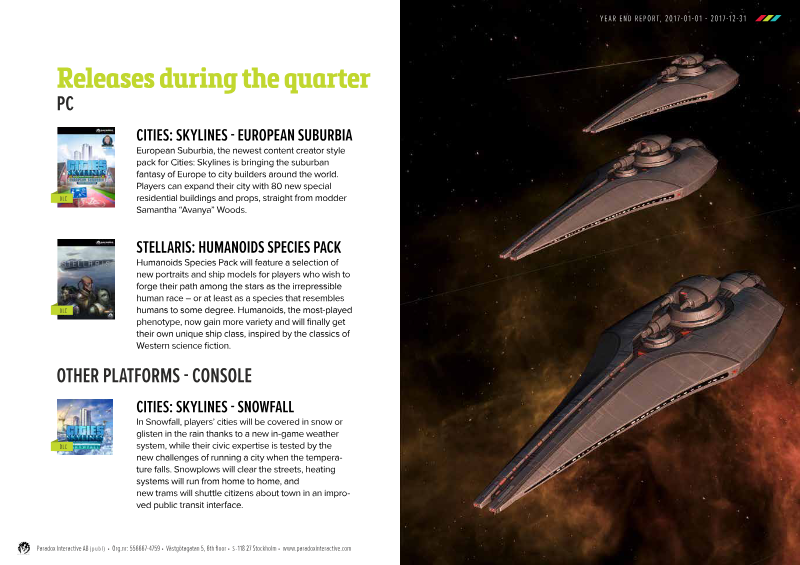
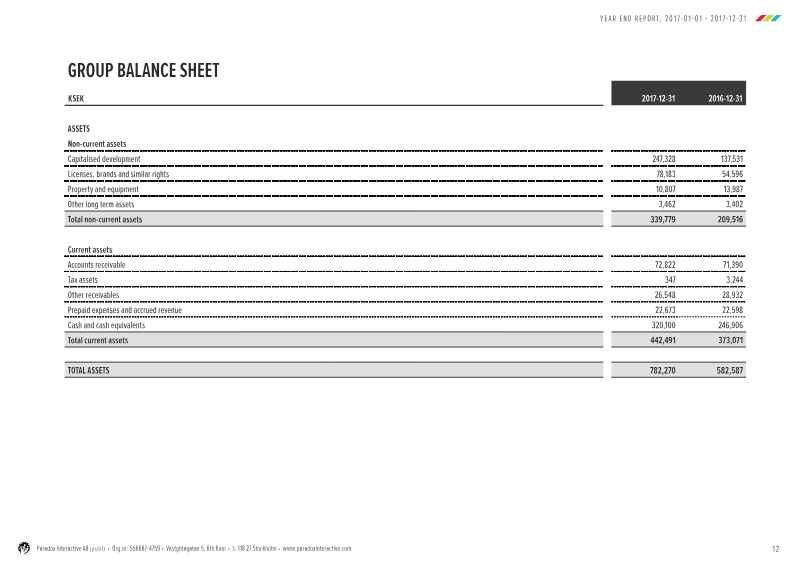
Paradox Interactive’s 2017 year-end report highlights a period of significant financial growth and organizational expansion.
- Paradox Interactive achieved annual revenues of SEK 813.8 million in 2017, a 24% increase over the previous year, with operating profit rising 10% to SEK 339.8 million.
- Financial growth was driven by the sustained performance of core titles, specifically Cities: Skylines, Stellaris, Europa Universalis IV, Hearts of Iron IV, and Crusader Kings II.
- The company expanded its development capabilities through the acquisition of Triumph Studios and a 33% stake in Hardsuit Labs.
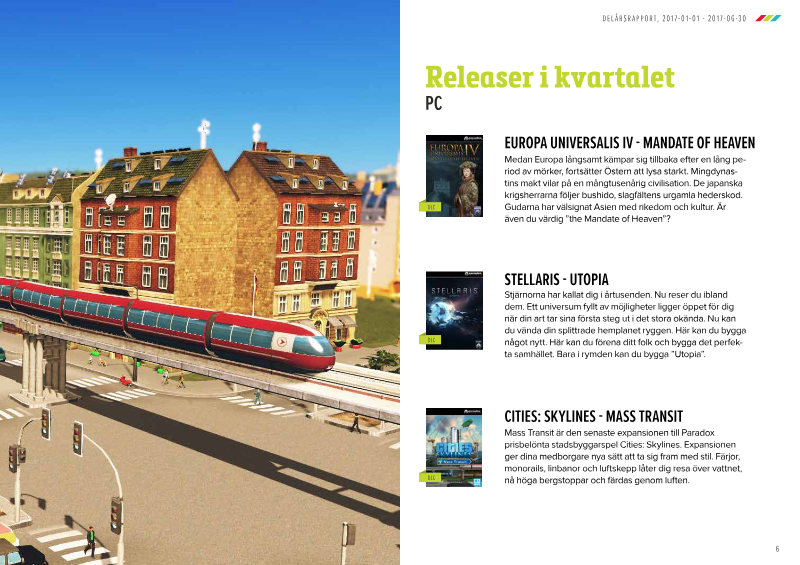

Paradox Interactive Interim Report: January – June 2017
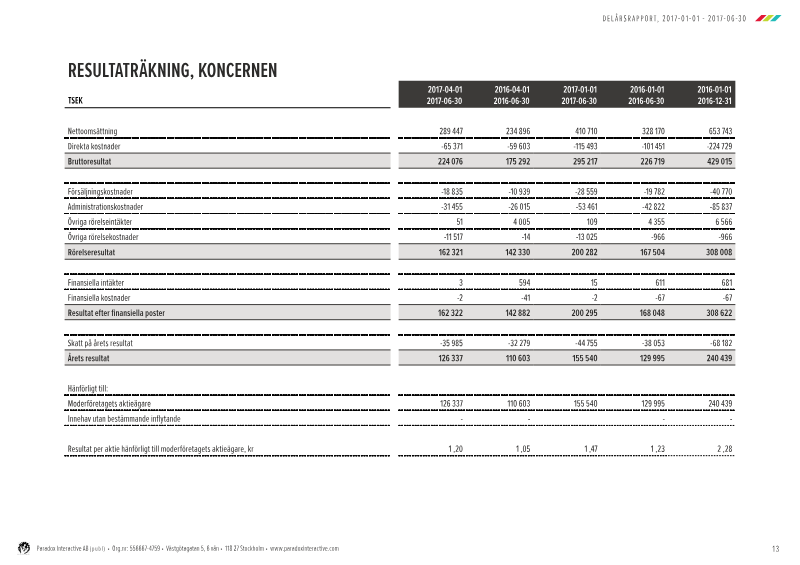
Paradox Interactive demonstrated robust financial growth during the first half of 2017, characterized by significant revenue increases and strong operating margins.
- Paradox Interactive reported a 25% revenue increase to 410.7 million SEK and a 20% operating profit rise to 200.3 million SEK for the first half of 2017 compared to the same period in 2016.
- The company maintains a strong financial position with 253.2 million SEK in cash and cash equivalents and a 75% equity ratio as of June 30, 2017.
- Growth is driven by a core portfolio of established titles including Stellaris, Cities: Skylines, Europa Universalis IV, Hearts of Iron IV, and Crusader Kings II.
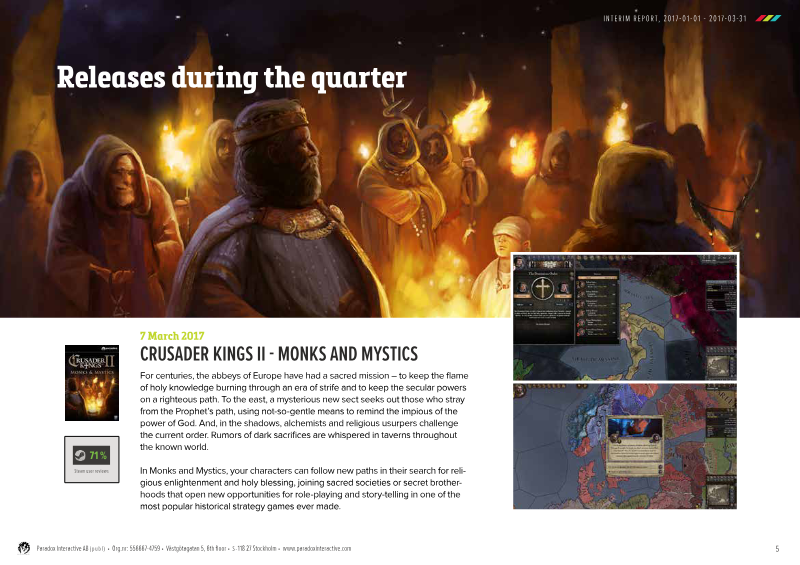
Paradox Interactive Interim Report: Q1 2017
The Paradox Interactive interim report for the first quarter of 2017 outlines the company’s financial performance and operational developments, highlighting a period of significant growth driven by its established portfolio of strategy games.
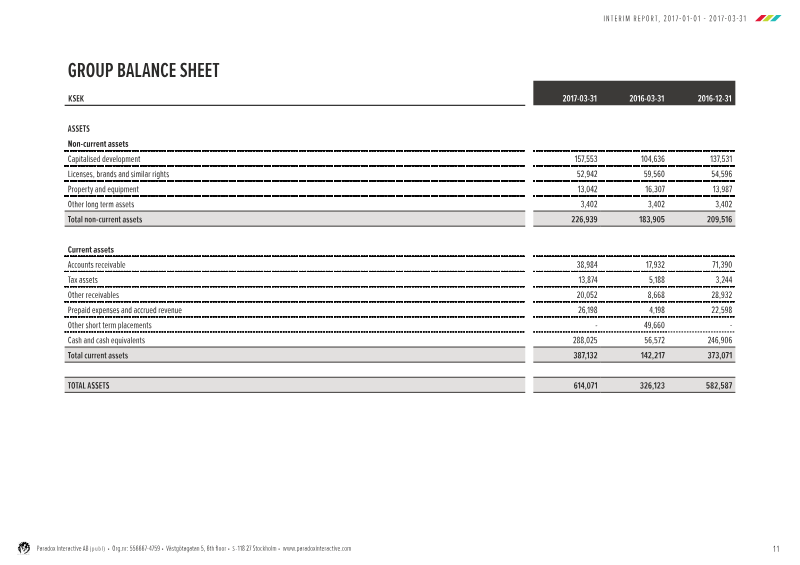
- Paradox Interactive reported Q1 2017 revenue of SEK 121.3 million, representing a 30% increase compared to the same period in 2016.
- Operating profit grew by 51% year-over-year to reach SEK 38.0 million, with a profit after tax of SEK 29.2 million.
- The company maintained a strong liquidity position with cash and short-term placements totaling SEK 288.0 million as of March 31, 2017.
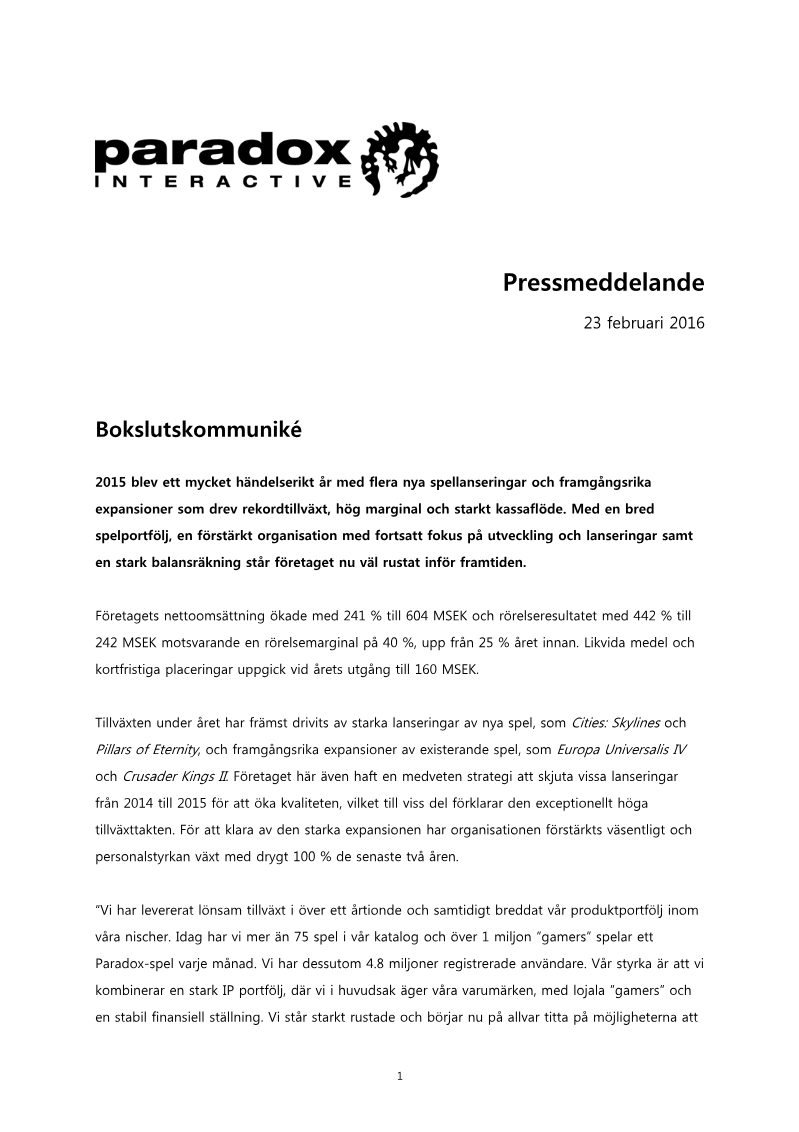
Paradox Interactive Year-End Report 2015
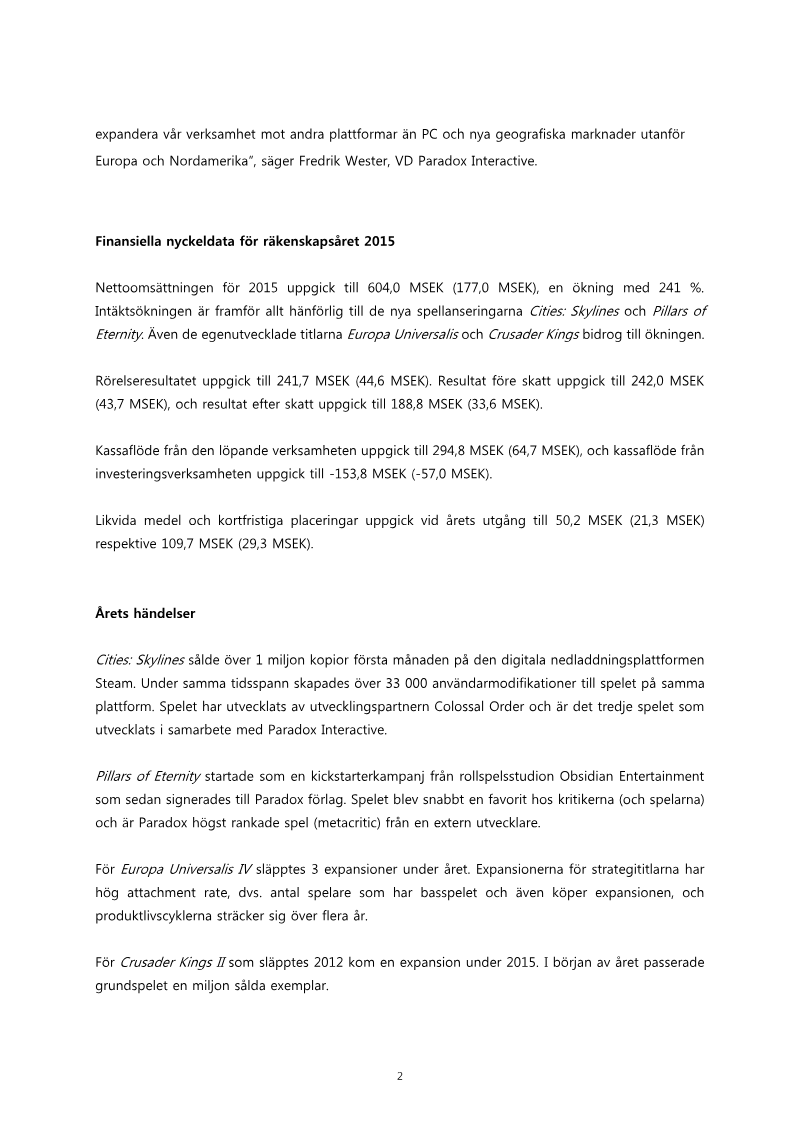
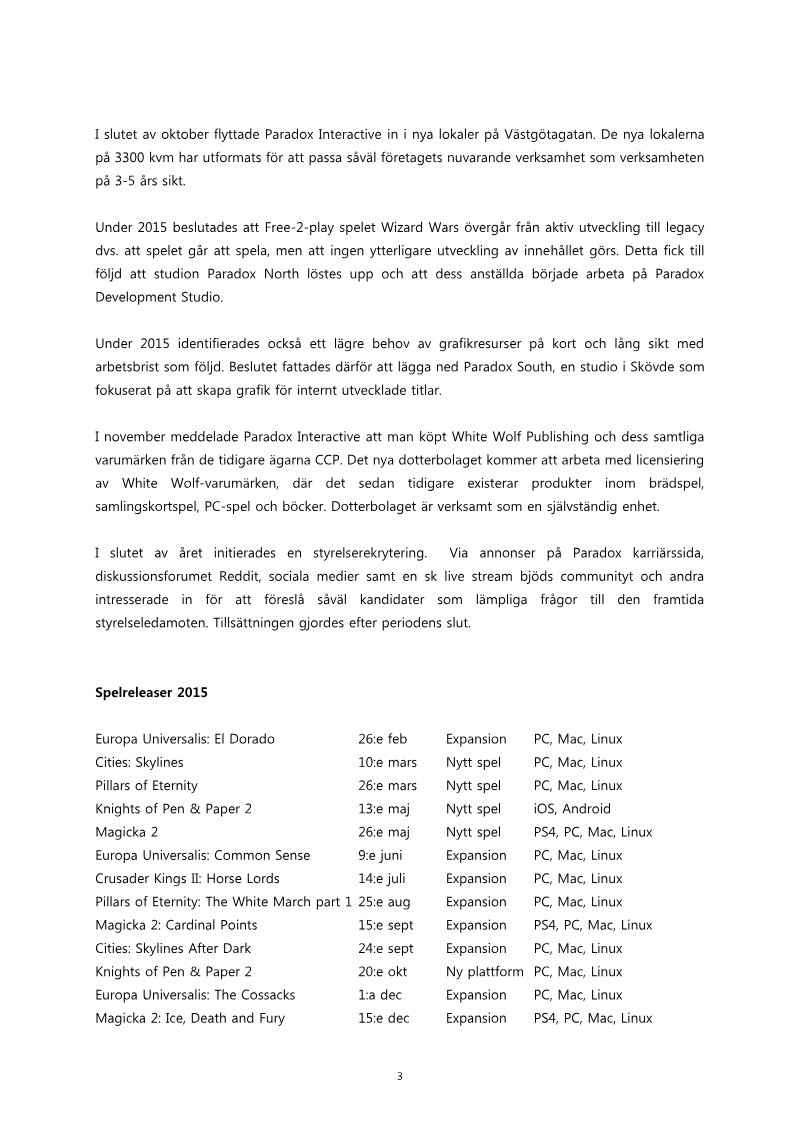
The 2015 year-end report for Paradox Interactive details a period of significant financial growth and organizational expansion, driven by a robust portfolio of new game releases and successful expansions.
- Paradox Interactive achieved significant financial growth in 2015, with net sales rising 241% to 604 million SEK and operating profit increasing 442% to 242 million SEK.
- The company’s operating margin improved to 40% in 2015, up from 25% in the previous year.
- Financial performance was driven by the successful launches of Cities: Skylines and Pillars of Eternity, alongside continued engagement with established titles like Europa Universalis IV and Crusader Kings II.
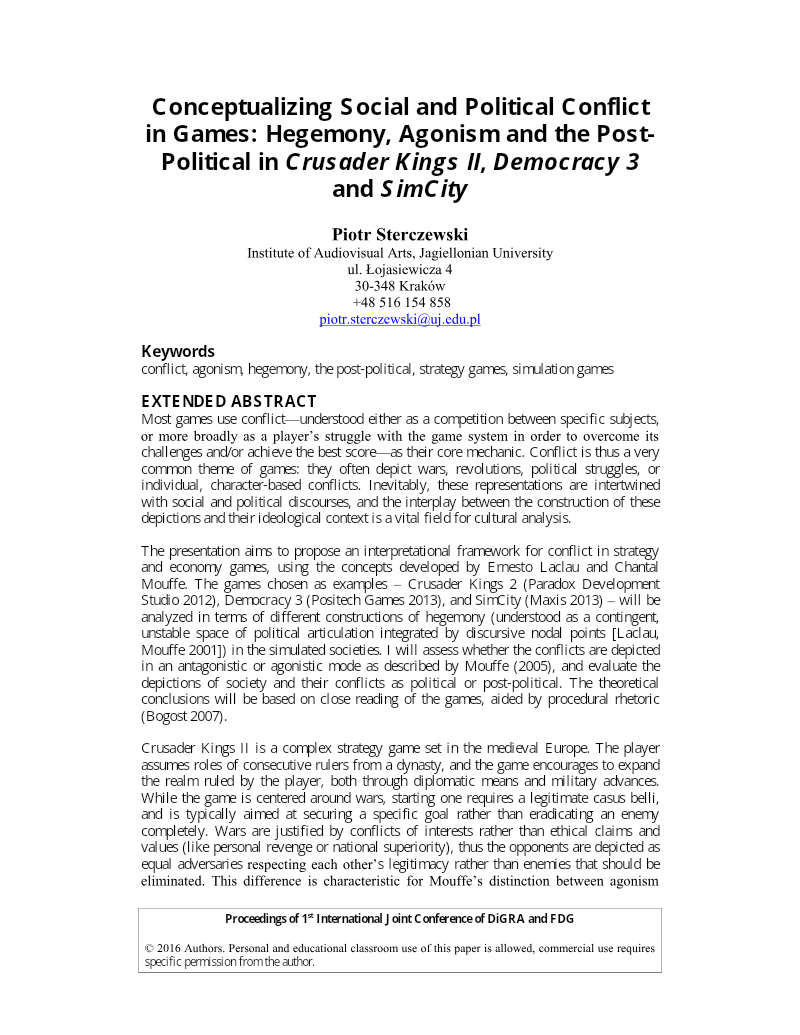
Conceptualizing Social and Political Conflict in Games: Hegemony, Agonism and the Post-Political in Crusader Kings II, Democracy 3 and SimCity
This paper proposes an interpretive framework for analyzing social and political conflict in strategy and simulation games, drawing on the theoretical vocabulary of Ernesto Laclau and Chantal Mouffe.
- The paper proposes using Laclau and Mouffe's vocabulary to analyze how games depict social and political conflict, arguing that each game's conflict modes reveal its underlying ideological assumptions.
- The key analytical distinction is between agonistic conflict, where opponents recognize each other's legitimacy and compete within a shared framework, and antagonistic conflict, which divides society into friend and enemy.
- Crusader Kings II is read as largely agonistic because wars require a legitimate casus belli and a shared feudal order, while religious wars and non-Christian rulers in expansion content push it toward antagonism.
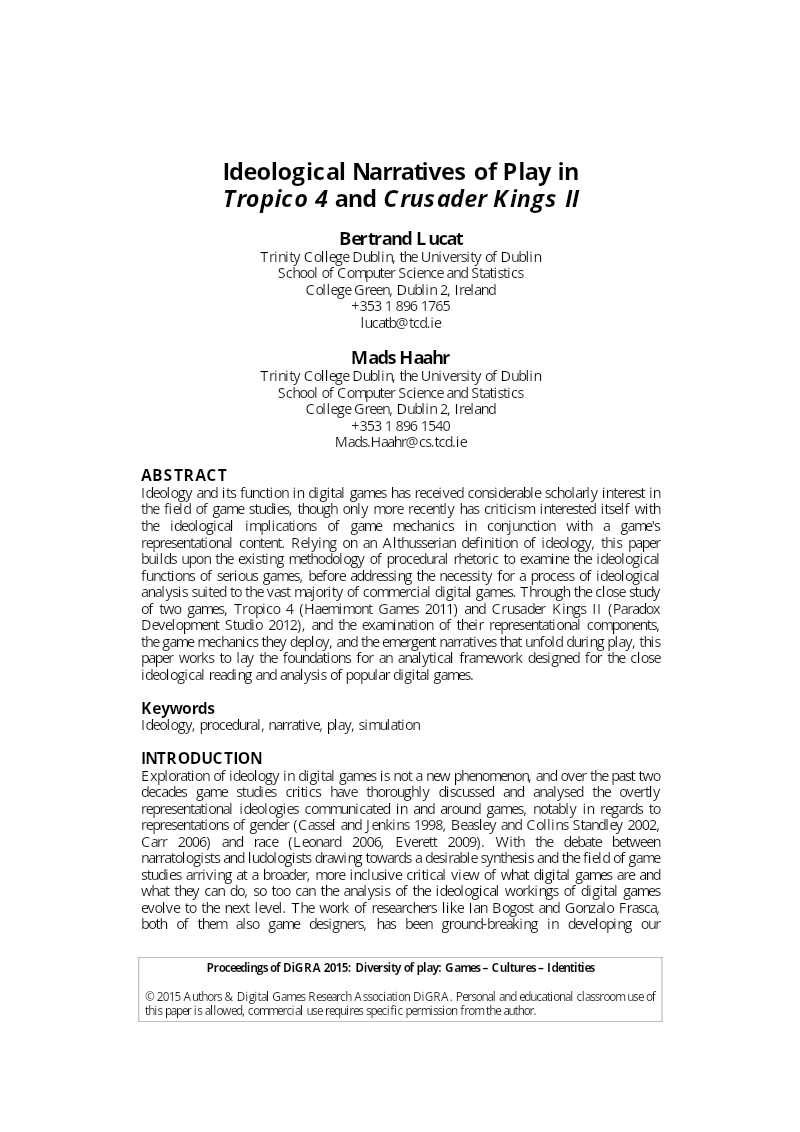
Ideological Narratives of Play in Tropico 4 and Crusader Kings II
Commercial digital games that lack explicit ideological agendas nonetheless embed ideology through their mechanics, and this study examines how such "ideological narratives of play" emerge.
- Games without explicit ideological agendas still embed ideology through their procedural mechanics, and this meaning emerges through play rather than explicit messaging, drawing on Althusserian theory and Bogost and Frasca's concept of procedural rhetoric.
- Procedural mechanics give games a dual capacity: they can reinforce dominant ideologies or open space for critique, depending on which choices the systems reward.
- In Tropico 4 (Haemimont Games, 2011), rewarding popular satisfaction, supported by a dehumanized satirical population, steers players toward a satisfied, socialist-leaning society that makes utopian alternatives appear achievable.
Religion in Games - I: Mechanics, Lore, and Heart - Extra Credits
The integration of religion into video games is a multifaceted endeavor that is best understood by categorizing its application into three distinct levels: lore, mechanics, and faith.
- Religion in video games is effectively categorized into three distinct levels: lore, mechanics, and faith.
- Games like Crusader Kings II and Civilization V successfully model religion as a functional force that shapes geopolitical conflict, societal development, and cultural worldviews.
- Titles such as The Witcher and Dragon Age utilize religious frameworks to influence individual moral choices, highlighting the tension between selfless altruism and institutional corruption.

Games You Might Not Have Tried - ep 4 - Find New Games - Extra Credits
This analysis highlights a curated selection of video games that offer unique, novel, or under-the-radar experiences for players.
- Crusader Kings II differentiates itself in the grand strategy genre by prioritizing complex interpersonal dynamics, familial rivalries, and dynasty management over traditional territorial conquest.
- Artemis Spaceship Bridge Simulator innovates by utilizing a LAN-based cooperative structure where players perform specific bridge officer roles, emphasizing communication over standard controller-based gameplay.
- Avernum: Escape from the Pit demonstrates the successful adaptation of tactical RPGs to mobile platforms, proving that touch interfaces can effectively enhance complex, turn-based mechanics.
Companies behind it
As the documents state it.