
Crusader Kings
GameBy Paradox Development Studio · Released Jul 15, 2004
Documents about Crusader Kings
Whitepaper2 pages
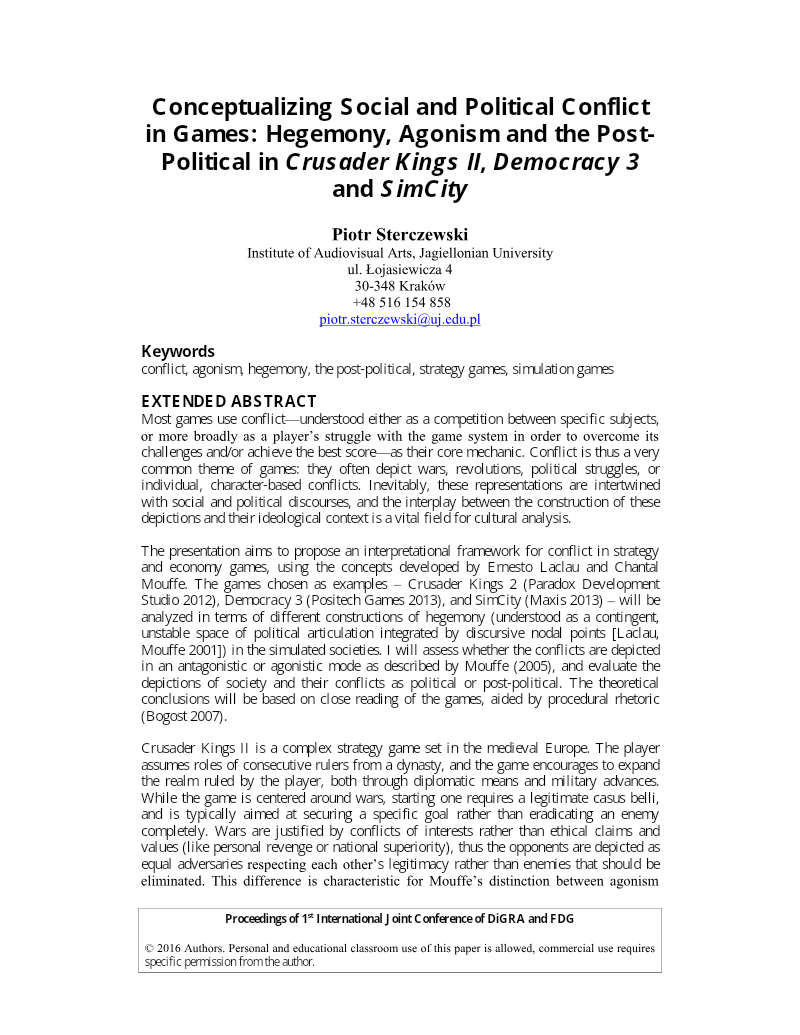
Conceptualizing Social and Political Conflict in Games: Hegemony, Agonism and the Post-Political in Crusader Kings II, Democracy 3 and SimCity
This paper proposes an interpretive framework for analyzing social and political conflict in strategy and simulation games, drawing on the theoretical vocabulary of Ernesto Laclau and Chantal Mouffe.
- The paper proposes using Laclau and Mouffe's vocabulary to analyze how games depict social and political conflict, arguing that each game's conflict modes reveal its underlying ideological assumptions.
- The key analytical distinction is between agonistic conflict, where opponents recognize each other's legitimacy and compete within a shared framework, and antagonistic conflict, which divides society into friend and enemy.
- Crusader Kings II is read as largely agonistic because wars require a legitimate casus belli and a shared feudal order, while religious wars and non-Christian rulers in expansion content push it toward antagonism.
DiGRAJan 2016
Companies behind it
As the documents state it.