Digital Games
Company
Documents about Digital Games
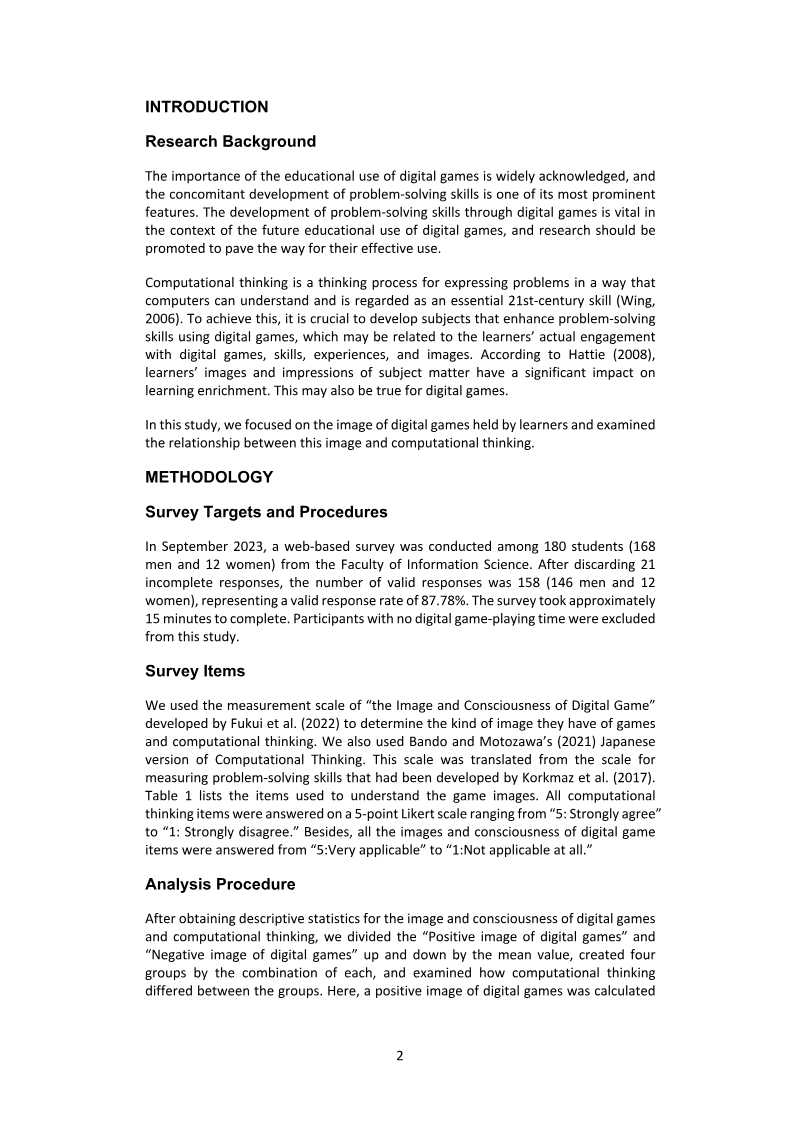
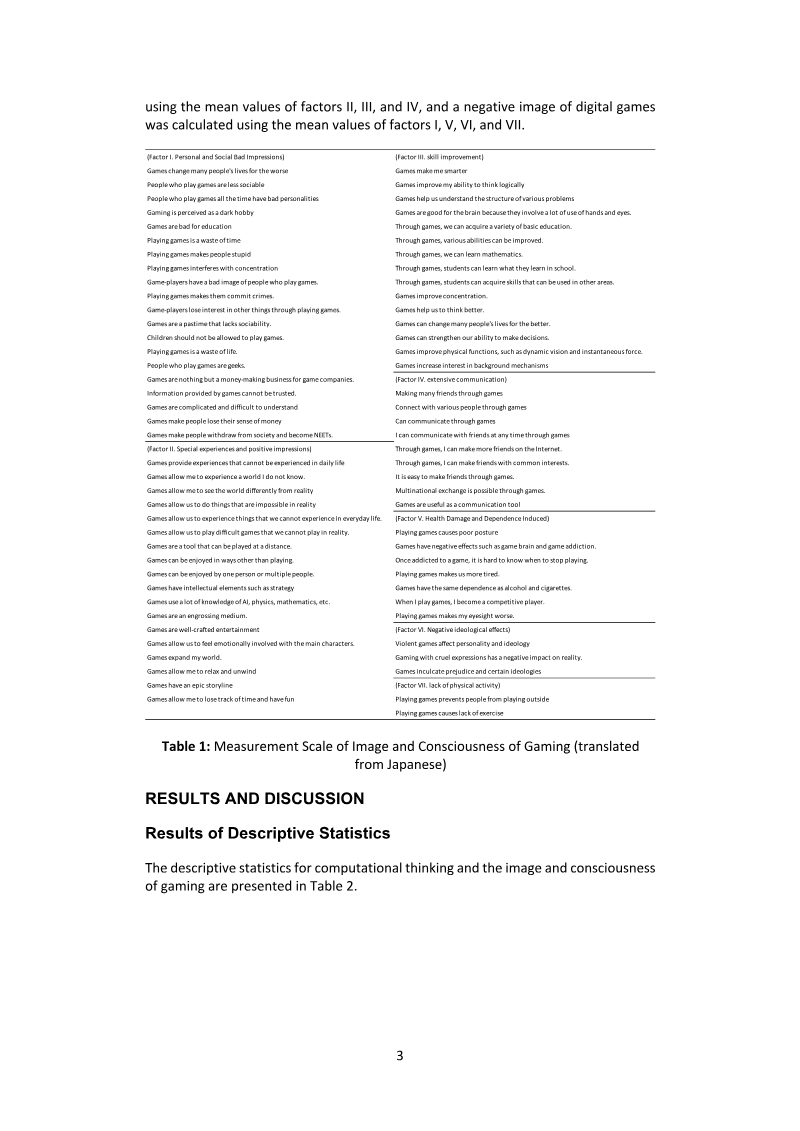
Differential Impact of the Positive and Negative Image of Digital Games on University Students' Computational Thinking
This study investigates the relationship between university students' perceptions of digital games and their computational thinking skills.
- Students in this Japanese university survey (158 valid responses, 146 men and 12 women) held relatively favorable views of digital games, scoring highest on special experiences and positive impressions (4.52) and lowest on personal and social bad impressions (2.42).
- Students who were split into four groups by positive and negative image scores differed significantly in creativity (F = 8.61, p < .01), with those holding both strong positive and negative images scoring higher than others.
- Those with stronger positive game images scored higher on creativity than those with weaker positive images, showing a link between favorable perceptions and creative computational thinking.
Zinecraft: Zines as Companions to Games Research
This paper, by Hailey J. Austin and Mirjam P. Eladhari, was published in the Transactions of the Digital Games Research Association (August 22, 2024, Vol. 7 No 1, pp. 185-224).
- Austin reported three key findings from creating her travelogue zine: self-reflection on her research, tactile and visual condensing of larger concepts, and a personal touch that made the research more relatable.
- The authors' workshop at Nordic DiGRA 2023 had 12 participants, excluding facilitators, who each made a zine about their conference experience.
- The authors argue that analyzing zines in a manner similar to scientific publications would be problematic because zines do not have keywords and would as a corpus be a plethora of anecdotes and outliers.
Seyyed of Cyrus the Great: Iran's Confused Nationalism in Games
This paper by Kamiab Ghorbanpour and Patrick Prax, published in the Transactions of the Digital Games Research Association (Vol. 7 No 1, 2024), examines Iranian video games.
- The authors describe a dichotomy in Iranian game development between independent games and government-affiliated propaganda games, which they say has existed since the mid-1990s and was in full effect until 2011.
- The authors state that the government-made games were defined by Tasnim News Agency as 'Games to combat the Western influence with the right politics'.
- In a survey of 48 Iranian gamers, 37% of those aware of the modern titles had a positive view of them, while 50% had a negative view.
Creative-Rational Tensions in Game Development: A Danish Case Study on Team Collaboration
This paper by Mark Staun Poulsen and Hanna Wirman, published in the Transactions of the Digital Games Research Association (2024), reports an ethnographic case study of a single 8-person development team at Triband, an established indie studio in Copenhagen, Denmark.
- The team's Sprint Reviews used a scripted voting format that operationalised 'proven' as the criterion for judgment, and deliberately steered away from concrete feedback for improving designs.
- The authors argue that Sprint Retrospectives operate on a meta-level with a pre-emptive function, while Sprint Reviews balance framing the conversation with reducing workload.
- The project lead moderated the Sprint Review to focus members' attention, and the authors describe it as a framework for refining the conversation from preference to viability.
Embracing Global and Local: How Game Industry Expatriates Work Between Global and Local Game Development Practices
This paper, by Solip Park and published in the Transactions of the Digital Games Research Association (2024), examines immigrant or expatriate game developers, called "game expats," in Finland.
- Game expats generally described their day-to-day work as similar after migration because it relies heavily on globally shared tools and platforms. Compatibility with these tools positively affected their migration intentions in the short term.
- Participants described niche tools or unconventional skill sets as a risk, and one participant said he would rather migrate again when his contract expired.
- Participants reported that terminology and work practices varied between countries and companies, and they often had to adjust on their own. One participant said nobody explains what terms mean.

Putting the Cybermedia Model Into Educational Practice: Expanding the Framework
The paper is published in Transactions of the Digital Games Research Association, August 22, 2024, Vol. 7 No 1, pp. 21-48.
- The authors expand the original four-dimension cybermedia model with institutional frames as an additional fifth dimension and introduce interferences as a sixth dimension to highlight interactions between dimensions.
- The authors argue that teaching with games and teaching about games are distinct uses, and that a title judged unsuitable as a teaching tool can still be productively taught about.
- The authors expand the materiality dimension to include political economy, labor relations, environmental sustainability and planned obsolescence, and state that the cybermedia model has not sufficiently accounted for such factors at the level of political economy and ecology.
The Game Weavers: A Feminist Approach to Game Writing
Louise Persson and Rebecca Rouse, faculty in the Game Writing undergraduate program at the University of Skövde, propose the "weaving way of thinking" as a lens for game writing, with game story as a tapestry.
- The authors state that many commonly used game writing textbooks emphasize the Hero's Journey as necessary for success, and they argue that when this structure alone dominates storytelling, stories of the everyday, the collective, and the more subtle or nuanced sources of wonder are left out.
- The paper proposes the weaving way of thinking as an alternative to design thinking, which the authors describe as operating from solutionism and hierarchy.
- The Game Writing program at the University of Skövde was established in 2012, and its first major revision in 2020 broadened the definitions of game narrative and storytelling and changed the way the game writer role is viewed.

Gamemasters of the Playground: Exploring Children's Leadership Roles when Programming Hybrid Digital-Physical Outdoor Playground Equipment
The paper by Andreas Bergqvist and Jon Back, published in Transactions of the Digital Games Research Association (July 29, 2024, Vol.
- An implicit social role, termed the 'gamemaster', emerged in a participant in each of the five groups, centred on use of the programming device.
- The gamemaster role was about helping and coordinating as well as directing, and the role extended beyond the group in follow-up interviews.
- In four of the five groups, the first participant to pick up and successfully use the prototype went on to act as gamemaster.
Endure, Join Them, or Leave? Suffering Women in Mobile Game Advertising
Kati Alha's study, published in the Transactions of the Digital Games Research Association (2024), examines advertisements for two free-to-play mobile games aimed at women, Project Makeover and Matchington Mansion, both developed by Magic Tavern.
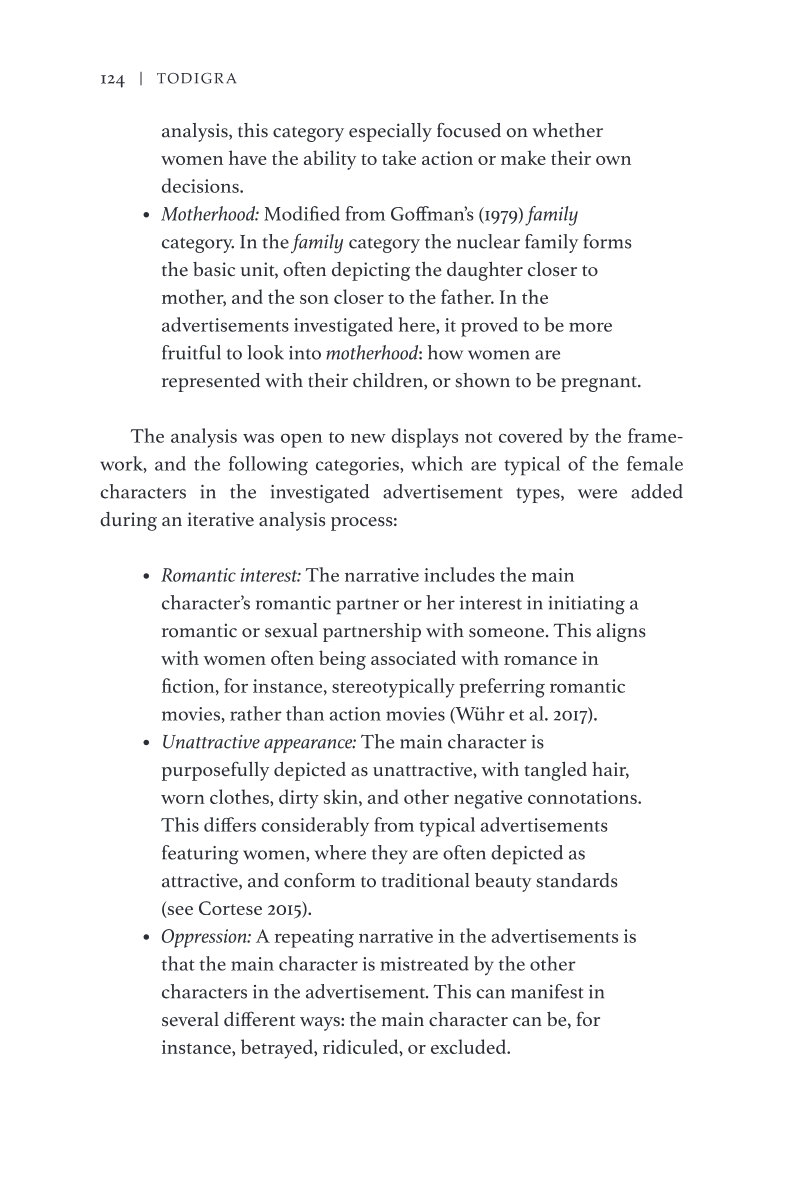
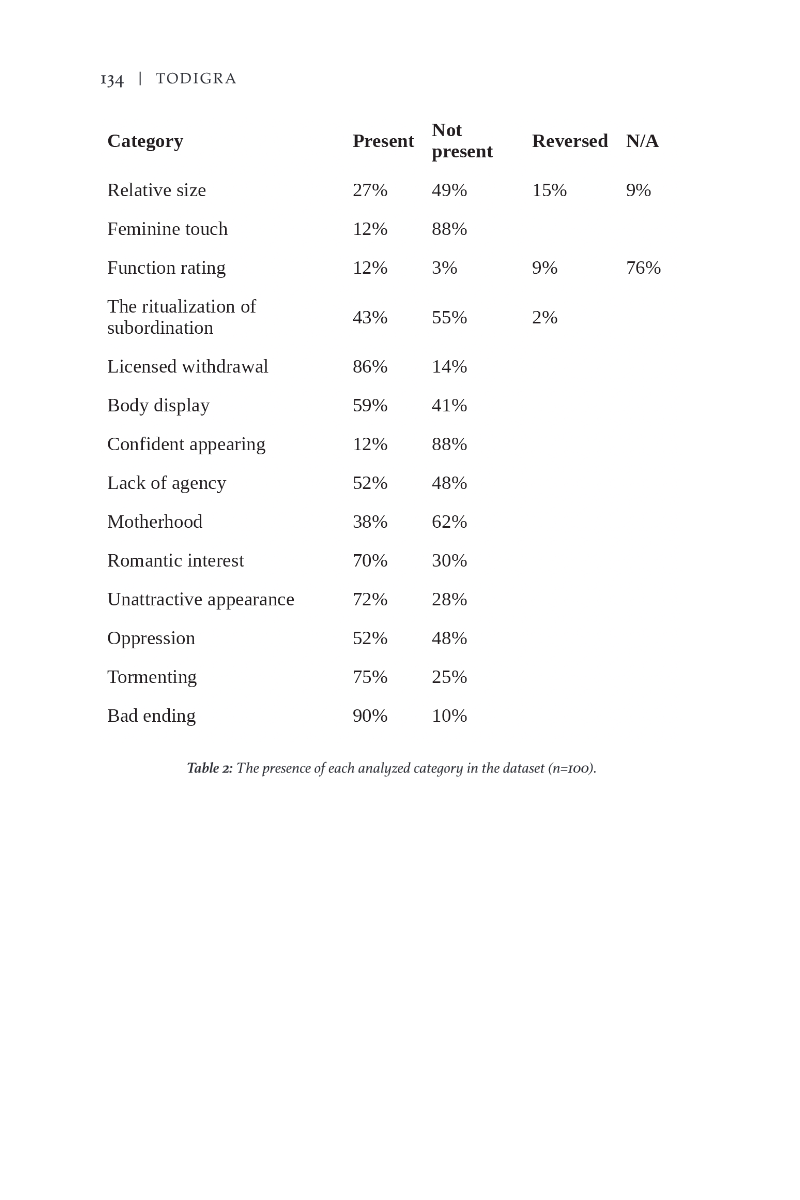
- All analysed advertisements showed the main character lacking agency, with the advertisements depicting her as passively waiting for others to decide or rescue her.
- In half of the advertisements, someone in the game was actively harming the main character, through cheating, abandonment, bullying, or physical harm.
- The confident appearing display was found in only 12 percent of advertisements, and even then it was almost always only for a moment when something went right before taking a turn for the worse again.
1001 Followers in 20 Days: Framing the Playful Use of Fame-Enhancing Bots on Instagram
Nathalie Schäfer's paper, published in the Transactions of the Digital Games Research Association (2024), examines fame-enhancing bots on Instagram, a practice called botting.
- The author's dog-themed botting experiment reached 1001 followers on the twentieth day and 1368 generated followers after 32 days of use.
- Over the 32-day project, the bot followed 12,761 accounts, unfollowed 9,790, commented 2,396 times and liked 1,858 posts.
- The author argues that botting breaks Instagram's rules and gives botters an unfair advantage over other participants.
Character-Driven Narratives in D&D5E and Fate: Core System
Joy Kumral and Luis F.T. Meza's article, published in Transactions of the Digital Games Research Association (July 29, 2024, Vol. 6 No 3, pp.
- The authors argue that D&D5E's Inspiration mechanic is a weaker incentive for character-driven play, because Advantage is available from other in-game situations such as assisting another character.
- The authors argue that in Fate: Core System, Aspects work as both Reactive and Active traits, since they can create new conflict through Compelling.
- The authors state that Fate's Compel mechanic lets a player or GM introduce complications, and that a Compelled player must take action that generates conflict for their character.
The Ink Splotch Effect: A Case Study on ChatGPT as a Co-Creative Game Designer
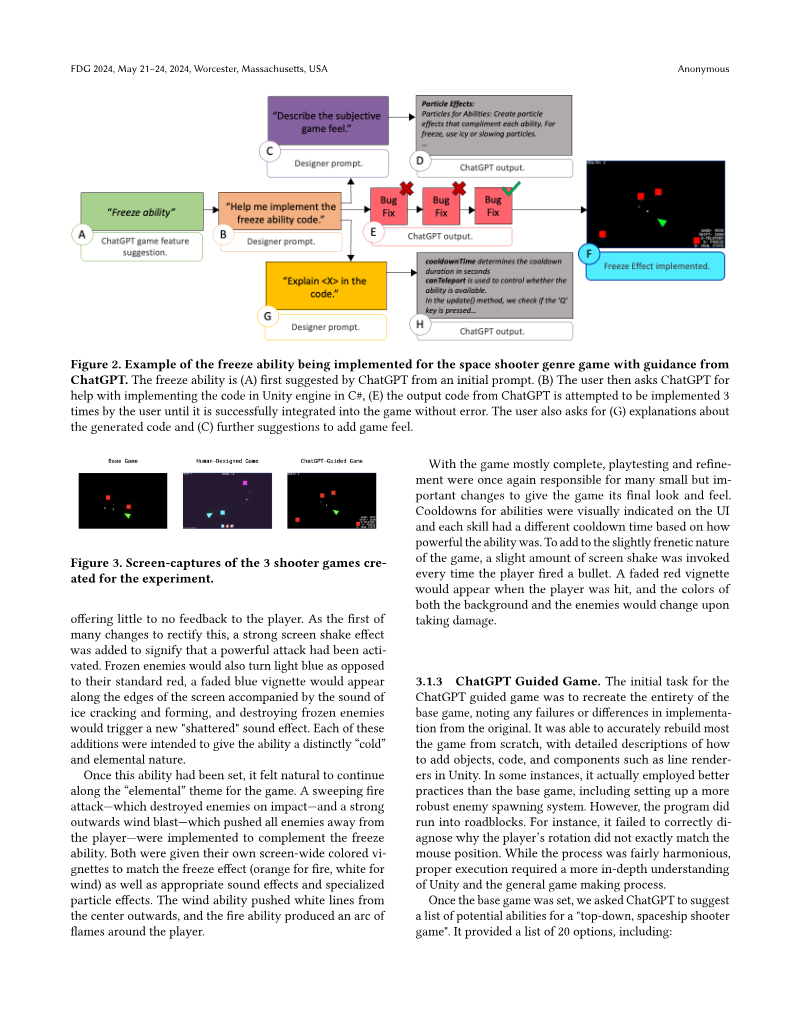
The Ink Splotch Effect is a 2024 Foundations of Digital Games paper by Asad Anjum, Yuting Li, Noelle Law, M Charity and Julian Togelius, studying whether ChatGPT (GPT-3.5) can act as a co-creative game designer.
- The authors state that ChatGPT performed best when prompted for abstract, high-level feature suggestions rather than direct code implementation.
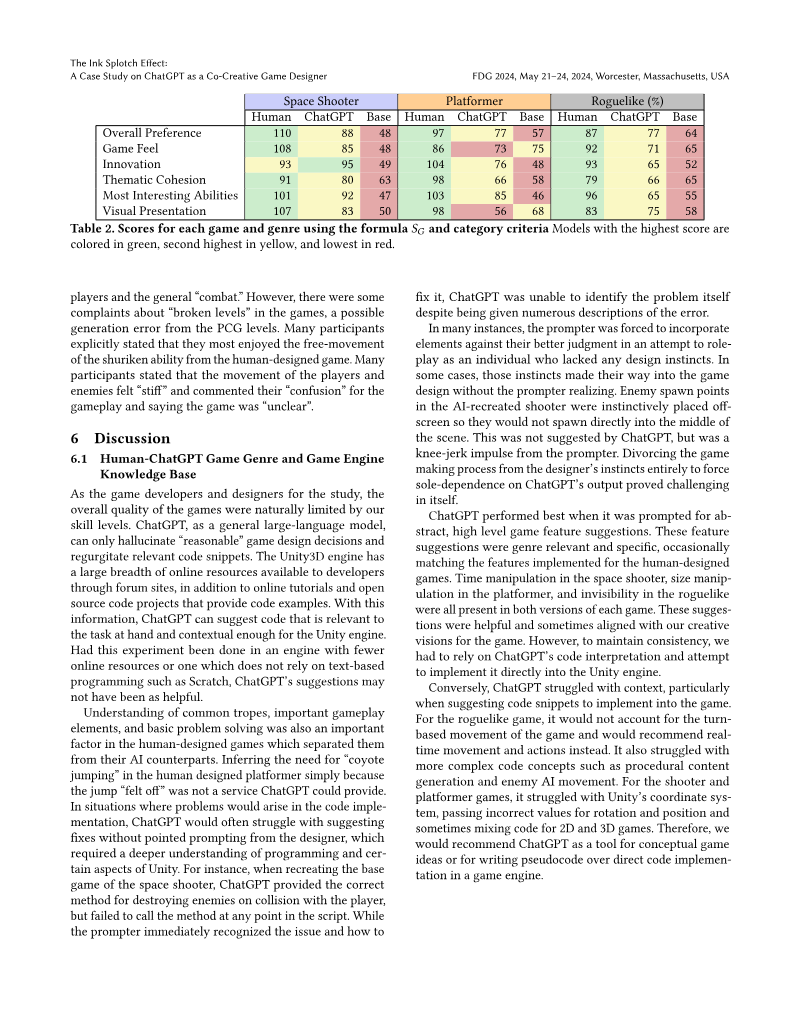
- The authors report that participants almost consistently rated human-designed games higher than ChatGPT-suggested games, with both above the baseline in most categories.
- The authors report that ChatGPT could not recreate the turn-based roguelike base game and struggled with its procedural generation and enemy AI.