
DiGRA
The Digital Games Research Association: the international association of academics and professionals who study digital games. Its Digital Library holds the proceedings of the DiGRA conferences since 2002.
Documents
Bonding with Horses and Other Animals in Breath of the Wild
This extended abstract, presented at DiGRA 2018 by Frederic Seraphine of the University of Tokyo, examines how the animal and horse systems in Breath of the Wild (Nintendo, 2017) foster player attachment to non-human artificial agents.
- Imperfect, variable animal behavior, such as a horse's delayed readiness for riding and unpredictable control responsiveness, gives animals a sense of personality, while fully trained, predictable behavior risks making them feel impersonal.
- Generic and repetitive animal mechanics strip creatures of subjectivity and expose the game's artificiality, undermining player attachment to non-human agents.
- Naming and accessory customization function as appropriation mechanics that let players project personality onto animals and support emergent, player-authored narrative.
Sense of Belonging: The Ideology of Chinese Educational Games
This extended abstract, presented at DiGRA 2018 by Chen Yingrong of Lingnan University, examines how Chinese government-sanctioned online games are used to cultivate a sense of belonging and patriotism among players.
- The paper argues that fostering a sense of belonging is the most important design factor in state-approved Chinese educational games, which it frames as a vehicle for disseminating political ideology rather than a space for diverse expression.
- Belonging is defined as accepting the nation's organization, policies, and protections while linking personal identity to protecting China's image, with patriotism and resistance to what is framed as liberal "invasion" as related goals.
- The author contends these games are more effective than traditional text-based or audiovisual media because they offer multiple paths to victory, subtly encouraging pride and loyalty rather than forcing particular choices.
Memory and Meaning in Analogue: A Hate Story and Nier: Automata
This paper examines how two games, Christine Love's visual novel Analogue: A Hate Story (2012) and Platinum Games' action RPG Nier: Automata (2017), make the act of saving and loading data meaningful beyond its usual role as a gameplay mechanic.
- The paper argues that save and load systems in games can carry narrative, thematic, and interpretive meaning, not just serve as a gameplay mechanic, prompting reflection on how the past is stored, accessed, and remembered in digital culture.
- It frames its analysis through the concepts of "mechropolitics" (who lives and dies within a game's systems) and "mnemopolitics" (whose lives are remembered and how), drawing on theorists of archiving, difficult knowledge, and testimony.
- In Analogue: A Hate Story (2012), players cannot see every file in a single playthrough, so they must decide whom to believe and what to preserve, a choice tied to Leigh Gilmore's notion of the "adequate" versus "tainted" witness.
Defining Genre in Video Game Historiography: Structural, Discursive, and Sociocultural Definitions
This paper argues that video game genre definitions fall into three types and that a sociocultural approach best serves historical research on games.
- The paper identifies three types of video game genre definitions: structural (genre as inherent organization of games and play), discursive (genre as a way of using and relating texts), and sociocultural, which it argues best serves historical research.
- Structural definitions struggle to explain the divergent meanings players and critics assign to the same titles, while discursive definitions detach genre from the games themselves and so have limited practical use.
- The proposed sociocultural definition treats genre as a set of games classified together by one or more social groups, drawing on Wendy Griswold's cultural sociology.
"Travel Bugs": Toys Traveling Socially Through Geocaching
This study examines toy tourism within the international geocaching game, focusing on Travel Bugs: trackable metal tags attached to toys that move between geocaches around the world.
- Geocaching's Travel Bugs are trackable metal tags attached to toys that move independently between geocaches around the world, with each journey documented on dedicated online pages, making toy tourism a form of mobile, social object play.
- The authors propose a conceptual framework linking the digital, physical, and social dimensions of toy tourism, showing how these practices become more gamified, goal-oriented, and measurable.
- The findings come from a qualitative case study based on an August 2016 internet survey of 45 geocachers recruited via Facebook groups, supplemented by stories from the Groundspeak Forum, so the conclusions are explicitly provisional given the small sample.
(Re)Play the Beginning of the End: 1988 as Prequel to Umbrella Movement in Hong Kong
This study examines 1988, a 2015 alternative history game by Hong Kong designer Cheng Lap, as a form of digital activism in the aftermath of Hong Kong's 2014 Umbrella Movement.
- The study treats 1988, a 2015 alternative history game by Hong Kong designer Cheng Lap, as a form of digital activism emerging from the aftermath of the 2014 Umbrella Movement, set a decade before the 1997 handover to China.
- The game places a teenage immigrant from mainland China against a hegemonic alliance of the Chinese Communist Party and real estate interests, and the author argues it actively constructs and circulates "Hong Kong local" identity as an emerging nationality.
- The analysis distinguishes two dimensions of "Hong Kongness": the richly detailed fictional Hong Kong built within the game, and the online community that treats playing and discussing it as a progressive political act.
Playing for Real
This theoretical paper by Lyuba Encheva examines the use of games for non-game purposes, using the case of Pymetrics, a recruitment company that employs computational neuroscience, artificial intelligence, and game design to assess job seekers' character traits and match them with suitable careers.
- The paper is a conceptual, interpretive essay by Lyuba Encheva examining a single commercial case, Pymetrics, a recruitment company that combines computational neuroscience, artificial intelligence, and game design to assess job seekers' traits and match them to careers.
- Its central claim is that gamified assessments blur the boundary between virtual and embodied experience, reflecting Jean Baudrillard's concept of "integral reality," in which virtuality substitutes for and reorders the real.
- The author argues gamification functions as a symbolic strategy for managing the perceived illusoriness of the world, and that Pymetrics' games are designed to produce real-life consequences rather than remain confined to play.
Playing with a Brand: The Brazilian McDonald's Paper Tray Case
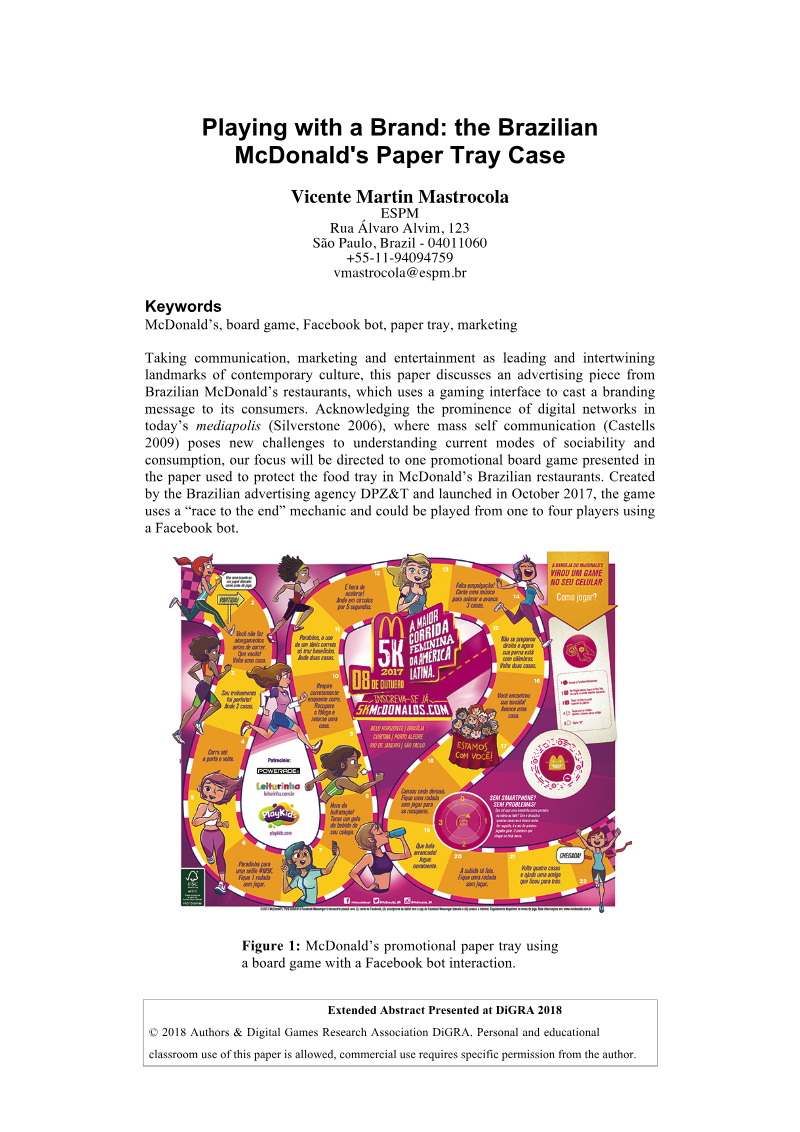
This extended abstract examines a promotional board game printed on the paper tray of Brazilian McDonald's restaurants, created by the advertising agency DPZ&T and launched in October 2017.
- The case study examines a promotional board game printed on paper trays in Brazilian McDonald's restaurants, created by the ad agency DPZ&T and launched in October 2017.
- The game is a 'race to the end' for one to four players, where scanning a code activates a Facebook Messenger bot that delivers McDonald's quizzes, enigmas, and trivia, and correct answers advance player pawns.
- The winner earns a chance to receive a prize such as fries or ice cream, linking entertainment directly to a commercial incentive.
From Silent NPC to Active Consumer: Representing Female in Chinese Video Game Culture
This extended abstract examines how female players and female characters have been represented in Chinese video game culture, a topic the author argues has received little scholarly attention compared with Western gaming research.
- The paper argues that female representation in Chinese video games moved through three stereotypes since the 1990s (women as male-desire objects or silent NPCs before the 2010s, prosumers of boys' love content in TANBI games from 2012–2016, and cash cows in mobile otome games), and that these stereotypes have not disappeared but become more subtle.
- Drawing on Stuart Hall's theory of representation, the author treats gender images as culturally constructed meanings shaped by industry, popular culture, and players rather than neutral reflections of players.
- The first stereotype was exemplified by titles such as The Legend of Sword and Fairy and the Dragon Oath series, where women appear as sexualized figures, devoted assistants to male heroes, or silent non-player characters.
Disappearing into the Mirror: Robert Maxwell and the Early UK Videogames Industry
This extended abstract, presented at DiGRA 2018, examines Robert Maxwell's influence on the early UK videogames industry through his publisher Mirrorsoft, a subsidiary of Mirror Group Newspapers.
- Mirrorsoft, the games publishing subsidiary of Mirror Group Newspapers under Robert Maxwell, is argued to have treated games publishing as a strategic investment, and its collapse after Maxwell's empire dissolved in 1991 left the UK games sector without a bona fide international publisher during a critical transition.
- The paper argues Mirrorsoft could have steered the industry's shift from small-team, open-platform development toward standardized, closed-platform production, but this potential was never fully realized.
- Early convergence between newspaper and games operations is illustrated by Maxwell's push to modernize newsprint production through desktop publishing, which connected to the 1986 release of Fleet Street Publisher for the Atari ST.
Identities, Genre and Design in Game-Making
This extended abstract, presented at DiGRA 2018, examines how young people use game-making to express identity and how established game design conventions and genre norms shape that process.
- Young people use game-making to experiment with cultural preferences, claim social positions, and reject others, but this expression is negotiated rather than unconstrained, shaped by individual preferences, genre conventions, and technical limits.
- Popular culture strongly shaped the games: themes and custom characters functioned as deliberate cultural statements that participants used to signal how they wished to be read by others.
- Study of two London after-school clubs (a community centre serving Latin American migrants and a primary school), with about ten hours of weekly instruction, involved participants aged 11 to 18 who produced eleven games in MissionMaker, a platform for building 3D games from ready-made assets and simplified scripting.
Make Tents, Not War: Queer Play as Play-That-Critiques
This paper examines whether players can engage critically with a game regardless of the designer's intent, shifting attention from the design of critical games to the critical capacities of play itself.
- Players can critique a game through play itself, regardless of whether the designer intended critique, shifting focus from designing critical games to the critical capacities of play.
- The paper defines critique broadly, following Dunne and Raby as a gentle refusal or wishful turning away from what exists, so critical play need not be negative in tone.
- Queer play is framed as a practice that rejects the assumptions a game encodes and may pursue forms of interaction not oriented toward fun.