1 free read left. Create a free account for unlimited reading + AI research.
Create free accountArticle DiGRA
1 free read left. Create a free account for unlimited reading + AI research.
Create free accountArticleDiGRA
The paper describes women as sexualized figures, devoted assistants to male heroes, or silent non-player characters, citing The Legend of Sword and Fairy and the Dragon Oath series.
This extended abstract examines how female players and female characters have been represented in Chinese video game culture, a topic the author argues has received little scholarly attention compared with Western gaming research. Drawing on Stuart Hall's theory of representation, the paper treats gender images not as neutral reflections of players but as cultural meanings constructed through language, imagery, and social practice within a specific historical context. The central thesis is that over three periods since the 1990s, three female stereotypes have emerged through the combined influence of the game industry, popular culture trends, and players themselves, and that these stereotypes have not disappeared but become more subtle.
The first stereotype, dominant before the 2010s, casts women as objects of male desire, appearing either as sexualized figures designed for visual pleasure, devoted assistants to male heroes, or silent non-player characters who deliver quests. This pattern is traced through titles such as The Legend of Sword and Fairy and the Dragon Oath series. The second stereotype, associated with TANBI games from 2012 to 2016 on the Orange Light Games platform, positions women as prosumers who consume and create boys' love content, gazing at male characters and often producing their own works through platform tools, which the author reads as a limited but real form of participation in game production. The third stereotype frames women as cash cows in otome games such as Love and Producer and Tabikaeru, where spending on power-ups and the short lifespan of such mobile titles are described as economically and emotionally exploitative.
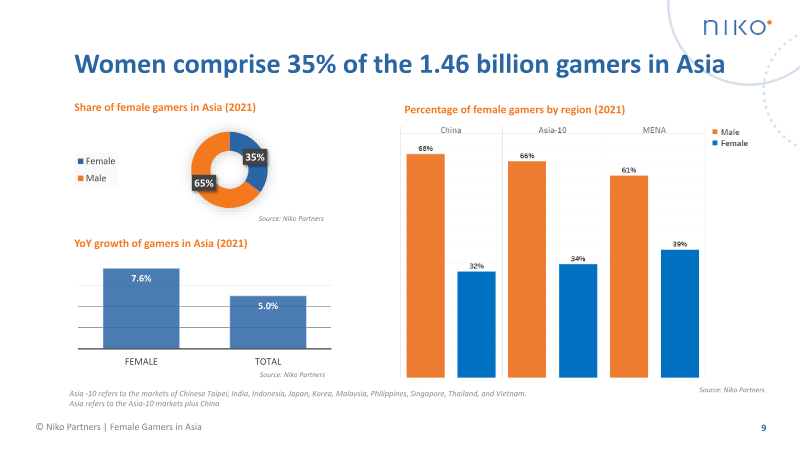
The paper's data is primarily contextual rather than quantitative. It cites the 2017 China Gaming Industry Report, which reported a market of roughly 203 billion yuan and 583 million users, with mobile games accounting for 57 percent of revenue and female mobile gamers making up more than half of that segment. The analysis itself is qualitative and interpretive, relying on close readings of selected games and on the theoretical framework of representation rather than on surveys or player sampling. Its scope is limited to Chinese games and their social context from the 1990s onward.
Each row is a game or company this document names, each column a document, oldest first. A mark means that document names it. Select a row to see those documents.
DiGRA · 2022
DiGRA · 2022
DiGRA · 2022
DiGRA · 2022
DiGRA · 2022
DiGRA · 2022
DiGRA · 2022
DiGRA · 2022
DiGRA · 2022
DiGRA · 2022



DiGRA · 2022
DiGRA · 2022
Mobilegamer.biz · 2026