
DiGRA
The Digital Games Research Association: the international association of academics and professionals who study digital games. Its Digital Library holds the proceedings of the DiGRA conferences since 2002.
Documents
Mama Ludens Ex Domo: Using Feminist Methods to Diversify Game Culture
This paper by Jessica Enevold presents a feminist action research project aimed at diversifying game culture by bringing mothers who play digital games into view as legitimate participants.
- The paper argues that explicitly feminist, qualitative action research can both generate research insight and raise consciousness among marginalized women, positioning these methods as a tool for leveling the playing field across gender and age in game culture.
- Its empirical basis is the "Mama Ludens" project on gaming mothers, examining how they manage time and leisure within family life, using in-depth home and online interviews, participant observation, play diaries, a research blog, and planned "pizza parties" to foster exchange.
- A life-line interviewing tool adapted from Davies helped many participants recognize themselves as long-term rather than accidental gamers, with some reporting more than twenty years of play.
Players, Diverse Bodies and Embodied Interpretation: Issues in Research Design
Diane Carr's paper outlines the research design for a study of disabled players' interpretations of science fiction themed games.
Improving Interaction With Non-Player Characters Through Physiological Data
This work-in-progress paper proposes using physiological data to estimate players' emotional states so that non-player characters (NPCs) in video games can respond to how players feel rather than relying solely on their prior choices.
Sarmatian Gamified: Sarmatism in Contemporary Polish Gaming Culture
This paper examines how sarmatism, the cultural ideology of the Polish-Lithuanian nobility from the sixteenth to eighteenth centuries, has been revived and reinterpreted within contemporary Polish gaming culture.
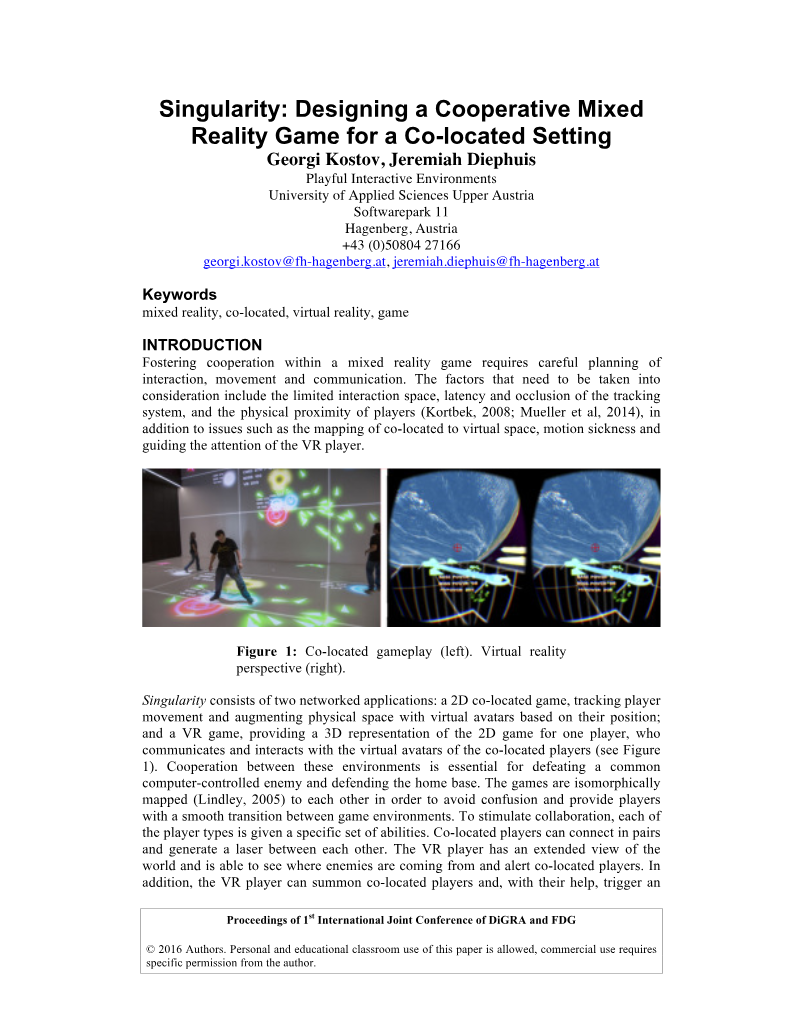
Singularity: Designing a Cooperative Mixed Reality Game for a Co-located Setting
"Singularity" is a design-focused paper describing a cooperative mixed reality game built for co-located play, in which a 2D physical-space game with tracked players is networked to a VR game played by one participant.
Operational Logics, Paratexts and the Production of Knowledge: The Diablo III Case
This paper proposes a framework for analyzing fan-generated paratexts surrounding Blizzard's Diablo III and its expansion Reaper of Souls as active elements in the game's evolving state rather than peripheral commentary.
- Mateusz Felczak's paper treats fan-generated paratexts (Reddit and Battle.net forum posts, in-game chat transcripts, community guides, YouTube) as an "undecided zone between the inside and the outside" of a work, arguing they belong to the game's diegesis and actively shape evolving game states.
- The study adopts Noah Wardrip-Fruin's operational logics framework, tracing interplay among data, process, surface, interaction, author, and audience, and treats patterns between computational elements equally with human-computer interaction rather than privileging either layer.
- The case study is Diablo III: Reaper of Souls (2014), chosen for its always-online model of updates, patches, and minor adjustments, which the author uses to examine how data moves from cloud-based computation into the game interface.
Playful Fabrication: Speculative Game Designs for 3D Printers
This paper argues that 3D printing and other personal fabrication tools remain stuck in a utilitarian, engineer-oriented phase, and proposes a research agenda called "Playful Fabrication" that prioritizes expressiveness, play, and communication over practicality.
Only If For a Knight: Romantic Subplots in cRPGs in the Light of Courtly Love Trope
This paper examines romantic subplots in computer role-playing games through the lens of the courtly love trope, a medieval code in which a noble knight loved a woman from a distance, performed valorous deeds to earn her favour, and was bound by the secrecy and chastity that defined such passion.
- Modern fantasy cRPGs adapt the medieval courtly love trope, keeping its emphasis on quests, favours, and gift-giving while dropping its associations with adultery and chastity.
- The courtly love framework maps naturally onto RPG mechanics, which is why it is a common foundation for romance design in the genre.
- Romance paths are a key point of divergence in players' experiences and a driver of narrative engagement and fandom participation.
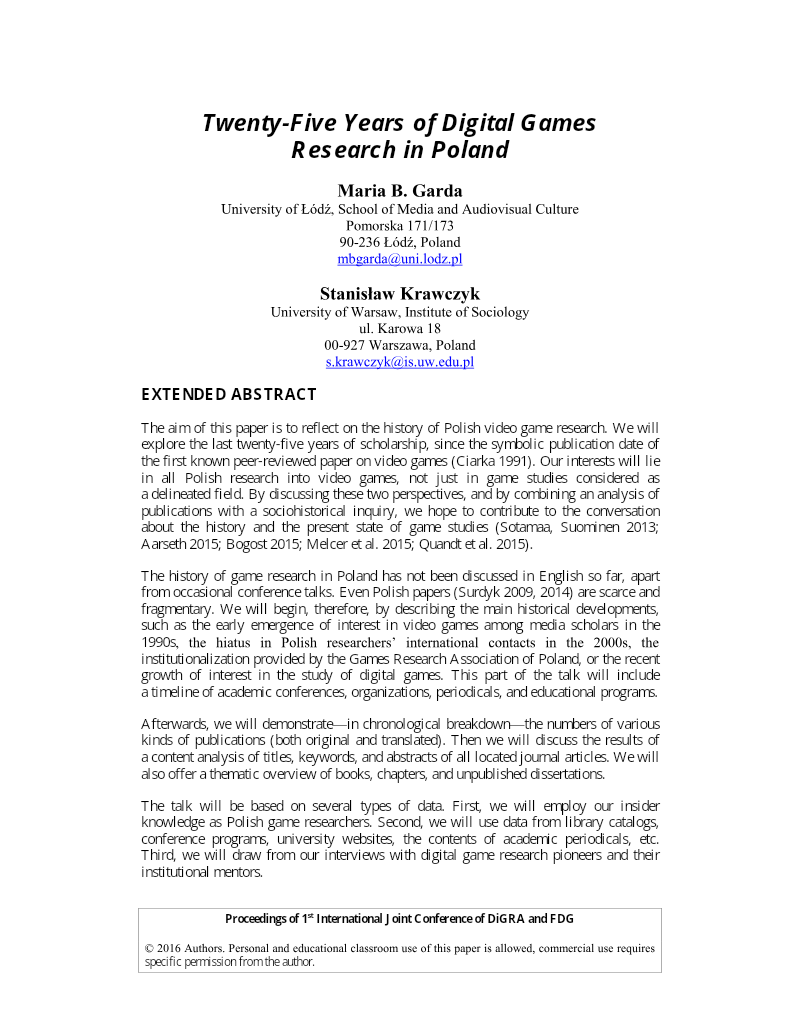
Twenty-Five Years of Digital Games Research in Poland
This paper traces the history and present state of Polish video game research over roughly twenty-five years, beginning from what the authors identify as the first known peer-reviewed Polish paper on video games, published in 1991.
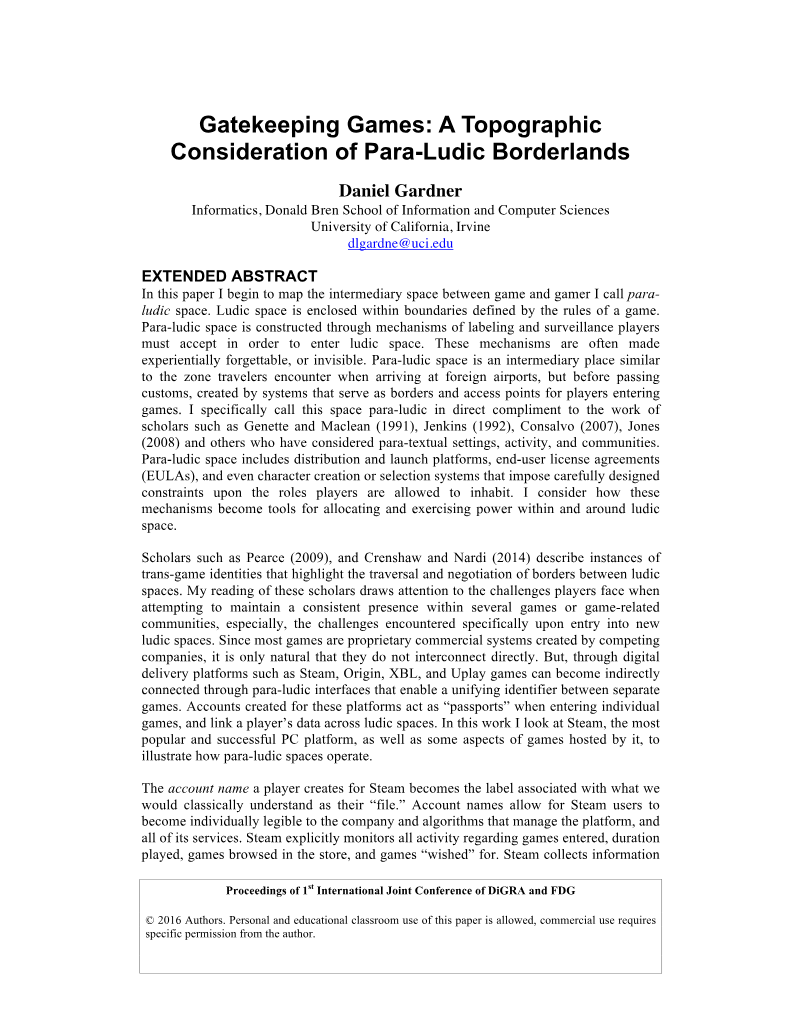
Gatekeeping Games: A Topographic Consideration of Para-Ludic Borderlands
This paper introduces the concept of "para-ludic space," an intermediary zone between a game's rule-bound interior and the wider player experience, and examines how distribution platforms, end-user license agreements, and character creation systems shape access, identity, and power for players.
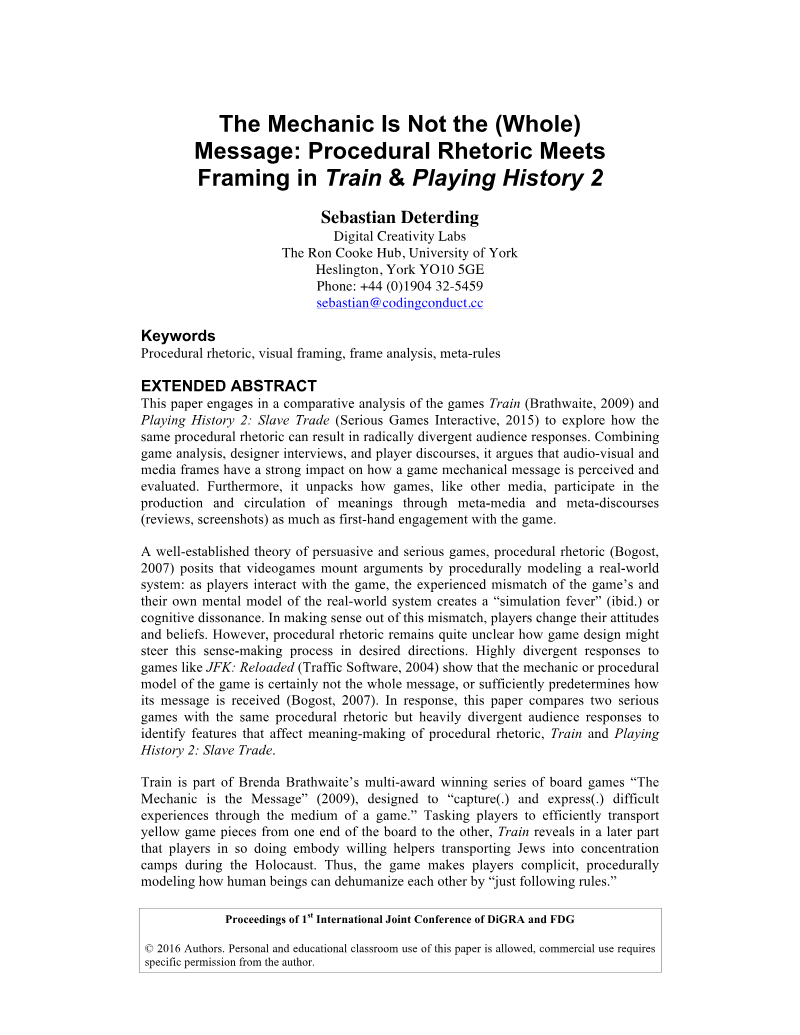
The Mechanic Is Not the (Whole) Message: Procedural Rhetoric Meets Framing in Train & Playing History 2
This paper compares two serious games that share a nearly identical procedural rhetoric yet drew sharply different public reactions: Brenda Brathwaite's Train (2009), which received largely critical acclaim, and Playing History 2: Slave Trade (2015), which provoked a public outcry that led developers to remove one of its…
- The central thesis is that a serious game's mechanics do not fully determine how its message is received; audio-visual framing and the social frames surrounding public circulation play a decisive role in shaping meaning.
- The divergent receptions of Train (2009, Brenda Brathwaite) and Playing History 2: Slave Trade (2015) correlate with how each was presented to the public rather than with their nearly identical procedural rhetoric.
- Train circulated mainly through a carefully composed photograph of its board on a shattered glass window against a black background, which signaled seriousness and unease and positioned it as an adult art piece, activating an art frame that licenses uncomfortable engagement.
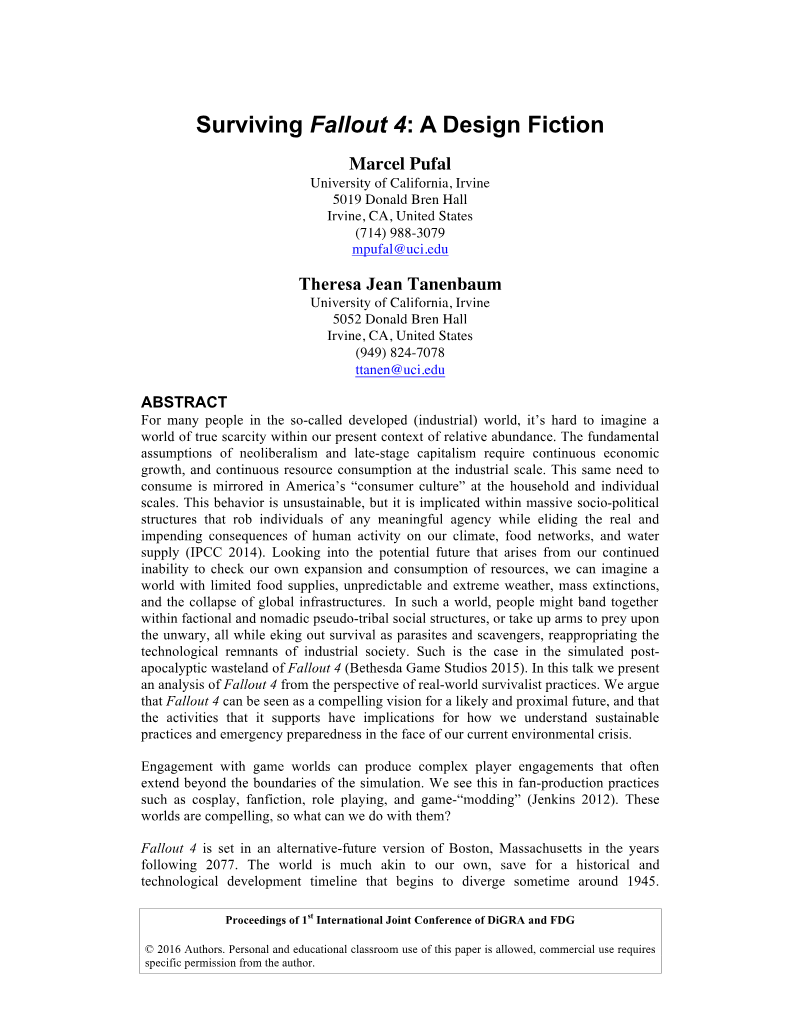
Surviving Fallout 4: A Design Fiction
This paper by Marcel Pufal and Theresa Jean Tanenbaum argues that the postapocalyptic video game Fallout 4 (Bethesda Game Studios, 2015) can be read as a design fiction: a plausible vision of a near future shaped by unsustainable resource consumption, climate pressure, and collapsing infrastructure.
- The paper argues that Fallout 4 (Bethesda Game Studios, 2015) works as a design fiction: a plausible near-future vision shaped by unsustainable resource consumption, climate pressure, and collapsing infrastructure.
- The authors frame the game as a rehearsal space where players can explore survivalist practices and sustainable behavior without the heavy-handed moralizing typical of environmental messaging.
- The analysis credits the game's believable world-building to a design process that asked what it would truly take to produce each object, structure, and settlement system, citing details like functional rain barrels and water-pumping mechanisms.