
DiGRA
The Digital Games Research Association: the international association of academics and professionals who study digital games. Its Digital Library holds the proceedings of the DiGRA conferences since 2002.
Documents
The Comparative Self: Understanding the Motivation to Play and the Subsequent Video Game Use
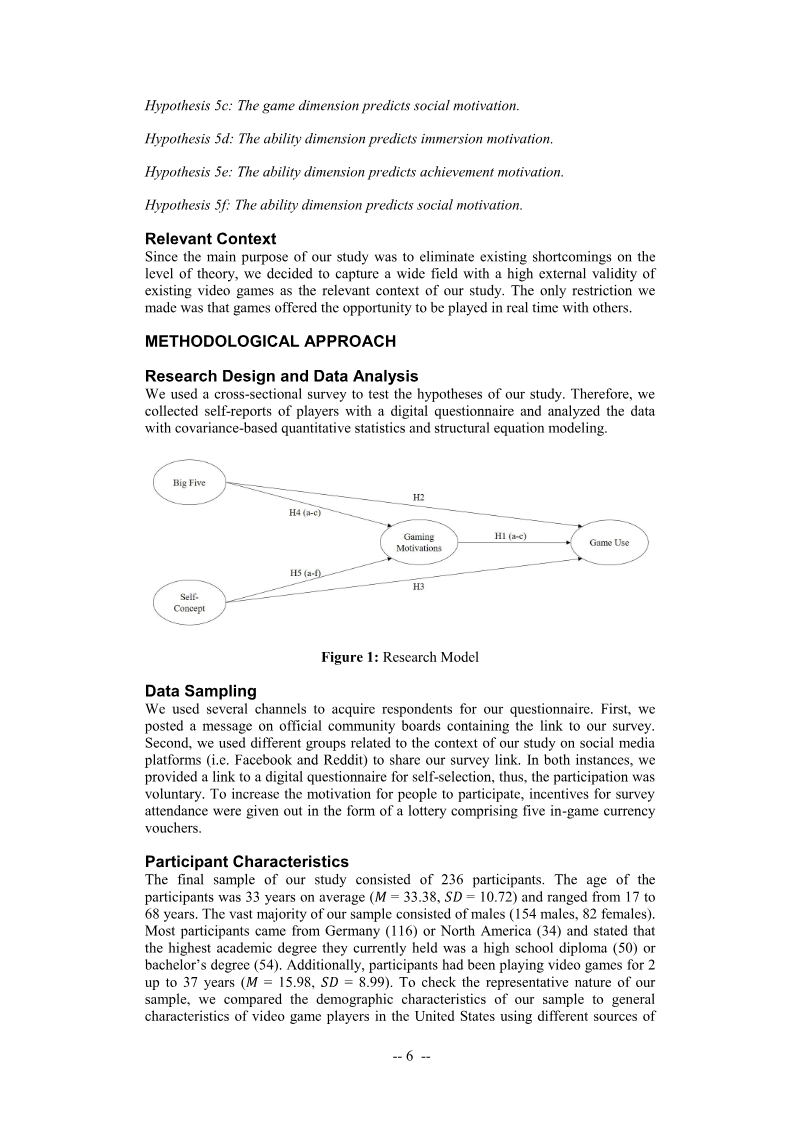
The study investigates whether a fluid, context-dependent self-concept, grounded in Social Identity Approach theory, explains video game motivation and use better than the static Big Five personality model.
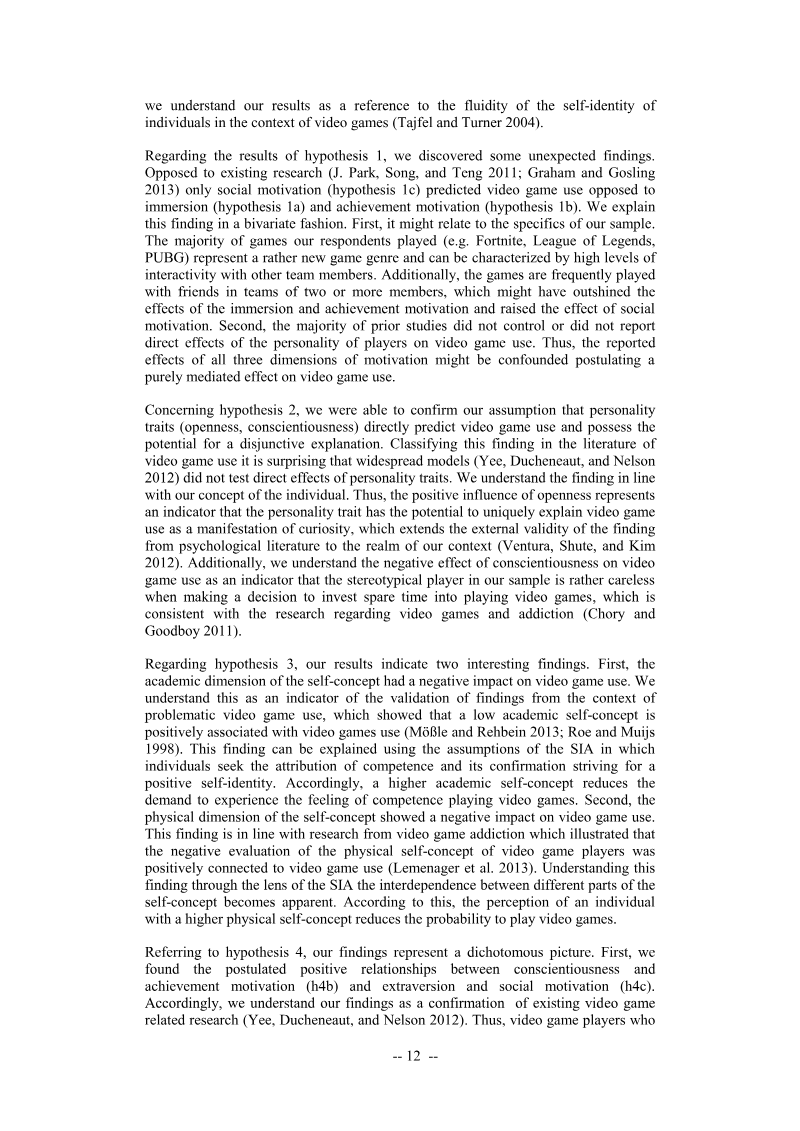
- A survey of 236 mostly male players (average age 33) found that a context-dependent self-concept explained about 30% of the variance in video game use, versus 25% for the stable Big Five personality model, with stronger model fit indices for the self-concept framework.
- Social motivation was the only motivation type that significantly predicted actual game use (β = .29, p < .001).
- The ability dimension of self-concept was the strongest predictor of both immersion motivation and overall game use.
Taiko no Tatsujin: Musical Literacy in the Media Mix
Taiko no Tatsujin is examined as a case study in the Japanese media mix, where the rhythm-game franchise combines anime, J-pop, and geemu ongaku (video game music) with the performance culture of traditional taiko drumming.
- The study argues that Taiko no Tatsujin cultivates "game musical literacy," which extends beyond the functional decoding of gameplay cues to combine media literacy, ludic literacy, and knowledge of communal musical practice, framed through Christopher Small's concept of "musicking."
- The franchise operates across two cultural tracks at once: media-mix music drawn from anime, J-pop, and game soundtracks, and the traditions of taiko drumming practice.
- The analysis treats taiko as a communal, secularized "new folk performing art," with game design referencing the chū-daiko drum, its physical gestures, and matsuri festival atmosphere, including yagura bandstand imagery.
Character-Driven Narrative Engine: Storytelling System for Building Interactive Narrative Experiences
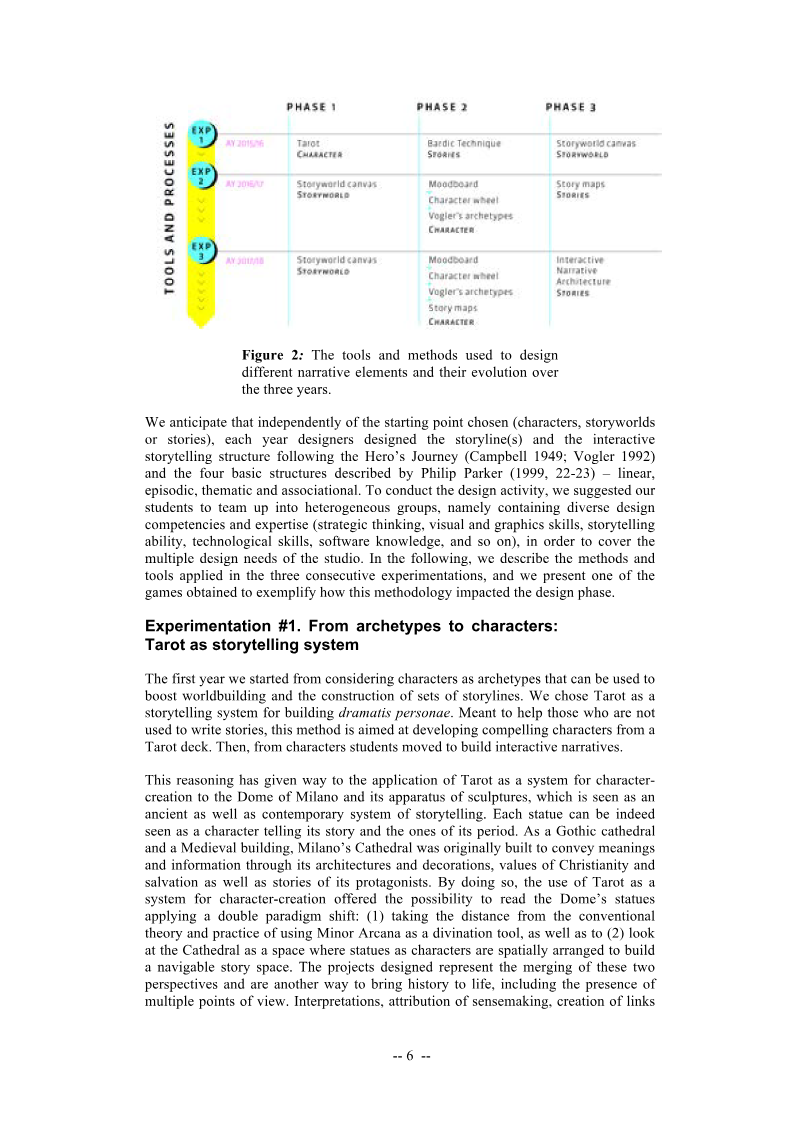
This document presents a practice-based research program conducted at Politecnico di Milano between 2015 and 2017, with a fourth edition in progress, in which roughly 150 MSc design students developed interactive, character-driven narratives.
- The research program at Politecnico di Milano (2015–2017, with a fourth edition in progress) involved roughly 150 MSc design students developing interactive, character-driven narratives, with findings drawn from qualitative ethnographic observation rather than quantitative audience measurement.
- Standard character-development tools such as Vogler's archetypes, the Storyworld Canvas, and the Character Wheel helped build characters but proved insufficient for designing interactive narrative structures, prompting the authors to move beyond them.
- Beginning from existing literary sources, such as Calvino's Invisible Cities, improved the completeness and consistency of storyworlds compared with starting from Tarot-archetype characters, which students found hard to make credible.
A Taxonomy of Game Engines and the Tools that Drive the Industry
The document argues that "game engine" is too vague a term to support rigorous research or clear public discourse, and it proposes a taxonomy that situates engines within the broader game production pipeline.
- The report argues that "game engine" is too vague a term for rigorous research and proposes defining an engine as the core product-facing engine plus its user-facing production tools, with the full production pipeline covering every connected piece of software.
- The authors cite Starbreeze's costly late switch from its in-house Valhalla engine, essentially a renderer without production tooling, to Unreal as evidence that the distinction between core engine and tooling matters in practice.
- A triple-A title such as Assassin's Creed: Odyssey involved roughly 4,388 credited staff across 55 studios and 692 or more distinct roles, a scale the authors argue no single software product can serve.
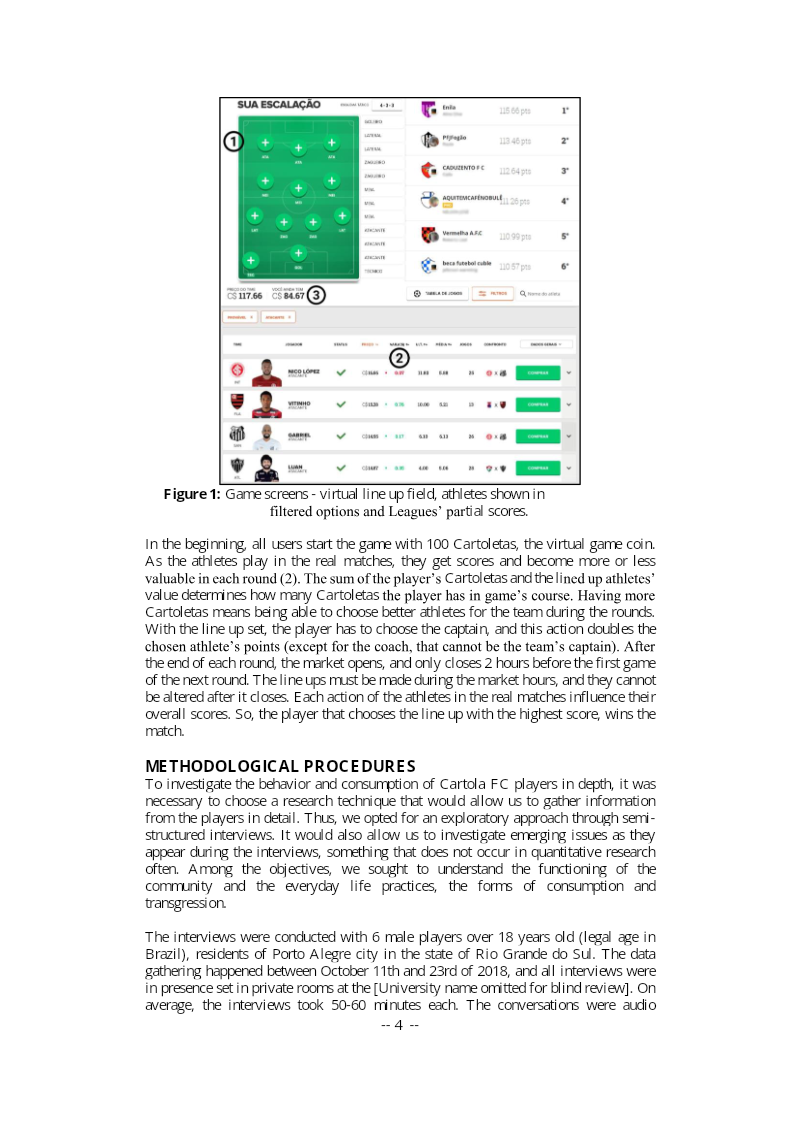
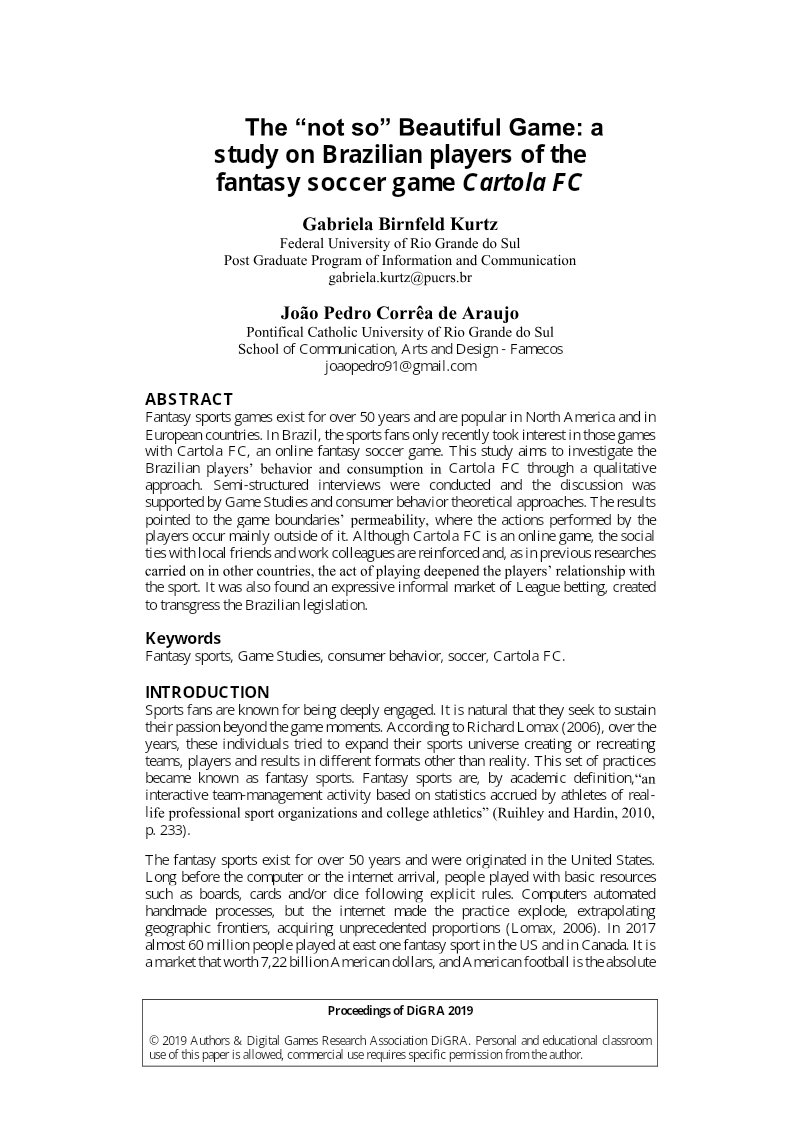
The "Not So" Beautiful Game: A Study on Brazilian Players of the Fantasy Soccer Game Cartola FC
Kurtz and Araujo's study examines how Brazilian players engage with Cartola FC, the popular online fantasy soccer game, drawing on qualitative semi-structured interviews with six male players in Porto Alegre.
- Cartola FC is experienced as a practice that extends into everyday life, shaping how players seek information, interact with friends and colleagues, and deepen their attachment to soccer rather than functioning as a self-contained game.
- The study, based on qualitative semi-structured interviews with six male players in Porto Alegre, frames players' behavior as a distinctly Brazilian blend of a trickster-like pursuit of advantage and a warm, sociable use of play to strengthen relationships.
- Players value the PRO mode for access to more Leagues, status, and possible prizes, and the community is driven by shared soccer passion and social bonds.
Co-Constructing Virtual Identities: Insights from Linguistic Analysis
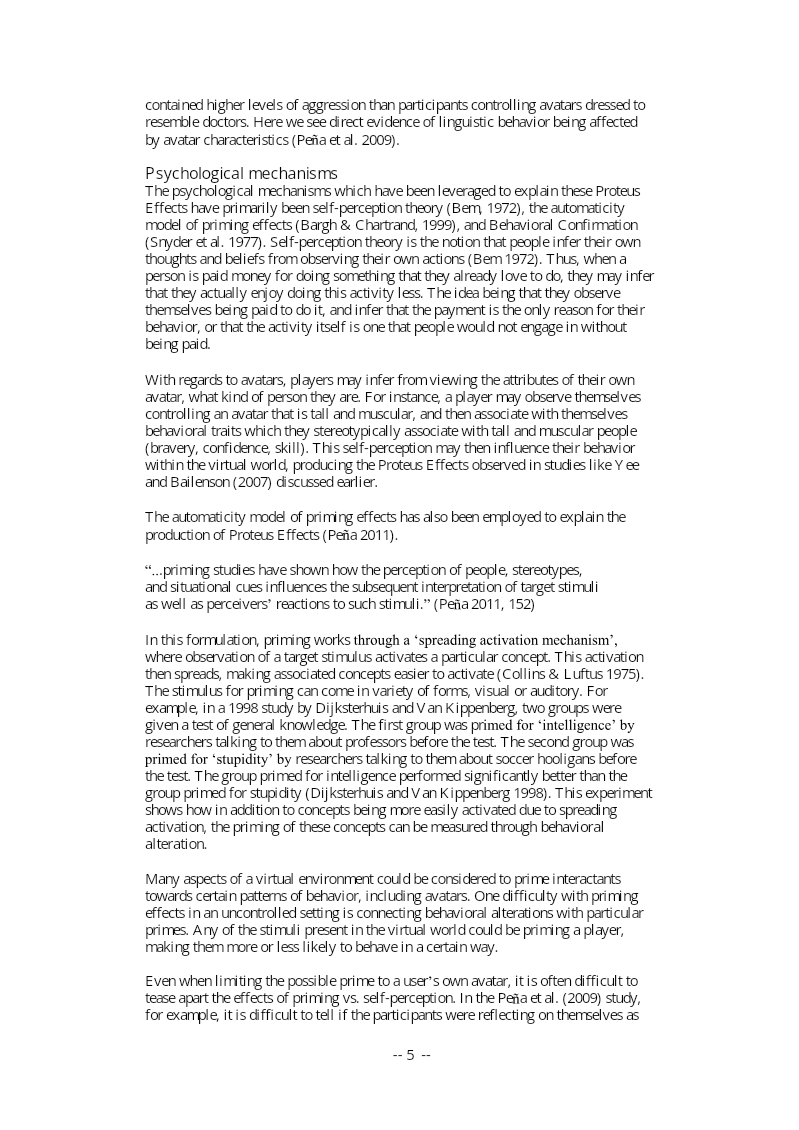
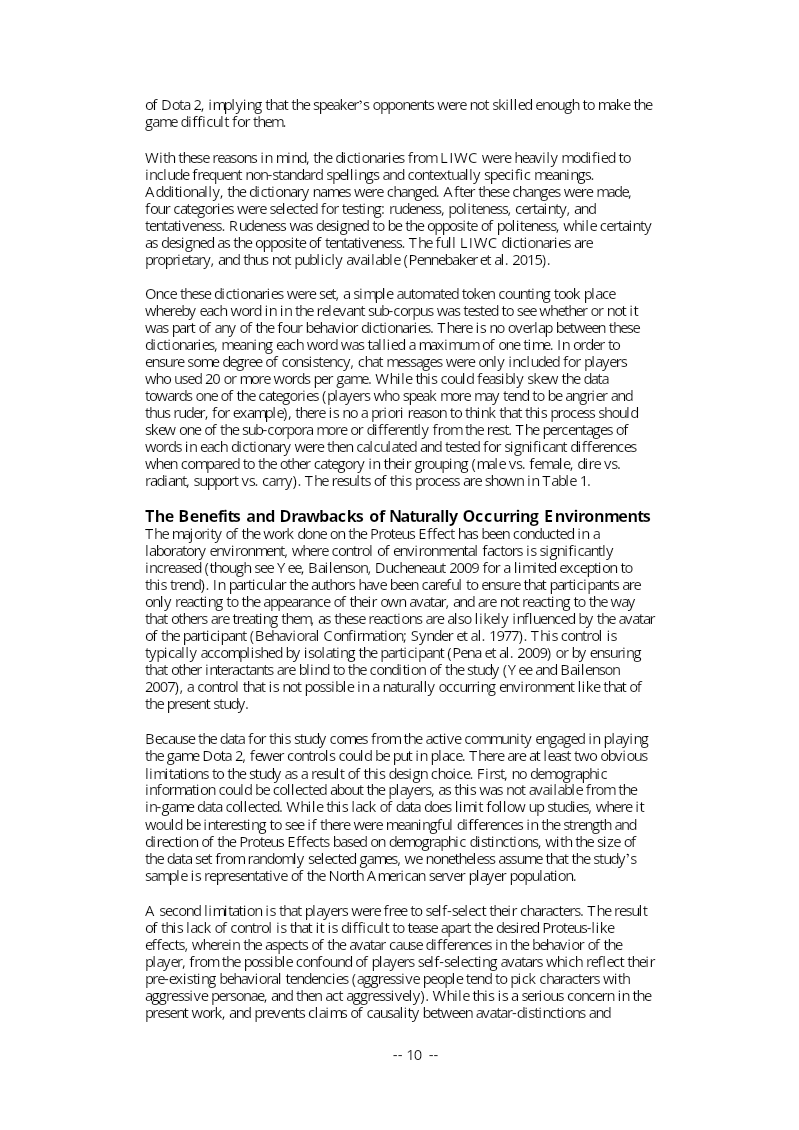
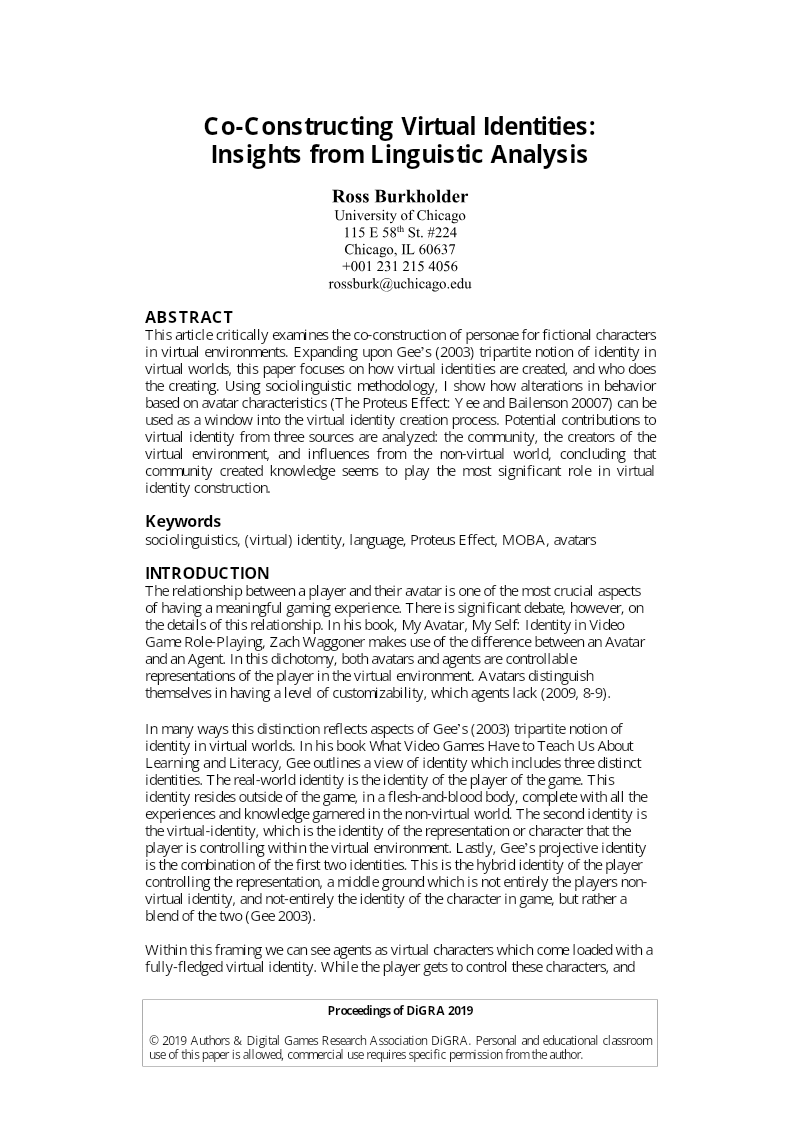
This study examines how virtual identities are co-constructed through language in the online multiplayer game Dota 2, testing whether players' linguistic behavior shifts depending on the avatar they control.
- Players' chat language in Dota 2 shifts measurably depending on the avatar they control, supporting the Proteus Effect in a naturally occurring online setting, though causal claims remain limited without experimental controls.
- The strongest linguistic variation follows community-defined roles (carry versus support) more than the game-defined Dire versus Radiant faction divide, suggesting functional roles shape behavior more than purely aesthetic distinctions.
- Hero-level differences were small but statistically significant, and analysis of individual heroes revealed larger differences than analysis of grouped categories.
Beyond the Wall: The Boundaries of the Neomedieval Town in Singleplayer Roleplaying Games
This study examines how neomedieval fantasy roleplaying games define the boundaries of their cities, arguing that these boundaries are constructed primarily through non-spatial, system-level rules rather than topography.
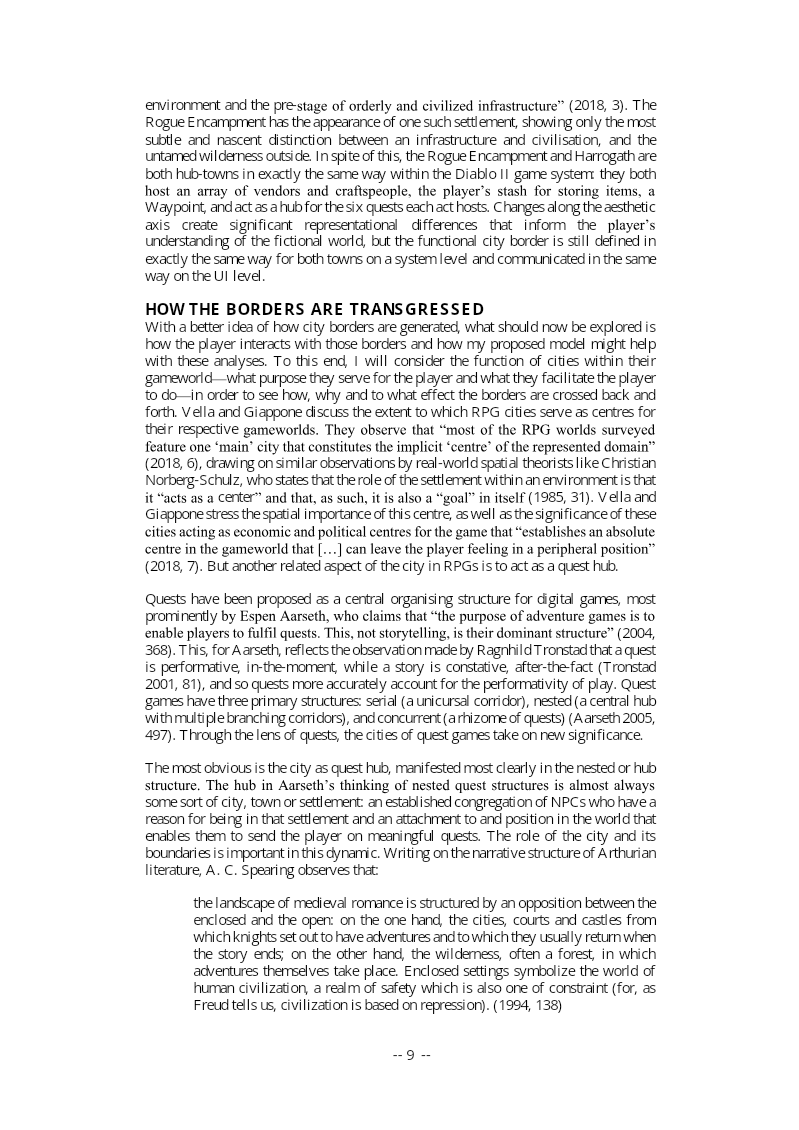
- The central thesis is that a game town's boundary is defined less by its physical layout than by system-level rules governing what the player can do there, such as whether they can be attacked, trade with vendors, or rest safely.
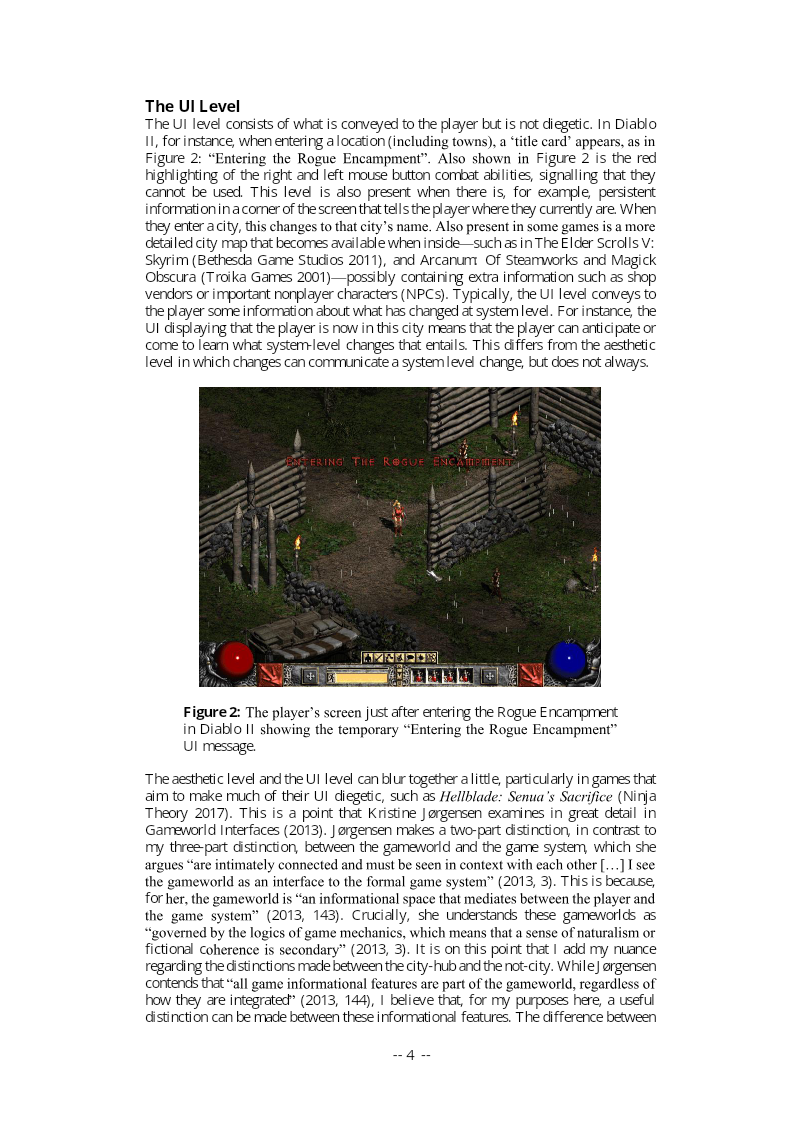
- Aesthetic and interface cues do not create the town/wilderness distinction on their own but reinforce or blur the functional rules beneath it, as shown by the Rogue Encampment and Harrogath, which share identical functionality yet differ visually in how sharply they separate settlement from wilderness.
- Diablo II's Tristram and Travincal look urban but operate as hostile wilderness, illustrating how appearance and function can diverge in game cities.
Romance Never Changes…Or Does It?: Fallout, Queerness, and Mods
Kenton Howard's paper argues that the Fallout series has historically offered only superficial queer content, and that Fallout 4, though it permits same-sex romance, reduces companions' sexuality to a player-selected option through shallow mechanics and visuals.
- Kenton Howard argues that Fallout 4 permits same-sex romance but reduces companions' sexuality to a player-selected option through shallow mechanics and visuals, reinforcing heteronormativity.
- Fallout 4's romance system treats all companions identically, rewards heterosexual pairings with additional perks, and defaults its imagery to a straight male player in a heterosexual marriage.
- Critical reception ranges from praise for the expanded romance options to dismissal of queer relationships as evidence of developer laziness rather than meaningful engagement with queer experience.
Discourse at Play: Construction and Professionalism of Video-Based Game Reviews
YouTube video game reviews have emerged as a significant form of criticism, yet they remain understudied relative to text-based outlets.
- Video game reviews on YouTube partly mirror traditional professional-critic styles, but consumer-oriented reviews do not follow the discursive patterns documented for film and other established media.
- Factor analysis of 28 discourse items identified two dimensions, a high-art factor and a popular aesthetic factor, with first-person perspective and personal playing experience each appearing in 93% of reviews.
- Among 150 randomly sampled reviews of 2016 and 2017 releases, reviewers using high-art discourse tended to have posted more videos and produced better-edited content, while popular-oriented discourse showed no comparable relationship.
Polygonal Modeling: The Aestheticization of Identity
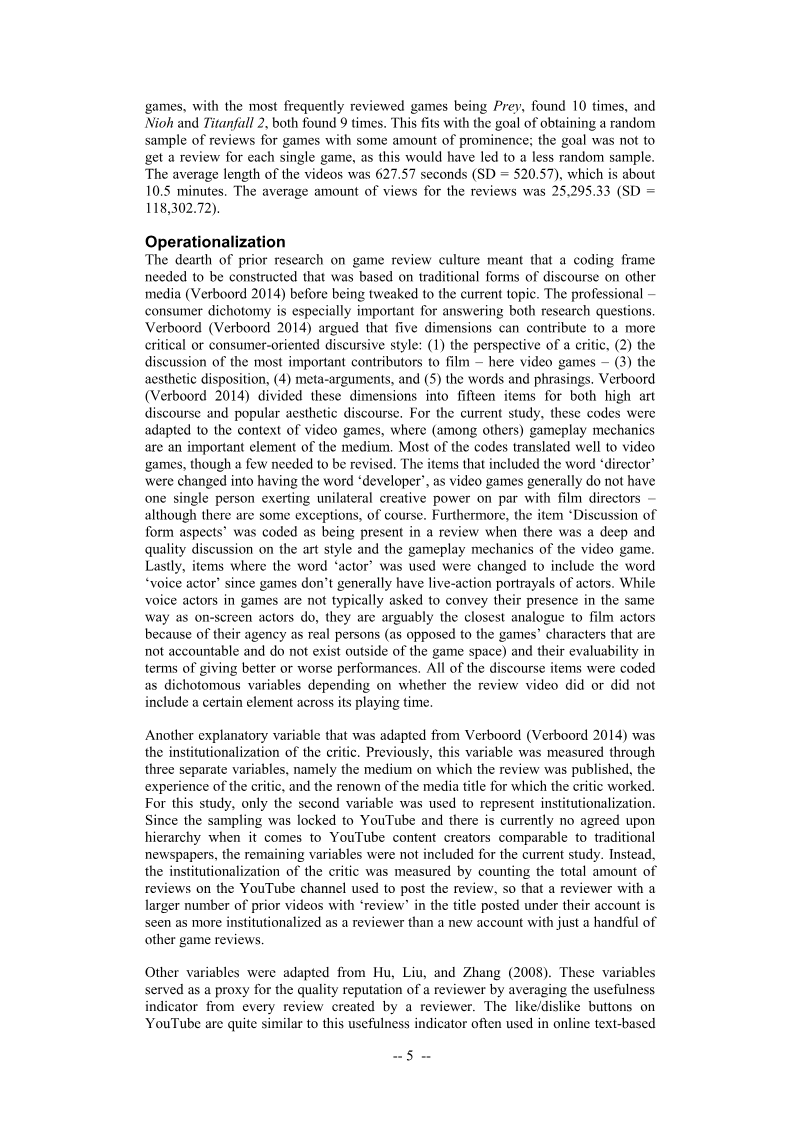
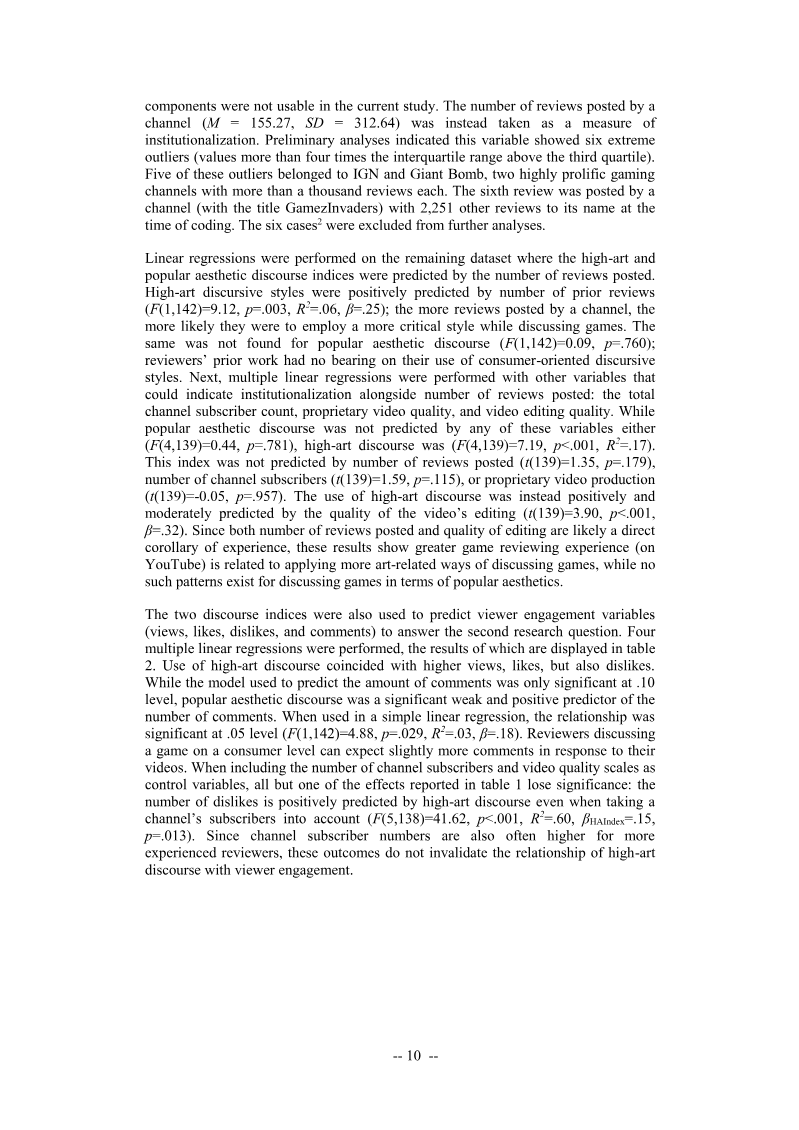
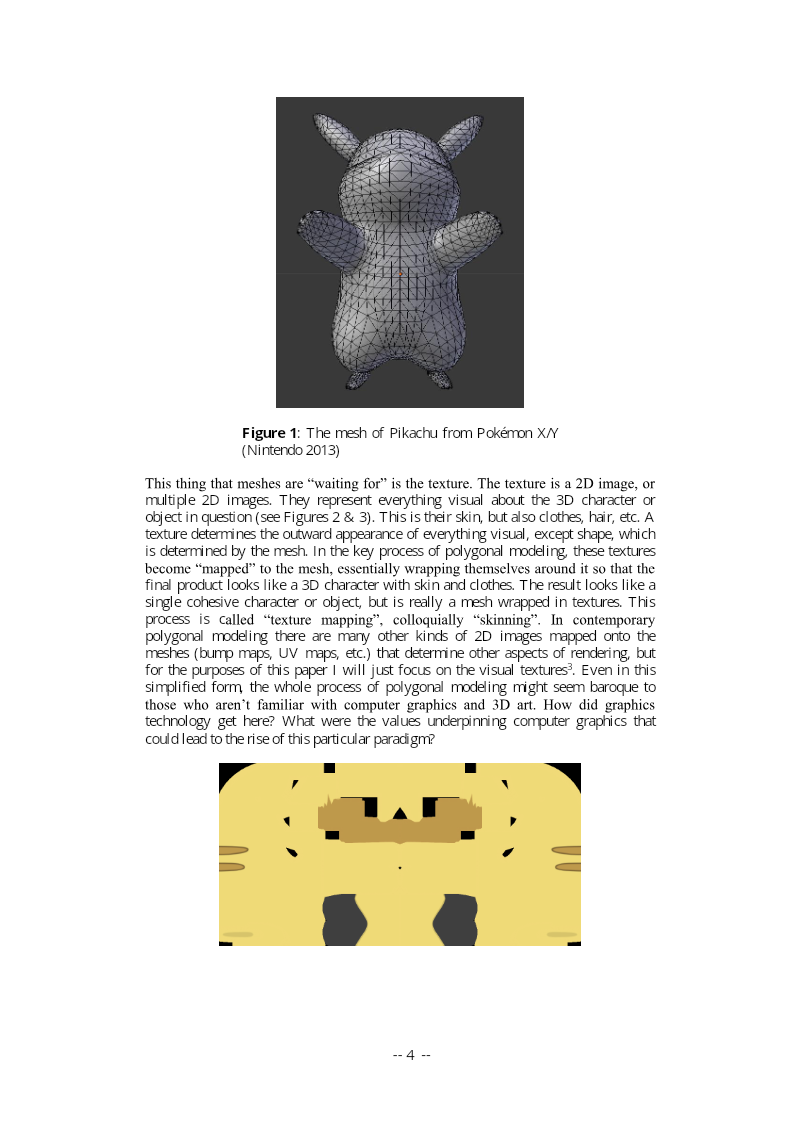
Kerich's paper argues that polygonal modeling, the dominant 3D paradigm in which a mesh is wrapped in a detachable "skin" texture, carries reductive assumptions about identity and the body.
- The paper argues that polygonal 3D modeling, which wraps a mesh in a detachable skin texture, embeds reductive assumptions about identity and the body that originate in engineering culture's prioritization of functionalism, efficiency, and capitalist rationalism.
- Separating mesh from texture mirrors engineering's 'interchangeable parts' principle, making player skinning easy and reducing identity to surface, which the author links to the commodification of selfhood under a neoliberal view of identity as something to be bought and sold.
- Drawing on Wirman's research, the analysis finds that skinning enables resistant, reifying, and regressive uses alike, with regressive examples including neo-Nazi modifications and 'sexy' mods that homogenize diverse character representations.
A Typology of Rumble
"A Typology of Rumble" argues that controller rumble, though ubiquitous in digital games since the late 1990s, has been overlooked in game studies and design literature.
- Controller rumble has been ubiquitous in digital games since the late 1990s but remains overlooked in game studies and design literature, which has focused more on haptics in virtual environments and exergames.
- The study's empirical base is nine single-player action and adventure titles spanning the PlayStation 1 through PlayStation 4 generations, analysed through close play and extended sessions rather than player-response data.
- The central contribution is a two-dimensional typology classifying rumble by feedback source (environment, object, interface, or body, with body subdivided into kinaesthetic, physiological, and extrasensory) and by level of operation (ludic, dramatic, or technical), drawing on semiotic denotation and connotation.
Exploring the Effects of VR Gameplay Videos on Performance and Experience
A 2019 DiGRA study by Jeffrey Ho investigates whether watching virtual reality (VR) gameplay videos can indirectly improve players' in-game performance and game experience through observational learning.
- Watching a three-minute first-person VR gameplay video significantly improved performance in the study: viewers scored a mean of 2.00 gadget (secondary-weapon) kills versus 0.38 for controls (p < .01).
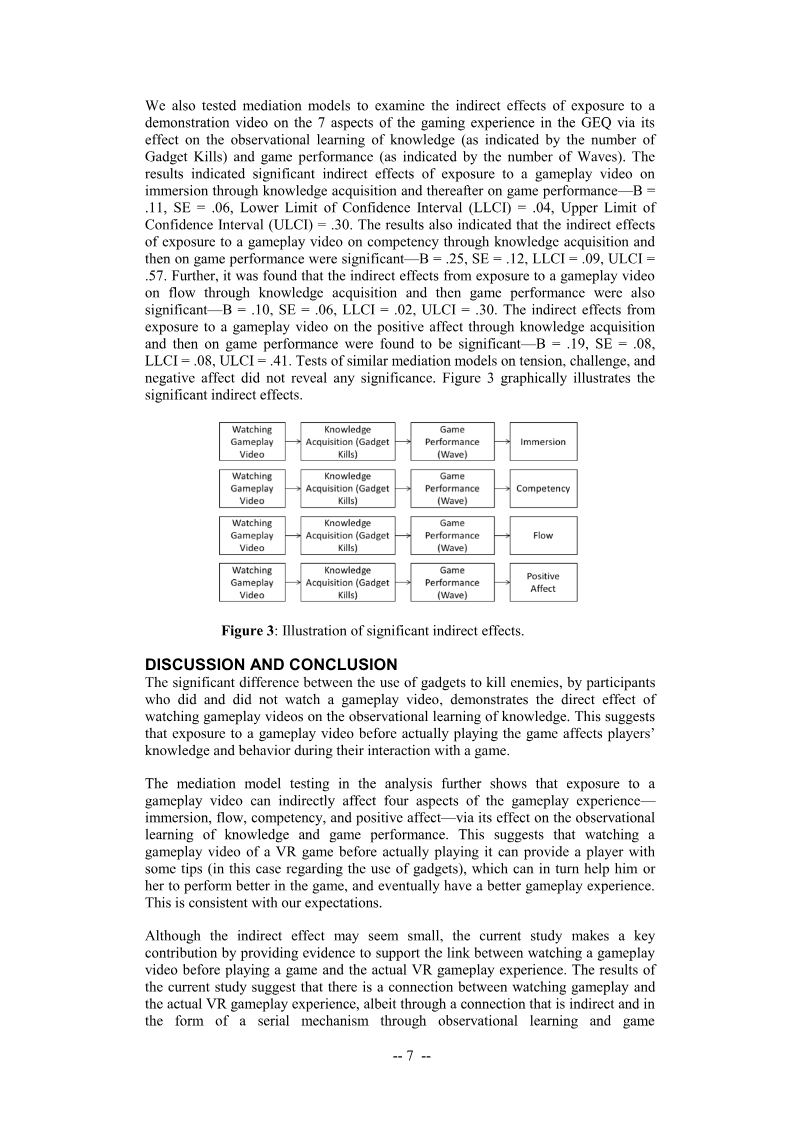
- Video exposure produced no direct effect on the seven measured aspects of game experience, but mediation analysis showed it indirectly enhanced immersion, competency, flow, and positive affect via knowledge acquisition and better in-game performance.
- Motor-skill learning, tension, challenge, and negative affect showed no significant indirect effects from watching the video, suggesting observational learning transferred knowledge more than physical skill.