
DiGRA
The Digital Games Research Association: the international association of academics and professionals who study digital games. Its Digital Library holds the proceedings of the DiGRA conferences since 2002.
Documents
Game Fiction: Playing the Interface in Prince of Persia: The Sands of Time and Asheron's Call
This paper argues that videogame play involves negotiating several simultaneous points of view, including cameras, avatars, interfaces, and cut-scenes, and that mastering these perspectives is central to completing a game's goals.
- Videogame play requires negotiating several simultaneous points of view (cameras, avatars, interfaces, and cut-scenes), and mastering these perspectives is central to completing a game's goals.
- The paper proposes "game fiction" as the imaginative devices games use as native rule elements, a framing that sidesteps the ludology-narratology debate and lets non-narrative games like Tetris or chess be analyzed for their fictional construction.
- In Prince of Persia: The Sands of Time, the minimal on-screen interface (life bar, time circle, sand tanks, power tanks) functions like adjectives describing the Prince's state and location, with the time circle marking chronological position in the reversed-time narrative.
Designing Goals for Online Role-Players
This paper, by Markus Montola of the University of Tampere, examines how persistent online worlds can be designed to serve role-players, a growing audience whose motivations differ from those of regular gamers.
- Role-players construct subjective fictional worlds (diegeses) and pursue goals chosen by their characters rather than goals encoded in game rules, and they often treat winning or losing as meaningless.
- The paper distinguishes exogenous goals (the player's own reasons), endogenous goals (built into game rules), and diegetic goals (belonging to the character's imagined world), arguing role-players largely disregard endogenous goals.
- It proposes six criteria for effective online role-playing goals: diegetic desirability, plausibility, sensibility, consequentiality, relative optionality, and sociality.
End of Story? Quest, Narrative and Enactment in Computer Games
Anders Sundnes Løvlie challenges Espen Aarseth's claim that games labeled "narrative games" are better understood as "quest games," a position rooted in the ludology-narratology debate in computer game theory.
- Løvlie argues against Espen Aarseth's view that 'narrative games' are better understood as 'quest games,' using Remedy Entertainment's 2001 third-person shooter Max Payne as a counter-example whose linear, heavily narrated structure cannot be separated from its gameplay.
- The author proposes 'enactment' as a more fitting concept than acting or authorship, describing the player as reacting to a script of narrative and rules rather than performing a fixed script or freely authoring the experience.
- Max Payne's dream sequences deliberately break genre conventions, and the game's forced repetition of an unavoidable event with identical outcomes is read as an attempt to express metaphysical themes through new media, drawing on Manovich's database-interface model and Jakobson's paradigm-syntagm account of poetry.
Feel It, Don't Think: The Significance of Affect in the Study of Digital Games
Eugénie Shinkle's paper argues that game studies methodologies focused on visual, narrative, and semiotic content overlook the embodied, physiological dimensions that give digital games their meaning.
- Shinkle argues that game studies focused on visual, narrative, and semiotic content overlook the embodied, physiological 'feel' of gameplay, which she calls affect: a multisensory, temporally delocalized experience that operates partly outside linear time and conscious choice.
- The paper distinguishes affect from emotion and presents itself as a preliminary theoretical examination rather than an empirical study, drawing on Massumi, Grodal, Aarseth, and Poole.
- Sega's rave-inspired Rez is cited as an example whose appeal lies in a trance-like synchronicity between player and environment rather than in level completion.
A Cognitive Psychological Approach to Gameplay Emotions
This paper applies a cognitive psychological framework to the emotions arising from gameplay in story-driven video games, arguing that these gameplay emotions, distinct from fiction emotions and artefact emotions, deserve focused study.
- Gameplay emotions are treated as a distinct category from fiction emotions and artefact emotions, and the paper argues they deserve focused study in their own right.
- Drawing on Nico Frijda's appraisal and action-tendency theory and Ed Tan's work on film emotion, the author maps how players evaluate their coping potential in game situations and how emotions drive action.
- The paper's central contribution is a set of appraisal dimensions (motive consistency, expectedness, causal attribution, certainty, appetitive versus aversive orientation, and control potential), each illustrated with examples from titles such as Max Payne, Metal Gear Solid 3, Splinter Cell, Resident Evil 4, ICO, and XIII.
On the Ontology of MMORPG Beings: A Theoretical Model for Research
This theoretical paper argues that the ontology of MMORPG beings, the essential characteristics of online avatars, is a neglected fifth research theme in Game Studies.
- The paper argues that the ontology of MMORPG beings (the essential characteristics of online avatars) is a neglected fifth research theme in Game Studies, alongside the social, individual, narratological, and ludological traditions.
- Its core claim is that established Game Studies traditions implicitly rely on an ontological foundation that has never been made explicit, so ontological clarification is presented as a prerequisite for coherent MMORPG research.
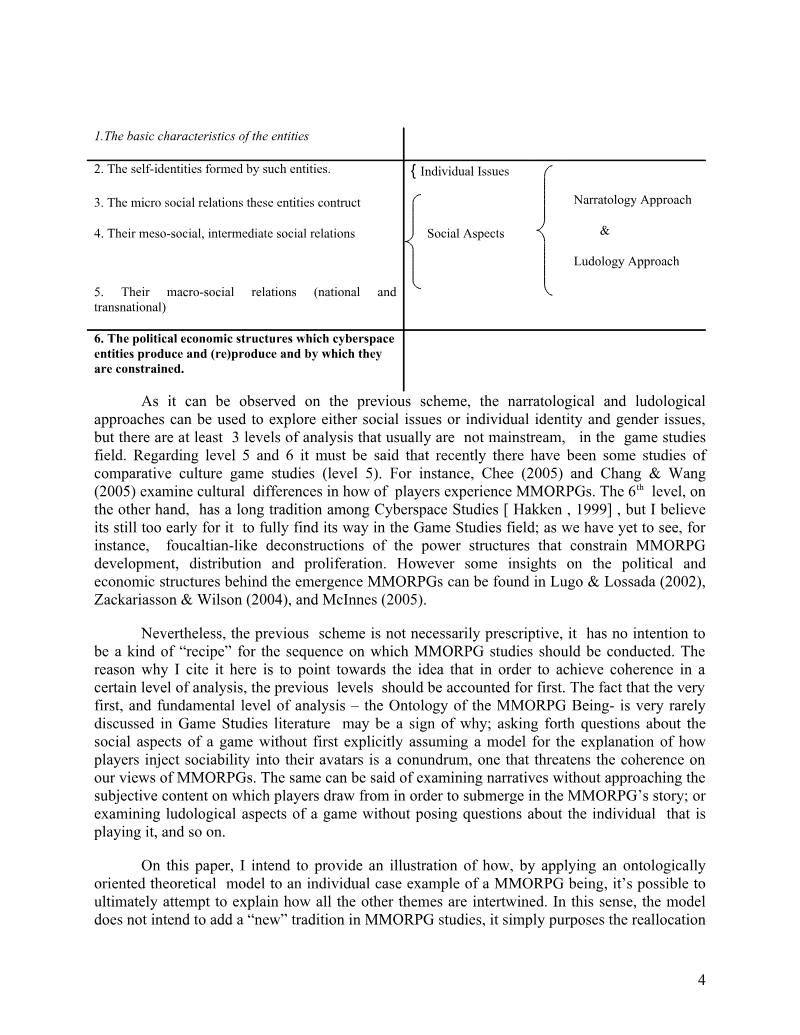
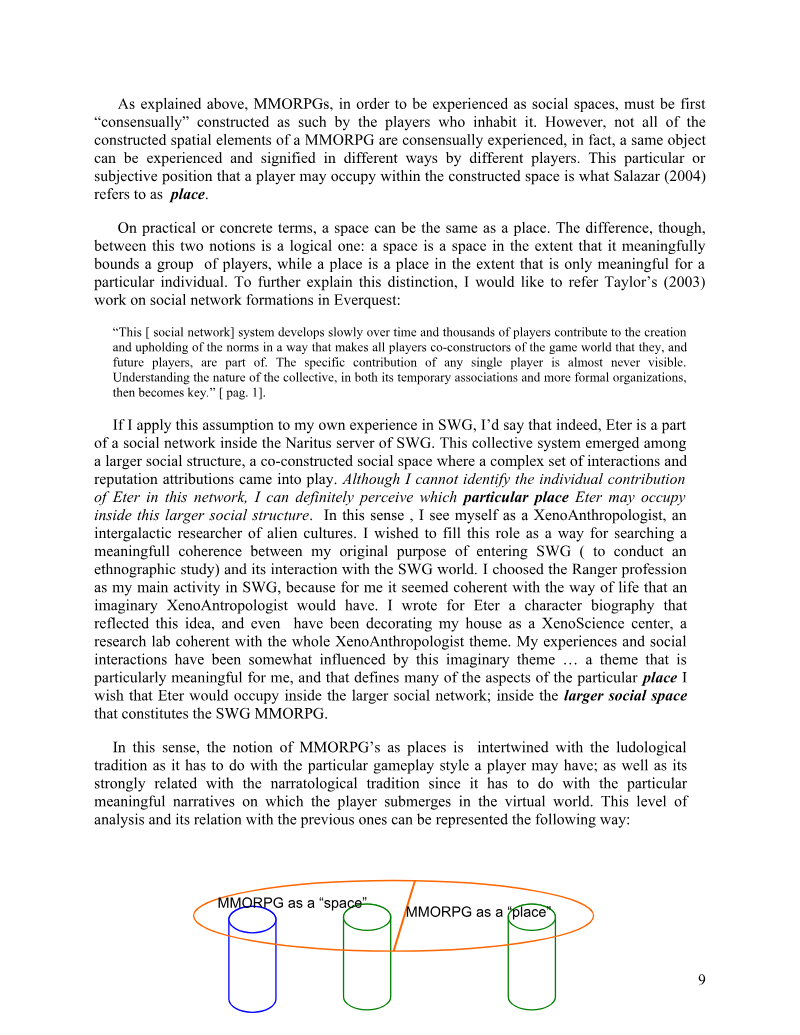
- The proposed model is layered, starting from the player's pre-existing subjective content and developers' software, hardware, and design elements, then analyzing MMORPGs as game spaces, social spaces, and individual places, and culminating in player identity expressed through cyborg-like avatars.
The Ethics of Computer Game Design
Miguel Sicart's "The Ethics of Computer Game Design" argues that computer games should be understood as moral objects whose code and architecture embed ethical values and function as power structures shaping how players act and experience play.
- Miguel Sicart argues that computer games are moral objects whose code (rules) and architecture (experienced play space) embed ethical values and act as power structures that shape how players behave.
- Sicart treats games as agents with a degree of artificial agency, which grounds the claim that they can be genuine ethical objects rather than neutral entertainment.
- Because designers inevitably shape the choices available to players and the values those choices express, Sicart concludes that designing games is itself a moral act.
Beyond P-1: Who Plays Online?
This study examines who plays online games and how their preferences cluster, aiming to move beyond earlier qualitative typologies toward a quantitative, empirically grounded framework.
- Exploration and themes/plot (88.5% each), good characters (86.2%), and graphics (79.3%) were the most important game features to surveyed online gamers, while military themes (31.9%) and realism (41.3%) ranked lowest.
- Based on a survey of 1,178 online gamers recruited via websites and bulletin boards, the sample is self-selected, heavily engaged, and skewed toward dedicated and Western players, limiting generalizability.
- Gender preferences diverged: males rated weapons, technology, and competition more highly, while females were more often indifferent to these features.

Making Right(s) Decision: Artificial Life and Rights Reconsidered
This paper, a DiGRA 2005 conference contribution by Juyun Kim, examines whether artificial life (A-life) and artificial intelligent robots raise genuine questions about rights and moral standing, using the popular simulation game The Sims as its primary case study.
- The paper argues that as machines become more socially interactive and emotionally expressive, the boundary between human and machine becomes less fixed, calling for a reconsideration of what rights mean for artificial life.
- The author's central evidence is qualitative analysis of public forums about The Sims and the robotic pet AIBO, where players described deliberately cruel treatment of their Sims (such as drowning or confining them) while also expressing guilt and reluctance to harm characters resembling family or friends.
- Research on AIBO users cited in the paper found people were attached to robotic pets yet seldom attributed moral standing to them, showing a gap between emotional attachment and moral consideration.

Mise-en-scène Applied to Level Design: Adapting a Holistic Approach to Level Design
This paper argues that mise-en-scène, the film concept of deliberately arranging everything visible within a frame to convey meaning, can be adapted to level design to deepen emotional engagement and communicate narrative and psychological subtext to players.
- Mise-en-scène, the film concept of deliberately arranging everything visible within a frame to convey meaning, is proposed as a framework for level design to deepen emotional engagement and communicate narrative and psychological subtext.
- The paper maps Robert Kolker's mise-en-scène elements (spatial arrangement, props, camera relationship, color, lighting, and framing) onto level designers' responsibilities such as set dressing, lighting, texturing, and object placement, noting that cinematography and costuming typically fall to other team members.
- Close readings of Kubrick's The Shining show how scale, the Overlook Hotel's labyrinthine architecture, shifting color temperatures from warm amber to cold blue, atmospheric effects like snow and haze, and repurposed props reinforce themes of isolation, decay, and supernatural dominance.
Video Games: A Significant Cognitive Artifact of Contemporary Youth Culture
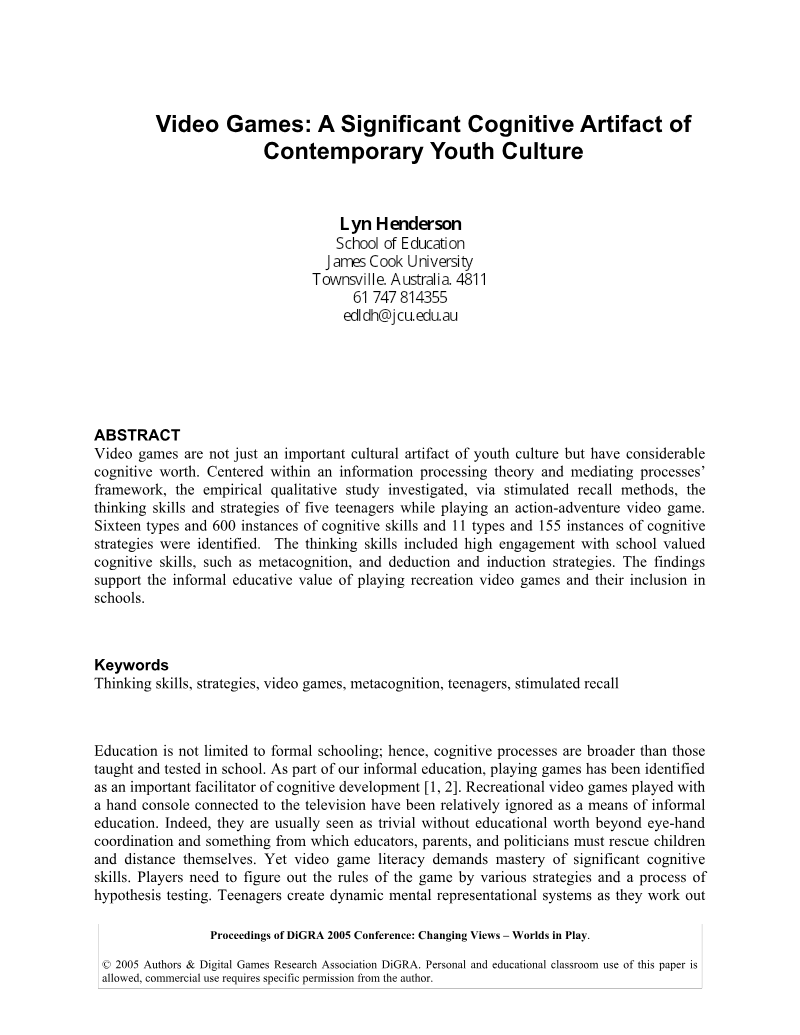
This paper argues that recreational video games carry informal educational value, examining whether playing a commercial role-playing game can engage the thinking skills and strategies that formal classrooms prize.
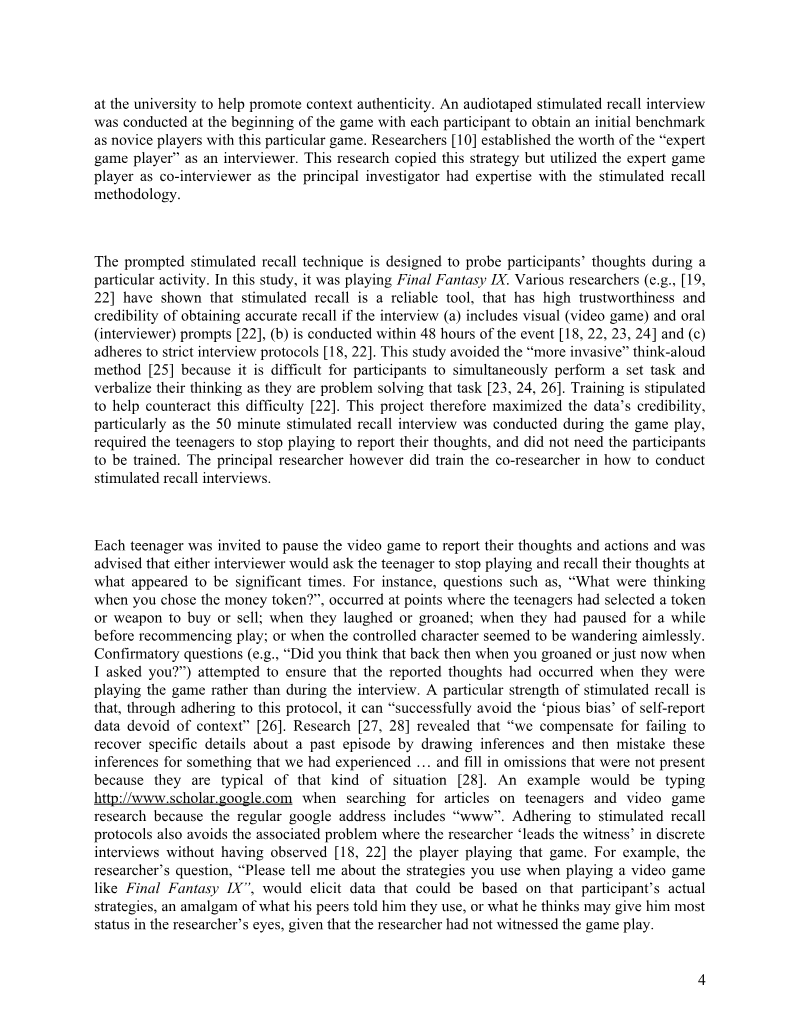
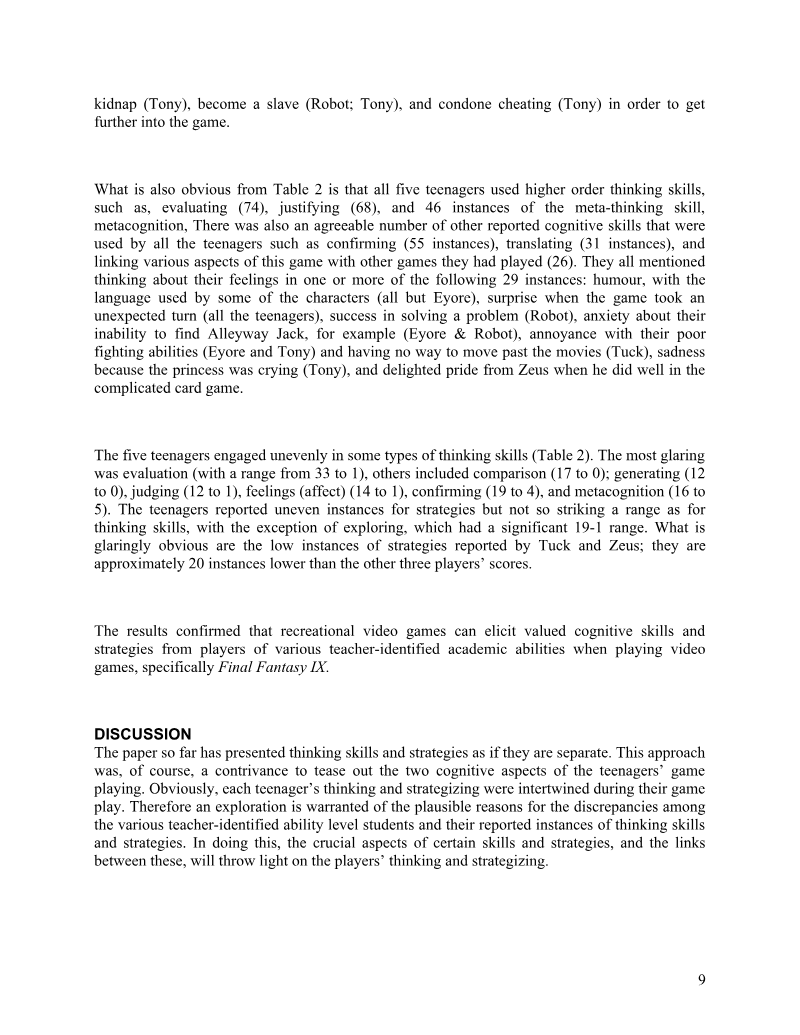
- A study of five 13-year-old players of Final Fantasy IX recorded 600 instances of thinking skills during play, most often predicting, evaluating, and justifying, plus 155 instances of strategy use led by exploration and trial-and-error.
- All five participants engaged in higher-order reasoning while playing, supporting the authors' claim that recreational games can be a legitimate site of cognitive activity.
- Informal cognitive performance during play often diverged from teachers' ability ratings, as one student rated average outperformed a peer rated very high, which the authors use to question conventional academic assessment.
A Real Little Game: The Pinocchio Effect in Pervasive Play
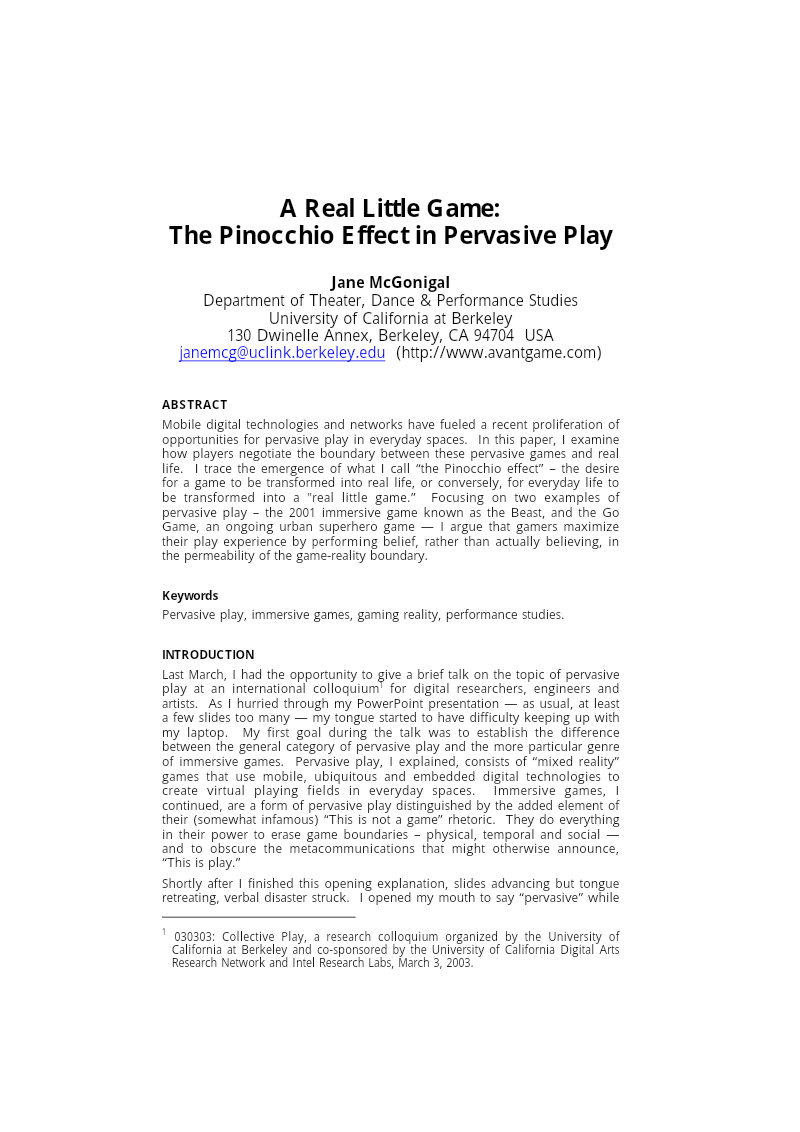
McGonigal's paper contends that immersive and pervasive game players are not credulous dupes but knowing participants who strategically perform belief, a dynamic she names the "Pinocchio effect."
- McGonigal argues that immersive and pervasive game players are knowing participants who strategically perform belief (the "Pinocchio effect") rather than credulous dupes, challenging press coverage of the 2001 alternate reality game The Beast.
- Evidence from The Beast shows players repeatedly smoothed over moments that threatened to expose the game's construction, such as WHOIS lookups revealing hidden domain ownership, a link to Microsoft, and an actor's slip, in order to sustain the "This is not a game" framing.
- Interview evidence from the designers, Lee and Stewart, supports the view that audience complicity, not gullibility, kept The Beast's experience alive.