User Acquisition reports and market data
Documents
Panel: Are Influencers the Future of Game Marketing?
Influencer marketing has transitioned from a supplementary tactic to a foundational pillar of modern game promotion.
- Game marketing strategy has shifted from prioritizing raw follower counts to focusing on a creator's ability to drive measurable actions within niche audiences.
- Successful campaigns now utilize a hybrid model that balances large-scale celebrity partnerships for initial visibility with long-term micro-influencer relationships for sustained community growth.
- Publishers are increasingly integrating influencers early in the development cycle to move beyond transactional product placements toward authentic, collaborative content.

Fireside Chat: Beyond IDFA - The Publisher Viewpoint
The mobile gaming industry is currently navigating a significant shift in user acquisition and monetization strategies following the deprecation of the Identifier for Advertisers (IDFA) and the implementation of Apple’s App Tracking Transparency (ATT) framework.
- The deprecation of IDFA and the implementation of Apple’s App Tracking Transparency (ATT) framework have shifted the mobile gaming industry from granular, user-level tracking to a landscape defined by aggregate data and probabilistic modeling.
- Long-term commercial success is increasingly dependent on core product quality and retention, as marketing can no longer compensate for poor engagement through precise, individual-level targeting.
- Developers are pivoting toward creative, brand-focused marketing strategies, including influencer partnerships and traditional media, to reduce reliance on automated, data-heavy bidding systems.
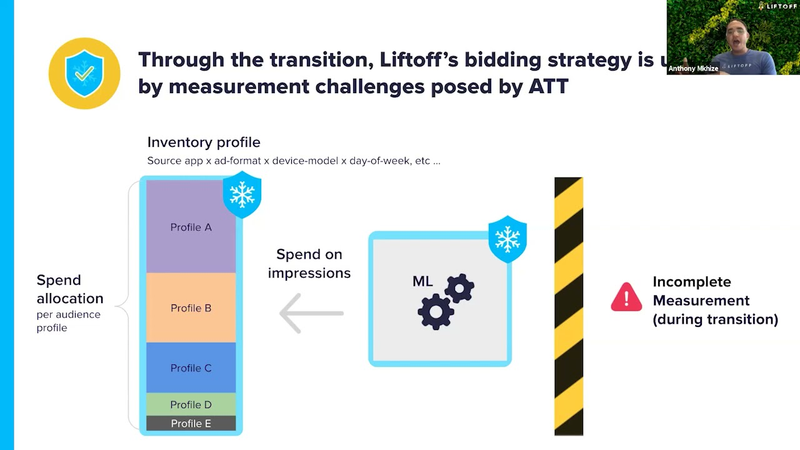
Superstar Session: Liftoff's Preparation for ATT
Apple’s App Tracking Transparency (ATT) framework necessitates a fundamental shift in mobile advertising, requiring developers to move away from traditional user-level tracking toward the SKAdNetwork (SKAN) ecosystem.
- Maintain a dual-campaign structure by separating pre-ATT traffic measured by mobile measurement partners from post-ATT traffic measured via SKAdNetwork (SKAN).
- Keep parallel infrastructure running for three to five months to allow for background training of SKAN-based models and bidding optimization before fully shifting spend.
- Freeze existing machine learning bidding models during the initial post-launch period to protect campaigns from volatility caused by measurement breakages and non-measurable inventory.

Superstar Panel: How the Industry is Preparing for Post-IDFA
The mobile gaming industry is undergoing a fundamental structural transformation following Apple’s deprecation of the Identifier for Advertisers (IDFA).
- The mobile gaming industry must transition from granular, user-level tracking to privacy-compliant frameworks like Apple’s SKAdNetwork following the deprecation of IDFA.
- Developers should shift focus toward high-quality creative assets and sophisticated data science models that operate without personally identifiable information (PII).
- To mitigate the loss of external tracking, marketing efficiency must be sustained through internal levers such as live-ops, push notifications, and rewarded ad models.

Panel: Is it Still About the Whales? Getting the Most of Your Users
The gaming industry is undergoing a fundamental shift in how it identifies and monetizes high-value players, moving away from an exclusive focus on traditional whales toward a more nuanced, hybrid revenue model.
- High-spending player cohorts continue to generate approximately 80% of total game revenue.
- The deprecation of Apple’s IDFA has forced a shift away from traditional acquisition strategies toward RFM (recency, frequency, and monetary) models to track player behavior.
- Studios are increasingly using contextual signals, such as session depth and device data, to predict and identify potential high-value users in a privacy-restricted environment.

Superstar Session: How to Win in a Fragmented Mobile Market?
The mobile gaming industry faces a period of significant transformation driven by increased market fragmentation, evolving regulatory oversight of major app stores, and shifting user acquisition dynamics.
- By 2023, an estimated 1.7 billion mobile gamers are expected to utilize alternative app stores, creating a significant revenue opportunity outside of primary global storefronts.
- Developers are increasingly targeting emerging markets in the Middle East, Africa, and Latin America, where growth is outpacing established regions due to the adoption of direct carrier billing.
- Automated distribution solutions now allow developers to bypass the resource-intensive process of managing store-specific SDKs, enabling simultaneous deployment across multiple Android storefronts.

Fireside Chat: Being Successful in Self-publishing
Success in the hyper-casual gaming sector is fundamentally rooted in rigorous, data-driven decision-making rather than creative intuition.
- Success in hyper-casual gaming relies on rigorous, data-driven analysis of cost per install, retention rates, and session duration rather than creative intuition.
- Studios should only attempt self-publishing after achieving a proven hit and mastering core development processes under the guidance of established publishers.
- Hyper-casual titles should be used as a strategic springboard to fund and transition into mid-core titles, which offer superior long-term stability and intellectual property value.

Panel: Choosing the Best Ad Format for Your Game
Mobile game monetization strategies currently center on balancing cost-effective ad formats with sophisticated user segmentation to navigate a shifting landscape of privacy regulations and user tracking limitations.
- Monetization strategy must shift from blanket approaches to granular A/B testing and data-driven user segmentation to compensate for the decline of traditional tracking and privacy-focused regulations.
- Video ads remain the industry standard for cost-efficiency and accessibility, while playable ads are largely reserved for established titles due to their high production costs.
- Developers are increasingly adopting contextual targeting and non-intrusive formats like offer walls to maintain revenue from non-paying users in a privacy-restricted environment.
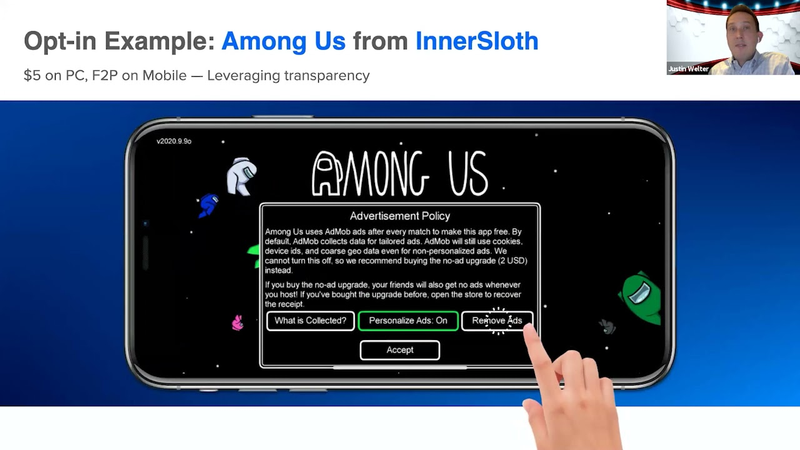
Monetisation Optimisation in Apple's New Normal
The mobile gaming industry faces a significant shift in monetization and user acquisition strategies due to Apple’s implementation of iOS 14 privacy changes, specifically the transition to an opt-in model for the Identifier for Advertisers (IDFA).
- The transition to an opt-in model for the Identifier for Advertisers (IDFA) under iOS 14 requires publishers to shift from traditional tracking to privacy-compliant frameworks like Apple’s SKAdNetwork.
- Publishers should implement header bidding or advanced bidding to allow real-time competition among ad networks, which stabilizes eCPM rates and offsets the loss of granular targeting.
- Rewarded video ads are the most effective format for maintaining engagement, as they consistently demonstrate higher completion rates and user preference compared to non-skippable formats.

Panel: Best Practices in User Acquisition & Retention
Modern user acquisition strategies are shifting away from traditional reliance on dominant social platforms like Facebook toward more diversified channels, including Google’s Universal App Campaigns, Unity, and AppLovin.
- User acquisition strategies are shifting from a reliance on Facebook toward a diversified mix of channels including Google’s Universal App Campaigns, Unity, and AppLovin.
- Marketing should be managed as a dynamic financial investment where capital is reinvested as long as marginal revenue exceeds the marginal cost of acquisition, rather than operating under rigid monthly budgets.
- Playable ads are a high-performance format that can increase install rates by two to three times compared to standard video advertisements.
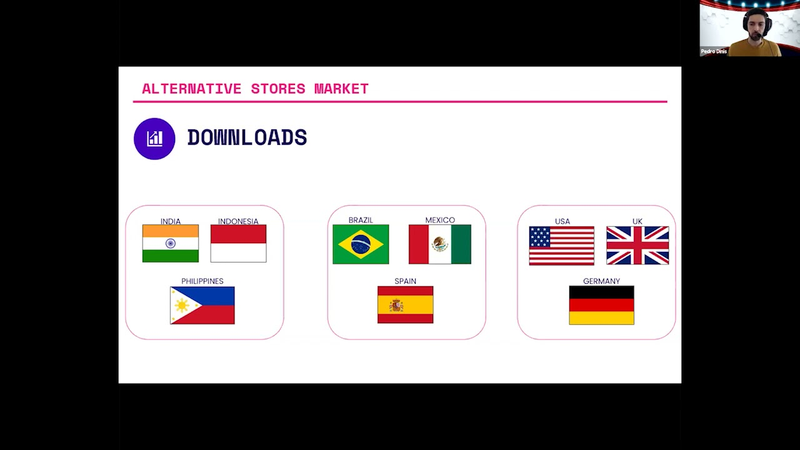
Growing Your Audience in Alternative App Stores
Alternative app stores have emerged as a critical growth frontier for mobile game developers, currently accounting for over 20 billion annual downloads.
- Alternative app stores, including Aptoide and OEM platforms like Huawei’s AppGallery, now account for over 20 billion annual downloads and represent 10 to 20 percent of the total Android market.
- Expanding into alternative channels requires a shift from automated, programmatic advertising to a hands-on operational model focused on direct business development and localized content.
- Alternative stores offer lower competition and more stable organic download rates compared to the saturated Google Play Store, making them effective for generating incremental revenue without cannibalizing existing traffic.
The Big Catch – Unlock New Audiences with Motivational-led Creative
The gaming industry often suffers from short-termism, where developers target narrow, saturated audiences with repetitive gameplay-focused advertisements.
- Developers should shift from gameplay-focused ads to a motivation-led strategy, targeting eight core psychological drivers: self-expression, social connection, progression, expertise, discovery, power, escapism, and relaxation.
- The gaming audience is broader than traditional stereotypes, with 86% of internet users playing mobile games and 50% of the mobile gaming demographic being women.
- Women demonstrate higher engagement levels than men, with mobile gaming sessions that are 25% longer on average.