1 free read left. Create a free account for unlimited reading + AI research.
Create free account
Superstar Session: Liftoff's Preparation for ATT
Key insights
6 takeaways- 01Prioritize the immediate integration of SKAdNetwork, the definition of clear optimization events, and rigorous frequency analysis to navigate the transition to privacy-compliant advertising.
- 02Maintain a dual-campaign structure by separating pre-ATT traffic measured by mobile measurement partners from post-ATT traffic measured via SKAdNetwork (SKAN).
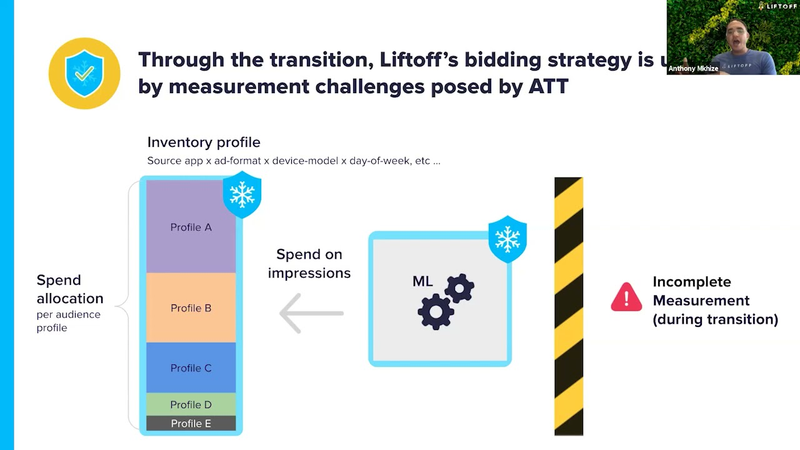
- 03Freeze existing machine learning bidding models during the initial post-launch period to protect campaigns from volatility caused by measurement breakages and non-measurable inventory.
- 04Keep parallel infrastructure running for three to five months to allow for background training of SKAN-based models and bidding optimization before fully shifting spend.
- 05Implement automated machine learning tools to dynamically allocate budgets between pre- and post-ATT inventory to compensate for the loss of granular user-level attribution data.
- 06Proactive testing and close collaboration with measurement partners are the primary strategies for mitigating risks associated with ongoing uncertainty in attribution mechanics.
Ask AI about this video
Transcript
and now we're gonna move on to a superstar uh session uh we've got liftoff talking about their preparation for att uh anthony uh from liftoff i think is gonna join us in a second hopefully any moment now uh anthony how are you doing um fine here we go there we go good good good stuff awesome how are you pretty good pretty good so uh very very excited to see what you guys are up to um i've i've found it really hard to keep track and i do this stuff most of the time yeah i spent so much of my career you know being a front man for an ad company and i'm still struggling so obviously i'm not going to be alone i can't wait to hear what you've got to say about the preparation for all this stuff so uh please go ahead excellent so i'll just share my screen and oscar if you could give me a thumbs up once you're all good
all good on that you can see preparation for att i can indeed okay so yeah just an introduction i'm i'm anthony lawrence and keyser i'm a sales engineer here at liftoff uh liftoffs of programmatic dsp i'm sure you guys are aware um and we work with some of the biggest gaming developers huge player x king and today i'm going to be talking you through how we've been helping them prepare for att uh obviously as apple's at tracking transparency which is due to come into effect with uh ios 14.5 um which which could drop in any minute now so uh without further ado um oh okay so we distilled our approached into some operating principles in order to guide us through this big change uh the first of these principles was a a smooth transition into a post att world we wanted to change as little as possible wherever possible
in terms of setup performance and workflows obviously some change was going to be inevitable we wanted to identify performance risks and then provide some counter measure to those and then provide ample heads up and guidance to our clients uh on these unavoidable changes secondly we wanted to adhere to apple's privacy guidelines at all times and thirdly we would always use a independent third party to measure campaign kpis so i think it's certainly worth mentioning at this point what we did not are not and certainly would not be doing in preparation for a t uh we would not try and create a a unique identifier in some sort of fancy way that would be an idfa by proxy um we're not finally passing apple's statements uh to find possible loopholes and ways to interpret things that would uh let us keep the status quo and circumvent essentially the letter and
spirit of of att liftoff was focused on uh adopting uh measurement system uh scan or sk ad network i'll use the two terms interchangeably um four four uh devices on 14.5 and above uh and evolving in lock step with the increasingly privacy conscious world right okay so this liftoff performance engine and these three pillars um essentially at the heart of the engine is a ability to accurately value a an ad impression and then show a creative which will which will convert a user or a potential user um in an idea in a post idfa world many of the components from this performance engine the sections you see here in black actually remain unaffected so for example we've always relied on contextual signals the technology that drives the ability to value each ad impression impression um
does not always rely on per user data now obviously that being said there were some modifications that needed to happen the sections you see in blue here um they we the way we understood users uh had to be tweaked we had to aggregate and solve groups of users now moving forward we also had to ensure our our supply partners were scan ready as well um now speaking of supply uh this is what that section of the ecosystem looks like for us at this point in time in terms of scan readiness or sk ad network readiness how many of them have that integrated to allow their inventory to be able to be tracked by scan the sk that worked um obviously supply side plays a crucial world in the post att world in terms of tracking um and supply side deduction is lagging it's not where we would want it um we're seeing well it's improving you're certainly improving at an increasing
rate as well you're seeing 64 as of april uh the 17th uh our scandal uh impressions so those are impressions that are available to be tracked by scan um but i expect this to pick up as we hone in on that release date which which could be any day now any hour now um so moving on to what the landscape will look like just days after launch of 14.5 so if within 40 days we expect 65 of ios impressions to be on 14.5 devices and therefore subject to that at t framework now we base this prediction if we have a look at the chart here on on previous point releases 0.2 14.2 14.3 14.4 and they follow a similar pattern the adoption rate starts off slow and steady and then we see this big uptick and we expect a similar pattern for um for 14.5
now the environments can be fluid it's going to be turbulent it's going to be changeable and later i'll be talking through the measures that liftoff will be putting in place to smooth out that period um which if you remember was uh our first operating principle okay so apple's att framework essentially changes how we're going to be measuring conversions and giving rise for the need for two two ios campaigns a a post att campaign so for devices running on 14.5 or or later on scan enabled inventory will use scan ice cad network for attribution and pre-att campaign so that would be the existing ios campaign running on devices on 14.4 or below and will be measured by the by the mmp and i think this slide illustrates it uh better fundamentally um 14.5 or in fact the att framework really is giving us that measurement challenge
so following the launch there will be uh three different types of inventory each of which will be characterized by how they are measured so if we look at the chart here on the left hand side um the blue section is the world that we live in today it's the world that i woke up to this morning um where users on 14.4 or below campaign kpis measured by the mmp generally uh with those real-time granular postbacks we're getting for pre and post in-store reporting now the green section the green and yellow section but we'll partner yellow section for a second the the emergence of those are the release of 14.5 and if you if you look at the date that we that's the date we were expecting it so um so yeah it's been a while um so that appears these sections appear once the um once ios 14.5 is out and users are upgrading from 14.4 into 14.5 and therefore campaigns will be measured by scan scan in that green section now that
yellow section at the bottom there is uh those are 14.5 users as well but they are actually in-app source apps where the publisher app hasn't done the required work in order to allow their inventory to be able to be tracked by scan which still might be an issue as we saw the lagging scan adoption on the supply side before so we're in a bit of a quandary with this because the users upgraded onto 14.5 more than likely hasn't opted into sharing their ivfa um and we can't probabilistically or fingerprint match them um we know that's a big no-no so they can't be attributed by the by the mmp and it can't be attributed by scam because the publisher app hasn't done the required work in to allow their inventory to be able to be tracked by scan so they fall into this this um non-measurable pool of inventory now how how long this pool of inventory lasts
how deep or wide it is is completely dependent on supply-side deduction of that scan integration which like i said we expect to um to increase as we hone in on the release date okay so how to manage the transition um so to make sure our customers were set up for success i'm going to run through um our approach and recommendations in these three areas the bidding strategy the budget allocation between those two campaigns that pre-att campaign uses on 14.4 or below measured by the mmp and the post att campaign used on 14.5 and moving forward and above measured by scan um and then finally advising on campaign setup changes and and gold definition okay so bidding strategy ml approach let's um here we see a depiction of the feedback loop ml has to change train and adjust its bidding decisions and
optimizations and therefore drive better performance the first measurement challenge we have here is that pool of supply that we are the non-measurable pool the pool there will be no learned data for ml um so we're not going to be learning anything from that section of supply so we have incomplete data essentially uh that's major challenge number one um number two the second problem is that we we fully expect tracking breakages and instability especially during the transitional period at the beginning um why do we expect this we well this is the first time apple was rolling this out at scale so every entity in the in the ecosystem whether it be a source app would be an exchange whether it be a dsp whether it be an mmp whether it be an advertiser has to do work to get ready uh for scan attribution now all of their efforts have to go correctly in order for attribution to work this is the first
time source apps have been tasked with the responsibility of ensuring that tracking tags are going to be working properly in order for advertisers to be able to track conversions so we think things things might go wrong here um i mean things have been going wrong we've been dealing with some measurement challenges uh some bad setups uh impacting scan reporting and also just straight up breakages really bugs on the apple side um what's the correct adjective incomplete misleading implementation documentation which has led to some problems with scan reporting so it's important that when bidding strategy and ml was so tightly coupled with measurement that if breakage has occurred those breakages are going to feed back in bad data and drag ml away from performing well and we certainly don't want that so what's our plan when it comes to those two measurement challenges uh previously mentioned um
we have a strategy that involves freezing ml um and we believe that this has a number of advantages um initially it will help weather the storm protect from those those measurement challenges the breakages the incomplete data learning off of bad data will keep campaign ml models frozen in their most up-to-date state locking in that um that buying strategy and in the background we'll be collecting scan events and training scan uh uh taught ml in the background whilst running on that frozen ml so by employing this strategy we believe we're going to get better out of the gate performance we've got that optimal buying strategy locked in we'll have robustness or protection from those tracking breakages um and a big one here i think is we'll be able to provide more time a time to really decide on the optimal campaign setup for that post att campaign which will be attributed by scan um we'll be accumulating no scan postbacks
and events which will be training the models in the background and we'll be able to maximize the amount of time supply has in order to to integrate sk ad network or scan on their inventory to allow to shrink that non-measurable pool of inventory tackling that incomplete data problem that i mentioned before um so this strategy of freezing uh ml would only be in play during that transitional period when scan only when the scan only models we've been training in the background start predicting better than frozen models we have implemented on campaigns we'll start slowly shifting spend towards those uh those scan only taught ml models so how long do we think that we can run on on um on those frozen models uh we've actually been successfully doing this for over three months for a privacy um inclined customer of ours so we expect we'll be able to run performance between three to five months on those
frozen ml okay budget allocation so to maintain optimal performance budgets are going to have to be um dynamically distributed across those two inventory types so pre and post att campaigns are going to run concurrently um and obviously target mutually exclusive inventory so whether it uses on 14.4 or below or 14.5 um supplier value availability is going to rapidly change um potentially by the hour especially in that initial period post launch so the pre-att campaign used on 14.4 supply will dwindle as users upgrade and move into 14.5 and we don't want to over spend on that shrinking supply and then the post att supply is going to rapidly grow and we don't want to hold back a campaign with a static budget on that so to avoid um degrading performance budgets are going to have to be um
dynamically adjusted between pre and post so this brings up our auto rank feature that we've developed which is essentially automatic budget allocation between those two campaigns so obviously an overall budget for both will be set and then our algorithms will take the guesswork out of how to split between pre and post um the auto ramp feature here is going to be more responsive to large well inventory changes in general than any sort of manual analysis that a human being could ever really do especially in that initial really dynamic period post launch so campaign setup and goal definitions for our post att campaign we're going to have to uh pick the right event to optimize towards four scan um to maximize performance we have been suggesting uh we select a an event that goes frequently after we install an upper funnel event um ideally within that that first day
after install this is going to maximize the volume and freshness of data for training that ml uh allowing it to make better bidding decisions especially important because of the 24 hour timer mechanics of the scan attribution so when it comes to the right optimization event to pick if you have a campaign currently live with liftoff we can conduct some frequency capture analysis of those events uh to advise which one would be most optimal to pick we can also well we also suggest you work with your mmp to define these events as well um we're going to support cpi and cpi optimization for those scan tor ml models and the sooner we have those scan events coming back and a event pick to optimize towards the sooner we can start training those scan taught models in the background right this lots of words on this slide
but let the broad brushstrokes of it are this on the left-hand side we see the risks involved um with the changes ahead the implications of those risks in the middle and then are counter measures that we uh liftoff has put in place um so just to broadly go over it the lagging supply adoption will have a negative impact on on post-aett supply we've been raising awareness in the industry about what's at stake in solutions um and working directly with exchanges and and our top source app to ensure scan compliance uh so walking back to those tracking breakages and the integration issues as far as data for ml the response for this if you remember was to freeze our most performing ml and those models locking in that optimal buying strategy and safeguards against the data pollution and it also buys time for scan setup and optimization um and finally a complicated setup for scan events we which will negatively impact measurability and performance
um we are going to analyze the capture rate of the events that you have coming back currently and then uh suggest which one would be the most optimal underscan attribution mechanics to to optimize awards and provide a step-by-step checklist in order to maximize scan readiness um uh when it comes about which could be any day any hour now okay um i think yep that is it i'd uh like to throw back to oscar there oh great stuff but i seem to have missed the mute button when i pressed it we have a whole bunch of questions for you as i'm sure you understand but i mean for me what i think is um clear anyway it's just we we even though we know it's coming even though we know it's well presumably any minute you know i'll say something about it probably um we still have a lot of uncertainty and it sounds like there's going to be a
lot of transitional stages that you know as a developer as a publisher of games we're going to have to kind of rely on on you guys on on the kind of platform providing psp and so on and so forth to be able to help advise us and help us understand what the best you know way forward is um you know is it is it simply that i mean is it do we just have to wait and and platforms or is there anything else that we should be doing uh yeah well i mean it is a waiting game certainly uh there are some due diligence that we can put in place now we can make sure that we have scan integrated ideally now we can make sure we're receiving those scanned postbacks and we're forwarding them on correctly to your mmp and you're seeing what we're seeing um we can also pick an event to as i mentioned in the presentation we can pick an event to optimize towards now we can start training our scan only models as well so we don't start um from a from a standing start
so i mean those those are the big things here let's get scan integration working postbacks coming through and check that all of the pipes are plugged correctly um so we're not caught off guard and we're not doing this after it's already launched yeah i think that's really important isn't it so do what you can i think it's going to be particularly impactful on people who've got already got momentum uh a lot of studios we work with are just trying to work out how they're gonna test the basic stuff let alone you know it's their game of interest at full let alone how they optimize it feels to me like a lot of the kind of the really difficult stuff is working out how we're going to do if you're used to being able to really target efficiently to know you know retargeting works well and how you've got your audience you know behaviors and your segments and your row ass that's the part that's the difficult bit for me i mean i think i can promote for a long time is that fair no i think yeah i think you're completely right um i think there's gonna be there's going
to be a lot of testing in trial and error because um that's going to be inevitable um especially when it comes to conversion value modeling i think you might also see certain um [Music] conversion value models arising in certain verticals so uh so travel might set up conversion values in a certain way gaming might do it in a certain way um so that's going to be interesting to monitor as well yeah i think it would be interesting to see how you can learn some how the how other sort of that fight function in this way i mean i think particularly a rewarding video would be interesting anyway enough of me tasking stuff uh we have some questions for you so do you help in ua only or can a developer monetize through liftoff as well and can we get lift off demand through fiber or some other mediation uh yet liftoff's connected with all of the the major exchanges i'm sorry i missed that first bit was the first bit it was do you help in ua only so you
don't know or do you focus on monetization or both um so liftoff runs um ua campaign certainly and re-engagement campaigns um generally focusing on driving users to down funnel events um so yes certainly cool and so the next one was um what is your main source of inventory and can you explain your dsp user journey main source well as i mentioned before we are connected across all of the major exchanges um so all types of inventory uh there's not an inventory source where um that we would not be able to offer certainly so whatever it might be video banners interstitials native whatever it is uh certainly we can provide uh another question we've got is what is ml art now i'm pretty sure it's machine learning i think they're pretty sure it's machine learning acronym industry i should have i should have
made that clear yes i mean like i've been doing this stuff for so long and i've learned acronyms this last few weeks you know it's like uh yeah the the number of acronyms seems to be exploding as we get more and more i think i think there's a sort of factor between a level of uncertainty and the number of new acronyms we invent yeah is that fair when we're trying to deal with you know rapid changing environments i think it's understandable we grasp a shorthand as quickly and easily as possible i think historically in monetization we use the term whale a lot which i'm trying to avoid using and but i can see why we end up doing it anyway um next apple hasn't mentioned idfa in the event yet i don't know if it's over yet or not somebody might tell me um so i believe we started on the hour didn't they is it seven yeah they've been going for since i was
i've got a tech radar in the background um running live i think it was actually 6 p.m so they've been going for an hour and a quarter um yeah so okay that's interesting well yeah i really thought it was today yeah i can see um elements apparently um but jess has just confirmed that uh uh oh no it's over no mention well thank you jess well that's interesting i mean i i'm i'm not an actual user but of course it's such an important part of our industry yeah and it's very what do you make of that the fact that they haven't come tonight i mean i've been going through through the ringer with this uh as you could have seen in one of our slides earlier we've been prepping for this since the beginning of march um and i really what if we could just get a date it would make everything a lot easier to plan for it's the not knowing could it be this
week could it be next week um everyone's kept on their toes it's not i mean they're the biggest technology company in the world so our my chagrin is probably not even going to be a blip on their radar but it's it's it's annoying um yeah i i find it strange that they haven't mentioned it because it is going to be an absolutely monumental change um so yeah not this maybe next one but at the end of the day i think what we are seeing in you know whatever you think about apple's decision or not the reality is that we are seeing a you know a ground shift in terms of the interesting premise and i think and there's also particular we've been doing some work recently with the ico so that's the um the um um privacy group uh in the uk recently about how to gain uh how to incorporate particularly child related privacy in game design and it's fascinating kind of looking at that piece you know just how important it's now
becomes in terms of a kind of cause um and i think you know one of the biggest risks i think we have is as a as an industry is i i keep going back to the cookie thing i i think that the the way that cookies operated that making people less safe i think that's a travesty i don't want to see privacy becoming something which causes people to be less safe and less able to protect their their needs and and i i wouldn't be surprised if that's a concern that organizations like apple have and they want to make sure they do the right thing yeah but it feels seem like they've already said what they're doing to a large extent do you think there's anything that's yet to come that we haven't haven't yet understood or or do you think we're just waiting for them to pull the plug um is there something yet to come there was a period in time where i was learning more and more uh about how the mechanics of attribution especially around att
work scan was working and the delivering of the message from apple has not been uh it's not been clear and helpful in my opinion um so around the privacy thresholds when it comes to conversion values um in the postbacks we'd love some more information on exactly how that's going to work uh same thing with the source app um all of these things uh just an explaining an explanation of how they work even if they're not going to change how they work would be would be absolutely fantastic so work upon the rules which are being inflicted might be a tad harsh but but at least enforced yeah no it's interesting um there's a note here which i think has come from jazz as well on the uh on the on the chat but um apparently um air tag requires uh um ielts 14.5
and air tag is launching on april the 30th so does that mean they've kind of secretly launched it uh well announced it as next anyway whatever um i just think it's fascinating we're in incredibly fascinating times um you know at the same you know month that we're um we're losing idfa we're seeing steam giving us some level of attribution for pc games which is a i think a phenomenally positive thing um but again privacy will be important there as well and one last softball question before i uh i invited you to come on um softball question for you what is the difference between a dsp and an ad network a dsp buyer's exchange buys from exchanges um an ad network will have a network of um of publisher properties underneath them so liftoff is programmatic dsp buying from all of the major ad exchanges the fibers the googles of
this world um an ad network would be an an app login i believe yeah i would forget and i always i always make the mistake between demand and supply side because my head as a game maker it's the wrong way around but i've spent so much time i should know by now but anyway anthony thank you so much for that really fascinating stuff i think we're amazingly interesting times and um i really appreciate you you do that i will sort out the um the hours about to start that later for the question give us as well thank you very much you
Summary
Apple’s App Tracking Transparency (ATT) framework necessitates a fundamental shift in mobile advertising, requiring developers to move away from traditional user-level tracking toward the SKAdNetwork (SKAN) ecosystem. The primary strategy for navigating this transition involves a phased approach that prioritizes stability by freezing existing machine learning bidding models during the initial post-launch period. By locking these models, advertisers can shield campaigns from the volatility caused by measurement breakages and the influx of non-measurable inventory resulting from lagging supply-side integrations.
To manage this shift, a dual-campaign structure is essential, where pre-ATT traffic measured by mobile measurement partners remains separated from post-ATT traffic measured via SKAN. This methodology allows for the accumulation of reliable data and the background training of new SKAN-based models. Developers are encouraged to maintain this parallel infrastructure for three to five months, providing a sufficient window to optimize bidding performance before fully committing spend to the new privacy-compliant framework.
Success in this environment relies on the immediate integration of SKAdNetwork, the definition of clear optimization events, and rigorous frequency analysis. Automated machine learning tools should be employed to dynamically allocate budgets between pre- and post-ATT inventory, ensuring that performance remains consistent despite the loss of granular attribution data. While the industry faces ongoing uncertainty regarding attribution mechanics and the broader impact of privacy regulations, proactive testing and close collaboration with measurement partners remain the most effective strategies for mitigating risk and adapting to the evolving digital advertising landscape.


















Comments