1 free read left. Create a free account for unlimited reading + AI research.
Create free account
Monetisation Optimisation in Apple's New Normal
Key insights
6 takeaways- 01Rewarded video ads are the most effective format for maintaining engagement, as they consistently demonstrate higher completion rates and user preference compared to non-skippable formats.
- 02The transition to an opt-in model for the Identifier for Advertisers (IDFA) under iOS 14 requires publishers to shift from traditional tracking to privacy-compliant frameworks like Apple’s SKAdNetwork.
- 03To improve opt-in rates, publishers should use pre-prompt strategies that transparently explain how data collection supports free-to-play experiences.
- 04The adoption of SKAdNetwork necessitates a move toward contextual targeting and programmatic solutions to mitigate reporting delays and the loss of traditional audience targeting capabilities.
- 05Publishers should implement header bidding or advanced bidding to allow real-time competition among ad networks, which stabilizes eCPM rates and offsets the loss of granular targeting.
- 06A hybrid monetization model that combines programmatic bidding with clear value-exchange disclosures is the industry-standard approach for sustaining growth in the post-IDFA ecosystem.
Ask AI about this video
Transcript
so let's get started that's what we're here to do our first track of the day monetization optimization and apple's new normal great topic very timely and we have as our guest justin welter vb brand performance and business development sharing examples that we'll be listening in here about how publishers are addressing apple's new requirements and i'm sure it's going to be a great pick as well because a little bit of a fun fact here it's in his dna as i understand it justin you were a varsity poultry judge at oklahoma state university prior to graduating joining google so if you can pick them this is it i'll leave it to you so thank you guys thank you all so much uh good morning from sunny not so sunny really san francisco
i'm excited to to speak with you all today really appreciate the opportunity um i said i'm here to talk about uh monetization optimization in apple's new normal um so as we know there's a lot of changes that are coming down the pike with regards to ios 14 and specifically around privacy specifically around tracking specifically around attribution so what i want to do is talk a little bit about about those changes talk a little bit about the mobile app ecosystem obviously kind of introduce ad colony a little bit but specifically talk about how apple's upcoming changes are going to impact that ecosystem right i mean there's obviously it's going to impact all of us and i think that there's a lot to discuss so kind of kind of jump into things um so a little bit about ad colony we were founded in 2008 by game developers for game developers our bread and butter is really in-app rewarding video what we do really
is we work to match the most engaging creative to the right user at the right time and really focusing on ensuring that publishers have the highest ecpm possible as a result of that since our founding we've found that there are certain kind of there is a certain kind of monetization journey that occurs um and so uh specifically you know in it i'm sure we're all very familiar with this but you know a developer launches an app they'll do user acquisition via ads or across promotion for that app right the next step will obviously be to monetize those users typically done by either in-app purchases or in some cases revenue through ads and then the final step in that journey is really kind of taking those monetization revenues and then reinvesting them if you will into uh you know gaining new new users and so uh
the point of this is that basically this is kind of a circular journey that kind of goes from launching an app to monetizing that app to you know finding new users to that i don't think that this is anything new for any of us but i think it does you know when we're kind of in the midst of this journey we kind of ask ourselves you know what is the best way to to leverage ads to monetize our content without kind of um sacrificing any type of user experience and i think that the reality is is that the market has kind of you know luckily the industry really has kind of come to a consensus on that and uh what it is is that users truly prefer value exchanges as opposed to not so users are more comfortable with ads when they're given a choice and what i mean by that is that um you know if you're playing a game and a user is able to uh you know uh let's say uh you know you have an option between
uh you know showing uh being shown an ad or you know doing an in-app purchase the user is much more comfortable and open to ads when they are given that opportunity for value exchange when they're given that option and so specifically what do i what do i mean by that what does that look like here's an example of a video ad and one of our publishers uh where the publisher is able to you know there's an opportunity for ad to be shown the user is able to click on that ad click to watch that ad rather and then a hilton ad is shown and as a result of this kind of experience at a high level this is actually three times more preferable by users as opposed to non-skippable pre-roll videos and is actually like uh is actually ex results in ninety percent more uh ninety percent higher video completion rates and so with that in conjunction with the astronomical growth that we have seen in the market uh in
gaming gaming is projected to be 3.3 billion users plus globally by 2023 and then you add in the fact that there are uh the vast majority of the users the vast majority of this time that they spend is actually you know when it comes to their digital time is actually spent uh 68 of their time is spent in mobile apps uh for the segments of 18 to 44. there's no real wonder as to why marketers are interested in mobile gaming right and it also kind of speaks to why these changes are in the ecosystem especially by apple are so important to to marketers and to to publishers because it really is going to impact not only how they uh specifically monetize their content but then also how they do user acquisition so without further ado let me kind of talk a little bit about two of those changes
specifically uh around idfa opt-ins and around sk ad network and then kind of discuss some best practices that we've seen um you know publishers leverage and then also some best practices going forward with regards to uh how publishers can better monetize their content in these changes um so first and foremost as i think most of us know idfa is going away uh is changing to a uh opt-in experience and so what that means is it basically uh you know for monetization and for tracking purposes apple is basically requiring the publishers get permission from users in order to to obtain and track that idfa and so what does that mean well there's going to be a prompt i think we're pretty much familiar with what this prompt is uh we've seen it probably on the location side of things but this is gonna be new for the tracking purposes of things um and that prompt will basically you know a user will have to accept to that in
order to for the publisher to obtain the idfa and if they accept well everything's going to continue as normal but if they deny well then they won't have that you know publishers won't have that idfa for tracking purposes and if they do anything around trying to fingerprint or track the users assuming that the the user has told them not to then they risk actually being completely bland from the app store so the point of this is that there are huge implications that can occur here and the question for a publisher becomes you know how do i get the highest opt-in rates how do i increase my chances of being an opt-in because this isn't going to be something that you can ask every 30 days this is going to be as i understand basically a one and done kind of scenario and so uh what i want to kind of do is show some best practices that we've seen with publishers to kind of discuss a little bit what those you know how to kind of ensure that you're getting the highest opt-in rates possible so here's facebook i'm sure we're all
familiar with this this is actually some testing that they've done i haven't actually seen this on my app yet but i've seen i've heard that this is kind of going around at this point and what this is is this is kind of a pre-prompt that they've kind of created and what what is within this pre-prompt is basically very clear indication as to what's being tracked and why it's being used and this kind of goes back to um you know showing exactly what creating transparency with the user and a clear understanding of what that value exchange is that we kind of referred to earlier with rewarded right we feel that in showing um users of choice right or giving them an understanding of things i think that they're more open to to kind of interacting with stuff and so point b is kind of you know in transparency you know the the goal is to allow for users to have a higher opt-in rate overall and so there's a couple examples i want to show that are from the industry that i think are kind of unique and interesting so first and foremost is among us from
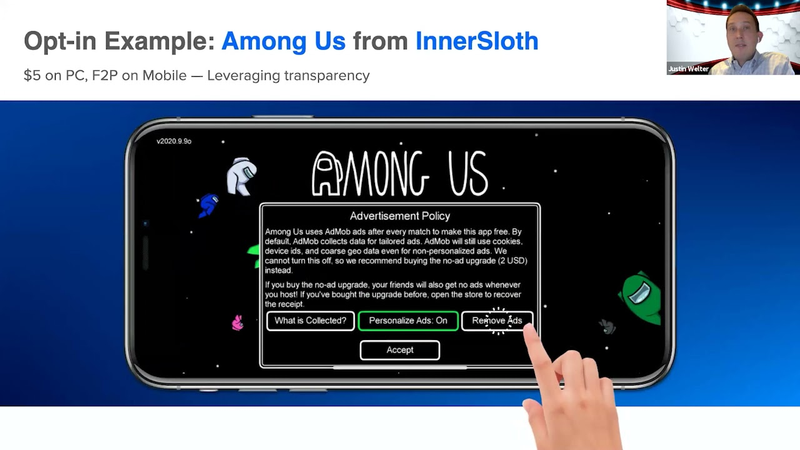
inner sloth this is unique for a variety of reasons basically this is a pre-prompt that happens right when you open up the app upon launch and it has a clear indication as to what the policy is what's collected why it's collected but there's two kind of interesting things about this i want to kind of highlight first and foremost this is something they've been doing prior to all the announcements with apple this is something that's been kind of in there i think really from the beginning of their their launch on the app side of things and what's unique about this wording is it basically says hey we use google admob admob collects certain information we can't control what that information is we can't turn that information off if you're uncomfortable with this for any reasons you can basically you know choose to remove the ads uh you'll be brought and then basically brings them to a storefront where they can basically purchase uh you know an ad-free version of the app right and then go from there and of course obviously if they want to accept they can accept and continue on playing the game as usual but
again this is something that's kind of interesting because it specifically says everything is selected it tells you whether the ad personalization is on asking if you want to remove ads and then you have the opportunity to accept right another example that i like is this example from ball blast by voodoo and i call this kind of referred to this as ask educate and then the ask again approach and so what happens here specifically is you have a pre-prompt again that pre-prompts you to say for instance you choose no then you're brought to kind of a branded panel that basically explains you know why we use this why it's important to us as as app developers um and it kind of allows for the publisher to actually educate the user as to what is the value exchange that's occurring you know obviously then the user can basically choose to continue and they'll brought back to the actual apple prompt or they can choose to kind of go through an in-app purchase and choose an ad-free version of the app but again this is kind of interesting
because it focusing on that value exchanging explicitly determining what that is right obviously if the user wants they can go straight and say hey i allow for this no problem then they're brought back to the to the the apple prompt and they can choose to allow for tracking there um and then another example i think is kind of interesting this is kind of a unique example i don't i call this kind of the the branded the branded uh animation or branded uh pre-prompt um and basically what happens here is that upon launching the app uh there's kind of a a brand interstitial that basically says okay again pre-prompt explains what's being tracked why it's being tracked etc and if you look at this basically uh there's an animation that emphasizes the user to click ok and if they do so then they're brought to the prompt if they click don't allow then there's a potentially a one-time nudge if you will where either that animation will move
over to the okay or maybe the interstitial will kind of shake a little bit something will occur that's basically one time that says hey look like we would really prefer for you to do this um and so this is kind of unique a little bit different um and i think it's kind of uh it allows for some type of interaction within the app for some type of branded content that is let's say maybe in tune with the brand and what the app is proposing um i think with all these examples it's important to say that there are no hard and fast rules um it's all comes down to you know your users your app what you feel is best for them apple really hasn't said that there are specific best practices around this they haven't really said what will be allowed in the pre-prompt quote-unquote and what won't be and so i think it's important to do some testing here i would say also that because you know you have the potential of that pre-prompt being uh disapproved or not approved rather um that it's important to kind of test
some maybe some of your your long tail apps as opposed to like flagship apps just because uh you know you don't want to be in a situation where you create a different experience and then ultimately that experience is disallowed so um again just to kind of emphasize these are all kind of suggestions that we've seen in in in the in the ecosystem i think they're all kind of interesting different and i think they're going to be important to kind of experiment to see how to get that the highest opt-in rates possible um another um item that's going to be kind of announced and i think is important to understand is sk ad network um i i'm sure that most people have kind of just heard about this or kind of have kind of a brief understanding i'm not going to go into the technical aspects of things but i do want to just kind of provide a brief overview of what sk ad network is and why it's important so basically what it is is apple's attempt to do attribution um in a privacy safe manner right and so we're kind of taking away from the idfa
world and we're kind of entering into apple's kind of attribution world where everything is going to be focused on privacy and i think what's most important in all the details that you're looking at and kind of analyzing is that basically everything's said and done ad colony is completely integrated for into skid network and is basically future proof uh for uh the io ios 14 launches they're occurring um what is important to understand though with all of this changes that are occurring is it will affect modernization and um because of the various reporting delays that ski networking have some privacy limitations it really means that basically managing your waterfall is going to become a lot less scientific um what's going to happen is is that you're going to have a lot more contextual targeting as opposed to like audience targeting and as a result your ad networks their performance is going to vary day to day week to week there's going to be a lot more fluctuation
and so actually managing waterfalls on a day-to-day basis is going to be quite um it's going to be a little bit more difficult because of those fluctuations it's going to be a lot less predictable and so we suggest as a result of that to move forward with header bidding options r2b advanced spinning whatever you want to call it um and implement that because it's going to allow for you to have a lot more kind of granular controls a lot more better performance as opposed to managing the waterfalls within this kind of changing environment so specifically what does that mean why is that you know if you're not familiar basically header bidding or advanced bidding is basically a programmatic option that happens for every single impression where all the ad networks are able to compete on that impression in real time and so as a result you are guaranteed higher cpms because everybody's competing only the highest ecpm at the high speed wins and so you have you know higher higher revenue for for your apps but then i think also there's
more competition and there's less latency because you're not really working to kind of optimize your overall kind of waterfall on a day-to-day basis et cetera and so strong suggestion to move forward with that given these changes in sk ad network because you know i think everybody's trying to figure out specifically how will that affect things and i think it'll obviously as as discussed have implications on how you got to manage your ad network stack uh full list of um kind of the advanced spinning rtb header bidding partners i think it's important just to say that you know ad colony works with all these partners we do have now a shared owner in digital turbine between us and fiber but i think it's also very important for us to say that and to emphasize that we have been kind of agnostic in this space and we will continue to be agnostic and so we're going to work with all the players in space obviously it's it's important for us to do so and so um you know just to kind of emphasize that this is gonna be something that's gonna be important going forward and we will work with you know we work with
all the players uh to help you kind of implement this this technology and so um that's kind of the gist of things i think that these two changes are going to be obviously important for publishers moving forward are going to have implications on how you kind of monetize your your content and um obviously also on the other side of things how you do your ua and so just want to kind of point these out introduce us a little bit and then talk about some of those changes and hopefully help to uh you know allow you to better monetize your content going forward and hopefully that content will be monetized through advantage so thank you thank you as well justin and you finished literally just in time um questions are coming in i'll start off with a couple here how do we account for the fairly consistent use of tablets across the age segments i guess this goes back to the data you were showing earlier yeah i think that that actually is a count into there i don't know of the specific center but i i'm certain
that our team can follow up and provide that information to the team but i believe that that is when we're looking at mobile devices uh mobile devices are uh inclusive of tablet inventory as well some really fascinating um best practices and uh uh people are wondering also um some additional ones uh i mean that was your pick literally um is there one that you didn't add that uh you might have had you had the time uh there's there's a lot of changes are down the pike as i said i think that there are um i think that the thing that we're most kind of focusing on with discussions with our publishers is this move to advanced bidding but then also we would also probably emphasize using a hybrid approach as well um so one of the things that ad colony offers is a hybrid approach to helping publishers monetize their content so if you want if you still want to have that option of having a traditional waterfall it's certainly something that we can do and help to monetize you
with okay a question here from dan or don creek what do you think the drop of income will be cbd tbd i don't think that we have a full understanding of what that's going to look like um i think that that's going to depend on a variety of things whether it's going to really depend on how many people get that the overall industry how many like opt-ins you get on idfa because that's going to impact how everybody monetizes um and so uh i think it's yet to be determined there's some some rough estimates there i don't have that in front of me but there's some rough estimates you can probably find through some research is what that people think that's going to be um and so i think that's why we're kind of you know focusing on how do publishers get that often and then also how do they kind of leverage advanced uh advanced spinning as kind of a hedge to those changes okay lots of questions coming in just you're just going to have to bear with me and they want your estimates there is there some kind of estimation
of the impact on ecpms or cpi or maybe expected variations by segments of games or is all wait and see stephane rapanel wants to know that stefan i think it's going to be a combination both i think that there are certainly going to be um if you don't do advanced advanced bidding then you will probably see a variation of um ecpms affected across different industry or inventory segments um so let's say different types of games in this experience example again i don't have hard numbers just because we don't know yet like we there's very little there hasn't been a lot of testing that has been done uh the actual launch of this uh the opt-in um for idfa hasn't occurred yet and so it's hard to kind of say this is what's going to occur um but i would say again like your best bet is to hedge by implementing some type of rtb programmatic uh advancement implementation okay jonathan
harop to all panelists instead of only just in q a if someone chooses to go the advanced bidding route is more ad works ad networks better so is more better more partners oh there's no doubt about that i think that that's better if you look at it what's going to happen is you're going to have a kind of an impression by impression competition um so if i'm a publisher i would much rather have 10 out of 10 ad networks competing as opposed to just one but then again at the same time it's kind of a focus of it's a question of what does the publisher want so maybe one publisher has a handful of networks that they prefer to work with maybe they want to do only video ads as opposed to video and display maybe they want to have some type of maybe they have preferences with regards to uh you know uh rewarding ads versus not and so those are kind of choices that the publisher has but in as a whole i would say that the more competition is probably better okay uh no we're we're doing fine we have more questions we have a little bit
more time another one for you many ua channels have moved to cpm bidding instead of skid network and we've seen that so our audience wants to know what is the impact and how will it shape up in the future that is a great question and i think that that is something that is occurring and because if you are taking out kind of some of the science that's involved on the back end some ad networks are kind of forced to kind of move to just a straight cpm type of uh structure for payments and for forbidding and so um it's definitely something that i think is going to occur uh it's definitely there's i've personally heard a lot of rumblings about that um again i i don't know the specifics of of i think it's one of those things that maybe the first 30 days or first maybe let's say a quarter or so you'll see a kind of an emphasis on uh cpm bidding especially on ios as opposed to cpi bidding for example because of these changes and so uh what
will happen is this kind of uh there'll be some certainly some testing on that to understand what performance will look like and how it impacts overall cpms and the overall fluctuation is that what we'll be seeing what you hinted at in your presentation yeah i believe so yeah so a little bit of uncertainty and certainty certainty that there will be fluctuation uncertainty about the range okay one thing we are certain about is that uh privacy tracking it's a major term our question here is a scary term uh but consumers um are often targeted or they even like targeted ads as you showed personalized content can you share anything about how users feel about these ads changes to idfa so we have a we have someone who really wants to know more data around that 90 percent that you started out with do you have some more insights or something related to idf is a lot of information out there um i don't have any the the hard data running
for me right now but i know there was a very interesting um report by mary meeker and her her group a couple years ago about the uh desire for users to have uh merrymaker is a large vce out here in silicon valley who you know focuses on kind of internet trends and there was a large conversation about kind of rewarded ad types and specifically kind of users wanting to opt into that value exchange as opposed to being forced into it and so uh there's certainly a desire by users you know it comes down to would you rather from a publisher standpoint would you rather have uh your users to have a positive user experience where they're not kind of forced to have a pre-roll for example and they have the choice of saying hey you can either you know watch a video ad or you can pay for for an upgrade and so i think that that is what the root of this conversation is around uh you know user choice and user experience and kind of transparency there because it provides the publisher to kind of say this is why we
need this this is what we're doing this is why it's important it allows the user to have a choice to say well i can either go this route or i can go that route and so i think that that's something that's appreciating the industry absolutely and those best practice examples that you showed really appreciated because that shows you can do something as simple as like an innovative type of animation you know it's a little bit of a nudge uh not nagging just saying you know here i'm being very transparent very open about this and that seems to be the theme i think through your talk about that as well correct um we're we still have more questions but uh we are up on time i hope that maybe you will join uh the audience in discord or what were you planning to continue the conversation yeah so if there's more questions i'll jump into there in the next couple minutes and happy to answer any specific questions absolutely well thank you justin for sharing it was a very interesting conversation thank you obviously resonated with the audience they want to figure out the workarounds and you have offered exactly that so
thanks so much thank you so much you all enjoy and have a rest enjoy the rest of your day and i will jump into the discord now for everybody you're on awesome okay
Summary
The mobile gaming industry faces a significant shift in monetization and user acquisition strategies due to Apple’s implementation of iOS 14 privacy changes, specifically the transition to an opt-in model for the Identifier for Advertisers (IDFA). This shift necessitates a move away from traditional tracking methods toward privacy-compliant frameworks like Apple’s SKAdNetwork. As IDFA becomes restricted, publishers must prioritize transparency and value-exchange models to maintain revenue and user engagement.
Key findings suggest that users are more receptive to advertising when they are offered a clear choice, such as rewarded video ads, which demonstrate higher completion rates and user preference compared to non-skippable formats. To navigate the loss of granular tracking, publishers are encouraged to implement pre-prompt strategies that educate users on the necessity of data collection for free-to-play experiences. Successful examples include transparent disclosures that offer users the option to either consent to tracking or opt for an ad-free, paid version of the application.
Because SKAdNetwork introduces reporting delays and limits traditional audience targeting, the industry is shifting toward contextual targeting and programmatic solutions. Adopting header bidding or advanced bidding is recommended as a primary hedge against the volatility of the new landscape. By allowing multiple ad networks to compete for impressions in real-time, publishers can stabilize effective cost-per-mille (eCPM) rates and mitigate the unpredictability of manual waterfall management. While the long-term financial impact remains uncertain, the consensus among industry experts is that a hybrid approach—combining programmatic bidding with transparent user communication—is essential for sustaining growth in the post-IDFA ecosystem.






















Comments