Retention reports and market data
Documents

Battlefield 6 Goes Free-to-Play
Battlefield 6 is undergoing a strategic pivot by adopting a free-to-play model for its new RedSec mode, a move designed to compete directly with Call of Duty’s Warzone.
- Battlefield 6 is adopting a free-to-play model for its new 'RedSec' mode, featuring a 100-player battle royale format to compete directly with Call of Duty: Warzone.
- Monetization for the new mode will center on a 'Battlefield Pro' pass and a weapon blueprint system, both designed to increase average revenue per user (ARPU) and improve long-term player retention.
- Modern shooter success is increasingly dependent on rapid content pipelines, with studios turning to machine learning and AI to meet the high production demands of live-service models.

The Outer Worlds 2 developer Obsidian has turned its studio into a real world RPG
Obsidian Entertainment maintains a high-volume release schedule by utilizing a multi-team structure that prioritizes iterative development over the risks of massive, singular-project scaling.
- Obsidian Entertainment utilizes a multi-team structure and strategic co-development partnerships, such as with Eidos Montreal, to maintain a high-volume release schedule while avoiding the risks of singular-project scaling.
- The studio has implemented a unique internal tenure program that gamifies employee loyalty by mapping out a twenty-year career path to preserve institutional knowledge.
- Obsidian is shifting its strategic focus away from sequels for established intellectual properties to prioritize the cultivation of original franchises.

Monopoly Bingo Review: The most underrated genre in mobile gaming
Monopoly Bingo occupies a strategic position within the $400 million global bingo market by leveraging the recognizable Hasbro intellectual property to attract a demographic aged 35 to 54.
- Monopoly Bingo targets the 35–54 demographic within the $400 million global bingo market by utilizing Hasbro’s intellectual property to drive brand recognition.
- Since its early 2025 soft launch, the game has secured 60,000 to 70,000 daily active users and currently leads the bingo genre in total download volume.
- The game differentiates itself through a multi-card mechanic and a high-stakes progression system modeled after the economy of Golf Clash.

UGC Impact Report 2025
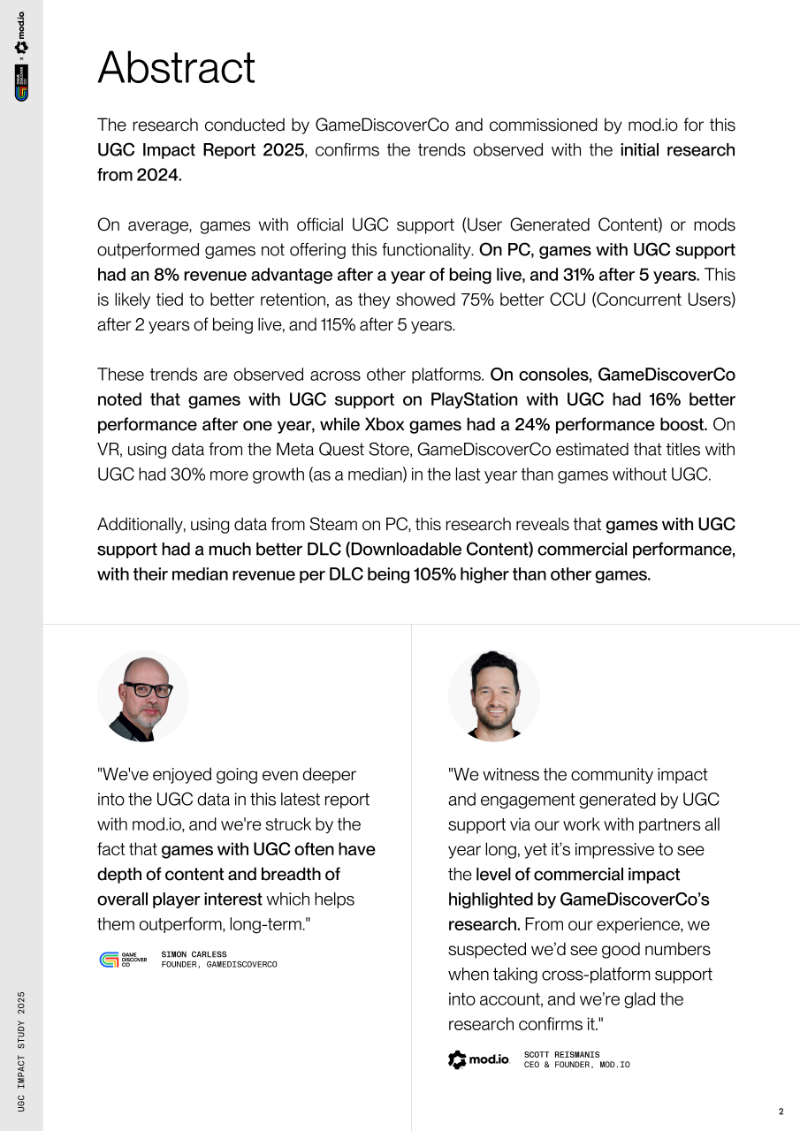
The UGC Impact Report 2025 provides a comprehensive analysis of how official user-generated content (UGC) and modding support influence the long-term commercial success and player retention of video games.
- Games with official UGC support on Steam show a 31% revenue advantage five years post-launch compared to titles without such support.
- UGC-supported titles on Steam maintain 115% higher concurrent user counts five years after release, significantly extending the game's lifecycle.
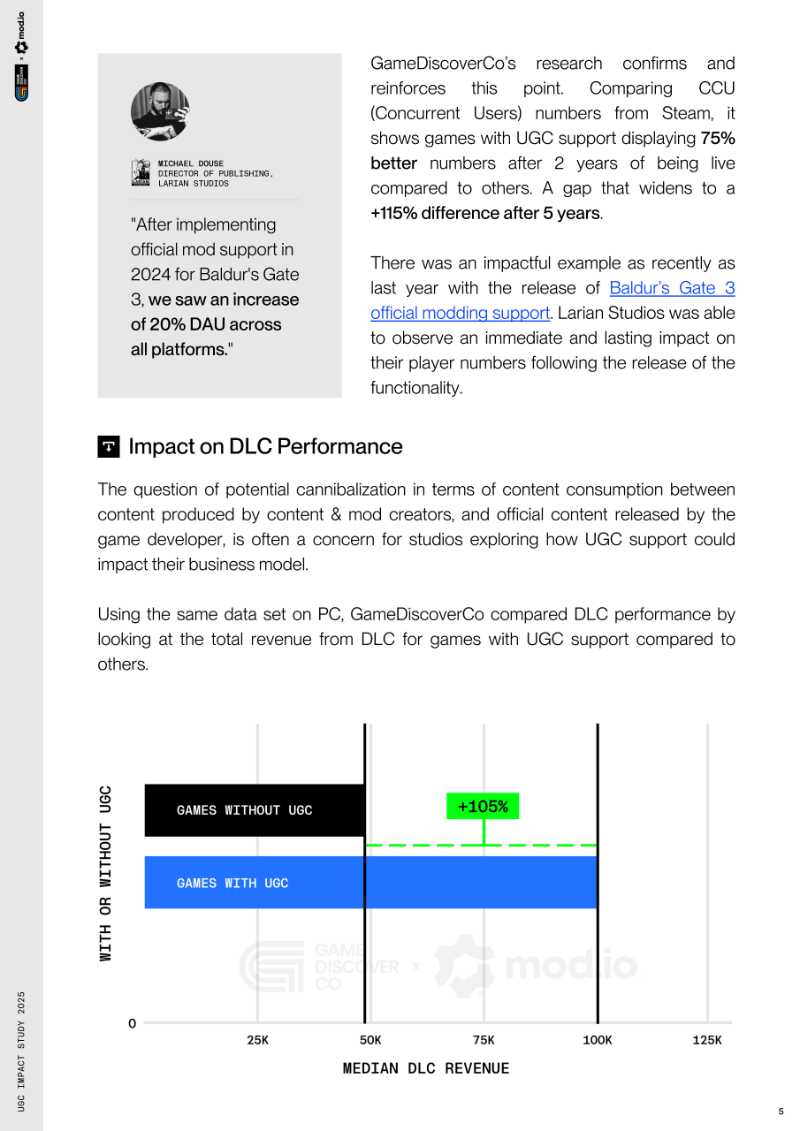
- Official UGC support does not cannibalize sales, as these titles generate 105% higher median revenue per DLC than games without community content.
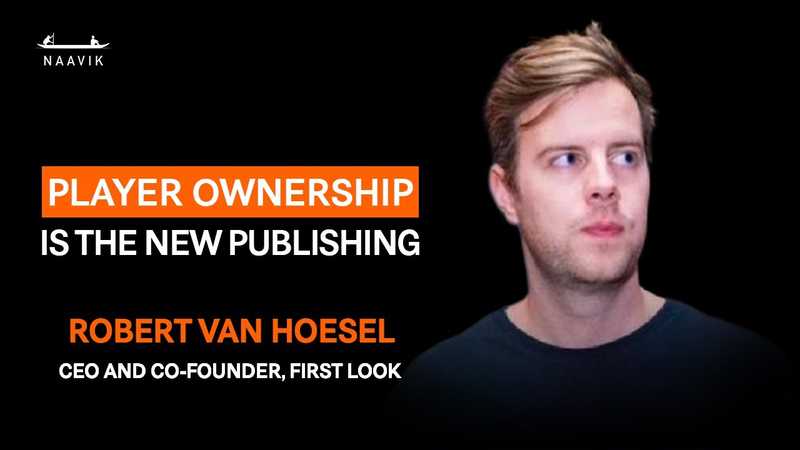
The Future of Game Publishing Is Player Ownership
The modern game publishing landscape is undergoing a fundamental shift toward self-publishing, necessitating a transition from traditional marketing models to data-driven player relationship management.
- First Look acts as a CRM for game studios, centralizing player data from platforms like Steam, Discord, and email to streamline playtesting, feedback collection, and community management.
- The platform currently serves over 100 active game studios, helping them manage self-publishing operations that were previously handled by external publishers.
- First Look was acquired by Pragma to unify the backend and frontend of game development, creating a more cohesive infrastructure for studios to manage player relationships and game operations.
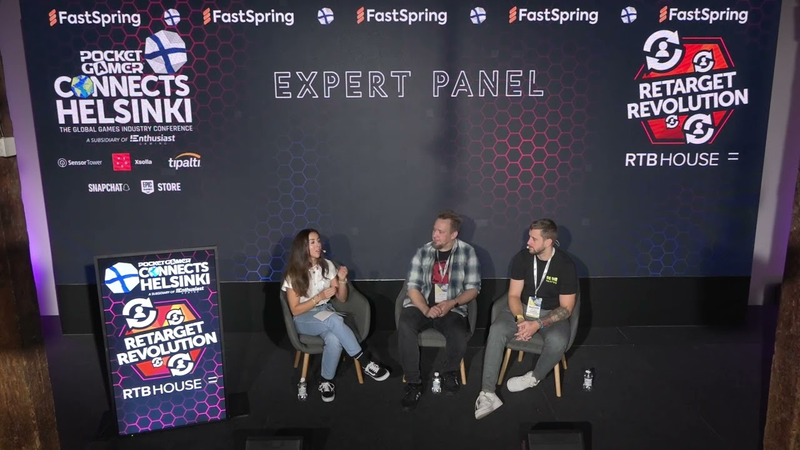
Panel: Future Of Retargeting - Hopes & Expectations.
Retargeting in the mobile gaming industry has evolved into a complex, non-evergreen strategy necessitated by increasing audience fragmentation and stringent privacy regulations.
- Retargeting strategy has shifted from broad outreach to granular, data-driven engagement that leverages in-game monetization metrics to identify and target high-value users.
- Industry focus is moving away from simple Return on Ad Spend (ROAS) toward measuring true incrementality to validate retargeting as a cost-effective alternative to rising user acquisition costs.
- Artificial intelligence is now essential for scaling re-engagement, specifically for automating audience segmentation and predicting individual player preferences in privacy-restricted environments.
Session: Successful Retargeting - The Essentials -Vera Manhoso, RTB House.
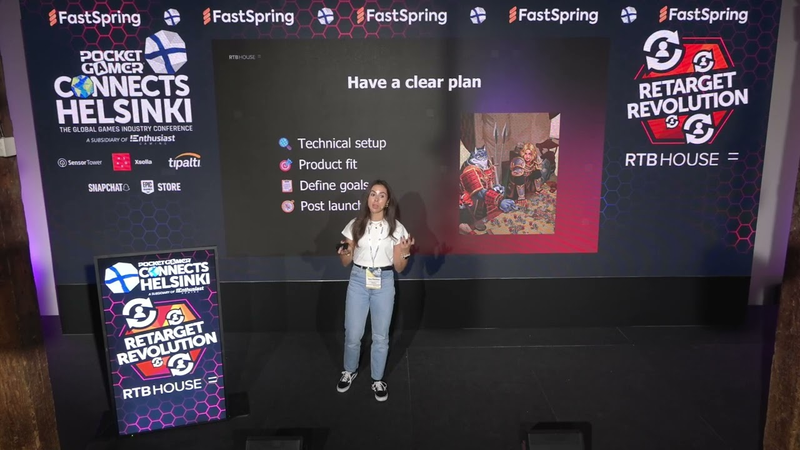
Retargeting serves as a critical, yet underutilized, strategy for mobile gaming studios to combat high user churn.
- User retention is a critical challenge for mobile gaming, as 77% of users are lost within three days of installation and 90% churn before reaching day 30.
- Retargeting campaigns should be segmented into two distinct strategies: retaining recent installs from user acquisition efforts and re-engaging lapsed users who have not played for an extended period.
- Technical readiness for retargeting requires an MMP (Mobile Measuring Partner) integration, consistent tracking of postback events, and a clear data-sharing agreement with partners to ensure user data remains secure and siloed.
Session: From Installs To Impact: Driving Sustainable App Growth On Snapchat - Sara Antonelli, Snap.
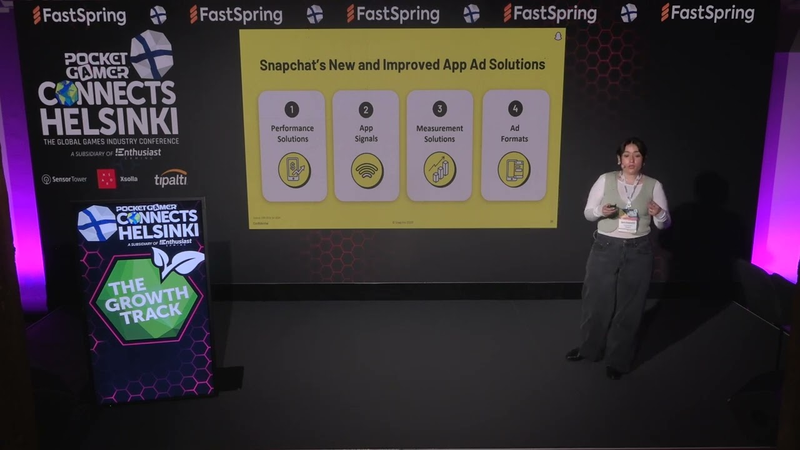
Snapchat’s strategy for driving sustainable mobile gaming growth centers on four pillars: audience scale, performance-driven solutions, privacy-centric measurement, and innovative ad formats.
- Snapchat's 'App Power Pack' leverages internal monetization learnings from Snapchat Plus—which generated $700 million in ARR and 15 million subscriptions—to provide mobile gaming advertisers with optimized user acquisition solutions.
- Snapchat's audience is highly active, with 59% of users playing games multiple times daily and 50% of users making in-app purchases, a rate double that of physical product conversions on the platform.
- The platform's 'Rewarded Play' ad solution has demonstrated significant performance, including cases with 35 times more iOS installs at an 80% lower cost per install and 60 times more purchases at a 90% lower cost per purchase.
Session: Unlocking D2C Growth: Embedded Payments + Reward-Driven Incentives - Archie Stonehill.
Direct-to-consumer (D2C) growth in the gaming industry is increasingly driven by the strategic integration of embedded payments and reward-based loyalty programs.
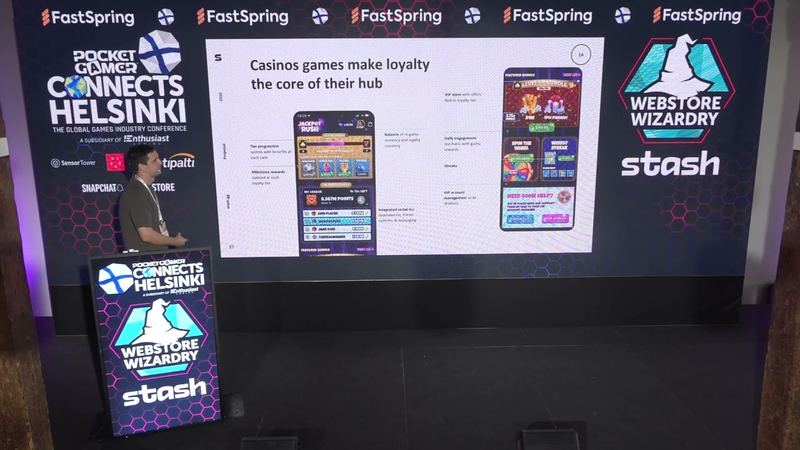
- Direct-to-consumer (D2C) loyalty programs are highly effective for channel shifting, allowing studios to remain profitable even when giving away up to 25% of value because of the increased margins captured by bypassing platform fees.
- Android's upcoming regulatory changes in the US are expected to significantly expand alternative distribution and native app payment options, potentially surpassing the current scope of iOS linkout policies.
- Loyalty programs should be designed as a core hub for the D2C experience, utilizing rank-based benefit multipliers that increase rewards as players spend more, thereby incentivizing long-term adoption of the web store.
Press Play, Part 2: What Games Get Wrong About Retention, and How to Fix It
The gaming industry is currently undergoing a significant shift as its core design principles—specifically those centered on behavioral psychology, engagement loops, and interactive mechanics—become highly sought-after assets in non-gaming sectors.
- Game design principles are increasingly being applied to non-gaming sectors, such as Duolingo’s gamified learning or BCG’s use of simulation games to teach corporate strategy to consultants.
- Retention is driven by a deep understanding of human psychology, personality traits, and motivations rather than relying solely on mechanics, monetization, or dopamine loops.
- The stigma surrounding video games has faded, allowing game developers to pivot their skills into roles within marketing, emerging technology, and digital product innovation at non-gaming firms.
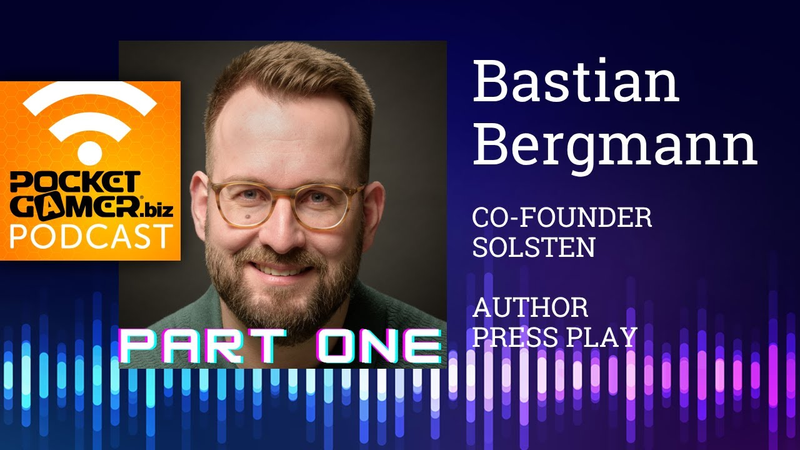
From Solsten to Press Play: Why Human-Centered Games Win
Gaming functions as a transformative technology that extends well beyond traditional entertainment, serving as a powerful mechanism for engagement and behavioral change in sectors such as fintech and wellness.
- Gaming is a highly effective engagement tool because it is an active, two-way medium involving constant action and reaction, unlike passive consumption models like social media.
- Successful brand integration in gaming requires moving beyond simple marketing activations to deep, complementary experiences that align with the brand's core product or service.
- Chipotle’s Roblox integration successfully drove record-breaking digital sales and loyalty program sign-ups by gamifying the customer experience and offering virtual rewards for real-world redemption.

Masters of Publishing 3: Ads Don’t Kill Retention, Bad Ads Do (Maayan Aharonovitch, Monetization)
Hybrid casual gaming represents a distinct industry segment that requires a sophisticated, integrated approach to monetization.
- Hybrid casual games must integrate monetization into the core gameplay loop during the initial design phase rather than treating it as an afterthought.
- Successful monetization relies on dynamic, automated player segmentation that identifies friction points and offers rewarded video ads as value-driven solutions.
- There is a strong synergy between ad-watching and paying behaviors, as high-value users often engage with both rewarded videos and in-app purchases simultaneously.