VideoPocketGamer.biz
Press Play, Part 2: What Games Get Wrong About Retention, and How to Fix It
7 Oct 202540 min video
Transcript
If you're on the game development and game design side today, your opportunity, what you can do in your career and where you can take your talents is exponentially bigger than I think what a lot of what a lot of people are realizing. Welcome back to part two of our conversation with Bastian Bergman, co-founder of Soulston and author of Press Play, why every company needs a gaming strategy, why gaming companies need to be thinking about what they have as well. Because in our last episode, we explored why gaming is a strategy. Why forwardthinking brands like Chipotle, Pelatin, others are using games to drive loyalty and revenues. Well, now we're going to talk with Bastian about what this shift means for you. Because good news is businesses, brands, banks, they all want to harness gaming talent because you have an understanding of
gaming mechanics and that's what they want. So they're hiring game developers, game designers, creative directors, talent where they can find it. And Bastian has the tips about how you can position yourself and your skills to be discovered, but also to lead the charge into what's next. So let's press play on part two.
Bastion, we we've been talking a lot about the opportunity to go beyond games, develop something that's more than games, and how to spot them. How do developers take that step back that you mentioned earlier and stop trying to solve a problem with a video game and have a more creative and playful approach to the consumer needs, you know, the the brand's needs and and building something that is of real value that maybe not a plain straightforward consumer video game? Yeah, it's a great question, Brian. And I think it comes
down to a combination of one, having a very deep and concrete understanding of the people that you're making this for or the people that are affected by whatever solution you're looking into, their needs, their motivations, even like personality traits, drivers, desires, a day in the life of what are the what are the things that they go through? what are they troubled by with the status quo of the experiences that they're using? That's that's the one the you know the one um side of the coin. The other side to that is um not jumping the gun and going straight to to your point. Okay, I'm going to build a full-fledged video game. Okay, start small. But how and and I think it comes down to how do you leverage the principles of game design of what it means to make a game
in the context of maybe that specific experience.
Dualingo has been cited as like you know one of the examples of like a you know non-gaming app or a consumerf facing app to basically go from it actually felt
like a learning app. Now when you open it it actually feels it completely feels and looks like a mobile game. Um I think that one's a little overblown for this. One of my favorite examples is actually um it's an email app called Superhum
which uh I mean we all write emails uh fortunately or unfortunately every single day we've all probably struggled with uh overflowing inboxes and uh and the pain that comes with it. And what Superhum did is they didn't go and build a video game for you know how do you write faster email or you know how do you clean your inbox more effectively. They literally applied the principles of game design to an email inbox program. So there's things about, you know, their specific shortcuts. They basically quote unquote gamified email
and their CEO is used to be a game designer at Jagex actually years ago. So that's where that intelligence came from. And they went through the same process of how you would design a core game loop and say, "Okay, well, what are the tasks? What am I what is the journey
that we're sending people on? What are the things that they need to do? what are the rewards that we can give them along that journey and then how do we keep that cycle going.
So when you use superhuman with all the different shortcuts and you go you clean your inbox you get like and you create you start an inbox zero street that you want to start keeping on.
Every time you clean your inbox you unlock a different background image that it sends to you which are like really cool poster type like shots. So there's an incentive there's a visual appeal to it. you. It gives you notifications of like, hey, you unlocked your first badge. You cleaned like 5,000 email conversations. Keep it going. So, there's a leaderboard element, but it's basically drawing from like pretty baseline, pretty foundational, very simple game mechanics, and it's applying those principles to the the email experience itself, rather than going all the way and saying we're going to have to reinvent the wheel. What is the type of game that we're making to solve this specific problem? So I think it's those
two that have and and then they have to come together obviously. Well, what are the pains? What are the needs? What are people trying to do here? What do they really want? How do we make this better for them? And then go, okay, let's apply game design principles and game design thinking to this specific experience and make sure that those two those two meet and that's going to create a very good experience for people.
Might even create new uh new jobs and partnerships if you think about it. You know, you might have a
Yeah.
the the the the head of creative gaming in in a company the same way they have
customer success manager. It might be, you know, customer gaming fun manager. I don't know. I'm just playing with this thought because now I'm seeing that it's beyond the game, but the game also has a place in these other companies. So for the many many in our audience who are brilliant but no longer at their studio because they've been made redundant or the studios closed down altogether. This says there's another type of partnership they can enter into. Is that correct?
You're you're absolutely right. And in fact like I think it was glass door or another recruiting company came out with a report recently and for the first time like the increase in gaming related jobs. Yeah.
In the non-gaming sector has been it's been it's skyrocketed. So there's over 20% of all new jobs in the technology sector broadly speaking are gaming related jobs. Game design, game development, and it's non-gaming companies.
And at the same time, new jobs in the gaming industry itself in the same time period only grew by 4%. So that gives you a very clear indication of where opportunity is and where where demand is and you know partnership opportunities but also if you're looking to make quoteunquote a career switch as an individual like your playing ground where you can take your talents and your skills are much bigger than well there's another gaming studio that I could go to or there's another
studio that makes the types of games that I'm that I've made in the past. you can you can think much much much much bigger than that. Um, so yeah, there's there's real opportunity and in fact um there's actually a story in the book that I highlight about uh Uni Lever because Uni Lever was one of the first global consumer brands to go into video gaming in 2012 I believe it was already when they struck a partnership with the Sims to integrate Dove the shampoo brand into Sims.
And I was talking to the SVP of you know digital media who oversaw that partnership already 13 years ago because they didn't do anything after that. And I said, "What happened? What I'm like, you guys were first and then what?" He goes, "Well, we lacked the skills and the talent internally to roll this out and make this a consistent part of our overall consumer engagement strategy. We simply had a talent gap and a skills gap that was far too vast for us to bridge. And the ramp up of what we'd have to go
through to get to the point where we could consistently execute on a gaming strategy in 2012 was prohibitive for us. So we scratched all of our efforts. And now fast forward, it's a different story. Um, a lot of the people that grew up playing video games where it was normal for people like, you know, our generation, for example, they're moving up in the workforce, you know, they're going from like mid-level positions to senior level positions. It's just overall gaming doesn't have the bad rep anymore that it maybe used to have. Doesn't doesn't have a lot of the a lot of the stigma and the stereotypes are starting to fade away. And I think that's going to unlock and you can see it in the job job postings. It's going to unlock even more opportunity for entire studios, entire teams, but also for you, you know, if you're as an individual game designer or game developer.
That is a very very uh very positive message for a change.
Oh, it it it's huge. And and Bastion, you're you're absolutely correct. The transferable skills from games are just becoming more and more applicable and
more and more in demand everywhere. And not just the really obvious things like virtual production and film, you know, where if you're an Unreal or Unity engineer, the film industry wants you, but the use of games within companies is another area where I don't think anybody's really been paying attention. H I ran into the head of the manufacturing cluster in Scotland recently and so that everything from leather belts to, you know,
actual space rockets, rocket engines. Um, and he was saying more and more of their members are asking about video games cuz they're using it for all of their internal learning and development, health and safety, skills training. Um, and so even beyond the value to brands and the consumerf facing stuff, the the the sort of the B2B side of things is is another big opportunity for games people to to get involved and reimagine how we teach the workforce of the future. And let's be honest, if if AI is is coming
to take our jobs, how do you retrain 50% of the working population? It's I think video games might have a role in that.
I completely agree. Like, you know, you look at Roblox today, um part of their internal recruiting tool is actually a video game that you play and it's got some psychological testing underneath, but you're playing a video game as part of the recruiting process. There's a company called Pytrics who's done something similar. I think they're part of Ranchot Group or some some other big like HR services company so to speak.
There's another company out there called TGA company where their whole premise is exactly what you said, Brian. It's it's effectively a gaming company,
but they're providing gaming and gaming services and tools and tech and the gaming technologies to B2B non-gaming companies. And it's all about education, internal training, upskilling, res-killing all through games or game related mechanics. And and I've been a part of a project um this was
11 years ago at this point when I was at BCG as a strategy consultant. my direct boss, my partner that I work with happened to publish a book at the time on corporate strategy and we built a video game to accompany that book. So it was the age old tale of, you know, in economics 101 where they use a lemonade stand to teach people basic economics. We took that as a principle to then have people run a lemonade stand in different economic environments, so to speak, which were different strategic environments, and people have to adapt how they run the lemonade stand and how they run the business given the changing environment that they're in, which was that was basically the the point and the premise of the book. They use that internally to teach all of the consultants at BCG about not only the book, but about the strategy so they could take it to their clients. And then they would actually run workshops with clients and corporate executives where they would literally be playing a video game on an iPad for like an hour and
people wouldn't even like want to like drop it. So it's I'm I'm in violent agreement with the premise that you just said like that's again back to a point we just made a couple minutes ago. the opportunity for if you're on the game development and game design side today, your opportunity, what you can do in your career and where you can take your talents is exponentially bigger than I think what a lot of what a lot of people are realizing.
That's a great great message particularly in these times. So we're all excited and Brian's speechless. I'm sitting here, we're just like, "Yes, I can see this. All the opportunities for gaming talent."
Yeah.
Beyond games. So, yes, give us some tips. Give our audience some tips how to spot them. I mean, is it a matter of, you know, checking out the brands, seeing what they're doing, connecting with them? Maybe there's something else different. I mean, we had people on the show, I think it again was a um Brian,
it was just like, you know, go and look in LinkedIn, but you know, sometimes it's not that simple. So what are some shortcuts?
Yeah, so one shortcut is I mean the LinkedIn one is the obvious one where look at where are companies what companies are advertising open jobs that are not gaming companies that have the word game or game design or game development subject. You'll you'll find quite a few.
Another good tip I would I would start to venture out and go to conferences and get myself out there that are not gaming gaming conferences. So obvious obviously
110%. Obviously, you still want to Yes. You still want to go to PGC, you know, PG connects and you want to hit up all those events, but I was I attended ad week in London,
you know, earlier this year and two or three of them like Activision, Blizzard Media was there, a couple of other like intelligence companies were there
and all of the brands were there. Mars, Uber, you name it. Everyone was there and a lot of people I had a ton of
meetings and everyone was so curious and engaged with like oh you guys come from gaming you understand people we need to figure out games
it's it's the easiest door opener that you could have at the moment when you can say like I work in games and I come from games what are you guys doing how are you guys leveraging or thinking about leveraging games to make the Uber experience better to position Mars within and video like I would I would look at those types of conferences that are more like marketing maybe advertising focused to an extent um and that are that are about bigger brands. Those two are by far the the the simplest one for sure.
Interesting that you mentioned that because I went to possible for the first time which will now be on my list. Possible is the one I do as well as now and a few others obviously but um there were sessions about brands and games. How do we get how do we make this happen? What needs to go on? I mean, it was great interest and possibles of
course brands, agencies, that's what it's about. But gaming was also a topic there. So, yes.
Um,
and maybe something you bring into Scottish Games Week and what you're doing overall, I mean, in your in your projects, Brian. Maybe there's a little bit of cross-pollination, forced cross-pollination with events that have nothing to do with games but bring together.
But so that this is the entire basis for the creation of more than games, Peggy.
It's a games conference or event I should say. Conferences are slightly oldfashioned, but it's a games event for non-games people. And it can pull in people from space, tech, fintech, finance, you know, um the very traditional financial services, um corporations, that's that's a a big sector here in Scotland, but travel and tourism, energy, oil and gas, you know, uh the green economy,
there's there's an interest in games from pretty much every other aspect of
this. And um I'm pushing it forward with my with my partner specifically because this is the one that we see could be you know have global potential.
How do we build a games event that pulls in the rest of the world not just the industry
but you know and and and split it up and make it relevant to the film sector to the education sector to everybody else. So watch this space. Um, but when it we get to the next iteration of it, Bastion, I feel there might be a keynote in there somewhere.
I wouldn't say no. I'm happy to help. Um, I think the data is is backing you guys up. I think it was Gamescom last year, Gamescom 2024.
Um, I don't want to mix my numbers too much, but I think it was at least 16,000 exhibitors that were non gaming exhibitors.
True. like the Volkswagens, the BMWs, like Netflix, Amazon, you name it. Adidas was there, Formula E was there.
Pretty much everyone was there. Like 16,000 is a big number.
So, I think your your intuition is is absolutely dead on and the data is there to support that intuition as well.
Let stick with the developers and and the opportunity in front of of game studios out there. Bastion. Um so pres let's say that our listeners are interested um they're going out they're they're going doing all the right things and sort of expanding their horizons. How do they continue that journey? How do they they talk to non-game companies whether they're brand owners or you know people in other sectors um in a way which helps them engage and and kind of
understand the problems that the the client is facing.
Yeah. I think um honestly the best advice at the very start is like with any human interaction make it about them.
Don't make it about yourself make it about them. and and start with well what is their interest? If you you know if you're talking to someone at a specific brand, what is their specific interest when it comes to video gaming for their brand? What are some of the challenges that this brand is experiencing or goals that they have for, you know, either different brands that they have? What do they want to accomplish? and and and be along for that explorative conversation and don't force it and jump straight in with well to back to what we talked about here's a game that I want to make for you guys or your competitor made this game and we need to make this type of game.
Make it about them and hear them out first and it's about arriving at the at the solution or at the possible solution that is optimal for the job that needs to be done and not for what we would like to do. That's not what this is about.
Yeah.
So, and I then I think a part of that is where you can show that you obviously
understand games. So, you should be familiar with well, okay, what are other companies doing? What experiences are out there? What's worked? What hasn't worked? There's a lot of public information. So, I think just being up to date with what's going on in that
the overlap between brands and gaming is is is important. You want to be able to speak and and to that and reference some of those examples. I think the other one is you want to be genuinely interested in the broader industry that the brand you're talking to is engaging in. So someone at Tesla that occupies themselves with video gaming and maybe in-car entertainment and in-car gaming is dealing with different questions, different challenges, different, you know, strategies, different industry dynamics than someone at the known. So, I think, you know, don't don't gravitate towards trying to cover like every single industry that's out there. Maybe start with what actually are you naturally curious about. Do you do you like cars? Does that just come naturally
to you? Because that's been a passion of yours. Great.
Start there and talk to Audi just announced they're they're doing in-car gaming now. Tesla was first, BMW was second, Volkswagen was third, Audi's now there. Like, they're Toyota has a partnership with Crunchyroll. like they're all they're all in that space now. So, I think start with where what feels authentic to you where you don't have to make an extra effort of I'm trying to read up on an industry and I'm trying to understand an industry uh I don't know like mechanical engineering or like some other stuff and you go like this is so boring to me like I can't wrap my head around this. You don't have to go to where what you're already passionate and just innately interested or curious about. And then the other component I think stay up to date with audience trends, needs, what people value and how that's evolving. Because if you can already come to the table with here are things that we're seeing like for your audience or for people that play these types of
games. You don't have to know everything, but have two or three nuggets and insights at hand that for the counterpart that you're speaking to allows them to understand and perceive you as the expert in your field that you are.
Yeah. And and I think the thing there is it's you don't want to be you can't be isolated or like just have like this um being very good at like at an individual island like I'm the best person at match three mechanics and that's like okay you're cutting yourself off from opportunity. So you want to be you know it's like this T-shaped model. You want to be able to hover across the surface, be able to speak confidently to a lot of different things, then selectively go deep, whatever the conversation requires. I think audience understanding is such a key one because again, back to the whole premise of this, if we don't know who we're making this for, we might as well go to the casino and bet it all on, you know, black and and just roll the dice with what we're with what we're building.
So, Bastion, first of all, it's great to
have some advice for our audience. You know, where do they need to go? What do they need to be talking about? What do they start with as topics? The homework they need to do. I have a practical question and that is who are they talking to? Because you go to a stand, you know, you're there, you're you're Audi, maybe that's an easy one because that's in game and they'll have people for that. But for many brands,
yeah,
this is a job title work in progress. So, you know, you're talk to VP of marketing. I don't know who you talk to. So what is the what is the bandwidth of possible
job titles you need to seek out at conference?
Yeah, it's a great question and I would say it it tends to fall into two camps then there's nuances but high level two camps.
If you're looking at a company that is direct to consumer like let's let's let's not take the car example because you're right like that's they'll they'll have like incar entertainment things like that. So that's very specific
honestly because if a brand is thinking
about getting into video gaming to engage consumers, it's it's the consumer engagement strategy. That's what games games are effectively becoming the new social media. So a lot of these efforts are going to be anchored in the marketing organization. So the CMOs, the VPs of marketing, the VPs of brand, director of marketing, you look at digital marketing, you want to make sure you're in those digital touch points, but that's definitely one bigger cohort. That's absolutely prime target group. You definitely want to talk to those people. The other group, what a lot of these companies will have is Puma, for example, has a director of uh emerging technology
where that gets grouped under because it's a new space for them. It's a new field for them. um and they'll sometimes treat it as a channel or as technology that they're exper experimenting with. So those people are really really good to talk to as well. And then the third category that I would offer is if you're running into product folks, anything that is around like digital media,
digital content, um you know, product and services innovation, things like that. That's where for example with Pelaton that group has a very specific name. It's interactive content where that where that sits. But it's anything that is in that section of like digital content, new products, new services. Those people are definitely going to be really really relevant and really interested to talk to you as well because that's where back to that you know the most sophisticated use case of how do you make games to be complimentary to a product that you already have or make it become the product in and of itself. But it's definitely the marketing teams that those organizations emerging technology is a really good title to go after. And then the third cohort kind of and also in that specific order, anything around digital content, digital media, new products and services. Um let let's kind of flip that slightly, Bastion. Um and look at Soulston because
obviously the company works on uh player insight, consumer insight. So how does how does that lens work within your you know your your wider work of engaging with the brands and bringing the two worlds closer together?
I mean it covers it it covers the foundation of who are we making something for in the broadest sense. Who's our audience? What are their needs?
What are their drivers and motivations? How does that shift over time? And who are we making something for? And how do we do that most effectively? Whether that's coming from a gaming context, whether that's you're coming from a specific genre and you're looking at the brand and you want to morph those two. We talk to IP holders and owners like Paramount all the time where they're coming to us and saying, "We want people to make a game with Yellowstone IP
and they use Sultan to go, let's look at Yellowstone fans and then go, well, what type of game would work best with the core fan base of Yellowstone." So that's it. It covers all of those ranges to stay up to date with that and understand if you're at that intersection between
gaming brands, IP, other industries even. It gives you that landscape. Um, what's really cool too is, you know, for you guys as like individual listeners and viewers, um, even if you're your company, it doesn't have like an enterprise license with Soulston. There's actually a new tool that we're releasing, um, called Allaris, which is effectively an AI assistant. It's going to be honestly 20 bucks a month to get in. It's going to be pretty cheap. allaris.new uh where you can go and sign up and that literally gives you the power of the Soulson Insight platform in your pocket in one simple tool. So if you're going out to these conferences and you go, I have meetings scheduled with the folks over at Denown, you could literally go to Allaris and then just say, hey, can you give me what are the top three nuggets, the top three insights about Volulvvic fans or Denown fans that I would need to know?
What games do they play? So you can come equipped to these conversations and basically have almost like have that
whole consumer insights research team on audiences in your pocket and at your fingertips at any point in time. So I definitely encourage you guys to take a look and check it out.
Wow is all I can say.
Amazing.
I was I was amazed last time when Joe told us about the other tool which is just like oh yeah you can like find the fit with the brand but now you're going to have it like portable before before the elevator pitch. That is so cool. It's the first time you can talk to any audience in the world.
Wow.
Yeah. Okay.
You're bigger than yourself at Soulston, Bastion.
I mean, this is something you could do for a lot of industries that you know, like like I'm thinking about you, Brian, you know, talking to the manufacturing industry,
right?
Um
yeah, this is so cool.
But but this is this is the whole point, Peggy. We're we're at the starting point, you I keep describing when I'm when I'm talking to the Scottish government, the UK government, any of the sort of the big public sector organizations, I keep saying video games
are our secret weapon
because nobody's thinking about them or using them or
understanding the power they have beyond the huge bottom line for that consumer market. But if we can make video games a more integrated and collaborative part of all of our other industries, um, wow, just imagine what's possible. So, I'm I'm I'm blown away, Bastion. I I really am. I love to The conversation with Joe was one of my favorites. Um, I think what you guys are doing is fantastic, but it's it's been a revelation.
You've given so much. First of all, it's great when people share advice and it's for free and it's on our podcast. So, I have to thank you for that, Bastion. You haven't kept it to yourself. Um, you're equipping us. You're setting us up for success. That's a positive. But, um, there are the blind spots. There are things that studios are missing. And of
course, you have Soulston. So maybe you can just give me briefly an idea of like what are the blind spots and how do studios close the gap?
Yeah, I think in general there's still too many studios out there when you know even at some of the and I'm not going to name names um but some of the most sophisticated gaming companies and you ask them they're working on a new game and you're asking them who you're making this for and they go well it's for 40 to 50 year old women in the southern states of the US. So that mindset still persists which is literally that statement is similar to saying that all women in you know the southern in the sunb belt that age group all eat the same food and they like the same color which is obviously not true. So I think that's overarchingly still a big blind spot of we're not going deep enough. We're we're sticking to demographic data to describe the audience that we're after. Maybe we're looking at a little bit of behavioral data and some preferences, which is good up to a certain point, but it's always looking
into the past because the behavior happened and you don't really know the why behind the behavior. You don't know what's driving it. So, I would always encourage people to first of all get rid of blind spots and also understand, well, what are our blind spots? You have to go deeper because you don't know sometimes what you don't know.
So, you're going to have to explore a little bit to understand,
oh, there's things that we actually had no idea about in the first place. We didn't even know that this existed. So I would always encourage everyone to go I have to understand the human being behind the player or the consumer that we're making this for. That's the premise. And that means we have to understand them as the human that they are. Which means we have to understand their psychology and their cognition and what how they're wired, what drives them in life, what motivates them. So you have to get down to that level.
One of the specific things that I can share because some of this stuff is pretty stable. others will shift over time. What's actually shifted between 2024 to 2025 and we have we have the state of the player report that's you know a available resource for free on
our website
for people that want to go check it out. But one of the nuggets that's in there is one of the one of the traits so to speak
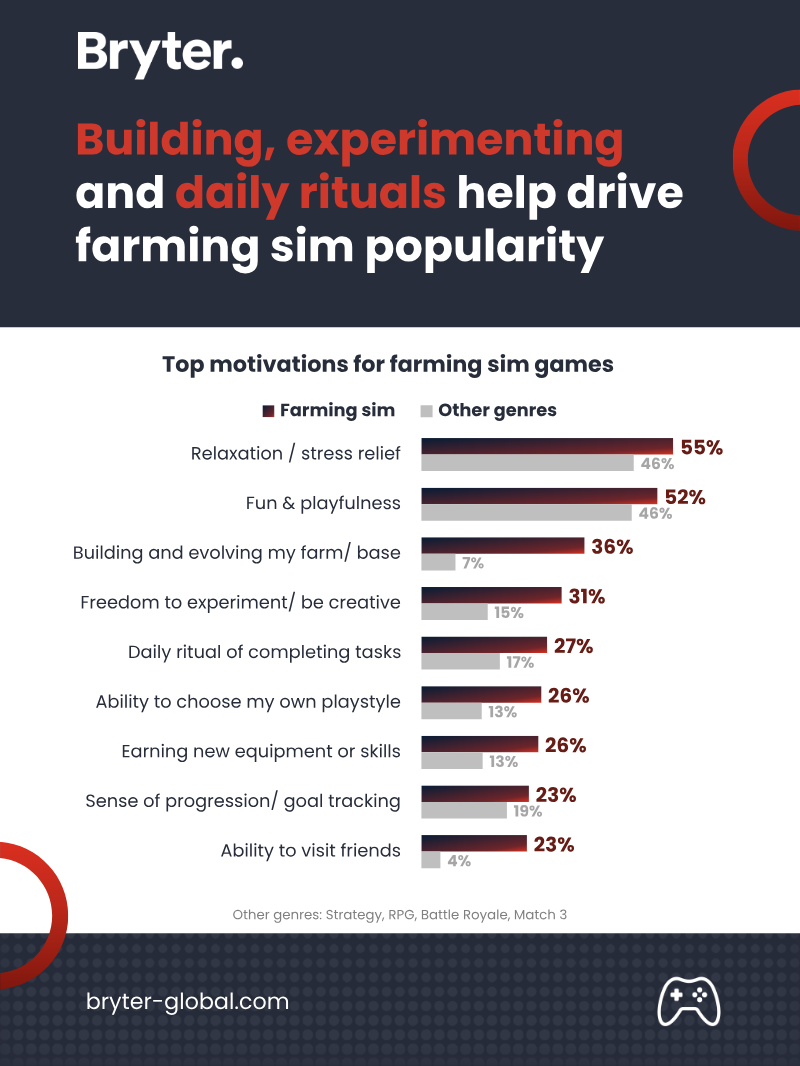
that shifted the most over the past year year and a half is moderation. So a desire for moderation went up the most out of any trait that is in the gaming population. So now you look at, oh, so that's why a lot of the bite-sized, more snackable, quick to pick up word games, puzzle games, like cozy games, all that category is on the rise because people are actively aspiring to moderate their consumption, moderate their behavior. They are not, there's a lot of people that don't want to sink hours and hours and hours into a specific game. Yes, there is audiences and segments that do that, but on a population level, moderation's definitely something that's been on the rise um per per the data that we that we see.
Makes makes sense because you know that COVID bump that attitude, that behavior, I mean, you know, we have summer, you
want to go outside, you well maybe not in this temperature, but you want to go outside, you want to do things and so that makes sense. You want to moderate your consumption. You talk about motivation, understanding motivation, how important that is, and I agree. So, I want to understand a little bit more about you, Bastian. You are fascinating. We could have a show just about what got you where you are because here you are. You're helping brands and studios navigate the industry, but you were also before a professional ice hockey player in Germany. So, helping teams, you know, navigate the arena as it were. Um, so tell me, you know, how does that fit together? your approach to strategy and you what you learned on the ice.
Yeah, there's a lot of things like that I took away from playing that sport um in a both professional and also just personal setting. Um I think in terms of approach to strategy, I think it was Wayne Gretzky that actually said it. Um he was a greatest hockey player of all
time. Um you have to skate to where the puck will be going, not to where the puck is. So
I think in order to be successful in business and as a studio and as a team, you have to you have to look ahead. You have to try and understand where trends and where things are moving, especially when you're making something for consumers and meet them where they are at slash where they will be
and not where they were at or just where they're at right now. So getting really good at anticipating and and seeing patterns and understanding where the puck could go, you know, literally um I think is really really really important. The other thing that I really took away from playing that game and playing that sport is more on the team management side because it's one of the few sports where even if you have the best individual player on your team, you're still not going to win because it's such a team sport where every single person on the ice and as a part of that team
plays such a crucial dedicated and important role. In case in point, like you know, the the NHL just wrapped up their season, you know, a couple couple couple weeks ago, and the Edmonton Oilers second time in a row in the finals, didn't win again. And they arguably have the two best individual players amongst ever play the game on their team
and they second year in a row they haven't won. and they got beat by Florida again which has good individual players but as a whole it is a much stronger team on every position and every individual piece yeah
is that much stronger which makes the collective that much stronger. So
yeah,
that is one of the key things when I and we're we're very fortunate at Sultan to have a team like that where we're great individuals, but it's the collective that really makes it and every person in its specific in their specific role is is just so crucial and so good at what they do. I think it's those two those
two things. And then I think the third one both for work but also just professionally personally. Um you got to grind sometimes in life and there's a certain tenacity. And I'm I'm a firm believer and that's how I was raised to is if you work hard enough and if you keep trying and you really excuse my French bust your ass,
yeah,
you'll get rewarded at some point. It's not maybe going to be on the timeline that you wanted it, but you'll get rewarded at some point. And I think hockey is very much a game where you need to be tenacious. You need to grind. You need resilience. You need to suffer through a lot of pain, a lot of push back. And eventually if you do that, you'll be successful. You'll get rewarded.
Beautiful. It It's Listen, we could and I wish we could keep going. Um but we we do need to draw things to a halt, unfortunately. Bastion. Um, but I think once the book's out and once we've kind of seen how it changes the world, perhaps we'll get you you and Joe back
on. Yeah.
Um, and and do things slightly differently.
Before we let you go, we have two questions we ask all of our guests. One is, what are you playing right now? What's obsessing you when you should maybe otherwise be going out and working?
And the other one in is favorite game of all time?
So, what I'm playing right now um is I mean the Switch 2 came out. Um, it's the first gaming console that my oldest daughter now gets to use. I'm introducing her to games and her and I are spending a lot of time playing Super Mario World together. So, that's mostly what's on deck right now, which is fun
to do that with your your kid. So, I'm really enjoying that experience.
Favorite game of all time. Um, favorite RPG, Ghost of Tsushima. Um, and then other than that, I grew up on all of the EA sports franchises. So whether it's NHL,
FIFA, like those two, and I'd probably pick NHL, but yeah, Ghost of Tsushima and then the NHL franchise, like all
time, I could pick up those games any day of the week. Yeah,
FIFA is
fabulous. Bastion, it's been a genuine pleasure. Uh, we will link to the book, we will link to Soulston, we will link to all of the things that you've discussed. Um, we would encourage everybody out there to to do exactly what you said, take that step back and look beyond this games industry into the wider world. Um, hopefully once the book is out and once it has changed the world, we'll be able to invite you back and uh we'll we'll be enjoying this larger and more collaborative games ecosystem.
Absolutely. And also that there's a world of opportunity. I mean, I love it when there's a positive message and in all of this, it's saying yes, there is more than games and there are more opportunities for gaming talent. So, thanks again so much for just lifting the lid on that and giving us something to think about, giving our audience something to think about going forward. Much appreciated.
Appreciate you guys having me.
Thank you so much. This show is all about how to do your job better, how to make an amazing game, how to market it, and you have a say. So, if you have a story or know someone we need to shine a light on, then we would love to hear from you.
We want to hear from you. We want to reflect the reality of the mobile games market in all its wonderful complexity and strangeness. So, if you have any suggestions for us, if you have any feedback for us, you can always get in touch. You can email us at podcastpocketgamer.biz. You can find us on Twitter @pgbiz and you can reach out to us through the pocket.biz website. If you're interested in listening to all of our podcasts, you can find them at pocketgamer.biz/mpodcast. And we would love to hear your thoughts on future shows.
And we've got you covered on all the major platforms. So subscribe to the audio podcast as Brian said, look for us on YouTube. If you want to read it, hey,
you can do that, too, because we have a companion post for you as well on the pocket gamer.biz website.
Tune in again for the next edition of the pocketgamer.biz podcast, and we look forward to speaking to you in the near future.
Auto-generated captions from YouTube — names and numbers may be misheard.
Key insights
6 takeaways · ~2 min read- 01Game design principles are increasingly being applied to non-gaming sectors, such as Duolingo’s gamified learning or BCG’s use of simulation games to teach corporate strategy to consultants.
- 02Retention is driven by a deep understanding of human psychology, personality traits, and motivations rather than relying solely on mechanics, monetization, or dopamine loops.
- 03The stigma surrounding video games has faded, allowing game developers to pivot their skills into roles within marketing, emerging technology, and digital product innovation at non-gaming firms.
- 04When engaging with non-gaming companies, developers should adopt a T-shaped skill model that allows them to speak broadly about industry trends while selectively diving deep into audience insights.
- 05Effective product design requires moving beyond historical behavioral data to understand the 'why' behind user actions, as past behavior does not always predict future motivation.
- 06To remain competitive, studios must anticipate future consumer trends rather than designing for current market conditions, effectively 'skating to where the puck will be.'
Ask AI about this video
Cite this video
Citation
Generating citation…


















Comments